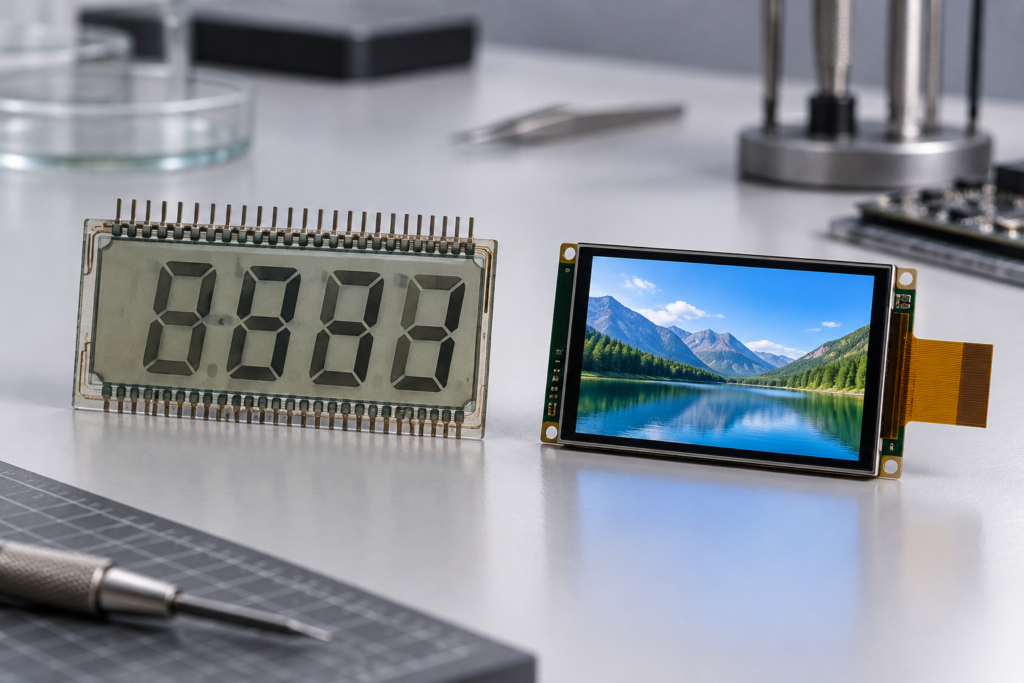
When discussing LCDs, we often implicitly refer to backlighting, but there is another type of LCD that is widely used in everyday applications: the LCD screen without backlight. This type of LCD is commonly found in outdoor devices and wearable devices, known as Reflective LCD.
How Reflective LCD Displays Work
1. Light Path and Optical Construction
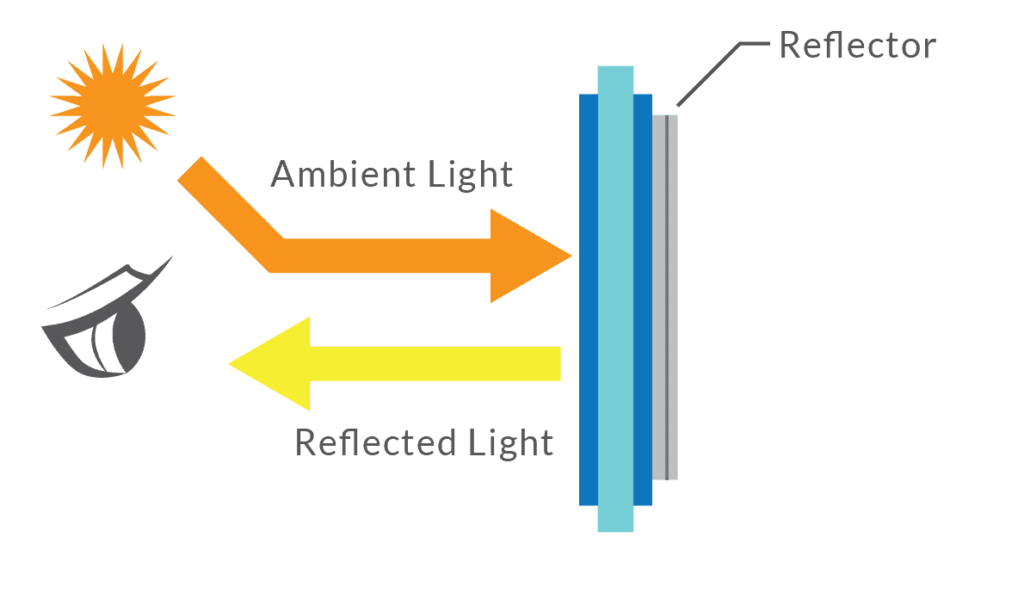
Reflective LCDs replace traditional white LED backlights with a metallic reflector, typically silver or aluminum, positioned behind the liquid crystal layer . Incoming light travels through the front polarizer → liquid crystal cell → color filter → ITO electrode → reflective mirror → and then reverses its path to reach the viewer.
Because this light traverses the LC cell twice, effective optical path length doubles, improving contrast and depth perception
2. Cell Structure & Alignment Layers
Reflective LCDs require precise liquid crystal alignment via rubbing-oriented alignment films (e.g., polyimide layers) on substrates. Spacers maintain a uniform cell gap (typically 3–5 μm), critical for consistent optical behavior.
3. Retardation & Phase Compensation
Some reflective panels include internally laminated retardation films (e.g., polymerized reactive mesogen layers ~1 µm thick) to engineer polarization and contrast. These films double the effect of liquid crystal retardation due to the reflective light path.
4. Pixel & Color Filter Design
Monochrome reflective LCDs simplify design by using uniform substrates with ITO electrodes and metallic foil—no subpixel color needed. Color reflective variants use striped RGB filters atop mirror layers, but remain limited in color gamut compared to TFT or OLED panels .
5. Surface & Polarizer Optimization
Specialized circular polarizers, anti-reflection coatings, and “wide-viewing compensators” mitigate glare and enhance brightness uniformity—essential in reflective mode.

[elementor-template id=”42795″]
LPRD & Advanced Reflective Displays
Low-Power Reflective Display (LPRD) modules incorporate enhanced color performance and frontend illumination . They leverage MEMS-interferometric (IMOD) or micro-cavity structures to provide vivid color with minimal power draw.
Examples include:
- Color RLCD panels by BOE, Hannstar: 18–20 % reflectivity.
- Qualcomm Mirasol display: MEMS micro-cavities creating color via optical interference.
- Sun Vision Display’s full-color RLCD monitor, showcased in early 2022.
Advantages & Drawbacks
✅ Advantages:
- Sunlight readability: Bright and crisp under direct light.
- Ultra-low power: No backlight, energy needed only for pixel refresh.
- Lightweight, thin: Perfect for wearable or embedded use.
- High durability: Minimal heat and stress, long lifespan.
⚠️ Drawbacks:
- Dependence on ambient light: Requires external lighting in darkness.
- Limited color: Most are grayscale; color-performing models still lag LCD/OLED.
- Technical complexity: Precise alignment and polarizer integration increase design effort and cost.
Key Applications
Reflective LCDs excel in:
- Wearables (fitness bands, smart watches)
- Outdoor instrumentation (e-bike displays, solar controllers)
- Industrial tools (utility meters, rugged handhelds)
- IoT devices (low-power data screens)
- Shelf-edge labels and signage (digital price tags, e-labels)
FAQ – Frequently Asked Questions
Q1: How do reflective LCDs achieve color?
Through enhancements like LPRD or IMOD, using micro-cavities or reflective color filters—though color saturation remains limited compared to emissive displays.
Q2: Can reflective LCDs refresh quickly?
Yes. Some LPRD modules support up to 30–60 fps—sufficient for animations or video .
Q3: Are reflective LCDs durable?
Yes. Reddit users have reported no degradation after 10,000+ hours of daily use .
Q4: What design challenges arise?
Maintaining uniform cell gap, mirror flatness, and polarization alignment is critical—errors cause edge shading or moiré.
Q5: Can reflective LCD work in low light?
You need frontlight LEDs or supplemental lighting in low-light conditions—transflective or frontlit variants are common alternatives.