OLED monitor market growth is a useful signal for industrial OEMs, but it answers a narrower question than many sourcing discussions assume. Rising shipments show increased unit-shipment activity within a defined product segment. They do not establish that an existing industrial LCD module will disappear, that OLED will cost less for a particular project, or that new factory capacity is available in the required format.
As of October 20, 2026, the evidence points to a display market with different investment and demand patterns across segments. The practical response is to distinguish those patterns before changing a product plan. This article uses published research and manufacturer announcements, then identifies the commercial implications as analysis rather than measured outcomes.
Read the OLED shipment figures within their stated market
TrendForce reported that global OLED monitor shipments increased 26.1% quarter over quarter and 98% year over year in the second quarter of 2026. The comparisons are with the first quarter of 2026 and the second quarter of 2025, respectively. Its release discussed new models, China’s 618 shopping event, and 27-inch QHD products among the segment’s demand factors.[1]
These figures describe unit shipments within OLED monitors. They do not measure retail sell-through or the installed base. They are not OLED’s share of all monitors, the growth rate of industrial displays, or a measure of total display demand. They also do not establish an annual growth rate that can be carried forward unchanged.
The report supports monitoring the segment in product planning. It gives buyers a reason to follow product availability and supplier participation. It does not provide the denominator needed to conclude that every competing technology is losing volume or that every end market is moving at the same pace.
For an industrial equipment business, the distinction is commercial. A finished desktop monitor and an embedded display assembly can have different buyers, purchasing cycles, installation constraints, and support expectations. Demand in one category can inform a market review without determining the sourcing decision in another.
Separate demand, fabrication capacity, and qualified supply
Three kinds of evidence often appear together in display headlines: sales or shipment growth, factory announcements, and supplier offers. Each addresses a different stage of the supply chain. Combining them into a single conclusion can conceal the information an OEM still needs.

BOE announced a mass-production launch and product delivery ceremony for its Chengdu Gen 8.6 AMOLED line on June 17, 2026. The disclosure linked the investment to high-end mid-size displays, including laptop and tablet applications.[2] This is a manufacturer announcement, not an independent audit of utilization, yield, or customer-specific availability.
Such investment adds a supply development worth monitoring. However, an industrial OEM needs a bridge between the factory announcement and an actual product offer. That bridge includes a named module, a suitable configuration, commercial terms, and a support arrangement that fits the equipment program.
| Evidence category | Question it helps answer | Question that remains open |
|---|---|---|
| Segment shipment research | Are unit shipments expanding within the defined product category? | Does the OEM’s application share that demand pattern? |
| Fabrication announcement | Where is a manufacturer directing production resources? | Which qualified products can this buyer obtain, and on what terms? |
| Project-specific supplier offer | What assembly and commercial arrangement can the supplier propose? | Does that offer satisfy the product’s acceptance and lifecycle requirements? |
The categories complement each other. A favorable market direction can justify evaluating an option. Only evidence closer to the actual equipment program can support a production commitment.
LCD investment and selective exits can coexist
A manufacturer can reduce exposure to one LCD category while continuing to develop another. LG Display’s March 22, 2026 announcement described mass production of an Oxide 1Hz laptop LCD supplied for Dell XPS products.[3] For this analysis, its significance is targeted premium LCD development. It does not establish features or availability for generic industrial LCD modules.
Older company disclosures help clarify the scope of an exit. In its first-quarter 2025 results, LG Display reported completion of the sale of its large-sized LCD plant in Guangzhou. The same disclosure discussed high-end LCD offerings, including IPS Black and next-generation Oxide, as well as automotive LTPS LCD.[4] That is 2025 context, not a new 2026 event.
Portfolio changes need category-level interpretation. A decision about a large-panel plant does not establish a company-wide end to LCD activity. Nor does continuing LCD development guarantee support for every older model.
For a buyer, both shortcuts are unhelpful. Assuming that all LCD supply is ending can trigger an unnecessary redesign. Assuming that a technology’s continued investment protects a specific module can delay action on a real product notice. Technology direction and model status require separate evidence.
Industrial sourcing economics differ from consumer volume economics
Growth in a consumer segment can support a wider ecosystem of products and suppliers. In principle, a larger ecosystem may improve the choices available to adjacent applications. That is a reason to review options. It does not establish identical economics across uses.
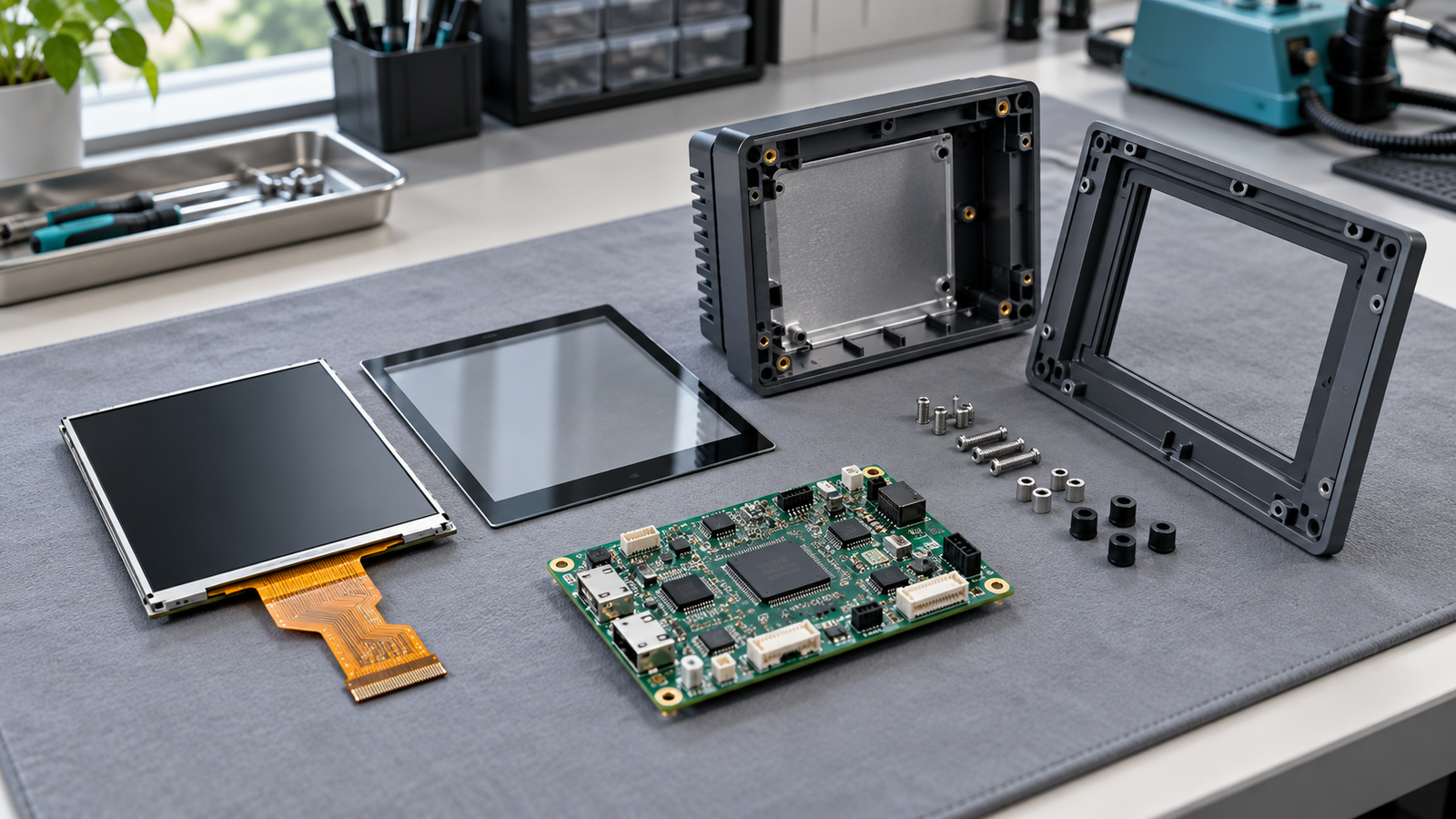
An equipment program may purchase a specific format in modest quantities and need a repeatable configuration over several product revisions. A high-volume consumer product may use a different format, purchasing schedule, and change process. The same technology label does not make those transactions equivalent.
Even when a panel becomes commercially attractive, the complete assembly determines the cost to the OEM. The relevant comparison can include controller adaptation, touch integration, mechanical work, qualification effort, software changes, and service arrangements. Which costs apply depends on the proposed change.
This creates a common decision error: comparing the current assembly’s full purchase price with a new panel’s quoted price. Those are different scopes. A meaningful comparison carries both options through to the point where the equipment can ship and be supported.
Another error is to treat a promising future option as immediately available supply. A supplier may be exploring a configuration without having a qualified production offer for the buyer. Keep that opportunity in the development plan, but distinguish it from a source that can satisfy an active order.
These observations do not favor one display technology universally. They explain why large market movements can produce different decisions at two OEMs. One may have a new product window and a clear customer benefit. Another may have a stable installed platform for which the change cost outweighs the available benefit.
Use market growth to test a product opportunity
For a new equipment design, market growth can justify an earlier commercial evaluation. The decision still needs an application-specific reason. A premium display option becomes more persuasive when customers value the resulting experience enough to support its complete cost.
Our proposed approach is to separate the value question from the sourcing question. First establish what the product gains and how the team will judge that gain. Then obtain a relevant supply proposal and assess whether its terms fit the program. Neither step substitutes for the other.
The engineering comparison belongs in that evaluation, but it is a separate task from reading shipment data. Test the proposed assembly against the application requirements. This market analysis asks whether the available evidence warrants opening or changing a sourcing decision.
Timing also matters. A development project can investigate alternatives before its architecture is fixed. A product already in production may need a stronger reason to absorb the same change. Market awareness is useful in both cases, but the cost of acting differs.
Choose a response that matches the program’s actual condition
The following scenarios are proposed decision paths, not predictions about shortages or supplier behavior. They show how the same market evidence can lead to different actions.
| Program condition | Commercial interpretation | Proportionate response |
|---|---|---|
| A stable LCD program with no verified supply issue | Market change creates an option to investigate, rather than a demonstrated reason to migrate. | Continue model-specific supply review. Evaluate alternatives when they support a product goal or credible risk response. |
| A new premium product with a plausible customer benefit | A different display approach may support differentiation if its full economics work. | Compare complete assembly proposals and qualification effort within the development schedule. |
| A documented discontinuation notice or project-specific supply constraint | The program has a concrete sourcing problem independent of the broad market narrative. | Assess the affected model, dates, demand, and available replacement routes using the actual notice and supplier evidence. |
In the third scenario, a replacement investigation may be necessary. The guide to replacing a discontinued TFT LCD module covers that distinct workflow. A market headline should not be treated as a substitute for a discontinuation notice.
There is no universal case here for stockpiling or immediate conversion. Either action commits resources. The justification should come from the program’s verified exposure and available choices, rather than a technology label.
Preserve options without assuming interchangeable supply
Our strategic recommendation is to make alternatives easier to assess while keeping each source’s status explicit. An option under investigation, an engineering sample, and an approved production assembly represent different levels of readiness.
This can improve planning discussions. Product teams can explore a premium opportunity without promising its release date. Purchasing teams can request evidence of continuity for an existing module without declaring a market-wide shortage. Engineering teams can estimate adaptation work before the business treats an alternative as equivalent.
For an actual sourcing review with RJY Display, share the current module identification, expected demand, required service period, installation constraints, and host-system requirements. Those details support a project-specific discussion of existing LCD modules and controller adaptation. Suitability, current availability, and lifecycle support need confirmation for the specific model and project.
OLED monitor expansion deserves attention because it changes the options worth watching. The sourcing conclusion still belongs at the level of the product being built: its customer value, qualified assembly, change cost, and support terms. Keeping those levels separate lets an OEM respond to market change with evidence rather than assumptions.
Frequently asked questions
Does OLED monitor growth indicate that an industrial LCD module will be discontinued?
No. Segment shipment trends do not establish the status of a particular module. Review model-specific notices and supplier commitments before treating continuity as a confirmed problem.
Does a new OLED factory mean lower prices for an OEM assembly?
A factory announcement does not establish the price or availability of a qualified assembly for a particular buyer. Obtain a proposal for the required configuration and compare complete change costs, volumes, and support terms.
When should an industrial OEM evaluate OLED?
Evaluate it when an application-specific customer benefit or a documented sourcing problem justifies the work. Check the complete assembly and commercial offer against the product program. Market growth can prompt that evaluation; it does not decide its outcome.
References
- Global OLED Monitor Shipments Grew 26.1% QoQ in 2Q26; ASUS Extended Its Lead Over Samsung While MSI Closed the Gap, Says TrendForce. TrendForce, 2026-08-13.
- BOE launches China’s first Gen 8.6 AMOLED production line, ushering in a new era for high-end displays. BOE, 2026-06-17.
- Oxide 1Hz laptop LCD mass-production announcement. LG Display, 2026-03-22.
- First-quarter 2025 results. LG Display, 2025.