In the rapidly evolving landscape of personal computing, the chassis has transcended its traditional role as a mere protective enclosure. It is now a strategic interface for brand differentiation and human-machine interaction (HMI). The integration of lcd panel computer case technology represents a paradigm shift, moving from static builds to dynamic, data-driven ecosystems. For Original Equipment Manufacturers (OEMs) and boutique PC builders, success in this “Interactive Hardware Era” requires more than just high-performance components; it demands a deep understanding of hardware-software integration, performance trade-offs, and supply chain reliability.
1. The Strategic Value of Interaction in PC Hardware
The surge in demand for pc case with screen on side and touchscreen computer case products is driven by a convergence of aesthetic trends and functional requirements. Modern users—ranging from hardcore gamers and streamers to professional creators—demand real-time telemetry and personalized visual feedback.
1.1 Enhancing the User Journey (UX)
Touch technology fundamentally redefines the PC user experience through:
- Real-Time Telemetry: Displaying critical stats such as CPU/GPU temperatures and fan speeds on an internal
computer case monitoreliminates the need for intrusive on-screen displays (OSD) during gameplay or high-load tasks. - Workflow Optimization: For streamers, a dedicated
lcd screen for pc caseacts as a secondary command center for Twitch chats, Spotify controls, or OBS monitoring. - Emotional Customization: The ability to display animated GIFs or personalized branding turns a standard
white pc case with screeninto a unique piece of digital art.

2. Technical Selection: The “Bar Type” Revolution
One of the most significant innovations in the pc case lcd display market is the adoption of the “stretched bar” or “strip” form factor. Unlike standard 16:9 displays, these panels are designed to fit into narrow spaces, such as the vertical front pillars or the power supply (PSU) shrouds of modern ATX cases.
2.1 Spotlight: The RV069LFM-350-40 Stretched Bar LCD
For manufacturers seeking a balance between resolution and spatial efficiency, the RV069LFM-350-40 is a premier choice.
| Parameter | Specification Details |
| Panel Size | 6.9 inch stretched bar LCD |
| Interface | MIPI (Mobile Industry Processor Interface) |
| Resolution | 280(RGB) * 1424 |
| Driver IC | ST7703I |
| Active Area (AA) | 33.60 (H) * 70.88 (V) mm |
| Display Mode | Normally Black, Transmissive IPS |
| Color Support | 16.7M Colors |
| Brightness | 350-400 nits (customizable) |
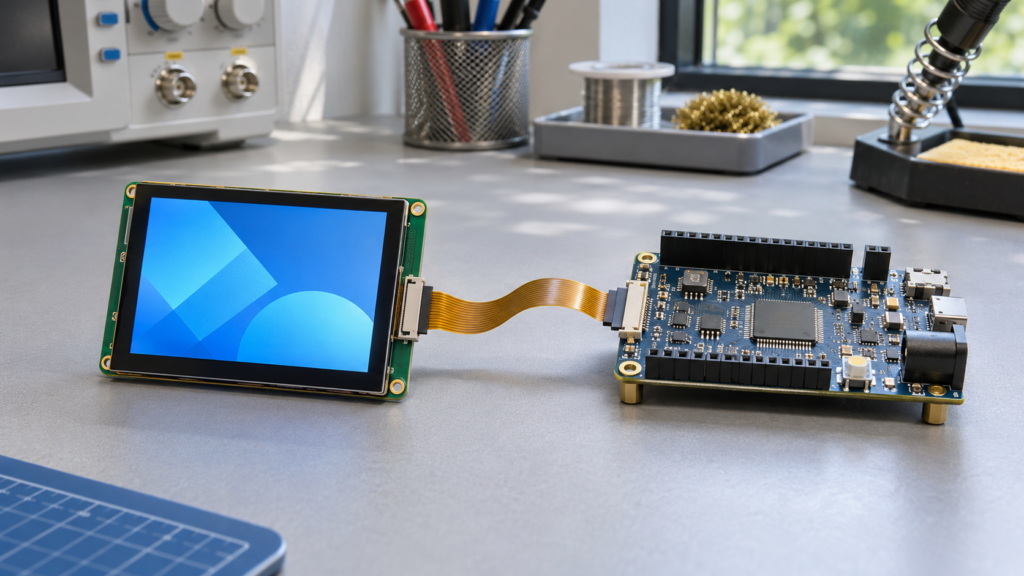
This specific panel offers a high-density visual experience in an ultra-slim vertical layout. Its 40-pin MIPI interface provides a high-bandwidth, low-power connection, making it ideal for integration with embedded computing modules often used in “smart” PC cases.
2.2 Performance Trade-off Evaluation
Choosing a panel like the RV069LFM-350-40 involves evaluating performance trade-offs. While IPS technology ensures wide viewing angles, engineers must also consider:
- Power Management: Stretched LCDs must be efficient to avoid contributing significant heat to the internal case environment.
- Signal Conversion: Since most PC GPUs output HDMI or DisplayPort, a conversion board (HDMI-to-MIPI) is often required for seamless integration.
- Durability: In a high-vibration and variable-temperature environment (inside a PC case), the panel must maintain structural integrity over a long lifecycle.
3. Market Benchmark Analysis: C-Side Innovation
To understand the competitive landscape, we must analyze the market leaders currently utilizing lcd for computer case technology.
3.1 Hyte Y70 Touch Infinite: The High-End Standard
The Hyte Y70 is widely considered the benchmark for the touchscreen computer case category.
- Specifications: Features a 14.9-inch 2.5K (682 * 2560) IPS touchscreen with 10-point multi-touch.
- UX Focus: Powered by the HYTE Nexus software, it allows for deep widget customization and interaction.
- Thermal Consideration: It uses a “Cold Floor” cooling design to mitigate the airflow impedance caused by the integrated screen panels.
3.2 Valkyrie VK-02: Efficiency and Control
A strong contender in the pc case with screen on side segment, the VK-02 focuses on industrial-grade specs.
- Display: A 10.1-inch IPS touchscreen with 1280 * 800 resolution.
- Capability: Supports up to 13 fans and triple 420mm radiators, showcasing that large screens can coexist with extreme cooling.
3.3 Jonsbo D31/D41: The Modular Approach
Jonsbo brought lcd panel pc case technology to the mainstream by offering an affordable, modular 8-inch screen that can be used either as a front panel or a standalone desktop monitor.
4. Accelerating New Product Development (NPD) with RJY Display
Developing a successful pc case lcd screen product requires more than just sourcing a panel. It requires an end-to-end integration partner. RJY Display leverages over a decade of expertise to simplify this complex process.
4.1 From Prototype to Mass Production
The transition from a concept to a retail-ready computer case with display involves several critical stages where RJY provides specialized support:
- Technology Selection & Design: Engineers work closely with clients to match panels like the RV069LFM-350-40 to the specific mechanical constraints of the chassis.
- Prototype Development: Rapid validation through schematic design, PCB layout, and Board Support Package (BSP) development, often delivering functional prototypes within 4-6 weeks.
- Risk Mitigation: Business specialists manage logistics, production scheduling, and inventory planning to ensure a smooth ramp-up to mass production.
4.2 Lifecycle Commitment & Maintenance
A major challenge for manufacturers is the short lifespan of consumer electronics components. RJY Display addresses this through:
- Long-term Supply Longevity: Guaranteed supply for 3-5 years for mass-produced models, preventing premature product end-of-life (EOL).
- Advanced Technical Support: Complimentary support for hardware debugging and firmware troubleshooting ensures that product maintenance costs remain low.
- Inventory Management: Local inventory planning reduces supply chain volatility, ensuring that components are available when needed for production runs ranging from 5,000 to 200,000 units.
5. Software Ecosystem: Driving the Interaction
The hardware is only as good as the software that drives it. For pc case screens, the industry standard remains AIDA64 Extreme, which offers a robust “SensorPanel” for real-time monitoring.
5.1 Professional Monitoring Tools
- AIDA64 SensorPanel: Uses a layer-based editor similar to Photoshop, allowing users to build complex dashboards with gauges, graphs, and custom images.
- HWiNFO64: Preferred by enthusiasts for its depth of sensor data and accuracy, often used as a backend for third-party skins.
- Proprietary Suites: Brands like Hyte (Nexus) and Thermaltake (TT RGB Plus 2.0) provide user-friendly, drag-and-drop interfaces that lower the entry barrier for non-technical users.
5.2 UI/UX Design Principles for Small Panels
When designing for a narrow bar screen like the RV069LFM-350-40 (280 * 1424), certain UI principles apply:
- Visual Hierarchy: Place the most critical data (e.g., GPU Temp) at the top or center of the “strip” where it is most visible.
- Clarity over Density: Avoid over-modifying. Focus on 10-12 essential KPIs to prevent cognitive overload on a small vertical display.
- Color Logic: Use red only for abnormal states (alarms) and muted grays for background elements to minimize eye strain.
6. The “Snowblind” Mod and DIY Trends
The DIY community continues to push the boundaries of pc case with screen on side technology through “Snowblind” modifications. This involves stripping an LCD monitor of its backlight and using the case’s internal white LEDs as the light source, creating a transparent display on the glass side panel.
6.1 DIY vs. Professional Integration
While DIY projects offer high customization, professional integration—like the solutions provided by RJY Display—offers significant advantages:
- Reliability: Industrial-grade components (rated for 50,000+ hours) vs. repurposed consumer monitors (rated for ~20,000 hours).
- Thermal Stability: Integrated designs are stress-tested to ensure the screen doesn’t fail under the high-temperature conditions of a modern gaming rig.
- Ease of Assembly: Plug-and-play kits like the
thermaltake lcd panel kitor pre-integrated cases like the Hyte Y70 provide a “buttery smooth” experience for the end-user.
7. Future Outlook: 2026 and Beyond
As we move toward 2026, several key technologies will dominate the pc case display market :
- MicroLED Integration: Offering brightness levels of 2,000-5,000 nits and a lifespan exceeding 100,000 hours, MicroLED will become the premium choice for interactive hardware.
- AI-Enhanced Displays: AI-driven systems will automatically adjust content based on the running application or ambient lighting conditions.
- Transparent OLED (T-OLED): Following the lead of concept products like the Lian Li DK-07 desk, transparent OLEDs will allow for holographic-like visuals without the need for high-intensity internal lighting.
8. Conclusion and Recommendations
The integration of touch technology into PC hardware is no longer a niche trend; it is a fundamental evolution of the DIY and OEM markets. To succeed, manufacturers must prioritize reliable hardware integration and long-term lifecycle support.
For Brand Owners: Leverage partners like RJY Display to accelerate your NPD cycle. Utilizing high-resolution, space-efficient panels like the RV069LFM-350-40 ($280 \times 1424$ MIPI) can provide the competitive edge needed in today’s crowded SERP.
For Enthusiasts: When choosing an lcd screen for pc case, look for IPS panels with high PPI ($170+$) and robust software support to ensure your “Interactive Case” remains a centerpiece of your setup for years to come.
FAQ: Professional Integration & Maintenance
Q1: What are the benefits of the MIPI interface in the RV069LFM-350-40 panel?
A: MIPI (Mobile Industry Processor Interface) is designed for high-speed data transmission with very low power consumption and low EMI. This is critical for internal PC displays where cable clutter and electromagnetic interference from the GPU can disrupt signals.
Q2: How does RJY Display handle product EOL (End-of-Life)?
A: RJY issues a notification 6–12 months before a component is discontinued. They provide “Last-time Buy” opportunities and a seamless hardware migration path to newer technology to prevent project downtime.
Q3: Can a touchscreen be used with standard PC monitoring software? A: Yes. High-end panels like those in the Hyte Y70 or Valkyrie VK-02 support Windows-native 10-point multi-touch. Software like HYTE Nexus is specifically built to map touch inputs to custom widgets.
Q4: Is it better to use HDMI or USB for PC case screens? A: HDMI is typically used for the high-resolution video signal, while USB (via internal 9-pin headers) provides the power and touch data. This hybrid approach ensures 60Hz refresh rates and smooth interactivity.