Facing a bottleneck in your Embedded Display Project?
Don’t let complex integration or supply chain issues slow your time-to-market. Book a free consultation with the RJY expert team for tailored design and manufacturing support.

A machine changes to a new screen, but the outline of the previous menu remains faintly visible. An operator may describe the problem as LCD burn-in, ghosting or a damaged screen. These terms are often used interchangeably, even though they can describe different display behaviors.
LCD image retention generally refers to a temporary residual image that remains after static content has been displayed for an extended period. Motion ghosting, backlight non-uniformity, electrical interference and permanent panel degradation can create different symptoms that require different solutions.
Understanding the difference matters for equipment designers. Replacing the LCD will not solve a problem caused by incorrect signal timing, DC imbalance, poor thermal design or application software that displays the same high-contrast interface continuously.
Image retention, sometimes called image sticking or image persistence, is a visible trace of previously displayed content. It is normally easiest to see after switching from a static, high-contrast interface to a uniform gray, white or mid-tone image.
Typical examples include:
The residual pattern may fade after the screen displays changing content or remains powered off for a period. However, recovery behavior depends on the panel, operating conditions, image pattern and cause. A screen should not automatically be classified as permanently damaged simply because a residual image is visible.

Not exactly. “Burn-in” is a broad consumer term frequently used for any persistent screen mark. In technical diagnosis, it is more useful to separate temporary image retention from permanent or long-term non-uniformity.
| Display symptom | When it appears | Typical behavior | First area to investigate |
|---|---|---|---|
| Image retention | After static content is removed | A faint previous image may gradually fade | Static UI duration, temperature and LCD drive conditions |
| Motion ghosting | While objects or images are moving | A trail follows moving content | Pixel response, temperature and frame behavior |
| Backlight non-uniformity | Visible across many images | Bright or dark areas remain fixed in place | Backlight, optical films, pressure and assembly |
| Signal-related artifact | During operation or startup | Lines, flicker, noise or repeated patterns | Timing, interface, grounding, power and FPC connection |
| Permanent degradation | Remains after recovery attempts | The pattern does not meaningfully change | Panel history, temperature, drive conditions and physical damage |
Whether a particular screen has recoverable retention or permanent degradation cannot be determined from the word “burn-in” alone. The equipment team needs to observe when the symptom appears, how it changes and whether it follows the displayed content.
A TFT LCD creates an image by controlling the electrical state of liquid-crystal cells. The applied drive is normally balanced over time so that the liquid-crystal layer is not exposed to a continuous DC component.
If the electrical balance is disturbed, charge-related effects can contribute to image sticking. Potential causes may include abnormal signal timing, an unsuitable drive condition, an incorrect initialization sequence or a panel and controller combination that has not been fully matched.
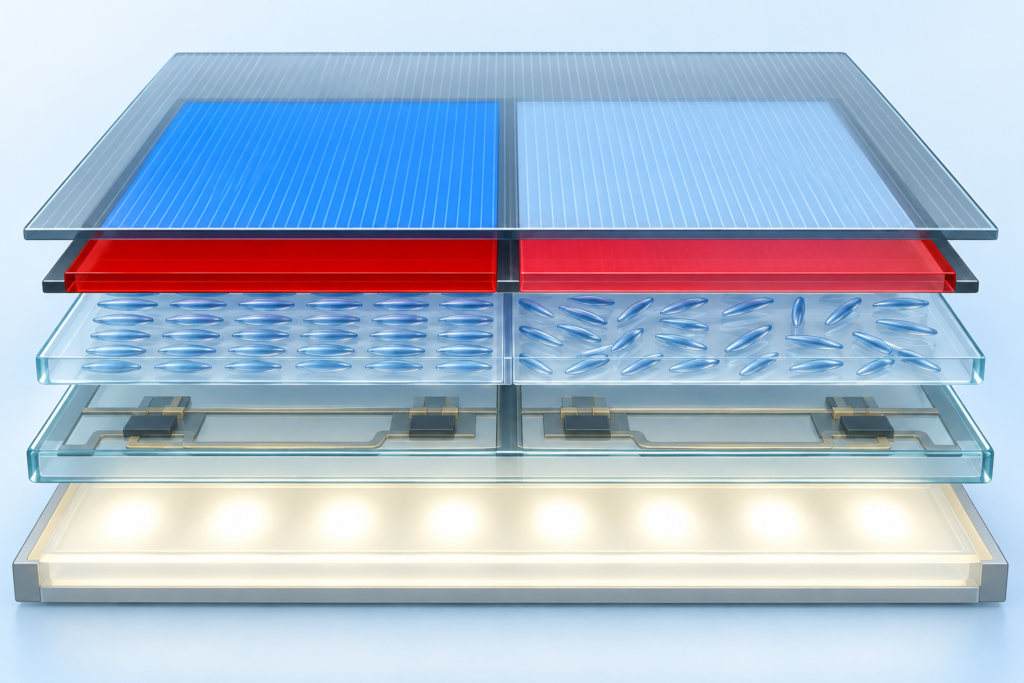
This does not mean every retained image is caused by faulty electronics. Static content, temperature and panel characteristics can also influence the result. The signal path should nevertheless be included in the investigation rather than treating the LCD as an isolated component.
Industrial interfaces often contain elements that barely move: navigation bars, alarm areas, numeric fields, logos, borders and fixed control buttons. When neighboring regions remain at very different gray levels for long periods, the pattern can become temporarily visible after the content changes.
A black-and-white grid or fixed high-contrast status panel generally creates a more demanding pattern than content that changes frequently and uses moderate differences in brightness.
Liquid-crystal response is temperature-dependent. At lower temperatures, pixel transitions may become slower, making motion trails or delayed changes more noticeable. Elevated temperature can also affect image-retention behavior, particularly when the screen continuously shows static content.
For this reason, a result observed on an open laboratory bench may not represent the display inside a sealed enclosure, near a heat source or in a cold outdoor installation.
Uneven pressure from the bezel, cover glass, adhesive, bracket or enclosure can disturb the optical appearance of an LCD. The resulting bright, dark or discolored area may be mistaken for image retention.
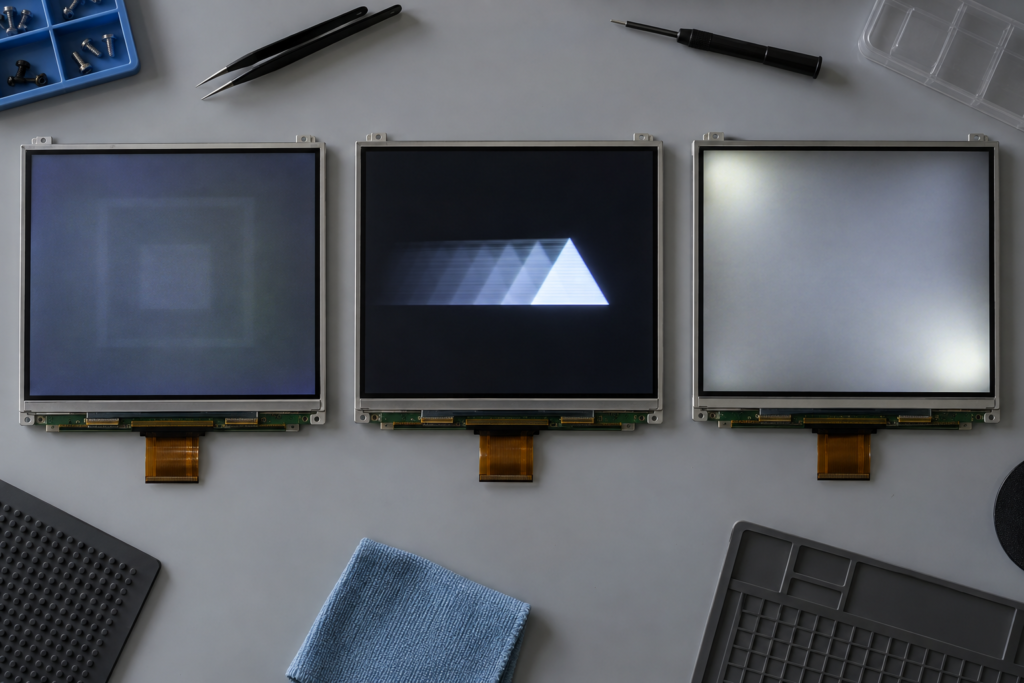
Pressure-related artifacts usually remain in the same physical location and may not match the previous screen content. Testing the module outside the enclosure can help separate a panel-drive issue from an assembly issue, provided the module is handled safely.
Unstable power rails, an incorrect startup or shutdown sequence, poor grounding, interface noise and marginal timing can produce artifacts that resemble persistence. Some appear only after warm-up, after repeated power cycles or when another part of the equipment is active.
A reliable investigation therefore needs both visual observation and electrical information.
Motion ghosting appears while content is moving. A shape may leave a trailing edge because pixels require time to transition from one state to another. It can be influenced by LCD mode, gray-level transition, temperature and the way the source renders moving content.
Image retention remains after the original content has been removed. A simple distinction is:
More than one condition can exist at the same time. For example, a display used in a cold environment may show slow motion response while also retaining a static status bar after extended operation.
Before changing anything, record the interface page, brightness setting, operating time, ambient temperature and equipment state. Photograph the screen using the same exposure and viewing angle where practical.
Also note whether the symptom appears immediately, only after warm-up or only after many hours of static operation.
Switch the LCD to uniform gray levels and simple full-screen colors. Mid-gray backgrounds are often useful because both lighter and darker residual areas can be easier to observe.
A generated test screen is preferable to a photograph containing gradients, compression artifacts or unknown color processing. Avoid drawing a conclusion from only one background.
If the visible trace matches buttons, borders, text blocks or other fixed elements from the previous page, image retention becomes a reasonable hypothesis. If the artifact does not match the displayed content, investigate the backlight, optical stack, mechanical pressure and signal system.
Run normal changing content or a controlled sequence of different gray levels. Observe whether the residual pattern becomes weaker. Do not use rapidly flashing content in a public or uncontrolled environment.
Recovery can support an image-retention diagnosis, but it does not identify the original cause. The system may still need changes to UI behavior, thermal management or LCD drive conditions.
Powering the equipment down can help determine whether the effect is temporary. Record the condition before shutdown and after restart rather than relying on memory.
There is no universal recovery time applicable to every TFT LCD. Panel construction, previous operating duration, temperature and severity all affect the result.
If the open-module test differs from the installed result, examine enclosure temperature, mechanical pressure, grounding, cable routing and nearby electronics. This step is especially important for sealed equipment and high-brightness displays.
| Observation | Possible explanation | Useful next check |
|---|---|---|
| The old menu is visible on a gray screen | Image retention | Run changing content and observe recovery |
| A trail appears only behind moving graphics | Slow pixel response | Compare at normal and low operating temperatures |
| A bright patch remains in one corner | Backlight, pressure or optical non-uniformity | Compare different images and inspect the assembly |
| Vertical or horizontal lines appear | Connection, timing or panel fault | Inspect the FPC, connector, signals and power rails |
| The artifact appears after another load starts | Power or electromagnetic interference | Monitor supplies, grounding and cable routing |
| The residual image never changes | Long-term degradation or another permanent fault | Compare with a known-good module under the same conditions |
For many embedded products, prevention begins in the application software. Industrial screens often remain on the same page for much longer than phones or consumer computers.
Small changes in position, color or layout can reduce the time that identical high-contrast boundaries remain on the same pixels. The movement must not interfere with usability or make safety-related information difficult to locate.
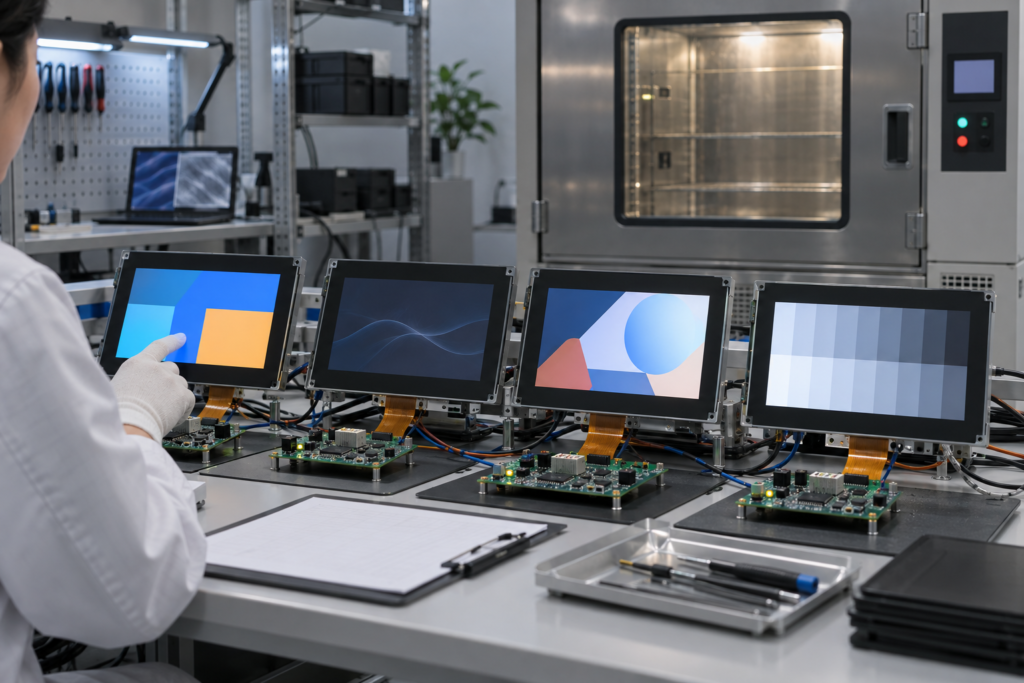
If operators do not need the screen continuously, the application can enter a lower-brightness page, screen saver or display-off state after an appropriate period. The design must account for applications where information must remain continuously visible.
Brightness should be selected for the real viewing environment instead of automatically operating the backlight at its maximum setting. This can also help control temperature and power consumption.
Reducing backlight brightness does not correct an electrically driven image-retention problem by itself, because the backlight and liquid-crystal drive are separate. It is one part of a broader display-management strategy.
A fixed pure-white element against a black background creates a strong boundary. Moderate colors and less extreme contrast may be considered for elements that remain visible for long periods, provided readability and application requirements are maintained.
Changing a clock value or a small data field does not necessarily refresh the rest of the screen. UI teams should identify which pixels remain unchanged across normal operation and design the idle behavior around those areas.
If image retention appears earlier than expected, varies between controller configurations or is accompanied by flicker and unstable startup, review the display-driving system.
The engineering review may need to include:
A controller board should not be considered compatible merely because it produces a visible image. Long-duration testing, startup testing and operation under the intended environmental conditions are also necessary.
Replacement may be appropriate when the residual image remains after controlled recovery attempts, the symptom is repeatable on an independent test setup or physical panel degradation has been confirmed.
Before replacing the module, determine whether the root cause is inside the LCD or elsewhere in the product. Installing a new screen without correcting abnormal timing, power, heat or mechanical pressure may allow the same problem to return.
A comparison with a known-good module can be useful:
A short visual inspection is not enough for products that will show the same interface for many hours. The prototype plan should reflect the real operating pattern.
Useful validation steps include:
The exact test conditions and acceptance criteria should be agreed for the selected display and application. A generic test result should not be treated as a guarantee for every LCD configuration.
If an equipment team needs help evaluating an abnormal TFT image, provide:
RJY can review the LCD module, controller-board configuration and display-related mechanical structure as a system. Any conclusion or proposed change must be based on the actual module and project conditions.
A faint image remaining on a TFT LCD is not automatically permanent burn-in. It may be temporary image retention, slow response, backlight non-uniformity, mechanical pressure or an electrical artifact.
The most useful first step is to identify when the pattern appears and whether it follows the previous content. Uniform test images, controlled recovery observations and system-level comparison can then narrow the cause.
If you are diagnosing an embedded or industrial TFT display, explore RJY custom display solutions or contact RJY with the LCD model, controller information, photographs and operating conditions for a project-specific review.
Not always. Some residual images fade after the content changes or the display rests, while other cases may involve long-term degradation or a different fault. Recovery behavior should be tested before the screen is classified as permanently damaged.
Image retention is a residual trace that remains after static content is removed. Motion ghosting is a visible trail that appears while an object or image is moving, commonly associated with pixel response behavior.
A screen saver or changing idle page can reduce the time that one static pattern remains on the same pixels. It cannot correct abnormal drive voltage, timing, temperature, mechanical pressure or an existing panel fault.
Lower brightness may reduce power and internal heat, but it does not directly correct every form of image retention. The backlight and liquid-crystal drive are separate systems, so the cause must still be diagnosed.
Not necessarily. First compare the pattern with the previous interface, test uniform screens, observe recovery and investigate temperature, timing, power and enclosure pressure. Replacement is appropriate only after the likely cause and module condition have been evaluated.
Share your display size, resolution, interface, brightness, touch requirement, controller board requirement, and application environment.
Continue reading related display technology guides and application references.


Talk to RJY’s engineering team for display matching, controller board review, and customization discussion.