Facing a bottleneck in your Embedded Display Project?
Don’t let complex integration or supply chain issues slow your time-to-market. Book a free consultation with the RJY expert team for tailored design and manufacturing support.

When it comes to high-performance screens in consumer electronics, wearables, or industrial devices, two display technologies dominate the landscape—AMOLED and IPS.Both have transformed how we view and interact with digital content, but they operate on fundamentally different principles. Understanding the key distinctions between AMOLED vs IPS displays helps you make the right decision for your product’s performance, durability, and cost.
AMOLED vs IPS display is a common comparison when product teams evaluate display technology for smartphones, wearables, smart panels, industrial HMIs, medical-related interfaces, vehicle-related displays, and embedded devices. AMOLED and IPS can both deliver high-quality images, but they work in very different ways.
AMOLED is a self-emissive display technology. Each pixel emits its own light, so black areas can be created by turning pixels off. IPS is a type of LCD panel technology. It uses liquid crystals, color filters, thin-film transistor control, and an LED backlight to form images.
Neither technology is universally better. AMOLED is often attractive for premium consumer devices, dark interfaces, slim designs, and high contrast. IPS TFT LCD is often preferred for stable brightness, long-duration operation, lower burn-in risk, mature supply, and many industrial or embedded display projects.
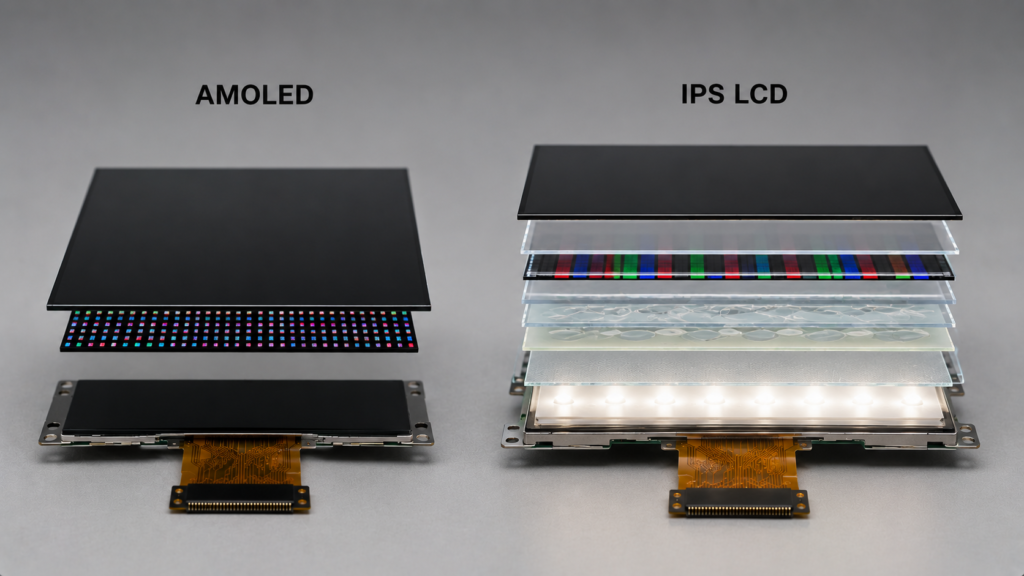
AMOLED stands for active-matrix organic light-emitting diode. It is a type of OLED display that uses an active matrix to control individual pixels. Unlike an LCD, an AMOLED display does not need a backlight. Each pixel produces light using organic light-emitting materials.
This self-emissive structure gives AMOLED several important characteristics. Black pixels can be turned off completely, which creates very high contrast. The display can also be made thin because there is no separate backlight unit. This is one reason AMOLED is widely used in smartphones, smartwatches, foldable devices, and premium consumer electronics.
However, AMOLED also has trade-offs. Organic emitting materials can age over time, and static UI elements may create burn-in risk if the display shows the same content for long periods. Cost, availability, size options, brightness behavior, and lifetime requirements should be evaluated carefully before choosing AMOLED for a product.
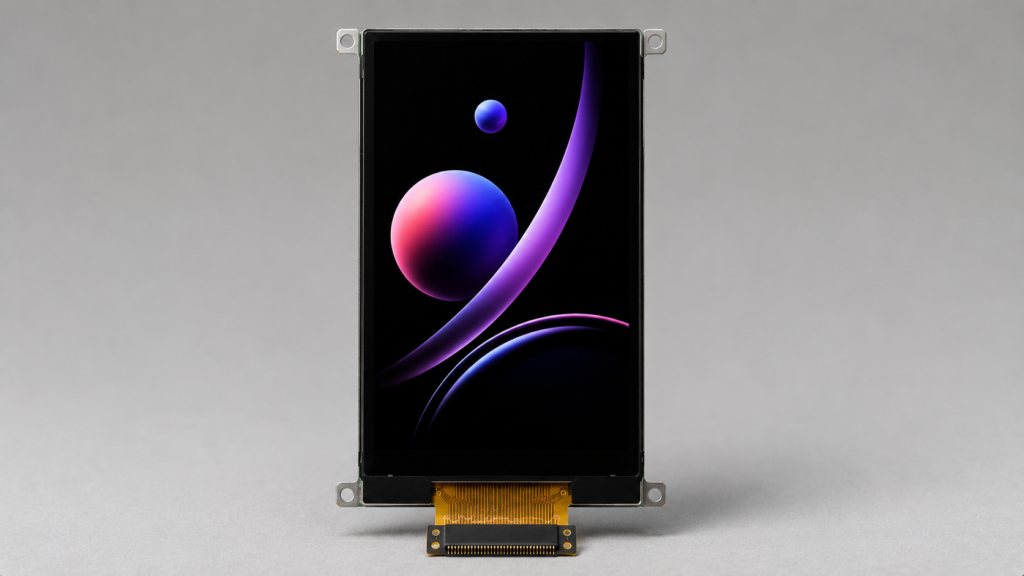
IPS stands for in-plane switching. It is a type of LCD panel technology. In an IPS LCD, liquid crystal molecules move more parallel to the display surface, helping the panel maintain stable color and contrast from wider viewing angles compared with many TN LCD panels.
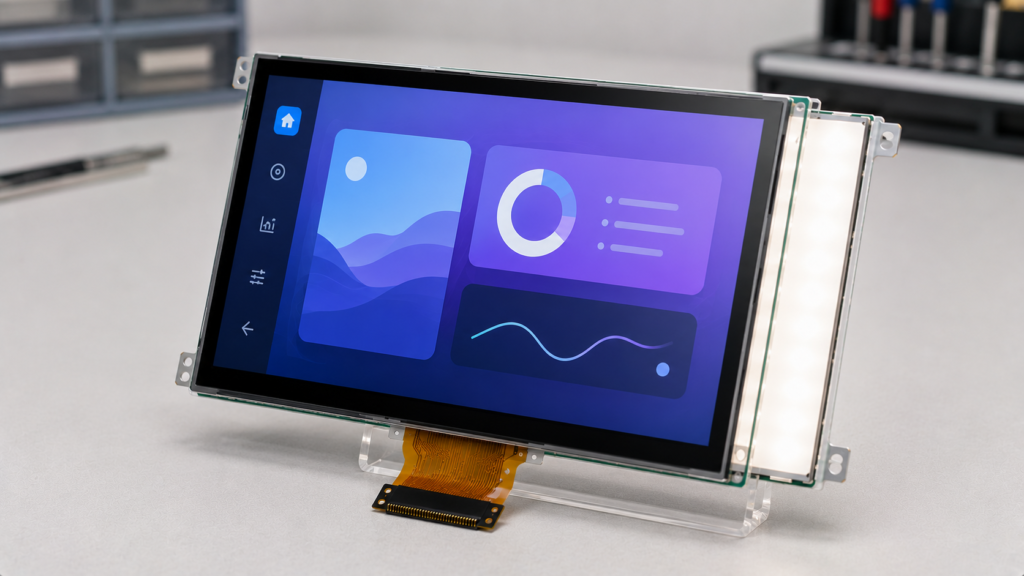
IPS is commonly used in TFT LCD modules. A typical IPS TFT LCD module includes a TFT array, liquid crystal layer, color filter, polarizers, LED backlight, driver ICs, FPC, and mechanical structure. Since liquid crystal material does not emit light by itself, the display depends on the backlight to make the image visible.
IPS TFT LCD is widely used in industrial displays, smart home panels, equipment interfaces, medical-related device displays, automotive-related devices, and other embedded products where stable viewing angle, mature supply, and long operating life are important.
The core difference between AMOLED and IPS display technology is the light source.
AMOLED pixels emit their own light. IPS LCD pixels control how much backlight passes through the liquid crystal and color filter structure. This difference affects black level, contrast, power behavior, thickness, lifespan, burn-in risk, brightness strategy, and application suitability.
| Factor | AMOLED Display | IPS Display |
|---|---|---|
| Display type | Self-emissive OLED technology | LCD panel technology |
| Light source | Each pixel emits light | Uses LED backlight |
| Black level | Very deep black because pixels can turn off | Limited by backlight leakage |
| Contrast | Very high | Moderate to good depending on panel and backlight |
| Power behavior | Can be efficient with dark UI | Backlight consumes power across the screen |
| Burn-in risk | Possible with static content over time | Generally lower burn-in risk than AMOLED |
| Module thickness | Can be very thin | Usually thicker because of backlight structure |
| Supply maturity for embedded LCD projects | Depends on size, vendor, and application | Very mature across many TFT LCD module sizes |
| Typical use | Smartphones, wearables, premium consumer devices | Industrial HMIs, smart panels, equipment displays, embedded systems |
AMOLED is often recognized for strong visual impact. Since each pixel emits light independently, AMOLED can produce very deep black areas and high contrast. This can make dark interfaces, videos, and premium consumer UI designs appear vivid.
IPS displays usually provide stable and natural image quality, especially when viewed from different angles. IPS is often selected when the display needs consistent color appearance and good readability in equipment interfaces, control panels, or touch displays.
The best image quality depends on the content. AMOLED may look stronger for dark UI and high-contrast media. IPS may be more predictable for long-running interfaces, industrial screens, and applications where stable brightness and viewing behavior matter more than dramatic contrast.
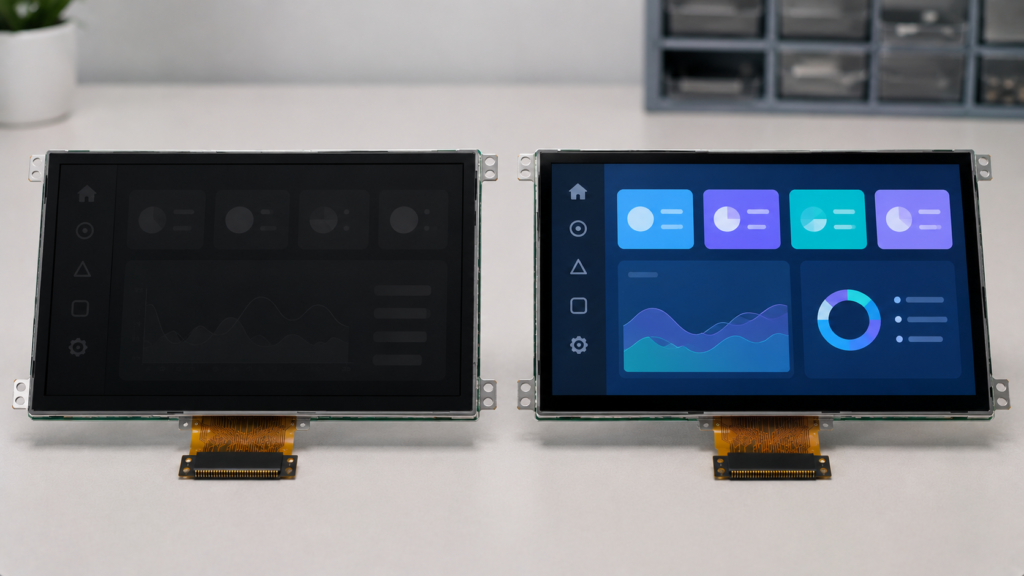
AMOLED has a clear advantage in black level. When a pixel needs to show black, the pixel can be turned off. This creates deep black and high contrast.
IPS LCD uses a backlight. Even when the liquid crystal layer blocks light, some backlight leakage may remain. This means black areas on IPS displays usually cannot match the black level of AMOLED.
For products with dark themes, media playback, premium visual interfaces, and always-on display effects, AMOLED can be attractive. For industrial interfaces with bright backgrounds, buttons, menus, and static data screens, the contrast advantage may be less important than lifetime, brightness, and supply stability.
Brightness is not determined only by the display technology name. AMOLED and IPS displays can both be designed with different brightness levels depending on the panel, driver, power design, thermal structure, and product target.
IPS TFT LCD modules often use LED backlights, which can be engineered for stable brightness. This can be useful for industrial displays, smart control panels, vehicle-related devices, and equipment interfaces that must remain readable under varying ambient light.
AMOLED can provide high perceived contrast, but brightness behavior depends on the panel design, content, power limit, and thermal management. For outdoor or semi-outdoor products, buyers should evaluate actual brightness, reflectance, cover glass, anti-glare treatment, thermal design, and power budget instead of choosing only by AMOLED or IPS.
AMOLED power consumption depends strongly on image content. Dark interfaces can consume less power because black pixels are off. Bright white backgrounds can consume more power because many pixels emit light at the same time.
IPS LCD power consumption is more strongly tied to the backlight. The backlight usually remains active across the display area, whether the image is mostly dark or mostly bright. Reducing backlight brightness can reduce power, but the image content itself does not change power behavior in the same way as AMOLED.
This means AMOLED can be efficient for dark-mode devices, wearable screens, standby displays, and UI designs with large black areas. IPS can be more predictable for fixed industrial interfaces, bright UI layouts, and applications where the display operates at a controlled brightness level.
Lifespan is one of the most important differences between AMOLED and IPS display technology in B2B products. AMOLED uses organic light-emitting materials that age with use. If static elements stay on the screen for long periods, burn-in or uneven aging may become a concern.
IPS LCD does not use organic light-emitting pixels. It still has lifetime-related components, especially the LED backlight, but it is generally less exposed to the same burn-in mechanism as AMOLED. This makes IPS TFT LCD a practical choice for interfaces that display static menus, icons, warnings, dashboards, or control screens for long hours.
For smartphones and wearables, AMOLED burn-in can often be managed with UI design, pixel shifting, screen timeout, dark mode, and software controls. For industrial HMIs or fixed equipment panels, static UI content may remain visible for much longer, so burn-in risk should be evaluated more carefully.
AMOLED can support very thin display designs because it does not require a separate backlight unit. This is useful for smartphones, smartwatches, foldable devices, and other compact consumer electronics.
IPS TFT LCD modules are usually thicker because they include a backlight unit, optical films, light guide plate, polarizers, and mechanical support. However, this structure is mature, cost-effective, and available across many module sizes and industrial formats.
For B2B embedded products, thickness is only one design factor. Engineers also need to consider cover glass, touch panel, FPC direction, mounting structure, connector location, backlight power, controller board, enclosure design, and long-term supply.
Both AMOLED and IPS can provide wide viewing angles in many modern products. AMOLED does not depend on LCD light polarization in the same way as IPS LCD, while IPS was developed to improve viewing angle and color stability compared with many older LCD panel modes.
In practical product selection, buyers should not rely only on the technology label. The actual viewing behavior depends on the specific panel, optical design, cover glass, bonding method, brightness, and installation angle.
For industrial HMIs, medical-related interfaces, and touch panels, IPS TFT LCD is often a strong choice because the viewing behavior is mature and predictable across many display sizes. For premium consumer devices, AMOLED can provide excellent viewing and contrast when the product design supports it.
AMOLED often costs more than IPS LCD in many product categories, especially when the required size, brightness, touch integration, or supply conditions are specialized. AMOLED availability also depends heavily on panel size and vendor ecosystem.
IPS TFT LCD is widely available across many standard embedded display sizes and resolutions. This makes it easier to source modules for industrial products, smart panels, control systems, security equipment, medical-related devices, and vehicle-related displays.
For B2B projects, the lowest panel price is not always the best choice. Buyers should compare full project cost, including module cost, touch panel, cover glass, backlight, FPC, controller board, firmware, testing, MOQ, lead time, and long-term supply risk.
AMOLED can be a strong choice when the product needs a premium visual experience, thin structure, deep black, and strong contrast.
AMOLED also has limitations that matter for product planning, especially when the display will show static content for long periods.
IPS TFT LCD is often selected for stable, practical display performance in embedded and industrial products.
IPS LCD also has trade-offs. It is not the best fit for every product.
For industrial products, the practical choice often depends on operating time, static UI content, viewing condition, brightness, supply stability, and service expectations.
Industrial HMIs, equipment screens, control panels, and automation interfaces often show fixed menus, alarms, icons, buttons, and status dashboards for long periods. In these cases, IPS TFT LCD is often a safer and more practical display direction because it avoids the same burn-in concern associated with AMOLED and is widely available in industrial display module formats.
AMOLED may still be considered for specialized industrial or handheld products where thin design, dark UI, high contrast, and premium appearance are more important than static UI lifetime risk. The product team should test the panel under real operating conditions before choosing it.
Medical-related interfaces need readable text, stable graphics, clear status information, and reliable operation. IPS TFT LCD is commonly considered for these needs because it provides stable viewing behavior and is available in many embedded display module sizes.
AMOLED can deliver excellent contrast, but static UI, lifetime behavior, brightness requirements, and procurement availability need careful review. For any medical-related product, display choice should be evaluated together with the device requirements, usage hours, UI design, documentation, and applicable compliance expectations.
Do not choose a display technology based only on visual appeal. Choose based on how the display will be used in the actual device.
Smart home and consumer products may benefit from either AMOLED or IPS depending on product positioning.
AMOLED is attractive when the product needs a premium appearance, deep black UI, slim profile, or standby display effect. This can fit wearables, smart remotes, premium control devices, and compact personal electronics.
IPS TFT LCD is often more practical when the product needs cost control, stable supply, touch interface support, and standard module availability. Many smart home panels, wall controls, and embedded consumer devices can use IPS TFT LCD effectively.
Vehicle-related displays may require stable brightness, readable UI, wide viewing angle, long operating life, and resistance to static UI aging. IPS TFT LCD is often a practical choice for dashboards, control displays, and equipment interfaces when the project needs standard module availability and mature integration support.
AMOLED can be attractive for premium visual designs, but burn-in, high-temperature behavior, brightness limits, lifetime expectations, and supply requirements should be reviewed carefully for vehicle-related products.
The final display choice should consider brightness, viewing angle, cover glass reflection, operating temperature, touch requirement, controller board, mechanical fit, and long-term production needs.
Choose AMOLED when the display’s visual impact, thin structure, and deep black contrast are central to the product experience.
AMOLED may be suitable for:
Before choosing AMOLED, evaluate static UI risk, operating hours, brightness needs, cost, supply availability, and lifetime expectations.
Choose IPS TFT LCD when the product needs stable viewing, mature supply, lower burn-in concern, and practical integration across standard display sizes.
IPS TFT LCD is often suitable for:
For many B2B display projects, IPS TFT LCD provides a strong balance of image quality, viewing angle, supply availability, cost control, and customization flexibility.
Start with the product requirements rather than the display label. The right display technology depends on use case, operating hours, UI content, power budget, mechanical design, and sourcing needs.
| Project Requirement | Recommended Direction | Reason |
|---|---|---|
| Deep black and premium visual contrast | AMOLED | Self-emissive pixels provide strong black level |
| Long-duration static UI | IPS TFT LCD | Lower burn-in concern for fixed menus and dashboards |
| Very thin consumer product | AMOLED | No backlight structure required |
| Industrial HMI or equipment display | IPS TFT LCD often preferred | Mature supply and stable operation for embedded projects |
| Dark-mode wearable interface | AMOLED | Dark pixels can consume less power |
| Bright UI shown most of the time | Evaluate both carefully | Power and brightness depend on real content and panel design |
| Custom touch display module | IPS TFT LCD often practical | Broad module options and integration support |
| Flexible or foldable design | AMOLED | Better suited to flexible display structures |
One common mistake is saying AMOLED is always better because it has deeper blacks. Deep black is valuable, but it does not automatically solve lifetime, burn-in, cost, brightness, or supply issues.
Another mistake is saying IPS is outdated because it uses a backlight. IPS TFT LCD remains a practical and widely used choice for many industrial, embedded, and equipment display applications.
A third mistake is ignoring static UI content. If the product shows the same buttons, icons, numbers, or menu bars for thousands of hours, AMOLED burn-in risk needs serious review.
A fourth mistake is comparing only the display panel and ignoring the full module. Touch panel, cover glass, FPC, interface, backlight, controller board, firmware, mechanical fit, and operating environment can affect the final display choice as much as the panel technology.
Before choosing AMOLED or IPS TFT LCD, buyers should prepare a complete display requirement. This reduces sourcing risk and helps the supplier recommend a realistic option.
Important information includes:
RJY Display supports TFT LCD modules, controller boards, and custom display solution discussions for engineering-driven B2B projects. For projects comparing AMOLED and IPS display technology, RJY Display can help review whether an IPS TFT LCD module, touch display, controller board, or customized TFT LCD solution is suitable for the application.
Custom display support can be discussed around existing TFT LCD modules, including brightness, touch panel, cover glass, backlight, FPC, interface, controller board, firmware, and mechanical structure coordination.
If your product needs a stable IPS TFT LCD module, touch display, high-brightness TFT LCD, controller board, or custom display integration, prepare your display size, resolution, brightness, interface, touch requirement, operating environment, and expected production demand before inquiry.
Send Your Display Project Requirements
AMOLED and IPS displays are built on different display principles. AMOLED is self-emissive, so each pixel creates its own light. This allows deep black, high contrast, thin structure, and strong visual impact. IPS is an LCD technology that uses a backlight and liquid crystal layer to form images. It offers stable viewing angle, mature module availability, lower burn-in concern, and practical long-term use in many embedded products.
AMOLED is often a strong choice for smartphones, wearables, foldable devices, and premium consumer products where contrast, dark UI, and thin design matter. IPS TFT LCD is often a stronger practical choice for industrial HMIs, smart panels, medical-related interfaces, security equipment, vehicle-related displays, and long-duration embedded applications.
The correct choice is not based on which technology sounds more advanced. It depends on the product’s real requirements: screen size, UI content, operating hours, brightness, power, burn-in risk, touch, interface, controller board, mechanical structure, cost, and supply plan.
The main difference is the light source. AMOLED pixels emit their own light, while IPS is an LCD technology that uses an LED backlight behind a liquid crystal layer.
AMOLED is better for deep black, high contrast, thin design, and dark UI. IPS is often better for long-duration static interfaces, mature module supply, lower burn-in concern, and many industrial or embedded display applications.
Yes. AMOLED uses organic light-emitting materials, and static UI elements can cause uneven aging or burn-in over time. The risk depends on brightness, content, operating hours, and software controls.
Yes. IPS is an LCD technology, so it normally needs an LED backlight to make the image visible.
IPS TFT LCD is often more practical for industrial HMI because it supports stable viewing, mature supply, long-duration operation, and lower burn-in concern for static interface elements.
AMOLED can use less power with dark UI because black pixels can turn off. IPS LCD power is more tied to the backlight, so image content has less effect on power consumption than AMOLED.
Outdoor readability depends on brightness, contrast, cover glass reflection, anti-glare treatment, thermal design, and power. AMOLED and IPS should both be evaluated by actual panel specifications, not only by technology name.
Choose based on product type, screen-on time, static UI content, brightness, power budget, burn-in risk, display size, interface, touch requirement, controller board, cost, and supply availability.
Share your display size, resolution, interface, brightness, touch requirement, controller board requirement, and application environment.
Continue reading related display technology guides and application references.
Explore product pages related to this article topic.
Talk to RJY’s engineering team for display matching, controller board review, and customization discussion.