Stehen Sie bei Ihrem Embedded-Display-Projekt vor einer Herausforderung?
Lassen Sie nicht komplexe Integration oder Lieferkettenprobleme Ihre Markteinführung verzögern. Vereinbaren Sie eine kostenlose Beratung mit dem RJY-Expertenteam für maßgeschneiderte Design- und Fertigungsunterstützung.
Die Leinwand des Architekten: Strategische Anwendungen für große LCD-Displays in modernen öffentlichen Räumen
Veröffentlicht:
8 Minuten Lesezeit
Aktualisiert:
In der sich ständig wandelnden Landschaft der Stadtarchitektur, der Gewerbeimmobilien und der Verkehrsinfrastruktur in Nordamerika und Europa ist statische Beschilderung faktisch überholt. Moderne öffentliche Räume erfordern Dynamik, Interaktivität und uneingeschränkte Anpassungsfähigkeit. Im Zentrum dieser digitalen Transformation steht ein Hardware-Element, das sich von einem einfachen Verbraucherfernseher zu einem robusten, hochhellen öffentlichen Infrastrukturvermögen entwickelt hat: das großformatige LCD-Display.
Während Direct-View LED (dvLED) für riesige Stadionbildschirme viel mediale Aufmerksamkeit erhält, bleibt das großformatige LCD (typischerweise von 55 bis 98 Zoll und größer) der unangefochtene Champion für Umgebungen, in denen das Publikum nah ist, in denen ultrahohe Auflösung (4K und 8K) erforderlich ist und in denen Touch-Interaktivität von größter Bedeutung ist.
Dieser umfassende Leitfaden untersucht die strategischen Anwendungen der Bereitstellung eines großen LCD-Displays im öffentlichen Raum. Wir lassen das Marketing-Geschwafel beiseite und tauchen direkt in die betrieblichen Realitäten, technischen Herausforderungen und ROI-Kennzahlen ein, die AV-Integratoren und Beschaffungsmanager verstehen müssen.
Die Leinwand des Architekten: Strategische Anwendungen für Großformat-LCD-Displays in modernen öffentlichen Räumen 3
1. Verkehrsknotenpunkte: Die sicherheitskritische Anzeige
Flughäfen, Bahnhöfe und U-Bahn-Terminals sind wohl die anspruchsvollsten Umgebungen für digitale Beschilderung. Ein Display an diesen Orten ist nicht nur dekorativ; es ist ein lebenswichtiges Betriebsmittel.
Anwendungen: FIDS und Wegweiser
Flug-/Passagierinformationsanzeigesysteme (FIDS): Eine aus mehreren Bildschirmen bestehende Videowand aus ultra-schmalen LCDs mit schmalem Rahmen ist der Standard für FIDS. Passagiere verlassen sich auf diese Bildschirme für Echtzeit-Gate-Änderungen, Verspätungen und Boarding-Status.
Interaktive Wegweiser: Ein eigenständiges, vertikal ausgerichtetes großes LCD-Display mit PCAP-Touch (projektiv-kapazitiv) ermöglicht Reisenden, ihre Route zu einem bestimmten Terminal zu planen, Toiletten zu finden oder ein bestimmtes Einzelhandelsgeschäft zu lokalisieren.
Die technische Realität
Die Bereitstellung eines großen LCD-Displays in einem großen Verkehrsknotenpunkt wie London Heathrow oder Chicago O’Hare erfordert strenge Hardwarespezifikationen:
24/7/365-Betrieb: Verbraucherfernseher werden ihre Netzteile innerhalb weniger Monate durchbrennen, wenn sie kontinuierlich laufen. Gewerbliche LCDs verfügen über Hochleistungskondensatoren, fortschrittliche Wärmeableitung und Algorithmen zur Minderung von Bildeinbrennungen.
Redundanz und Failover: Wenn der primäre Mediaplayer abstürzt, muss das Display automatisch auf einen Backup-Eingang umschalten oder eine zwischengespeicherte Notfallmeldung anzeigen. Ein leerer Bildschirm an einem Flughafen löst sofort Panik in der Menge aus.
Hohe MTBF (Mean Time Between Failures): Beschaffungsteams müssen Displays mit einer MTBF von mindestens 50.000 Stunden spezifizieren, um Wartungsunterbrechungen in gesicherten, schwer zugänglichen Terminalbereichen zu minimieren.
2. Digital Out-of-Home (DOOH) & Smart City-Möbel
Die europäischen und US-amerikanischen Außenwerbemärkte haben sich stark in Richtung programmatischer DOOH-Werbung verlagert. Das bedeutet, dass die Werbetafel an der Straßenecke nicht mehr eine einzelne Anzeige für einen Monat verkauft; sie durchläuft zielgerichtete, tageszeitabhängige Werbeinhalte.
Anwendungen: Straßenkioske und Haltestellenunterstände
Bus- und Straßenbahnhaltestellen: Ein 75-Zoll- oder 86-Zoll-großes LCD-Display, das in die Seite einer Bushaltestelle integriert ist, bietet einen doppelten Nutzen: Echtzeit-Verkehrsdaten auf dem oberen Drittel des Bildschirms und hochpreisige Werbung (Cost Per Mille) auf den unteren zwei Dritteln.
Smart City-Säulen: Gemeinden setzen große LCD-Säulen ein, die kostenloses öffentliches WLAN, Notfallwarnfunktionen und hyperlokale Bürgerinformationen bieten, vollständig subventioniert durch den Werberaum.
Die Leinwand des Architekten: Strategische Anwendungen für große LCD-Displays in modernen öffentlichen Räumen 4
Die technische Realität
Der Außeneinsatz ist ein brutaler Kampf gegen die Elemente.
Das Problem der Sonneneinstrahlung: Trifft direktes Sonnenlicht auf ein ungeschütztes LCD-Panel, kochen die Flüssigkristalle physikalisch und gehen in einen “isotropen Zustand” über, wodurch der Bildschirm zu einem massiven schwarzen Fleck. wird. Ein großer LCD-Außendisplay muss über eine fortschrittliche HVAC-Anlage (Heizung, Lüftung und Klimatisierung) oder aktive Lüfterkühlsysteme im Gehäuse verfügen, um das Panel unter 85 °C zu halten.
Der Helligkeitswettbewerb: Ein Innendisplay arbeitet mit etwa 350 bis 500 Nits. Um in der direkten Sommersonne in Madrid oder Los Angeles lesbar zu sein, muss ein Außen-LCD mindestens 2.500 bis 4.000 Nits.
IK10-Vandalismusschutz: Das Glas, das das Display schützt, muss optisch gebondet, chemisch gehärtet und nach IK10 zertifiziert sein, um einem direkten Schlag mit einem stumpfen Gegenstand standzuhalten.
3. Einzelhandelsumgebungen: Das Schaufenster gewinnen
Der stationäre Einzelhandel im Post-E-Commerce-Zeitalter muss einen erlebnisorientierten Vorteil bieten. Einzelhändler nutzen großformatige Displays, um die Lücke zwischen ihrer digitalen Marke und dem physischen Geschäft zu schließen.
Anwendungen: Schaufensterausrichtung und erlebnisorientierter Einzelhandel
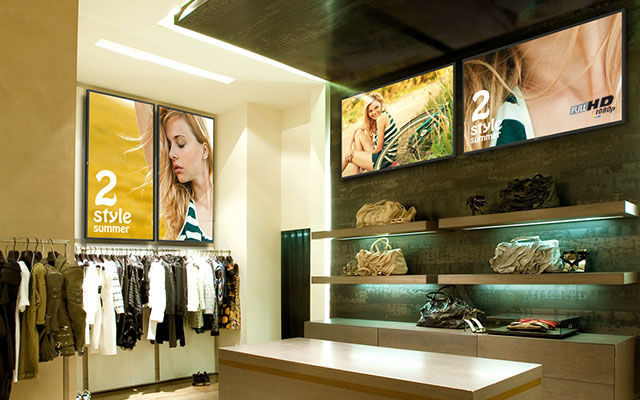
Schaufensterdisplays: Ein hochhelles großes LCD-Display, das direkt hinter dem Schaufenster platziert wird, wirkt wie ein digitaler Magnet und zieht Laufkundschaft von der Straße an.
Endkappen- und Feature-Wände: Im Geschäft zeigen große 4K-LCDs hochauflösende Lifestyle-Videos (z. B. eine Modemarke, die eine Laufstegschleife zeigt), bei denen Farbgenauigkeit und Kontrast von größter Bedeutung sind.
Die technische Realität
Bekämpfung von Schaufensterreflexionen: Ein Display in einem Schaufenster ist doppelten Reflexionen ausgesetzt – Blendung durch das Schaufenster selbst und Blendung durch den LCD-Bildschirm. Eine hohe Helligkeit (3.000 Nits) ist erforderlich, um die Reflexionen zu “durchbrechen”.
Sichtbarkeit mit polarisierten Sonnenbrillen: Standard-LCD-Panels emittieren polarisiertes Licht. Wenn ein Fußgänger mit polarisierter Sonnenbrille an einem Schaufenster vorbeigeht, kann der Bildschirm für ihn vollständig schwarz erscheinen. Premium-Einzelhandelsdisplays verwenden eine spezielle Viertelwellenplattenfolie (QWP), um das Licht zirkular zu polarisieren und sicherzustellen, dass der Bildschirm unabhängig von der Brille des Betrachters sichtbar ist.
4. Unternehmenscampus & Hochschulbildung
Die moderne Unternehmenslobby oder die studentische Hochschulvereinigung ist darauf ausgelegt, Besucher zu beeindrucken, Talente anzuziehen und komplexe Informationen schnell zu kommunizieren.
Anwendungen: Lobby-Videowände und Versammlungsräume
Architektonische Videowände: Das Zusammenfügen mehrerer ultra-schmaler LCD-Panels (z. B. 0,88 mm oder 1,8 mm von Rahmen zu Rahmen) ergibt eine riesige, nahtlose digitale Leinwand. Diese werden verwendet, um Unternehmensmarken, Echtzeit-Daten-Dashboards oder digitale Kunst anzuzeigen.
Auditorium-/Versammlungsraum-Displays: Ein 98-Zoll-großes LCD-Display ersetzt oft den traditionellen Projektor in mittelgroßen bis großen Konferenzräumen. Im Gegensatz zu Projektoren werden LCDs nicht durch Umgebungslicht ausgewaschen, sodass Besprechungen bei geöffneten Jalousien stattfinden können.
Die technische Realität
Farbkalibrierung: Beim Zusammenfügen mehrerer LCDs zu einer Videowand wirkt selbst ein Unterschied von 2-3% in der Farbtemperatur zwischen den Panels für das menschliche Auge schrecklich. Eine werkseitige und Vor-Ort-Hardware-Farbkalibrierung ist zwingend erforderlich.
EU-Ökodesign & Energy Star: Im europäischen Markt müssen große Unternehmensbereitstellungen strikt der aktualisierten Ökodesign-Richtlinie für elektronische Displays entsprechen, die strenge Grenzwerte für den Stromverbrauch vorschreibt. Displays müssen über Umgebungslichtsensoren verfügen, um die Hintergrundbeleuchtung am Abend automatisch zu dimmen und konform zu bleiben.
Strategische Beschaffung: Große LCD-Displays für Innen- und Außenbereiche
Um den Beschaffungsprozess zu vereinfachen, verwenden AV-Berater die folgende Basismatrix, wenn sie ein großes LCD-Display für einen öffentlichen Raum spezifizieren:
Spezifikation
Öffentlicher Innenraum (z. B. Einkaufszentrum, Flughafen)
Öffentlicher Außenraum (z. B. Bushaltestelle, Platz)
Helligkeit
500 – 700 Nits
2.500 – 4.000 Nits (plus QWP-Folie)
Betriebsstunden
16/7 oder 24/7 je nach Nutzung
Streng 24/7/365
Schutzart (IP)
IP4X oder IP5X (staubgeschützt)
IP56 oder IP65 (wasser- und feinstaubgeschützt)
Stoßfestigkeit (IK)
IK07 (gegen versehentliche Stöße)
IK10 (Vandalismus-sicheres Glas)
Thermisches Management
Passive Kühlung
Aktive Klimaanlage oder Luft-Luft-Wärmetauscher
Panel-Technologie
IPS oder VA
Ultra-hoch Tni (110°C) IPS
5. Integration des Backends: Das Gehirn des großen LCD
Die Beschaffung eines 98-Zoll-4K-Bildschirms ist der einfache Teil. Die versteckte Komplexität der Installation eines großen LCD-Displays im öffentlichen Raum liegt vollständig im Backend – der Software und dem Mediaplayer, die ihm sagen, was es tun soll.
Der Aufstieg von SoC (System on a Chip)
Vor zehn Jahren benötigte jeder kommerzielle Monitor einen sperrigen externen Computer zur Inhaltswiedergabe, der per HDMI angeschlossen und dann in einem überhitzten AV-Raum untergebracht wurde. Heute haben führende Hersteller kommerzieller LCD-Displays (z. B. Samsung, LG, Philips) leistungsstarkeSystem-on-a-Chip (SoC)direkt in das Display integriert.
Warum SoC wichtig ist
Reduzierung von Schwachstellen: Man eliminiert das HDMI-Kabel, das externe Netzteil und den externen PC-Lüfter – alles häufige Ausfallpunkte im 24/7-Betrieb.
Kosteneffizienz: Man kauft nicht mehr zwei Hardwarekomponenten (einen Bildschirm und einen PC), was die Stückkosten (BOM) bei einer Installation mit 50 Bildschirmen erheblich senkt.
Fernverwaltung: Integrierte SoCs verfügen meist über robuste Fernverwaltungssoftware (wie Samsung MagicINFO oder LG SuperSign). Ein IT-Manager in London kann ein Display in einer Pariser U-Bahn-Station aus einem Webbrowser heraus fernneu starten, die Firmware aktualisieren, die Innentemperatur überwachen und die Inhalte ändern.
Schlussfolgerung
Die Installation eines große LCD-Display im öffentlichen Raum ist kein Experiment mehr; es ist die grundlegende Erwartung des modernen Verbrauchers, Reisenden und Mitarbeiters. Der Unterschied zwischen einem erfolgreichen, ROI-positiven Digital-Signage-Netzwerk und einem ständigen Wartungsalbtraum hängt vollständig von der Auswahl der richtigen Hardwarespezifikationen für die Umgebung ab.
Wenn eine Organisation einen 85-Zoll-LCD wie ein Industriewerkzeug und nicht wie ein Konsumentenspielzeug behandelt – mit korrekter Helligkeit, Wetterbeständigkeit, Wärmemanagement und robuster SoC-Integration – erschließt sie eine unvergleichliche Plattform für Kommunikation, Werbeeinnahmen und architektonische Aufwertung.
Häufig gestellte Fragen (FAQ)
F1: Können wir nicht einfach den größten Konsumenten-Fernseher aus einem Elektronikmarkt kaufen und in unserer Firmenlobby aufhängen, um Geld zu sparen?
A: Nein. Dies ist der häufigste und kostspieligste Fehler, den Unternehmen machen. Konsumenten-Fernseher sind für den Betrieb von 4 bis 6 Stunden täglich in einem dunklen Wohnzimmer ausgelegt. Wenn man sie 24/7 in einer hellen Lobby betreibt, fällt das Netzteil innerhalb eines Jahres aus, der Bildschirm leidet unter dauerhafter Einbrennung (Burn-in), und der Hersteller erkennt die Garantie sofort an, sobald er erfährt, dass das Gerät im gewerblichen Umfeld genutzt wurde.
F2: Warum sollte ich für ein Einkaufszentrums-Verzeichnis ein großes LCD-Display einem Direct-View-LED (dvLED)-Wall vorziehen?
A: Betrachtungsabstand und Pixeldichte. Ein 85-Zoll-4K-LCD hat einen unglaublich engen Pixelabstand (d.h. man kann drei Fuß entfernt stehen und feinen Text perfekt lesen). Um eine echte 4K-Auflösung auf einer dvLED-Wand zu erreichen, kostet dies Hunderttausende von Dollar und erfordert einen enormen physischen Platzbedarf. Für interaktive Verzeichnisse oder Einzelhandelsumgebungen, in denen der Betrachter nah am Bildschirm ist, bleibt LCD in Bezug auf Klarheit und Kosten deutlich überlegen.
F3: Was ist “Optical Bonding” und warum wird es für Outdoor-Kioske empfohlen?
A: Optical Bonding ist ein Herstellungsverfahren, bei dem ein festes, transparentes Harz zwischen das LCD-Panel und die Schutzabdeckung aus Glas injiziert wird. Es beseitigt den Luftspalt. Dies bewirkt zwei entscheidende Dinge: Erstens reduziert es die interne Spiegelung drastisch, was die Ablesbarkeit des Bildschirms in der Sonne erheblich verbessert. Zweitens verhindert es, dass sich an kalten Morgen Kondenswasser (Beschlag) im Inneren des Glases bildet, was für Elektronik tödlich ist und das Seherlebnis ruiniert.
F4: Wir benötigen ein Outdoor-Display in Phoenix, Arizona, wo die Sommertemperaturen 115°F (46°C) erreichen. Wird ein LCD überleben?
A: Ja, aber nur, wenn Sie ein LCD mit einem Hoch-Tni (isotrope Temperatur) Panel und einem aktiv gekühlten IP65-Gehäuse spezifizieren. Standard-Flüssigkristalle kochen intern und werden bei etwa 85°C (185°F) schwarz. Hoch-Tni-Panels halten interne Temperaturen von bis zu 110°C (230°F) stand, bevor sie ausfallen. Kombiniert mit einer internen Klimaanlage oder Hochgeschwindigkeitslüftern sind diese Displays speziell für den Einsatz in Sommern im Nahen Osten und im Südwesten der USA konstruiert.
↗
Planen Sie ein Display-Projekt?
Teilen Sie Ihre Display-Größe, Auflösung, Schnittstelle, Helligkeit, Touch-Anforderung, Controllerplatinen-Anforderung und Anwendungsumgebung mit.