Facing a bottleneck in your Embedded Display Project?
Don’t let complex integration or supply chain issues slow your time-to-market. Book a free consultation with the RJY expert team for tailored design and manufacturing support.

In the ever-changing landscape of urban architecture, commercial property and transport infrastructure across North America and Europe, static signage has effectively become obsolete. Modern public spaces require dynamism, interactivity and unlimited adaptability. At the heart of this digital transformation lies a piece of hardware that has evolved from a simple consumer television into a robust, high-brightness public infrastructure asset: the large-format LCD display.
While Direct-View LED (dvLED) gets much of the media attention for massive stadium screens, the large-format LCD (typically ranging from 55 inches to 98 inches and above) remains the undisputed champion for environments where the audience is up close, where ultra-high definition (4K and 8K) is required, and where touch interactivity is paramount.
This comprehensive guide explores the strategic applications of deploying a big lcd display in public spaces. We will bypass the marketing fluff and dive straight into the operational realities, engineering challenges, and return on investment (ROI) metrics that AV integrators and procurement managers must understand.

Airports, train stations, and subway terminals are arguably the most punishing environments for digital signage. A display in these locations is not merely decorative; it is a vital operational tool.
Deploying a big lcd display in a major transit hub like London Heathrow or Chicago O’Hare requires rigorous hardware specifications:
The European and US outdoor advertising markets have shifted heavily toward programmatic DOOH. This means the billboard on the street corner is no longer selling a single ad for a month; it is cycling through targeted, time-of-day specific advertisements.
Outdoor deployment is a brutal battle against the elements.
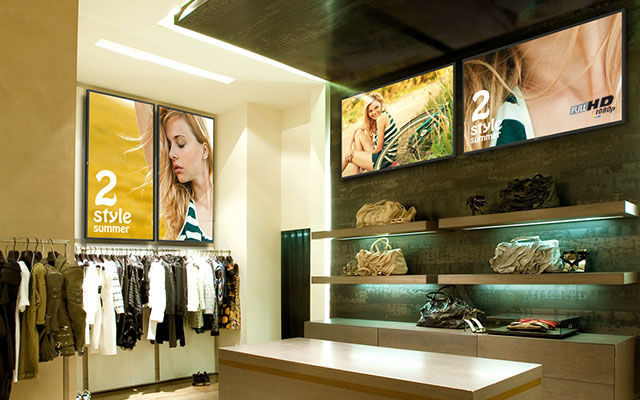
Brick-and-mortar retail in the post-e-commerce era must offer an experiential advantage. Retailers use large-format displays to bridge the gap between their digital brand and physical storefront.
The modern corporate lobby or university student union is designed to impress visitors, attract talent, and communicate complex information rapidly.
To simplify the procurement process, AV consultants use the following baseline matrix when specifying a big lcd display for a public space:
| Specification | Indoor Public Space (e.g., Mall, Airport) | Outdoor Public Space (e.g., Bus Shelter, Plaza) |
| Brightness | 500 – 700 Nits | 2,500 – 4,000 Nits (plus QWP film) |
| Operation Hours | 16/7 or 24/7 depending on usage | Strictly 24/7/365 |
| Ingress Protection (IP) | IP4X or IP5X (Dust resistant) | IP56 or IP65 (Water and fine dust proof) |
| Impact Protection (IK) | IK07 (Accidental bumps) | IK10 (Anti-vandal glass) |
| Thermal Management | Passive cooling | Active AC or Air-to-Air Heat Exchangers |
| Panel Technology | IPS or VA | Ultra-high Tni (110°C) IPS |
Procuring a 98-inch 4K screen is the easy part. The hidden complexity of deploying a big lcd display in a public space lies entirely in the backend—the software and media player that tell it what to do.
十年前,所有商用显示器都需要一台笨重的外置电脑来驱动内容,通过HDMI接口连接,然后被塞进过热的音视频机房里。如今,领先的商用液晶显示器制造商(例如三星、LG、飞利浦)已将功能强大的系统级芯片(SoC)直接集成到显示器内部。
The deployment of a big lcd display in a public space is no longer an experiment; it is the baseline expectation of the modern consumer, traveler, and employee. The difference between a successful, ROI-positive digital signage network and a constant maintenance nightmare comes down entirely to selecting the right hardware specifications for the environment.
When an organization treats an 85-inch LCD like an industrial tool rather than a consumer toy—specifying correct brightness, weatherproofing, thermal management, and robust SoC integration—they unlock an unparalleled platform for communication, advertising revenue, and architectural enhancement.
A: No. This is the single most common and expensive mistake businesses make. Consumer TVs are designed to run for 4 to 6 hours a day in a dark living room. If you run them 24/7 in a bright lobby, the power supply will fail within a year, the screen will suffer from permanent image retention (burn-in), and the manufacturer will instantly void the warranty the moment they realize it was used in a commercial setting.
A: Viewing distance and resolution density. An 85-inch 4K LCD has incredibly tight pixel pitch (meaning you can stand three feet away and read fine text perfectly). To achieve true 4K resolution on a dvLED wall, it would cost hundreds of thousands of dollars and require a massive physical footprint. For interactive directories or retail environments where the viewer is up close, LCD remains vastly superior in clarity and cost.
A: Optical bonding is a manufacturing process that injects a solid, transparent resin between the LCD panel and the protective cover glass. It eliminates the air gap. This does two critical things: First, it drastically reduces internal glare, making the screen much easier to read in the sun. Second, it prevents condensation (fog) from forming inside the glass on cold mornings, which is lethal to electronics and ruins the viewing experience.
A: Yes, but only if you specify an LCD with a High Tni (Isotropic Temperature) panel and an actively cooled IP65 enclosure. Standard liquid crystals boil and turn black around 85°C (185°F) internally. High Tni panels can withstand internal temperatures up to 110°C (230°F) before failing. Combined with an internal HVAC unit or high-velocity fans, these displays are specifically engineered to survive Middle Eastern and Southwestern US summers.
Share your display size, resolution, interface, brightness, touch requirement, controller board requirement, and application environment.
Continue reading related display technology guides and application references.
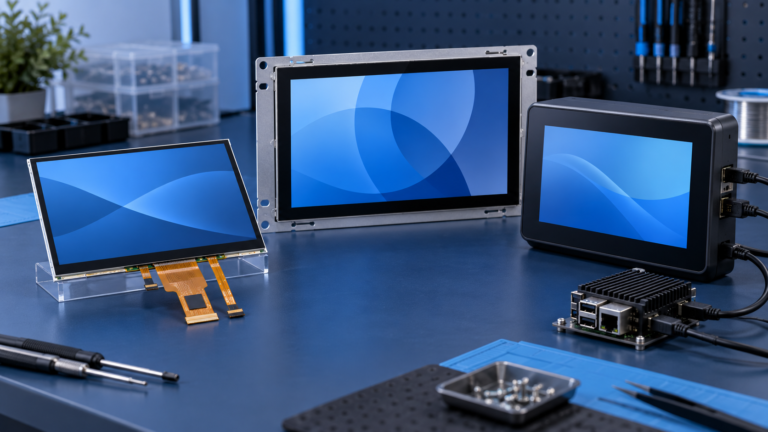
Explore product pages related to this article topic.
Talk to RJY’s engineering team for display matching, controller board review, and customization discussion.