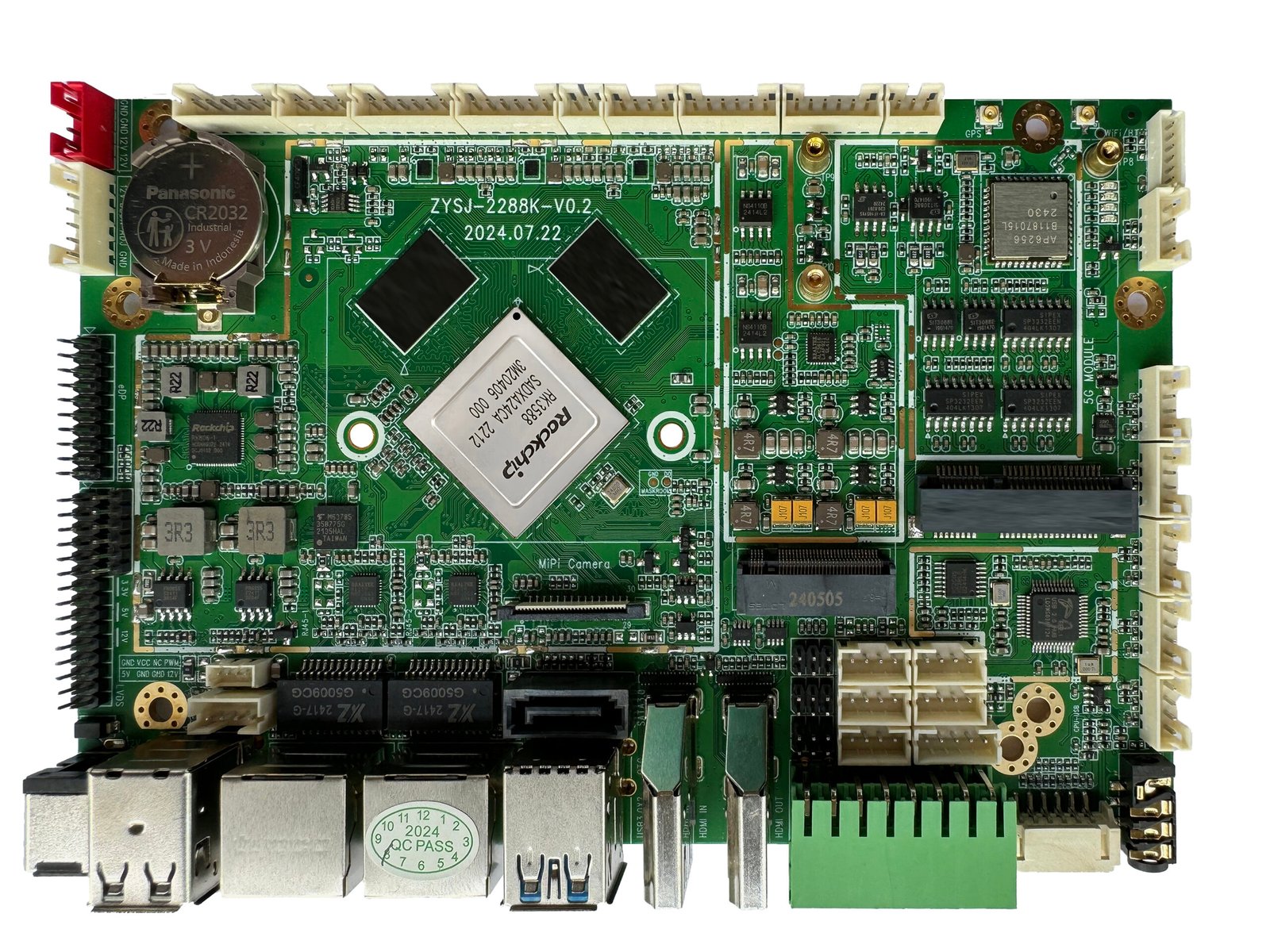
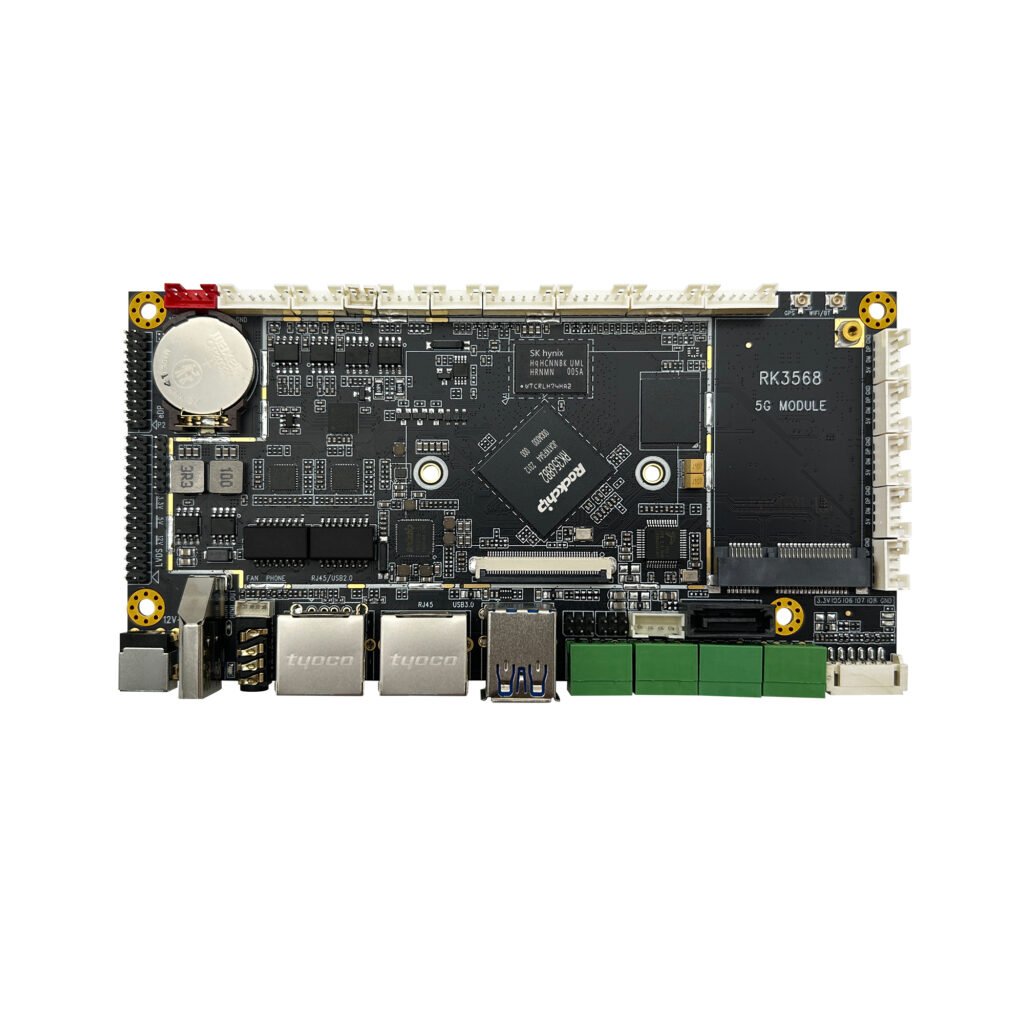
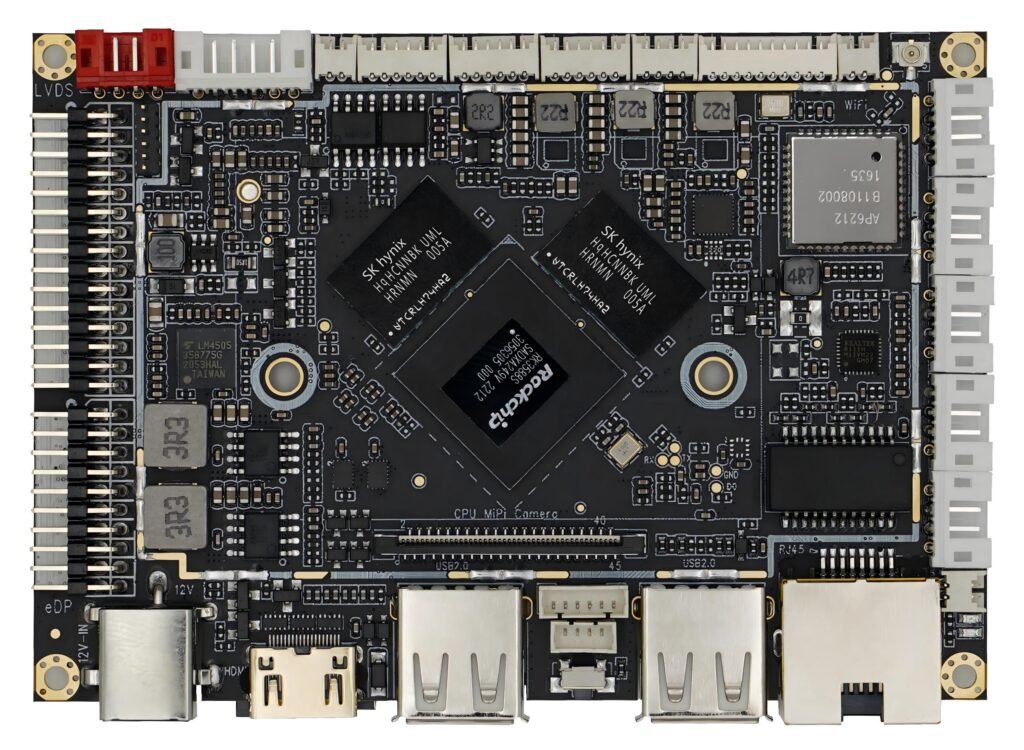
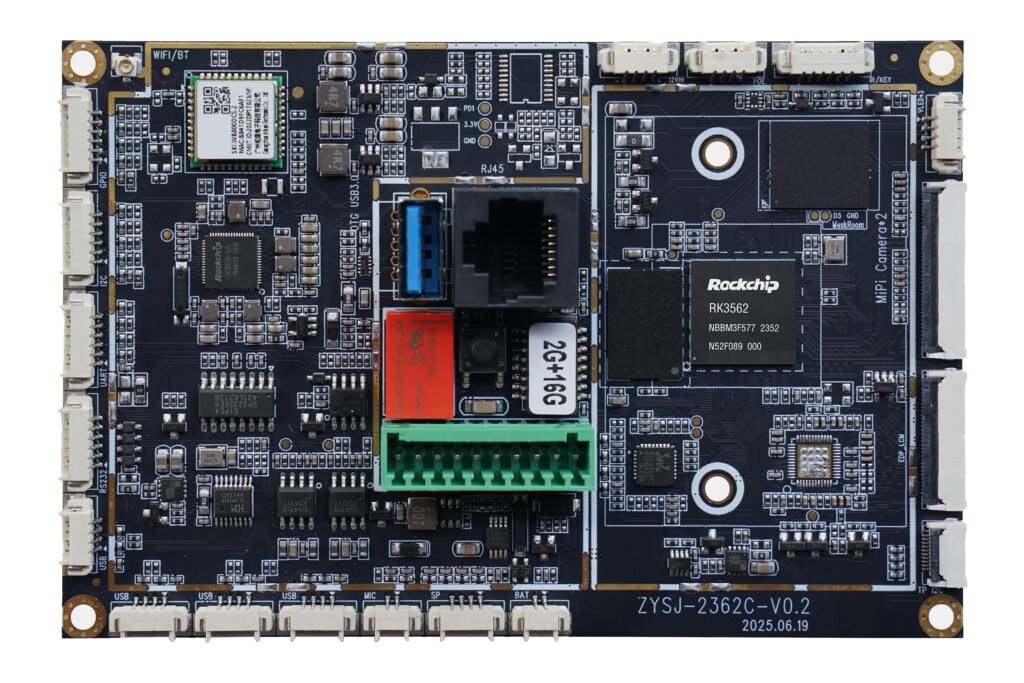
Placa de control industrial Octa-core Rockchip RK3588 – Chipset AI de 6.0 TOPS, WiFi, Bluetooth, USB 3.0

  • High Performance: RK3588 octa-core CPU (Cortex-A76 + A55) up to 2.4 GHz, Mali-G610 GPU, integrated NPU (6.0 TOPS)
  • AI Support: Compatible with TensorFlow, Caffe, MxNet, PyTorch; supports Android NN API and RKNN API
  • Stable & Reliable: Optimized hardware and software for 24/7 unattended operation
  • Highly Integrated: Dual Gigabit Ethernet, dual-band Wi-Fi, Bluetooth 5.0, HDMI I/O, LVDS/eDP/MIPI, audio, sensors, GPS, IR
  • Expandable: Multiple USB ports, RS232/RS485, UART, CAN, I2C, I/O, AD interface for peripherals

Descripción General del Producto

La RJY-2288K is a high-performance motherboard powered by Rockchip’s next-generation flagship RK3588 AIoT processor. It supports a wide range of operating systems including Android, Debian, Ubuntu, Tongxin, Kirin, and HarmonyOS. The RK3588 is built on 8nm LP process technology and features an octa-core 64-bit CPU Ideal Cortex-A76 + A55 architecture, reaching up to 2.4 GHz, delivering exceptional general-purpose computing performance.

The GPU is a high-end quad-core Mali-G610, and the CPU integrates an AI Neural Processing Unit (NPU) supporting IN4 / IN8 / INT16 mixed-precision computation, achieving 6.0 TOPS. The platform is compatible with various AI development tools and interfaces, supporting model conversion for TensorFlow, Caffe, MxNet, PyTorch, and providing APIs including Android NN API, RKNN cross-platform API, and TensorFlow interface.

This motherboard supports multi-screen independent display6/8-bit LVDS 1080P outputeDP and MIPI display interfacesHDMI 8K output, y HDMI 4K input. It features dual Gigabit Ethernet, 2.4/5G dual-band Wi-Fi, Bluetooth 5.0, as well as M.2/SATA/USB3.0, 4G/5G module interfaces, gravity sensors, GPS, CAN, RS232/RS485, I/O expansion, I2C expansion, MIPI camera inputs, and infrared remote control, offering a rich set of connectivity options.

Equipped with this powerful octa-core AI processor, the ZYSJ-2288K is ideal for a wide range of applications including smart fire safety, smart construction, industrial quality inspection, autonomous vehicles, smart agriculture, intelligent sorting machines, AI robotics, cloud servers, smart NVRs, metaverse systems, ARM PCs, security, medical, transportation, finance, industrial control, education, and retail. Its combination of hardware platformization integrada y el software intelligence enables a seamless human-machine interaction and networked device experience on a single intelligent terminal motherboard.


Especificaciones Técnicas

CategoríaEspecificación
Sistema OperativoAndroid 12.0 / Debian / Ubuntu 20.04 / UOS / Kylin / HarmonyOS etc.
Processor (CPU)Rockchip RK3588 (8nm LPP), ARM 64-bit octa-core CPU, 4×Cortex-A76 + 4×Cortex-A55, up to 2.4 GHz
GPUMali-G610 MP4 quad-core, supports OpenGLES3.2, OpenVG1.1, OpenCL2.2, 450 GFLOPS
NPU (AI)Built-in Neural Processing Unit, supports IN4/IN8/INT16/FP16, 6.0 TOPS, compatible with Caffe/MxNet/TensorFlow/TF Lite/ONNX/Darknet, AI development tools included
Memory (RAM)LPDDR4 4GB (options: 8GB/16GB/32GB)
AlmacenamientoeMMC 32GB (options: 64GB/128GB/256GB), SATA HDD expansion
ExpansiónPCIe M.2 4 lanes, supports M.2 2242/2260 size modules
NetworkingDual Gigabit Ethernet, 2.4G/5G dual-band Wi-Fi (Wi-Fi6 optional), Bluetooth 5.0, 4G LTE (optional), 5G NR (optional)
GPSBuilt-in GPS/BD module, sensitivity -162dBm, frequency 1575.42MHz, 20 channels, accuracy <10 m (optional)
Display Interfaces1×eDP 1.3 (4 lanes, 3.3V/5V), 1×LVDS (single/dual, 6/8-bit, 1080P60Hz, 3.3V/5V/12V), 1×HDMI 2.1 output 8K60Hz, 1×HDMI 2.0 input 4K60Hz, 1×MIPI output 5.7Gbps, multi-display support
Backlight & AudioOnboard 12V backlight, 1×audio output (2×18W 4R), 1×headphone out, 2×microphone inputs
Cámara1×MIPI camera input (up to 48MP, optional), USB camera support (optional)
USB Ports6×USB 2.0 HOST, 1×USB 2.0 CPU, 1×USB 3.0 CPU, 1×USB 3.0 OTG
PCIe / SIM1×Mini PCIe for 4G/5G LTE module, 1×SIM card slot, supports eSIM
IR1×infrared receiver, supports remote control
LED & Buttons1×power LED (red), 1×system LED (blue blinking), reset/power/upgrade buttons
Serial & I/O Expansion4×RS232, 3×RS485, 2×UART (TTL), 1×CAN, 1×I2C, 1×AD, 8×I/O expansion, 4×5/12V high-current ports
Fan / Light InterfacesSupports 5V/12V fan and light control
Fuente de AlimentaciónInput AC 100–240V 50–60Hz, output DC 12V/2A, supports auto power-on or key press startup
Entorno OperativoOperating Temp: -1070 °C, Storage Temp: -2070 °C, Storage Humidity: 10%-80%
Dimensiones160×105×20 mm
MultimediaSupports 8K 60fps H.265/H.264 decoding, 8K 30fps H.265/H.264 encoding, same-codec simultaneous decoding/encoding, up to 32×1080P30fps decoding and 16×1080P60fps encoding
System FeaturesMulti-language support, standard Android keyboard, optional third-party input methods, native Android with root access, customizable for product development
System ManagementReal-time remote monitoring, auto system recovery, 7×24h unattended operation, OTA remote upgrade, Wi-Fi Display, software watchdog (hardware optional)
Screen RotationSupports 0°/90°/180°/270° manual rotation and gravity sensor auto-rotation (optional)

Preguntas frecuentes

¿Es RJY un Fabricante de Equipos Originales (OEM)?

. RJY es un proveedor y fabricante directo con capacidades de integración vertical, ofreciendo innovación de hardware de ciclo completo desde el diseño y el ensamblaje de PCBA hasta la integración final del sistema.

¿Qué tipos de personalización acepta RJY?

Podemos proporcionar personalización en las siguientes cuatro áreas distintas: Sistemas e HMI, Módulos de Pantalla, Servicios de Software, Diseño Industrial.

¿Cuál es el estado de stock de este producto?

La mayoría de los productos en exhibición tienen al menos una unidad en stock para pruebas o muestreo rápido. Para solicitudes de muestras superiores a 20 unidades, consúltenos con antelación para confirmar el estado de stock actual.

¿Cómo se estructuran las tarifas para proyectos personalizados?

Nuestras tarifas para proyectos personalizados generalmente constan de dos componentes principales:
Tarifas NRE (Ingeniería No Recurrente) y precio por unidad..
En muchos casos, si su pedido alcanza un volumen determinado, ofrecemos compensar o acreditar una parte de las tarifas NRE.

¿Cuánto tiempo suele llevar un proyecto de personalización típico?

El plazo depende de la profundidad de la personalización:
Ajustes de Software/Firmware: 1-2 semanas
Modificaciones Menores de Hardware: 4-6 semanas
Proyectos de I+D de Ciclo Completo: 12-16 semanas

HABLE CON NUESTROS EXPERTOS

Cuéntenos sobre su proyecto o los desafíos que enfrenta. Nuestro equipo se pondrá en contacto con usted para analizar cómo podemos ayudarle a encontrar una solución.