Tandem OLED technology changes the light-emitting structure inside an OLED display. It connects multiple electroluminescent units in series so that more than one unit contributes light as current passes through the device. The same series current passes through the units; it does not split between them. Their combined light output can reduce the required current density at matched luminance, subject to the device design. It also adds electrical and manufacturing decisions that a finished-product specification alone may not reveal.
For OEM technology planners, the central question is how that architecture translates into a useful product. Lower current density can create room to improve brightness or aging behavior. Yet the voltage, materials, optical structure, drive conditions, and complete module still determine the outcome. This analysis follows those dependencies from the emissive device to published commercialization milestones available as of October 20, 2026.
Tandem connects emissive units within the OLED device
An electroluminescent unit contains the functional structure that produces light when injected charge carriers recombine. A tandem device places multiple such units in a series-connected stack. Charge-generation layers, often abbreviated CGLs, connect adjacent units and supply carriers to them. Primary research describes this series architecture and the role of the connecting materials.[1]
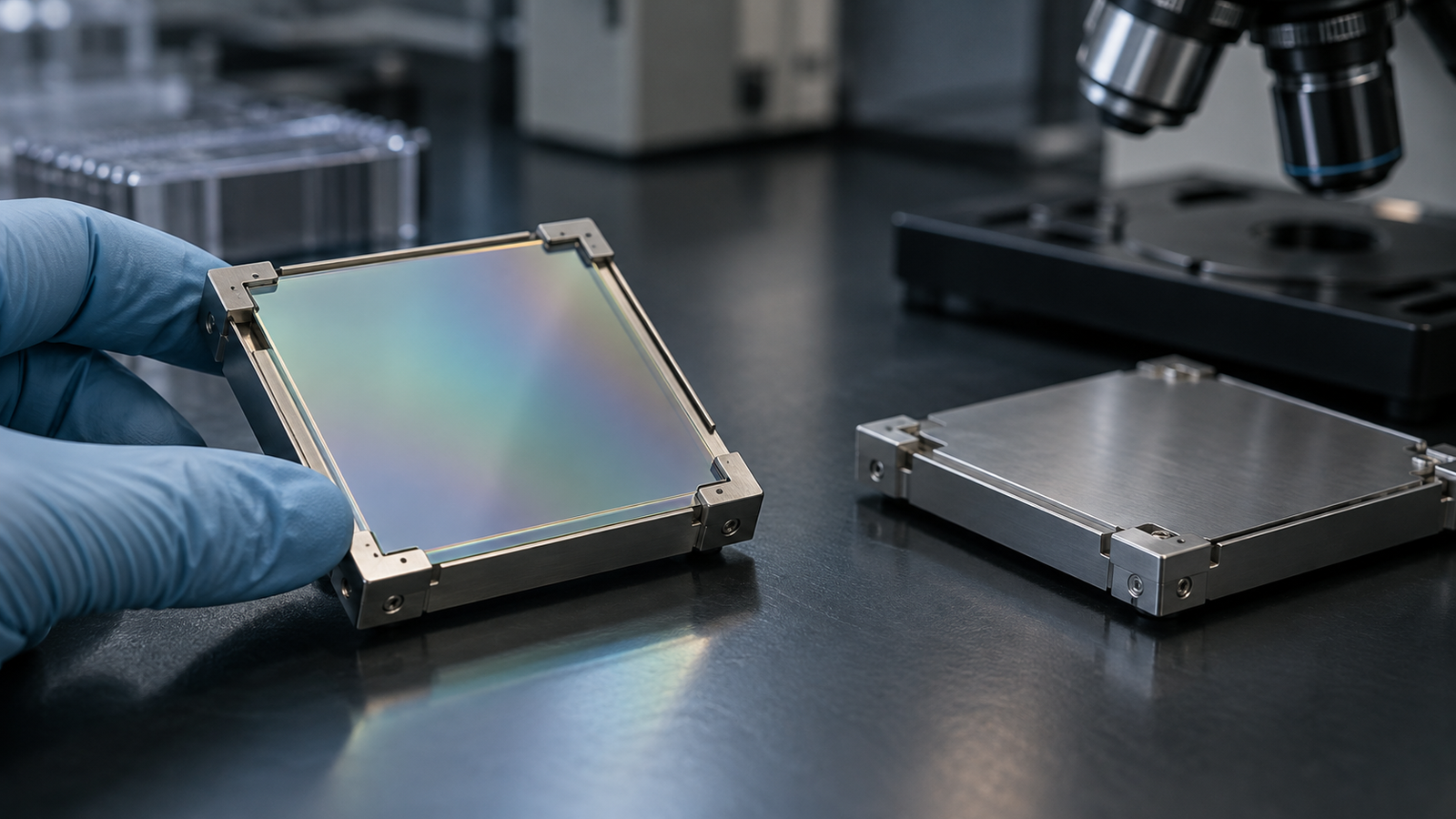
The unit is not a finished display. A complete panel also needs a structure to address its pixels, optical elements, protection from the environment, and electrical connections. Adding an emissive unit inside the device does not mean bonding two assembled monitors or complete display modules together.
This distinction prevents a misleading mental picture. Tandem is a device architecture with closely integrated layers. It does not describe two independent image sources with separate housings, controllers, and cover glass.
For product analysis, ask which part of the structure a claim refers to. An emissive-stack improvement can be real without proving a matching improvement in every property of the finished module. The connection between those levels needs product-specific evidence.
Lower current density does not automatically mean lower power
Current efficiency and power efficiency answer different questions. The first relates light output to current. The second accounts for electrical power. A primary tandem white-OLED study reports these measures and voltage separately, illustrating why they should not be treated as interchangeable.[2]
In a series stack, several emissive units can contribute light at a lower current density for a matched luminance. The stack can also require a higher voltage. The basic relation P = V × I explains why a current reduction alone cannot establish the power saving. It is an analytical relation, not a performance result for a particular display.
Consider a proposed panel that reaches the required luminance with less current. The useful next question is how much electrical power it consumes at that operating point. A lower current and higher voltage may produce a different result from what the current figure suggests. The answer requires the actual device behavior rather than an assumed multiplier.
Whole-device battery life adds another level. The display is one load among others, and its operating state can change with content and use. A panel-level efficiency result therefore cannot establish an identical improvement in equipment runtime.
Tandem expands the design choices available to the panel developer. It does not remove the need to compare complete operating points.
Brightness and aging compete for the available design margin
A developer can use the architectural benefit in different ways. One design objective may be lower current density through each emissive unit at the required luminance. Another may be greater light output under a different operating condition. Those are different product decisions.
Read headline gains with their test conditions. Do not assume that each benefit reaches its maximum at the same operating point. A brightness claim made at one setting cannot be combined freely with a lifetime claim measured at another setting. Doing so creates a product promise that neither measurement established.
Aging also needs a defined endpoint. A statement about retained luminance differs from one about color change or an application-specific visual requirement. A lifetime figure without its operating conditions and acceptance criterion leaves the OEM unable to judge whether it fits the intended duty cycle.
Tandem should therefore be evaluated as a way to manage electrical and optical demands, not as proof that aging has disappeared. It does not establish a universal burn-in-free result. Nor does a product example in one category establish qualification for another.
Keep emissive architecture separate from the rest of the panel
Several design choices can appear together in a commercial announcement. Separating them makes it easier to understand which change supports which claim.
| Design level | What it describes | What the label alone does not establish |
|---|---|---|
| Emissive stack | How the light-emitting units and their connecting layers are arranged | The complete panel power, lifetime, or production cost |
| Backplane | The circuitry that addresses and drives the pixels | The number of emissive units in the OLED stack |
| Subpixel and optical structure | How the display forms and presents the required colors | A universal arrangement shared by every tandem product |
| Encapsulation and module construction | How the panel is protected and integrated into an assembly | The suitability of that assembly for every installation environment |
LG Display describes its Tandem OLED technology using two RGB stacks within a panel, with IT and automotive applications among its stated uses.[3] The description identifies that technology approach; it should not become a universal definition of every supplier’s stack.
LG separately describes Tandem WOLED using stacked RGB light sources that produce white light for television and monitor applications.[4] RGB tandem and tandem WOLED therefore require careful terminology. A shared reference to stacked emission does not establish an identical color architecture or subpixel design.
Likewise, a backplane label such as oxide or LTPO answers a different architectural question from tandem. Keeping those terms distinct avoids attributing every characteristic of a new panel to one feature.
Industrialization requires more than adding another emitting unit
A useful device concept must work across a panel and remain consistent through manufacturing. For tandem structures, the connecting layers deserve particular attention because they sit between functional units and affect how the stack operates.

The 2017 laboratory study cited above examined trade-offs involving voltage loss and lateral conduction in connecting materials. Its observations concern the tested research devices, not a demonstrated defect or yield problem in commercial panels.[1]
The study illustrates a coupled design decision. It does not reveal how a commercial supplier resolves that decision in production.
At the manufacturing level, relevant questions include material compatibility, interface control, uniformity, defect detection, and repeatability. These are proposed areas of technical evaluation, not claims that a particular production line has failed in any of them.
More layers also do not establish a known cost multiplier. The commercial result depends on the process, materials, equipment, throughput, and acceptable output. Without those data, neither doubled cost nor a quantified yield loss is a defensible conclusion.
Industrialization evidence should consequently identify the product and stage reached. A functioning research device, a trade-show demonstration, and mass production each show progress, but they answer different questions.
Published milestones show adoption in specific product categories
LG Display announced mass production of a 13-inch tandem OLED laptop panel on June 24, 2024.[5] That is a historical commercialization milestone for a defined format. It does not establish that an equivalent module is available for every OEM project.

Apple’s May 7, 2024 iPad Pro announcement provides another commercial adoption example.[6] Its significance here is that tandem OLED reached a named finished product. The announcement is not a basis for reverse-engineering its detailed layer structure or transferring its product claims to other displays.
Later generation announcements need their own status labels. In May 2026, LG Display introduced third-generation tandem OLED and described a plan for production within 2026, initially for an automotive panel, with IT applications to follow.[7] This article has not verified completion of that plan as of October 20, 2026.
These milestones support a measured conclusion: tandem has demonstrated commercialization in selected products, while particular roadmaps still require confirmation. An automotive-focused announcement also does not certify generic tandem displays for automotive use.
Evaluate claims at matched operating conditions
For an OEM, the most useful comparison connects the claimed improvement to the intended operating point. The following table proposes how to interpret evidence; it is not a list of measured results.
| Claim under review | Evidence that makes it meaningful | Unsupported shortcut to avoid |
|---|---|---|
| Lower power | Electrical power measured at matched luminance, content, refresh behavior, and stated conditions | Concluding power falls by the same proportion as current |
| Longer useful life | Defined aging conditions, endpoint, duration, and relevant product data | Applying one comparison to all brightness settings and duty cycles |
| Higher brightness | The measurement mode, duration, display area, thermal conditions, and system power | Assuming the highest advertised brightness is a continuous operating point |
| Production readiness | A named product and evidence of its actual production or delivery stage | Treating a planned generation as a completed rollout |
Matched conditions do not mean that every application must use one test pattern. They mean that the comparison must preserve the conditions that determine the result. If a supplier changes several variables, the report should identify them so that the OEM can judge what caused the difference.
Interpret tandem as a complete display-platform decision
For teams starting from a TFT LCD or HMI product, tandem analysis belongs at the display-platform level. The overview of LCD and OLED display technologies provides broader context; this article focuses on the tandem architecture. The emissive architecture does not by itself establish mechanical fit, host compatibility, power requirements, thermal behavior, or support terms. Those properties belong to the selected assembly and its documentation.
Tandem OLED offers an architectural route to managing brightness and device stress, with real commercialization evidence. Its value in an equipment program still depends on the electrical operating point, manufacturing maturity, and complete module behavior.
For an existing TFT LCD baseline, Pantalla RJY can discuss project-specific LCD and controller fit. Any alternative display platform requires its own verified product documentation. That distinction keeps the system review useful without implying that a technology announcement is an available replacement assembly.
Preguntas frecuentes
Is tandem OLED two complete screens joined together?
No. Tandem describes multiple emissive units connected within an OLED device. It does not mean two assembled display modules with independent controllers and housings.
Does lower OLED current mean the display uses proportionally less power?
No. Electrical power depends on voltage and current. Compare actual power at matched luminance and operating conditions, then distinguish panel power from whole-device runtime.
Does a tandem OLED announcement establish suitability for an industrial product?
No. A technology milestone does not establish the behavior or qualification of a specific assembly. Evaluate the selected product documentation, operating conditions, and integration requirements for the intended equipment.
Referencias
- Stacking multiple connecting functional materials in tandem organic light-emitting diodes. Scientific Reports, 2017.
- The First Tandem, All-exciplex-based WOLED. Scientific Reports, 2014.
- Tandem OLED. LG Display, Accessed October 20, 2026.
- Tandem WOLED. LG Display, Accessed October 20, 2026.
- LG Display Starts Mass Production of Industry’s First Tandem OLED for Laptops. LG Display, June 24, 2024.
- Apple unveils stunning new iPad Pro with M4 chip and Apple Pencil Pro. Apple, May 7, 2024.
- LG Display presents future of displays with next-generation OLED technologies at SID Display Week 2026. LG Display, May 5, 2026.