








Chapter 1: Preface and 2026 Market Overview
1.1 The Definition of an Era: The Dominance of Capacitive Touch
As we navigate through 2026, the human-machine interface (HMI) has definitively standardized. The era of resistive touchscreens dominating industrial and commercial applications is largely behind us. Today, the touch panel capacitive technology represents the undisputed core of interactive displays. From complex medical ventilators to automated retail kiosks and robust factory machinery, the expectation for multi-touch, smartphone-like responsiveness is universal.
1.2 Market Sizing and Growth Dynamics
The global reliance on interactive interfaces has driven the capacitive touchscreen market to unprecedented heights. Industry analysts project the global market valuation to confidently breach the $15.5 billion mark by the end of 2026. This aggressive Compound Annual Growth Rate (CAGR) is fueled not just by consumer electronics, but heavily by the B2B sector—specifically the massive deployment of the integrated tft lcd module with touch screen in IoT devices, smart city infrastructure, and the booming electric vehicle (EV) sector.

1.3 The 2026 Procurement Environment: Iteration and Reorganization
Why is 2026 a critical pivot year for procurement professionals? We are witnessing a massive intersection of technological iteration and supply chain reorganization. The commercialization of foldable glass, ultra-large curved automotive displays, and the demand for edge-to-edge zero-bezel designs have fundamentally changed how a capacitive touch display is manufactured. Simultaneously, global geopolitical shifts are forcing OEMs to rethink their reliance on single-source suppliers, making 2026 the year of supply chain diversification, risk mitigation, and strategic technological partnerships.
Chapter 2: Core Technology Analysis and Selection Benchmarks
Procuring a display in 2026 requires looking far beyond the diagonal size and resolution. Understanding the underlying physics of a capacitive screen touch system is vital for matching the hardware to the application.
2.1 The Mainstream Architectures of the Capacitive Touch Display
- Mutual Capacitance vs. Self-Capacitance: The industry utilizes two primary architectures. Self-capacitance measures the current on each individual electrode to ground, making it excellent for single-touch precision and water rejection, but it suffers from “ghosting” when multiple touches occur. Mutual capacitance, the standard for 2026, measures the capacitance at the intersections of a grid (Rx and Tx lines). This allows for true, limitless multi-touch points, essential for modern gesture controls.
- In-cell and On-cell Proliferation: Historically, a touch panel was a separate glass layer bonded to an LCD (Out-cell). In 2026, In-cell (touch sensors embedded directly within the TFT pixels) and On-cell (sensors deposited on the LCD’s color filter glass) have proliferated deeply into the B2B space. This ultra-thin architecture significantly impacts procurement: it reduces the Bill of Materials (BOM), lightens the final product, and drastically improves optical clarity, though it requires closer collaboration with the raw LCD panel manufacturers.
2.2 Key Performance Indicators (KPIs) for Procurement
When specifying a touchscreen capacitive module, your RFQ (Request for Quote) must define these precise KPIs:
- Touch Sensitivity and Reporting Rate: Consumer tablets may accept a 60Hz or 120Hz reporting rate. However, for industrial CNC machines or medical diagnostic tools, latency can be dangerous. High-end modules now boast reporting rates exceeding 240Hz, ensuring instantaneous feedback.
- Optical Performance: A display is useless if it cannot be read. You must define the Transmittance (typically >85% for standard panels, >90% for optically bonded units) and control reflectance.
- Durability and Surface Treatments: * IK Rating: For public kiosks, specify an IK10 impact resistance rating.
- Treatments: AG (Anti-Glare) is critical for industrial lighting; AR (antiriflesso) is vital for outdoor sunlight readability; AF (Anti-Fingerprint / Oleophobic) is mandatory for medical and retail hygiene.
2.3 The Evolution of the Touch Controller IC
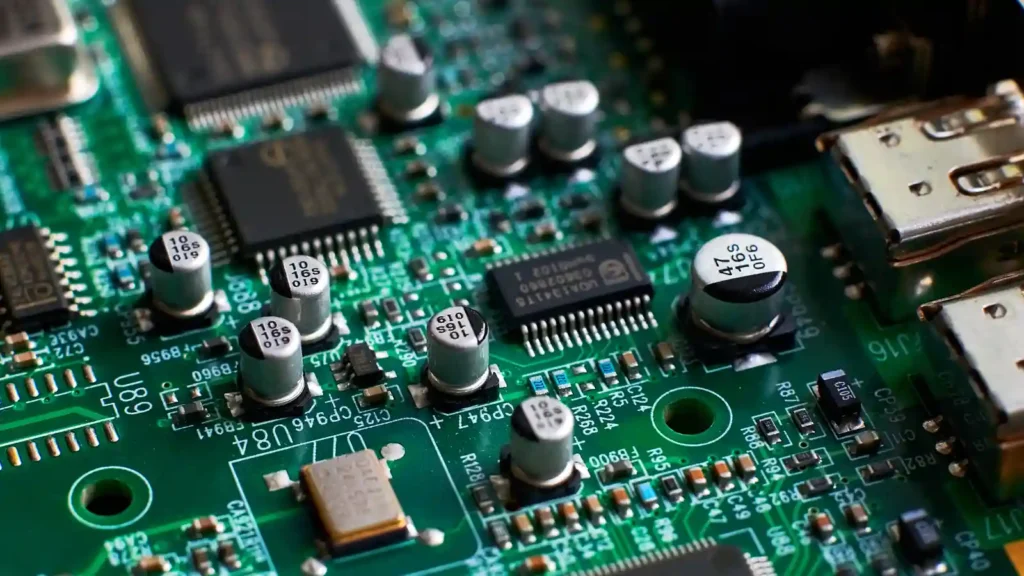
The brains behind the glass dictate the performance. In 2026, 8-bit and 16-bit controllers are obsolete for complex environments. The industry standard has shifted to high-performance 32-bit ARM-based Controller ICs (from brands like EETI, Ilitek, or Goodix). These powerful chips are necessary to run the complex algorithms required for advanced palm rejection, high-speed multi-touch, and noise filtering in electrically noisy industrial environments.
Chapter 3: In-Depth Solutions for the Custom Capacitive Touch Screen
Off-the-shelf solutions rarely fit the bespoke requirements of next-generation hardware. The true value of a display partner in 2026 lies in their ability to engineer a custom capacitive touch screen.
3.1 Industrial-Grade Customization Demands
- Thick Cover Glass Support: Vandal-proof kiosks and heavy industrial machinery often require cover glass exceeding 6mm, or even 10mm. Standard touch sensors cannot penetrate this dielectric thickness. A custom solution involves tuning the Tx driving voltage of the controller IC and designing a custom sensor grid with wider trace pitches to project the capacitive field through the thick armored glass.
- Glove Touch and Water Rejection: In operating rooms or outdoor marine environments, users wear thick gloves (latex or heavy leather) or operate screens covered in saline or rain. Advanced firmware tuning is required. The IC must be calibrated to differentiate between the localized, high-frequency touch of a gloved finger and the broad, low-frequency capacitance generated by a pool of water, actively suppressing the latter to prevent false triggers.
3.2 Irregular Shapes and Special Dimensions
- Bar Screens and Circular Displays: The retail and automotive sectors are rapidly adopting stretched “Bar Screens” for supermarket shelving and circular screens for smart thermostats and vehicle gauges. Laying out the ITO (Indium Tin Oxide) or metal mesh capacitive layer on these irregular shapes without creating “dead zones” at the extreme edges requires highly specialized laser etching and custom FPC (Flexible Printed Circuit) routing.
- Flexible and Foldable Modules: As flexible OLEDs gain market share, the accompanying touch layer must also bend. Procuring touch solutions for foldables requires moving away from brittle ITO glass and towards silver nanowires (AgNW) or ultra-thin metal mesh polymers that can withstand hundreds of thousands of bending cycles without resistance degradation.
3.3 Interface and System Integration
A tft lcd module with touch screen must communicate flawlessly with your motherboard.
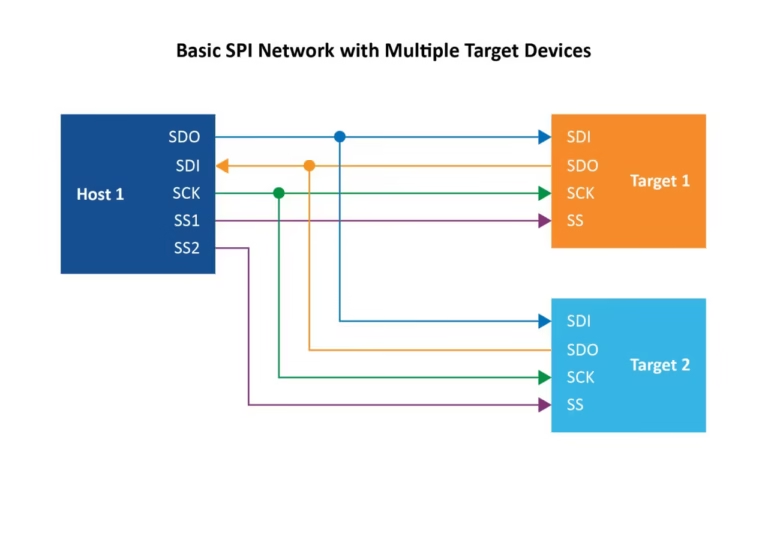
- Interface Selection: I2C is standard for smaller screens (under 10 inches) due to its simple two-wire architecture. However, for larger displays or systems where the screen is located far from the host board, USB or RS232 must be specified to prevent data packet loss and signal degradation.
- Plug & Play Drivers: In 2026, time-to-market is everything. You must ensure your supplier provides HID-compliant (Human Interface Device) touch panels. This guarantees seamless, driverless Plug & Play integration across modern Android, Windows, Linux (including Ubuntu and Yocto), and real-time embedded systems (RTOS).
Chapter 4: 2026 Global Supply Chain Dynamics and Cost Structures
To negotiate effectively, a procurement director must understand the macroeconomic forces driving the BOM (Bill of Materials) of a capacitive screen.
4.1 Core Material Cost Analysis
- ITO vs. Metal Mesh: Indium Tin Oxide (ITO) remains the cost-effective standard for screens under 15 inches. However, ITO’s high sheet resistance makes it unsuitable for larger screens. For 21.5-inch to 86-inch interactive whiteboards, the market has shifted to Metal Mesh (microscopic copper or silver grids). Keep an eye on copper and silver commodity prices, as they directly impact large-format panel costs in 2026.
- Cover Glass Trends: The cost of the cover lens is heavily dictated by the brand and treatment. While Corning Gorilla Glass remains the premium choice for extreme durability, massive improvements in high-aluminosilicate glass from domestic Chinese manufacturers offer 90% of the performance at a fraction of the cost, presenting a massive cost-down opportunity for OEMs.
4.2 The Global Production Landscape
- The Greater Bay Area (Shenzhen/Dongguan): This region remains the undisputed global epicenter for display module manufacturing. The hyper-dense concentration of glass cutters, IC bonders, backlight assemblers, and optical bonding facilities means that prototyping and scaling happen faster here than anywhere else on earth.
- Southeast Asia and South Asia Shifts: Driven by geopolitical tariffs and “China Plus One” strategies, 2026 sees a significant migration of final LCM (Liquid Crystal Module) assembly to Vietnam, India, and Malaysia. While this offers tariff relief, procurement teams must factor in the extended logistics timelines and currently less mature sub-tier component supply chains in these emerging regions.
4.3 Supply Chain Risk Management
- Semiconductor Cycles: The touch controller IC is subject to the vicious boom-and-bust cycles of global silicon foundries. A sudden shortage of 40nm or 28nm wafer capacity can halt your production overnight.
- Buffer Stock Strategies: To survive in 2026, “Just-In-Time” (JIT) manufacturing is too risky. Procurement agreements must now include VMI (Vendor Managed Inventory) clauses or rolling 6-month forecasts, forcing the supplier to hold strategic Buffer Stock of raw glass cells and critical ICs to absorb sudden demand spikes or supply shocks.
Chapter 5: Industry Applications and Differentiation Advice
The specifications for a tft lcd module with touch screen vary wildly depending on the end-use environment.
5.1 Automotive Electronics
The EV revolution has turned cars into computers on wheels. However, the automotive cabin is a brutal environment. Procurement here mandates AEC-Q100 certified components. The touchscreen must survive extreme thermal cycling (-40°C to +85°C or higher), intense continuous UV exposure without yellowing, and severe mechanical vibration.
5.2 Smart Home and Appliances
Consumers now expect their refrigerators and washing machines to look like giant smartphones. The trend in 2026 is edge-to-edge, zero-bezel designs with integrated “dead-front” aesthetics (where the screen is completely invisible until lit). Furthermore, post-pandemic hygiene awareness makes baked-in anti-bacterial nano-coatings on the cover glass a strong selling point.
5.3 Industrial Automation (HMI)
On a factory floor, electrical noise is the enemy. Massive motors and inverters generate Electromagnetic Interference (EMI) that can cause a standard touchscreen to register phantom touches or freeze completely. Procurement red lines here include strict EMC (Electromagnetic Compatibility) and high ESD (Electrostatic Discharge) resistance (often requiring 8kV contact and 15kV air discharge ratings).
5.4 Medical Devices
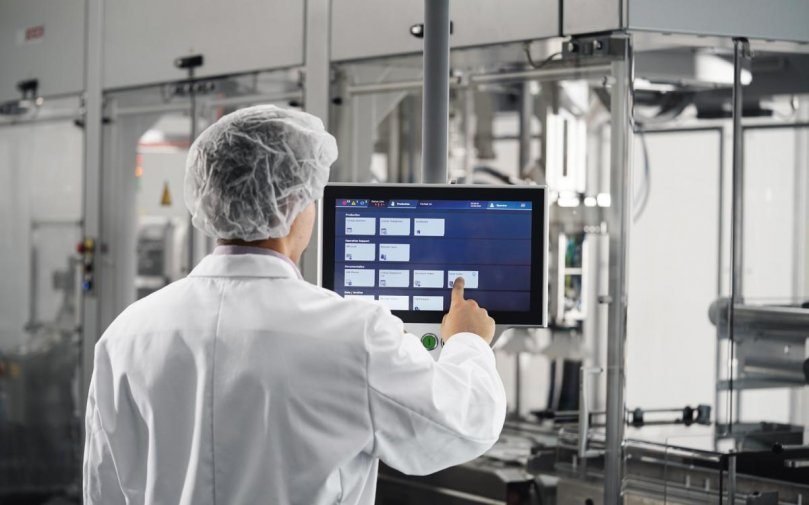
A touchscreen capacitive monitor on an ultrasound machine or patient monitor has two primary rules: it must never fail, and it must be sterile. Specify IP65 or IP67 rated front panels that are completely sealed. The glass must withstand continuous wiping with harsh chemicals, bleach, and 70% isopropyl alcohol without the AF coating degrading. Furthermore, the firmware must be flawlessly tuned to operate when the nurse is wearing multiple layers of surgical latex gloves.
Chapter 6: Practical Procurement Advice and Pitfall Avoidance
Finding a supplier on the internet is easy; qualifying a reliable manufacturing partner is the true challenge of 2026.
6.1 Supplier Evaluation Criteria
- System Audits: Do not accept a generic ISO9001 certificate at face value. If you are in automotive or high-end industrial sectors, demand an IATF16949 audit. This proves the factory utilizes advanced quality planning (APQP) and rigorous failure mode analysis (FMEA).
- R&D and Lead Time (L/T): A strong supplier should be able to turn around a custom CAD drawing for a custom capacitive touch screen in 3-5 days, and deliver a fully functional, optically bonded EVT (Engineering Verification Test) prototype within 3 to 4 weeks.
6.2 Quality Control (QC) Checkpoints
When drafting your quality agreement, specify the exact testing parameters:
- Visual Defects: Clearly define the acceptable limits for dead pixels, bright dots, and backlight bleeding (mura) based on varying zones of the screen.
- Functional Testing: Mandate automated linearity testing to ensure a drawn line perfectly follows the finger across the entire sensor grid.
- Environmental Stress: Demand data from High-Temperature High-Humidity (HTHH) testing and thermal shock chambers to ensure the optical bonding adhesive does not delaminate or bubble under stress.
6.3 The Pitfall Guide: What to Watch Out For
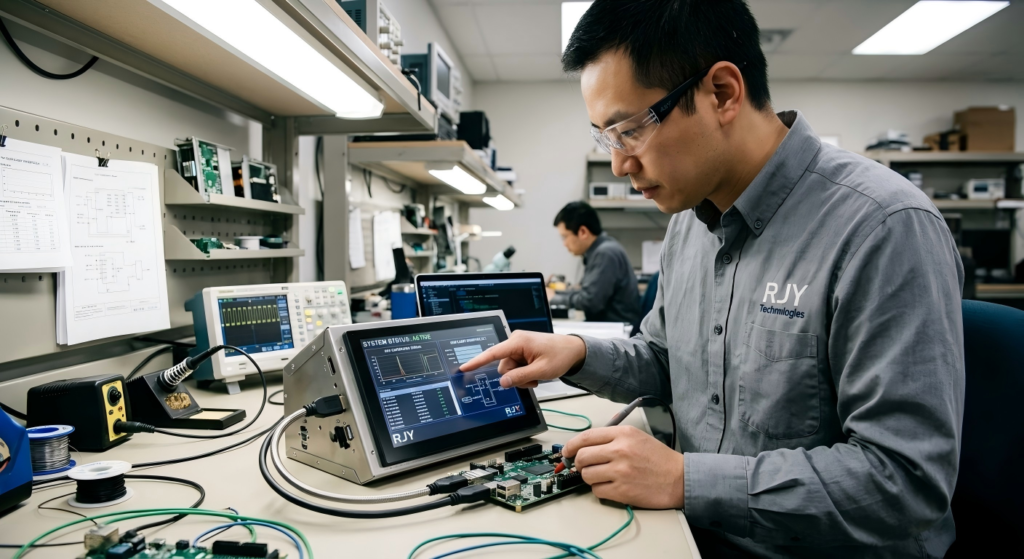
- The “Consumer Grade” Bait and Switch: The most common B2B pitfall. A supplier quotes an incredibly low price for an industrial display. They achieve this by using consumer-grade touch ICs (designed for tablets) instead of robust industrial ICs (like EETI EXC80W series). The screen will work in the lab, but will fail catastrophically when placed near an industrial motor.
- The EMI Firmware Trap: Many buyers assume that if an capacitive screen touch fails an EMC test, the hardware is ruined. A highly capable supplier knows how to utilize firmware debugging. By adjusting the frequency hopping algorithms and increasing the noise threshold via software, a failing screen can often be brought into EMI compliance without hardware redesign. Ensure your supplier has in-house firmware engineers, not just hardware assemblers.
Chapter 7: Conclusion and the 2027+ Outlook
7.1 Summary: The Shift to Total Cost of Ownership (TCO)
As we navigate 2026, the era of procuring displays based solely on the lowest initial unit price is dead. A cheap display that causes an assembly line shutdown due to ESD failure, or a medical device recall due to ghost touches, costs infinitely more than a premium module. Modern procurement decisions must be entirely Orientato al TCO (Costo Totale di Proprietà)—considerando affidabilità, tempi di integrazione, supporto in garanzia e sicurezza della catena di fornitura.
7.2 Tendenze Future
Guardando al 2027 e oltre, i confini del capacitive touch display continueranno ad espandersi. Stiamo già assistendo all'integrazione del riconoscimento predittivo dei gesti assistito dall'IA (dove lo schermo registra l'intento prima ancora che il dito stabilisca un contatto fisico). Inoltre, spinte dai mandati ESG globali, ci si aspetta una forte spinta verso vetri di copertura riciclabili e adesivi ottici a base biologica, che ridisegneranno completamente la distinta base del display futuro.
Domande Frequenti (FAQ) per Acquirenti Globali
Q1: Perché l'incollaggio ottico è cruciale per un modulo TFT LCD con touch screen nel 2026? A: L'incollaggio tradizionale con nastro adesivo lascia un'intercapedine d'aria tra il pannello touch e l'LCD. Questa intercapedine causa riflessi interni (riducendo la leggibilità alla luce solare), permette a polvere e umidità di penetrare e diminuisce la resistenza agli urti. L'incollaggio ottico riempie questo spazio con una resina otticamente trasparente (OCR) o un adesivo (OCA), risolvendo tutti e tre i problemi e diventando lo standard per qualsiasi dispositivo commerciale o industriale di livello serio.
Q2: Un touch screen capacitivo personalizzato può funzionare sott'acqua? A: I touch screen capacitivi standard non funzionano sott'acqua perché l'acqua è conduttiva e crea ponti tra gli elettrodi, confondendo il controller. Tuttavia, controller a mutua capacità avanzati, programmati con algoritmi specializzati di rifiuto dell'acqua, possono distinguere tra un tocco localizzato del dito e una dispersa pozza d'acqua, consentendo un funzionamento affidabile in caso di pioggia intensa o in ambienti marini.
Q3: Come scelgo tra un'interfaccia touch I2C e una USB? A: L'I2C è ideale per schermi di piccole dimensioni (tipicamente sotto i 10,1 pollici) integrati strettamente in un sistema compatto, poiché richiede cablaggio e alimentazione minimi. L'USB è obbligatorio per schermi più grandi, cavi più lunghi o sistemi che eseguono Windows/Linux, in quanto offre una larghezza di banda superiore, una migliore immunità al rumore e un supporto nativo plug-and-play per i driver.
Q4: Qual è il costo nascosto più grande quando si acquista un sistema touch screen capacitivo? A: I costi NRE (Non-Recurring Engineering) e di attrezzaggio per i progetti personalizzati del vetro di copertura e del FPC (Circuito Stampato Flessibile). Tuttavia, il vero costo nascosto è spesso una scarsa prestazione EMI (Interferenza Elettromagnetica). Il fallimento di un test di certificazione FCC o CE a causa di un touch screen rumoroso può ritardare il lancio del prodotto di mesi e comportare decine di migliaia di dollari in costi di riprogettazione e nuovi test.
Q5: Come posso verificare che il mio fornitore stia utilizzando un controller touch di livello industriale? A: Richiedete sempre una dettagliata distinta base completa (Bill of Materials) prima della produzione in serie. Controllate il numero di parte esatto dell'IC touch. I controller industriali di produttori come EETI o Ilitek hanno specifici datasheet che delineano i loro intervalli di temperatura operativa (es. -40°C a 85°C) e l'alta immunità al rumore da alta tensione. I chip consumer di solito arrivano al massimo a 70°C e mancano di robuste funzionalità anti-rumore.