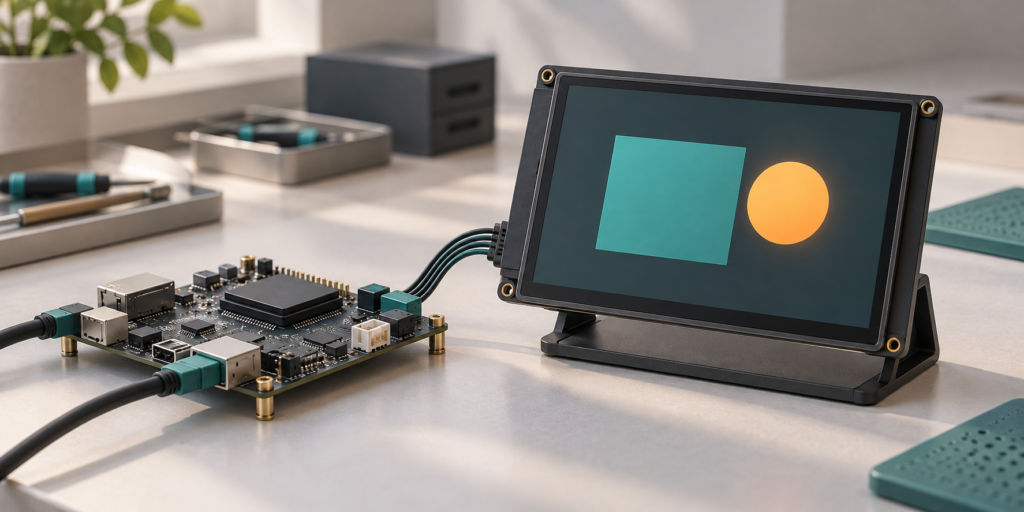
As of October 26, 2026, MicroLED commercialization calls for a product-specific assessment. Official announcements describe application-focused production, new manufacturing capacity, and interactive demonstrations. Those are different kinds of evidence. An OEM needs to determine which one supports the exact display it plans to buy.
For an OEM moving beyond a demonstration, the practical question is repeatable delivery. Can it deliver the required configuration across repeat batches, with documented acceptance limits, repair history, and a credible support plan? This article examines that question for direct-view displays that integrate separately made LEDs with a driving structure. It does not treat every MicroLED architecture as the same process or cover near-eye microdisplay qualification.
Read the 2026 announcements at their stated scope
The following three official announcements provide dated signals. Their statements remain company claims, not independent audits of factory output or customer qualification. The final column gives our interpretation of what an OEM still needs to establish.
| Announcement date | What the company reported | What it does not establish |
|---|---|---|
| March 30, 2026 | AUO described Micro LED mass-production progress and application deployments ahead of Touch Taiwan, scheduled for April 8–10. It presented transparent tiled modules as evidence of its production capability.1 | A company statement about selected applications does not qualify another module size, operating environment, or OEM delivery program. |
| May 4, 2026 | AUO outlined its SID 2026 demonstrations, including transparent Micro LED systems with sensing and interactive overlays.2 | A demonstration announcement does not provide a production acceptance record or a reliability report for an OEM’s intended assembly. |
| September 24, 2026 | AOTO reported that its new manufacturing center had entered production, supporting its P0.3–P1.5 Micro and Mini LED portfolio with chip-on-board (COB) and chip-on-glass (COG) packaging.3 | This portfolio-specific expansion does not prove maturity across all MicroLED routes, small embedded modules, or near-eye products. |
These statements make a blanket description of MicroLED as “prototype only” too broad. They also leave important gaps between a supplier’s reported progress and an OEM’s release decision. Readiness belongs to a defined product, process route, and acceptance standard. It does not transfer automatically between applications that share a technology name.
Ask the supplier to connect its announcement to an orderable configuration. A useful answer identifies the module revision, factory route, qualification status, and evidence available for that configuration. If the answer points only to a show display, keep the project at the evaluation stage.
Define the manufacturing route before comparing maturity

For heterogeneous integration, begin with a route description that identifies where the LEDs originate, how the supplier places them, how it makes electrical connections, and where it tests the assembly. Record the backplane or substrate, color implementation, packaging, and repair approach. These details define which evidence can support a comparison.
Equipment suppliers show that transfer, inspection, and repair are distinct manufacturing functions. Toray Engineering lists a mass transfer bonder, laser repair and trimming equipment, and photoluminescence inspection. Photoluminescence measures light emission under optical excitation. Its inspection description distinguishes luminescence-related defects from what visible-light surface inspection can detect.4 An equipment catalog establishes available process categories; it does not establish a display maker’s installed tools or results.
Radiant Vision Systems describes inspection across fabrication and assembly stages in its 2024 presentation overview. It focuses on later-stage metrology and identifies luminance variation, color variation, and pixel defects as sources of rework or waste.5
Our interpretation is that these distinct checks require separate evidence in a supplier review. A successful placement result does not answer the electrical acceptance question. A final illuminated sample does not reveal how much rework preceded it. Request evidence at the stage where each claim applies, then connect the stages through traceable lots.
Keep the comparison within a relevant product family. A packaging result for a fine-pitch tiled display should not serve as qualification evidence for an unrelated embedded module. If the supplier changes the substrate, assembly route, or color implementation, ask which previous tests remain applicable and which need to run again.
Turn yield claims into measurable questions
A yield percentage needs a numerator, denominator, test point, and acceptance rule. Without those definitions, two impressive numbers may describe different outcomes. The following framework is a proposed OEM review method, not a report of any supplier’s performance.
| Metric | Required definition | Decision it supports |
|---|---|---|
| Transfer acceptance | Accepted placements divided by attempted placements, with placement criteria and any exclusions stated. | Whether the placement process meets the agreed requirement for this route. |
| Electrical acceptance | Passing tested connections or devices divided by the corresponding tested population, with electrical limits stated. | Whether placed parts also satisfy the defined electrical test. |
| First-pass module yield | Modules passing the full agreed test before repair divided by modules entering that test. | How much output passes without rework. |
| Final module yield | Modules passing after allowed repair divided by the original tested module population. | How many tested modules become acceptable, including the effect of repair. |
| Repair burden | Repairs per module, repair cycles, time consumed, and the distribution across the lot. | Whether acceptable output depends on a manageable, repeatable repair process. |
Always keep the reporting period and lot identity attached. Ask whether the sample includes every unit in a run or a selected subset. Identify engineering lots separately from routine production. State whether scrapped or untested units sit outside the denominator. A combined figure can hide changes between routes, revisions, or batches.
Do not multiply unrelated headline percentages into a supposed final yield. Their populations may overlap, omit rejected units, or use different test limits. Request the actual count of modules entering and leaving each acceptance stage. Where counts cannot be disclosed, agree on a review method that still distinguishes first-pass output from recovered output.
Verify inspection and repair against the shipped module

Define the defect classes that matter to the product. An OEM may need limits for dark or bright points, uneven output, color variation, and intermittent behavior. Set the viewing distance, image patterns, operating condition, and measurement method with the supplier. A pass result has meaning only within those conditions.
Then ask how each acceptance item reaches the final test. Which checks cover the full active area? Which use sampling? How are uncertain results handled? Request a traceable example that follows one lot through inspection, repair, and final acceptance. The purpose is to understand the evidence behind a shipment decision.
For repaired modules, request the allowed repair count and reinspection procedure. In our review framework, equal final yields do not establish equal production effort: repair time and repeated inspection remain separate questions. Determine whether qualification samples represent the repair history expected in delivered goods. A pristine engineering sample cannot answer how routinely repaired production units will behave.
Repeatability matters more than a single excellent panel. Review separate batches made on the intended route. Compare acceptance distributions and failure categories, not just averages. A stable average can conceal a small group of modules that require substantially more repair or miss a critical optical limit.
Set release gates around the intended product
Use three decisions to control commitment. First, authorize evaluation when the supplier identifies an applicable product and can provide relevant samples. Test the feature that justifies MicroLED for this design under the actual optical and mechanical conditions.
Second, authorize integration only when samples match a documented configuration and acceptance method. Include the driving electronics, power arrangement, thermal conditions, and assembly interfaces in that configuration. If the supplier proposes a revision, record its effect on the evidence already collected.
Third, authorize production commitment when repeat-batch results support the requirement and commercial terms cover the remaining exposure. Establish how the supplier handles rejected units, replacement matching, process changes, and long-term availability. An attractive demonstration cannot resolve those obligations.
These gates allow targeted development without making an entire product launch depend on an unverified expansion plan. They also create a clear stopping point: if the next gate lacks evidence, continue evaluation or preserve the existing display design.
Use conditional scenarios for 2027–2028 planning
The following scenarios are the author’s conditional analysis, not numerical forecasts. They describe what evidence would justify a change in planning and can coexist across different product families. They do not assign market shares, predict cost parity, or set a universal replacement date for LCD or OLED.
Scenario 1: Existing applications gain more repeatable supply
If suppliers document consistent acceptance across production batches and make the relevant configurations available to OEMs, product teams could expand evaluation within those application families. This scenario strengthens with comparable lot records, controlled revisions, and reliable fulfillment. It weakens if specifications keep changing or delivery remains tied to individually managed projects.
Scenario 2: More products appear, but qualification remains selective
If announcements expand faster than route-specific evidence, OEM interest could grow while release decisions remain narrow. A compelling optical feature may justify a pilot but leave the production gate open. This scenario strengthens when suppliers offer samples without repeat-batch data. It weakens when the same configuration earns a documented production record under relevant conditions.
Scenario 3: A feature-led program advances without broad substitution
If a display’s transparency, form factor, or other measured feature solves a problem that the current design cannot meet, a targeted program could proceed despite added integration work. The case strengthens when system tests show that benefit and the supplier supports the required service plan. It weakens when the benefit disappears behind the product’s cover optics or requires unacceptable changes elsewhere.
Review these conditions at defined project milestones. Update the route and batch evidence each time. A new calendar year alone is not a reason to lower the acceptance threshold.
Keep today’s LCD decision tied to today’s requirements
For a product that needs an established TFT LCD solution now, preserve a separate specification and schedule. Our guide to custom versus standard TFT modules helps frame that decision. Review standard display candidates against the actual host, mechanics, optics, and validation requirements.
Contact RJY Display about a current TFT LCD project with those requirements and your target schedule. This next step concerns existing LCD options and project-dependent customization; it makes no claim that RJY supplies MicroLED products or represents the companies discussed above.
References
- AUO: AUO Lights Up Touch Taiwan 2026 with Leading Micro LED Innovation, March 30, 2026.
- AUO: AUO Leads a New Micro LED Interaction Paradigm at SID 2026, May 4, 2026.
- AOTO: AOTO Expands MicroLED Manufacturing with New Production Center, September 24, 2026.
- Toray Engineering: MicroLED Display-Production Equipment, accessed October 26, 2026.
- Radiant Vision Systems: Metrology and Quality Control of MicroLED Displays, presentation overview for the MicroLED Industry Association Meeting, February 15, 2024; accessed October 26, 2026. Used for fabrication-stage inspection and later-stage optical quality-control context.