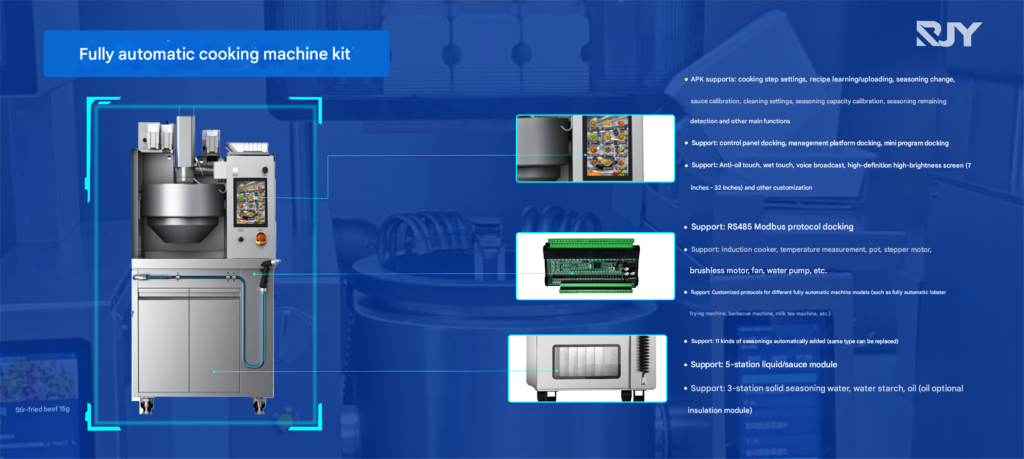
스마트 상업용 조리 장비를 위한 맞춤형 TFT LCD 디스플레이 사례 연구
Executive Summary
As competition in the commercial kitchen equipment market continues to intensify, manufacturers are looking for new ways to improve product functionality, simplify operation, and differentiate themselves from competing brands.
A commercial equipment manufacturer developing a new generation of intelligent cooking machines faced a challenge that extended beyond hardware selection. While the core cooking technology was already mature, the company needed a user interface capable of supporting advanced cooking workflows, recipe management, equipment monitoring, and future software upgrades.
To achieve these goals, the customer required a display solution that could seamlessly integrate with its control system while providing a modern touchscreen experience suitable for commercial kitchen environments.
RJY worked closely with the customer’s engineering team to develop a customized 10.1-inch TFT LCD display and touch solution that aligned with the product’s hardware architecture and software requirements. The result was a more capable user interface that helped the customer introduce features not available on competing products and ultimately secure orders from a major restaurant chain.
Customer Background
The customer is a manufacturer of intelligent commercial cooking equipment serving restaurants, central kitchens, food service providers, and chain dining brands.
The company had accumulated significant expertise in cooking automation and thermal control technologies. However, as customers increasingly demanded smarter kitchen equipment, the user interface became a critical factor influencing purchasing decisions.
Restaurant operators wanted more than cooking performance. They expected intuitive operation, visual recipe management, equipment diagnostics, and simplified staff training.
The customer recognized that the display system would play a central role in achieving these objectives.
Project Challenge
During the early development stage, the customer encountered several integration challenges.
The engineering team had already established a control platform and software architecture. However, aligning the display hardware, touch subsystem, and control system proved more complex than anticipated.
The challenge was not simply selecting a display size.
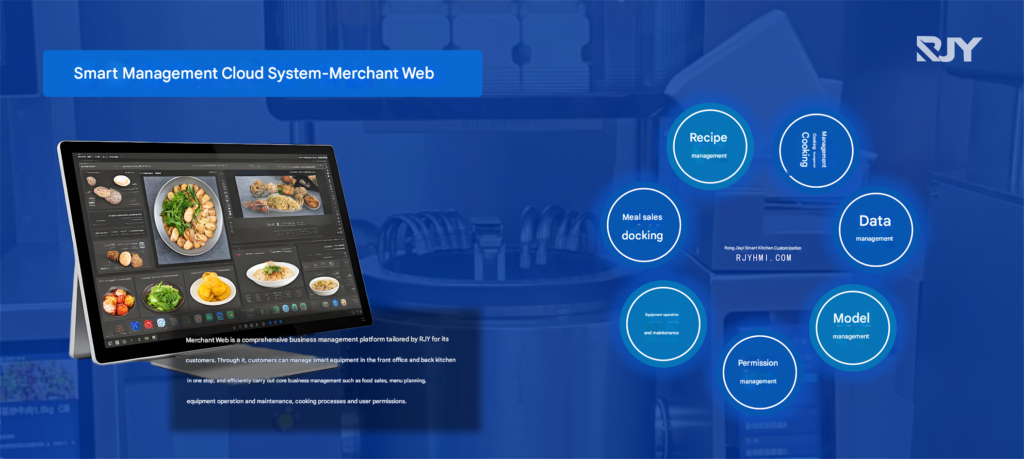
The display needed to function as the primary interaction point between kitchen staff and the machine. It had to support graphical menus, recipe selection, parameter configuration, equipment status monitoring, and future software enhancements.
The customer also wanted to introduce functionality that was not commonly available on competing products. This meant the display could not be treated as a standalone component. It needed to become an integrated part of the overall product experience.
As development progressed, the team realized that successful implementation required close coordination between display hardware, touch technology, firmware, and application software.
Technical Requirements
The customer defined several key objectives for the project.
First, the display needed to provide sufficient screen space for a modern graphical interface while remaining suitable for the equipment’s mechanical design.

Second, touch interaction needed to be responsive and reliable in a commercial kitchen environment where operators frequently interact with the equipment during busy service periods.
Third, the display solution needed to integrate smoothly with the existing control system to avoid unnecessary software redevelopment.
Most importantly, the solution had to support future feature expansion. The customer viewed software innovation as a long-term competitive advantage and wanted a display platform capable of supporting new functions as the product evolved.
RJY’s Solution
After reviewing the system architecture and project objectives, RJY recommended a customized 10.1-inch TFT LCD display combined with a tailored touch solution designed around the customer’s application requirements.
Rather than focusing solely on display specifications, the project was approached from a system integration perspective.
RJY engineers worked with the customer to evaluate the relationship between the display hardware, touch interface, controller architecture, and software environment.
This collaborative process helped identify potential compatibility issues early in development, reducing integration risks later in the project.

The customized solution provided a balance between visual performance, user experience, and system compatibility.
By aligning the display subsystem with the customer’s software strategy, the project team was able to create a more cohesive user experience while maintaining flexibility for future development.
Implementation Process
The implementation phase focused heavily on coordination between hardware and software teams.
Display integration projects often encounter challenges when hardware and software development proceed independently. To avoid this situation, RJY maintained close communication throughout the development process.
Prototype validation allowed both teams to evaluate interface behavior, touch responsiveness, screen layout requirements, and workflow design before finalizing the production configuration.
As software functionality expanded, the display solution continued to support evolving requirements without requiring major architectural changes.
This flexibility proved particularly valuable as the customer refined product features based on market feedback.
Throughout the
The final system delivered a user experience that was significantly more intuitive than traditional commercial cooking equipment interfaces.
Business Impact
The completed solution provided benefits beyond technical integration.
By leveraging the customized display and touch platform, the customer was able to introduce advanced operational features that were not commonly found in competing products at the time.
The graphical interface simplified operation, reduced training requirements, and improved workflow consistency across different users.
For restaurant operators, these improvements translated into a more accessible and efficient cooking process.
For the customer, the enhanced user experience became an important differentiator during sales discussions.
When presenting the product to potential buyers, the company could demonstrate capabilities that competing solutions lacked.
This differentiation ultimately contributed to the customer securing orders from a chain restaurant brand, helping strengthen the commercial success of the project.
While many manufacturers compete primarily on hardware specifications, this project demonstrated how user interface innovation can become a meaningful competitive advantage.
Engineering Lessons Learned
One of the most important lessons from this project is that display selection should not be treated as a late-stage purchasing decision.
In intelligent equipment, the display often becomes the primary connection between the user and the machine. Decisions regarding display architecture can influence software development, hardware integration, user experience, and future product expansion.
Another key takeaway is that successful customization requires collaboration between multiple engineering disciplines.
When display hardware, touch technology, control systems, and software development are considered together, the resulting product is typically more capable and easier to scale.
Finally, the project highlighted the value of designing for future functionality rather than focusing solely on immediate requirements.
The ability to support software evolution can extend product competitiveness long after the initial launch.
Related Solutions
This project is highly relevant to manufacturers developing:
- Smart commercial appliances
- Industrial HMI systems
- Food processing equipment
- Intelligent kitchen equipment
- Embedded touchscreen devices
- OEM display-integrated products
Organizations facing similar integration challenges can benefit from evaluating display solutions as part of the overall system architecture rather than as standalone components.
결론
As commercial equipment becomes increasingly intelligent, the quality of the user interface plays a growing role in product success.
For this intelligent cooking machine project, the challenge was not simply choosing a display. The challenge was creating a display solution capable of supporting software innovation, improving usability, and enabling product differentiation.
Through a customized 10.1-inch TFT LCD display and touch solution, RJY helped the customer bridge the gap between hardware and software development, creating a platform that supported both technical objectives and business goals.
The resulting product delivered functionality beyond competing offerings and helped the customer secure valuable business opportunities in the highly competitive food service equipment market.