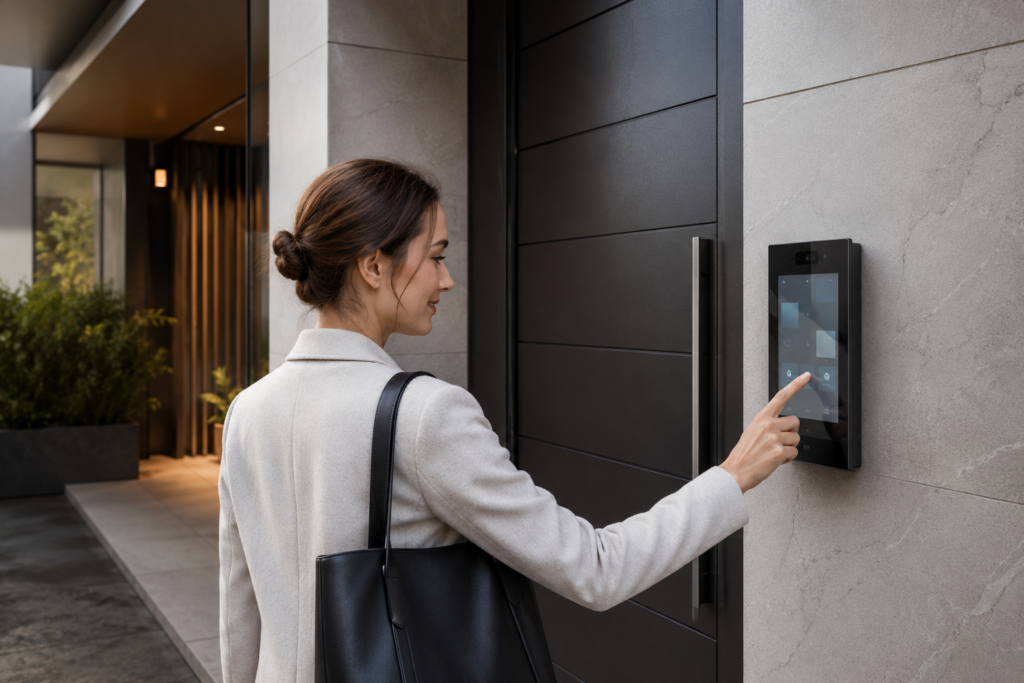
Residential access-control systems are evolving from simple keypads and audio intercoms into integrated entrance terminals with touch displays, cameras, card readers, status indicators and building-service functions. As the interface becomes more visible and interactive, the material covering the display becomes an important product decision.
Two common directions are a plastic cover lens and a glass cover lens. Plastic can support lower weight, impact-oriented designs and more freedom in forming the exterior surface. Glass is often selected for its rigid feel, surface appearance and scratch-resistant design potential. Neither material is automatically better for every access-control terminal.
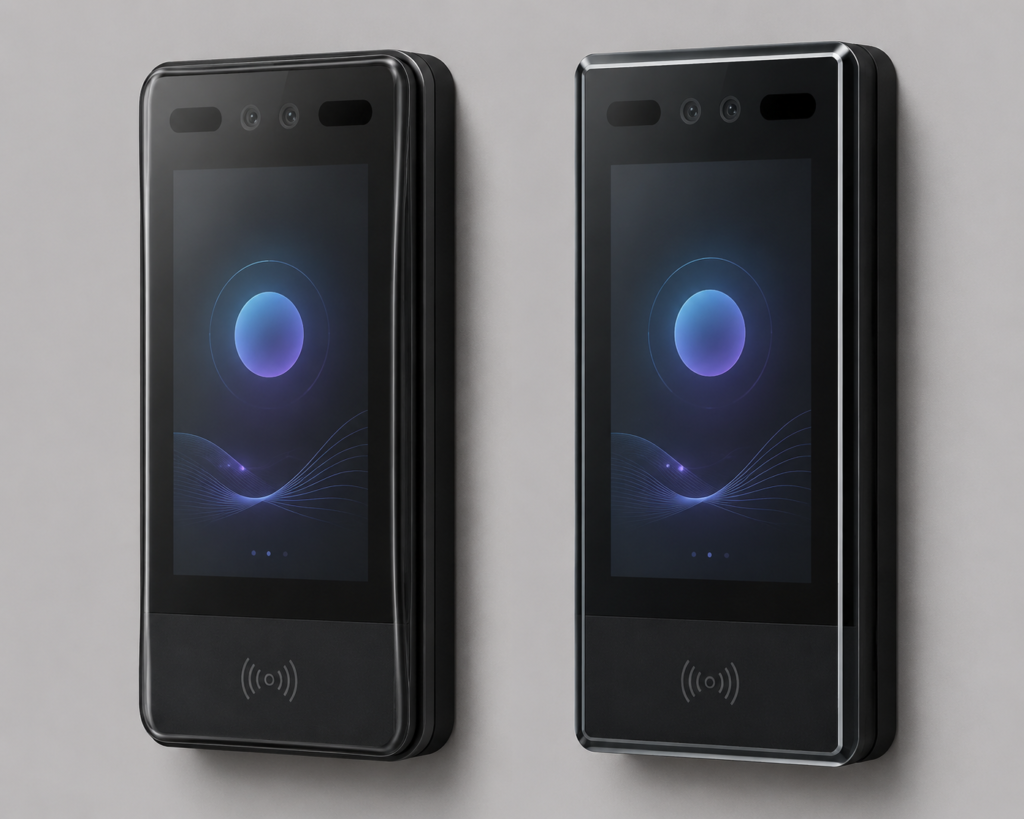
The correct choice depends on where the unit will be installed, how users interact with it, the desired industrial design, the touch structure, expected cleaning, outdoor exposure, impact risks and the mechanical support provided by the enclosure.
What Does “Soft Plastic Cover Lens” Actually Mean?
“Soft plastic cover lens” is not a precise material specification. It may refer to a polycarbonate sheet, PMMA acrylic, a decorated plastic film, a multilayer polymer structure or another transparent molded component. These materials do not have identical optical, mechanical or environmental properties.
Polycarbonate is commonly associated with impact resistance, transparency and design flexibility. SABIC describes transparent polycarbonate as a lightweight engineering thermoplastic with strength and impact-resistance characteristics.1 PMMA is another transparent polymer direction. Depending on the grade, it may be selected for optical appearance, weathering behavior or surface quality. Scratch-resistant treatments are also available for certain PMMA products, demonstrating why the material grade and surface treatment must be specified together.2
The word “soft” should therefore not be interpreted as meaning that the finished access-control display will remain freely bendable. Once a polymer lens is bonded, printed, mounted and supported by an enclosure, the behavior of the complete assembly depends on its thickness, geometry, support structure and integration method.
What Is a Glass Cover Lens?
A glass cover lens is a rigid transparent front component placed over the touch sensor or display assembly. Depending on the project, its design may include a printed border, transparent display window, camera or sensor openings, shaped outline and processed edges.
Different glass materials and strengthening processes provide different results. Ordinary soda-lime glass, thermally treated glass and chemically strengthened cover glass should not be treated as equivalent specifications. Specialized cover glasses are developed to improve resistance to scratches and handling damage, but those characteristics belong to the selected glass product rather than to every glass surface.3
For an access-control terminal, the glass must also be coordinated with the touch sensor, enclosure, adhesive or bonding structure, sealing concept and mounting method. Glass alone does not determine the impact resistance or environmental protection of the finished device.
Plastic vs Glass Cover Lens: Main Differences
| Decision Area | Plastic Cover Lens | Glass Cover Lens |
|---|---|---|
| Material definition | May use PC, PMMA, film or another polymer structure; exact material must be specified | May use different glass types and strengthening processes; exact construction must be specified |
| Weight | Generally supports a lower-weight front structure | Usually produces a heavier rigid front surface at comparable dimensions |
| Impact behavior | Some polymer grades, especially PC, are selected for high-impact applications | Strengthened glass can resist substantial handling damage, but edge support and impact mode remain important |
| Scratch behavior | Base plastic surfaces may require a hard coating or protective treatment for demanding use | Often selected when surface hardness and long-term cosmetic quality are priorities |
| Shape freedom | Can support formed surfaces, integrated features and complex molded geometry | Well suited to flat or processed rigid panels; complex shapes can increase processing requirements |
| Touch integration | Possible with a compatible sensor, thickness, stack and controller tuning | Widely used with projected-capacitive touch, subject to glass thickness and controller tuning |
| Visual character | Can support integrated plastic housings, curved forms and lightweight product styling | Often creates a rigid, smooth and premium-looking front panel |
| Outdoor suitability | Depends strongly on polymer grade, coating, UV exposure, temperature and sealing | Depends on glass selection, printing, bonding, edge design, sealing and the complete enclosure |
| Cleaning resistance | Must be checked against the exact material, coating and cleaning agent | Must be checked against the glass treatment, printing, bonding and cleaning process |
This comparison is a starting point rather than a substitute for material testing. A coated optical-grade plastic can behave very differently from an uncoated general-purpose sheet. Chemically strengthened cover glass can also behave differently from ordinary decorative glass.
When a Plastic Cover Lens May Fit an Access-Control Terminal
Impact-oriented entrance equipment
A polycarbonate-based direction may be considered when the front panel needs to tolerate accidental impact without using a heavy rigid structure. This can be relevant to shared residential entrances, delivery-access terminals or equipment installed where bags, tools and other objects may contact the unit.
Impact performance must still be validated at the assembled-device level. The lens thickness, unsupported area, mounting frame, internal clearance and impact location all affect the result.
Curved or integrated industrial design
Plastic materials can support formed surfaces, rounded transitions and integration with molded exterior components. This may help a product team create an access-control terminal that feels more like part of the building architecture than a separate rectangular screen.
Weight-sensitive wall-mounted products
Lower front-panel weight may simplify certain compact wall-mounted structures. The benefit depends on the total device construction, mounting method and required stiffness rather than the lens material alone.
Decorated hidden-interface concepts
Polymer films and molded structures can support printed or partially concealed interface areas. Designers may use these approaches to integrate illumination, touch controls or sensor windows into one visual surface. Optical transmission, color consistency and touch behavior must be confirmed using the final stack.
When a Glass Cover Lens May Be the Better Direction
Premium residential entrances
Glass can create a rigid, flush front panel that fits premium apartment entrances, villas, building lobbies and smart-home control products. The surface can visually connect the display, camera area and printed border into one finished interface.
High-frequency touch interaction
For devices that receive repeated swipes, taps and cleaning, glass may be preferred when long-term surface appearance is a major design priority. The actual scratch and wear performance still depends on the selected glass and surface treatment.
Flat PCAP touchscreen assemblies
Glass is widely used as the front lens of projected-capacitive touch assemblies. It can provide a stable surface over the touch sensor while supporting black-border printing and enclosure integration. Cover thickness, sensor pattern, grounding and touch-controller tuning must be evaluated together.
Products that prioritize a rigid front surface
A rigid glass panel can help the terminal feel structurally defined when users press, tap or clean the front surface. The enclosure still needs appropriate edge support, bonding and protection from concentrated mechanical loads.
How Cover-Lens Material Affects Touch Performance
Both plastic and glass can be used over a compatible touch sensor. The material name alone does not determine whether touch will work correctly.
Projected-capacitive touch performance can be affected by:
- Cover-lens material and thickness
- Distance between the user’s finger and the touch sensor
- Touch-sensor structure and electrode design
- Touch-controller selection and firmware tuning
- Printed borders and decorative layers
- Grounding and electrical noise from the host system
- Water, gloves and intended operating conditions
- Enclosure material and mechanical integration
A thicker or differently structured lens may require touch tuning. A touch assembly that performs correctly with one glass configuration should not be assumed to behave identically after replacing the glass with plastic.
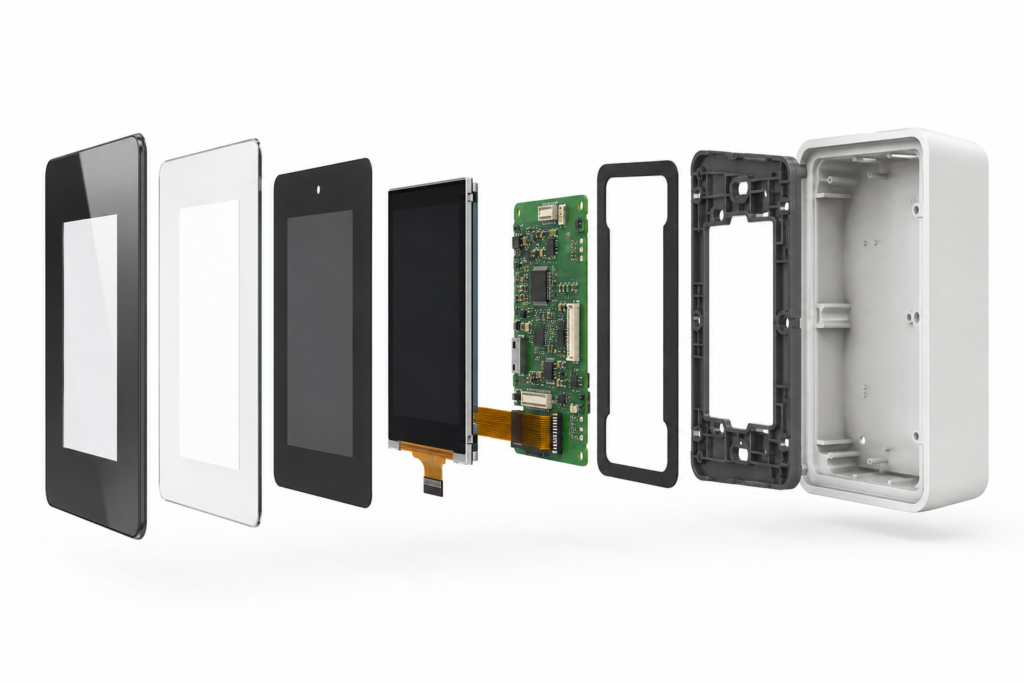
For more detail on how the complete display stack is coordinated, see the industrial touch-screen assembly guide and the TFT LCD lamination overview.
Outdoor Entrance Conditions Require a Complete-System Review
Residential access-control terminals may be installed indoors, under a covered entrance or directly in an exposed outdoor position. These are materially different operating environments.
For an outdoor or semi-outdoor terminal, engineers should review:
- Sunlight and ultraviolet exposure
- Seasonal temperature range
- Rain, condensation and humidity
- Dust and environmental contamination
- Cleaning chemicals and cleaning frequency
- Impact and vandalism risk
- Front-lens expansion and enclosure tolerances
- Adhesive, gasket, edge and cable-entry design
A weather-resistant polymer grade does not automatically make the complete terminal weatherproof. Likewise, a glass front does not automatically provide sealing or vandal resistance. The finished protection level is determined by the complete enclosure and assembly.
Cost and Manufacturing Considerations
Plastic is not always the lower-cost option, and glass is not always the higher-cost option. The commercial result depends on the required geometry, surface treatment, printing, tooling, dimensions, tolerance, production quantity and assembly method.
A molded plastic lens may require initial tooling but offer more integration freedom at suitable production volumes. A flat glass lens may avoid complex molding while still requiring cutting, edge processing, printing, strengthening or special openings. Prototype cost and mass-production cost should therefore be evaluated separately.
The material decision should be made after the product team has defined:
- Expected production volume
- Required surface shape
- Camera, microphone, speaker and sensor openings
- Touch and display stack
- Cosmetic-quality target
- Environmental and impact requirements
- Enclosure and assembly process
How to Choose Between Plastic and Glass
A practical selection process starts with the device’s highest-risk requirement:
- Choose an impact-oriented plastic direction for evaluation when low weight, formed geometry or resistance to accidental impact is the main concern.
- Choose a glass direction for evaluation when surface rigidity, scratch-resistant design potential and premium front-panel appearance are the main priorities.
- Compare both through prototypes when the product requires a balance of impact resistance, optical quality, touch behavior and cosmetic durability.
Do not approve the material from a sample sheet alone. The final comparison should use the intended thickness, printing, coating, touch sensor, adhesive structure, enclosure and mounting method.
RJY Display Support for Residential Access-Control Projects
RJY Display supports customization based on existing display modules, including cover glass, touchscreen, backlight, interface, FPC, controller board, firmware and display-related mechanical coordination.
Confirmed RJY capability includes custom cover-glass support. If a project specifically requires a PC, PMMA, flexible film or another plastic cover lens, its availability and scope should be confirmed separately before it is included in the product specification.
Controller-board compatibility must also be reviewed from the actual LCD model, resolution, interface, pin definition, backlight, touch interface, host architecture, firmware or operating-system requirements and application environment.
For an overview of the display layers that need to be coordinated, see how an LCD module is composed.
Information Needed for an Engineering Review
- Access-control terminal type and installation location
- Indoor, sheltered or exposed-outdoor environment
- Enclosure drawing and front-panel opening
- Target display size, resolution and active area
- Preferred glass, PC, PMMA or film direction
- Required lens shape, thickness range and printed areas
- Camera, microphone, speaker, card-reader and sensor openings
- Touch type and intended interaction requirements
- Impact, cleaning, UV and environmental requirements
- Host platform, display interface and controller-board requirements
- Sample quantity, estimated annual demand and project timeline
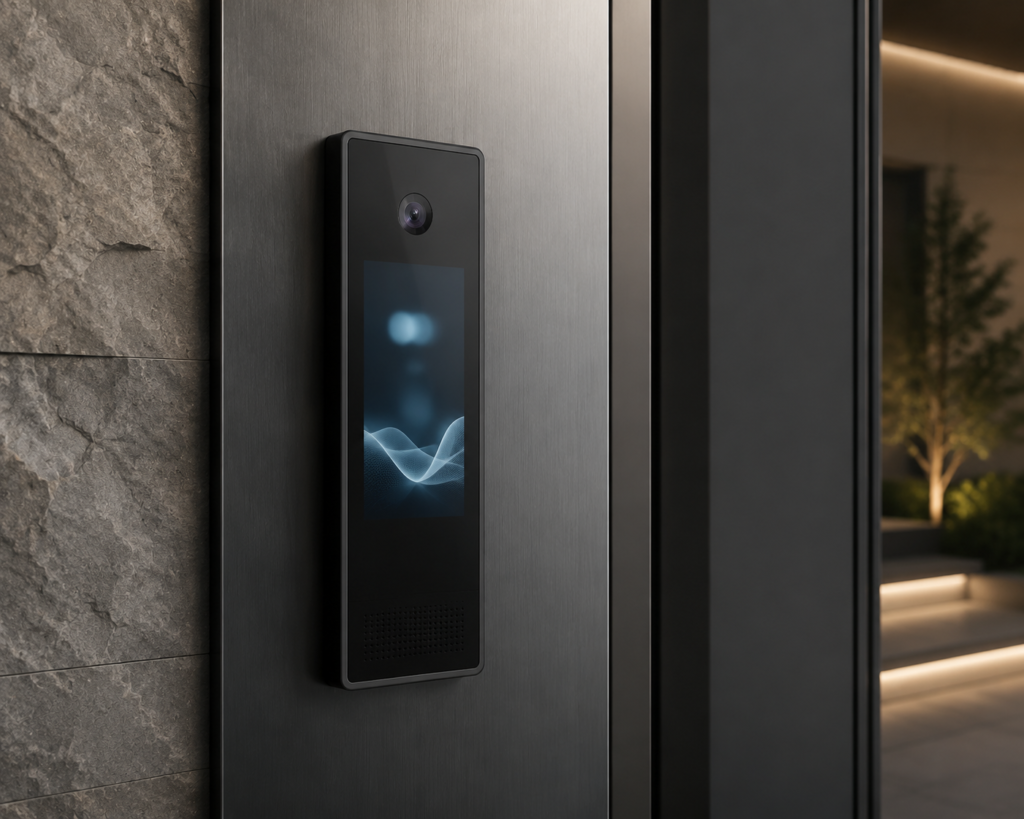
Choose the Front Lens as Part of the Complete Access-Control HMI
The front lens affects much more than appearance. It influences touch behavior, mechanical support, impact response, optical clarity, cleaning, enclosure design and the way residents perceive the finished access-control terminal.
If you are developing a residential intercom, smart door terminal or building access-control HMI, explore RJY custom display solutions or contact RJY with your display, touch, cover-lens and enclosure requirements.
Customization projects typically start from an MOQ of around 500 units, depending on the product type and project requirements.
Frequently Asked Questions
Is a plastic cover lens the same as a flexible display?
No. A plastic cover lens is the protective and decorative front component of the display assembly. It does not mean that the underlying TFT LCD or the finished access-control terminal is flexible.
Which is more impact resistant, plastic or glass?
Some polycarbonate materials are selected for high-impact applications, while strengthened glass can provide substantial resistance to handling damage. Final impact performance depends on the exact material, thickness, edge design, mounting and complete enclosure.
Which material is more resistant to scratches?
Glass is often selected when surface hardness is a priority. Plastic materials may require a hard coating or other surface treatment. Scratch performance should be confirmed for the exact material and finished surface.
Can projected-capacitive touch work through both plastic and glass?
Yes, both materials can be used with a compatible PCAP design. The cover material, thickness, sensor structure, controller, grounding and firmware tuning must be evaluated together.
Can RJY provide both plastic and glass cover lenses?
RJY’s confirmed capability includes custom cover-glass support. Plastic cover-lens requirements involving PC, PMMA or film should be submitted for a separate project-specific feasibility review.