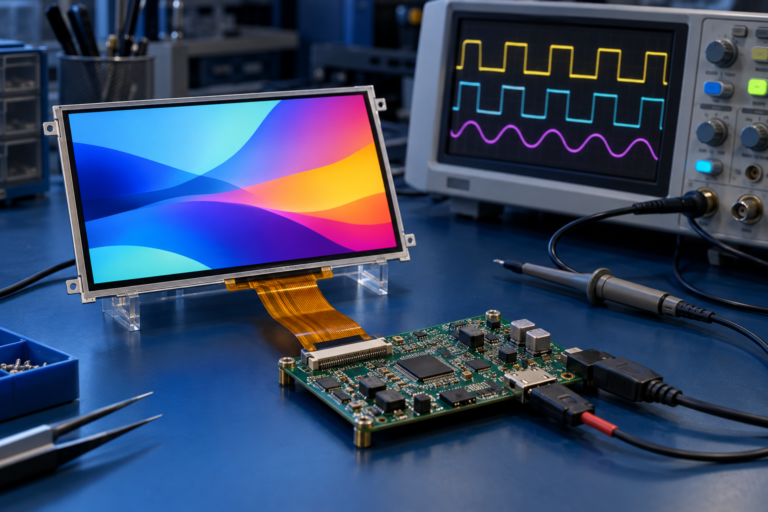
Enfrentando um gargalo no seu Projeto de Display Incorporado?
Não deixe que a integração complexa ou problemas na cadeia de abastecimento atrasem o seu tempo de colocação no mercado. Marque uma consulta gratuita com a equipa de especialistas da RJY para apoio personalizado em design e fabrico.
Os Displays de Cristal Líquido com Transistores de Película Fina (TFT-LCD) tornaram-se a base da tecnologia moderna de exibição, equipando desde smartphones e televisores até monitores de computador e displays automotivos. No entanto, o processo de fabricação por trás desses displays é altamente complexo, envolvendo diversas etapas críticas que garantem um desempenho de alta qualidade. Neste artigo, exploraremos as etapas principais da fabricação de TFT-LCD, desde a criação da matriz até a fabricação da célula e a montagem final do módulo.
Publicado:
Leitura de 14 minutos
Atualizado:
A fabricação de TFT-LCD é um processo de múltiplas etapas que transforma vidro, transistores de filme fino, material de cristal líquido, filtros de cor, polarizadores, circuitos de driver, componentes de retroiluminação e peças mecânicas em um módulo de exibição funcional. Para engenheiros e compradores B2B, compreender esse processo ajuda a explicar por que a seleção de displays não se resume apenas ao tamanho e à resolução. Também afeta a compatibilidade de interface, brilho, integração de toque, estrutura mecânica, confiabilidade, prazo de entrega e viabilidade de personalização.
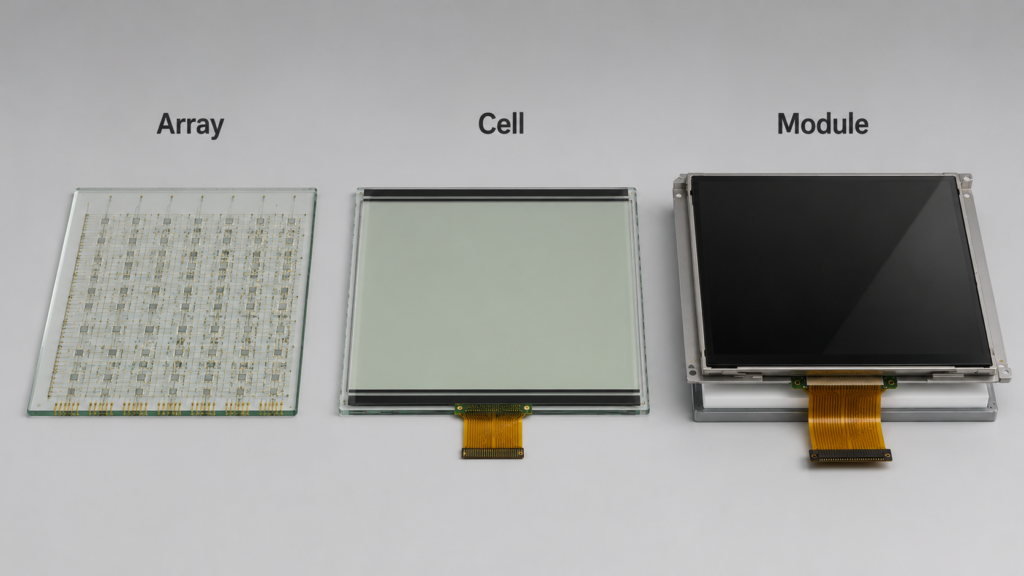
Um TFT-LCD não é fabricado como uma única peça simples. Ele é tipicamente construído em três grandes estágios: fabricação de matriz, montagem de célula e montagem de módulo. O processo de matriz cria o backplane de transistor de filme fino. O processo de célula combina o vidro da matriz TFT, o vidro do filtro de cor e a camada de cristal líquido. O processo de módulo integra polarizadores, ICs de driver, FPC, retroiluminação, moldura e outros componentes em um módulo LCD utilizável.
Este guia explica os principais processos de fabricação de TFT-LCDs e como cada estágio afeta o módulo de exibição final usado em dispositivos embarcados, IHMs industriais, painéis de casas inteligentes, displays relacionados a veículos, equipamentos de segurança e outros produtos B2B.
O que é um TFT-LCD?
TFT-LCD significa display de cristal líquido com transistor de filme fino. É um tipo de LCD de matriz ativa. Um TFT-LCD utiliza uma estrutura de transistor de filme fino para controlar pixels ou subpixels individuais com mais precisão do que os designs mais antigos de LCD de matriz passiva.
A camada de cristal líquido não emite luz por si só. Em vez disso, ela controla como a luz passa pela estrutura do display. Na maioria dos módulos TFT-LCD modernos, uma retroiluminação LED fornece a fonte de luz. A matriz TFT controla o comportamento dos pixels, a camada de cristal líquido modula a luz e o filtro de cor cria subpixels vermelhos, verdes e azuis.
Um módulo TFT-LCD finalizado pode incluir a célula LCD, polarizadores, IC de driver, FPC, unidade de retroiluminação, moldura de metal ou plástico, painel de toque, vidro de cobertura e, às vezes, uma placa controladora, dependendo do design do produto.
Os Três Principais Estágios de Fabricação de TFT-LCD
O processo de fabricação de TFT-LCD é comumente dividido em três estágios principais:
Processo de matriz: cria a matriz de transistores TFT em um substrato de vidro.
Processo de célula: combina o vidro da matriz TFT com o vidro do filtro de cor e o material de cristal líquido.
Processo de módulo: monta a célula LCD com polarizadores, ICs de driver, FPC, retroiluminação, moldura, painel de toque e outras peças.
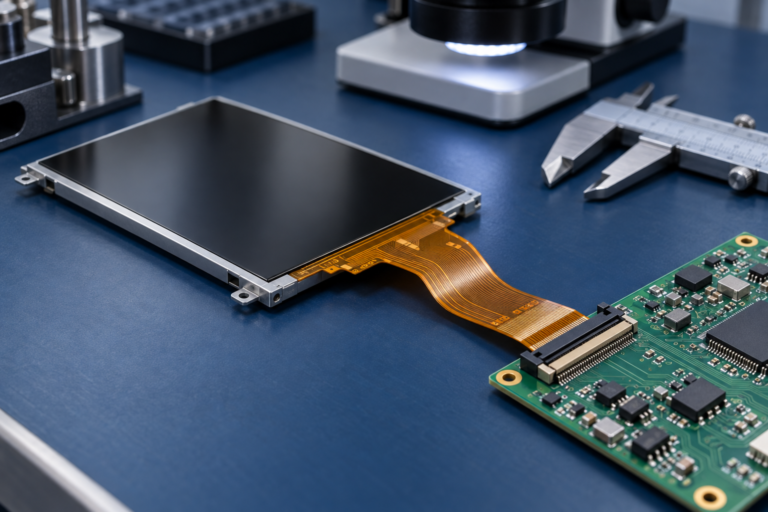
Estágios de fabricação de TFT-LCD mostrando o vidro da matriz, a célula LCD e o módulo de exibição finalizado
Esses três estágios definem a estrutura básica do display final. O processo de matriz afeta o controle de pixels e o desempenho elétrico. O processo de célula afeta o desempenho óptico e a formação de imagem. O processo de módulo afeta o brilho, a interface, o ajuste mecânico, a integração de toque e a usabilidade final.
Estágio de Fabricação
Propósito Principal
Resultado Chave
Processo de matriz
Construir a matriz de transistores TFT no vidro
Substrato da matriz TFT
Processo de célula
Unir o vidro TFT, o vidro do filtro de cor e a camada de cristal líquido
Célula LCD
Processo de módulo
Adicionar polarizadores, ICs, FPC, retroiluminação, moldura e peças relacionadas
Módulo TFT-LCD finalizado
Estágio 1: Fabricação da Matriz TFT
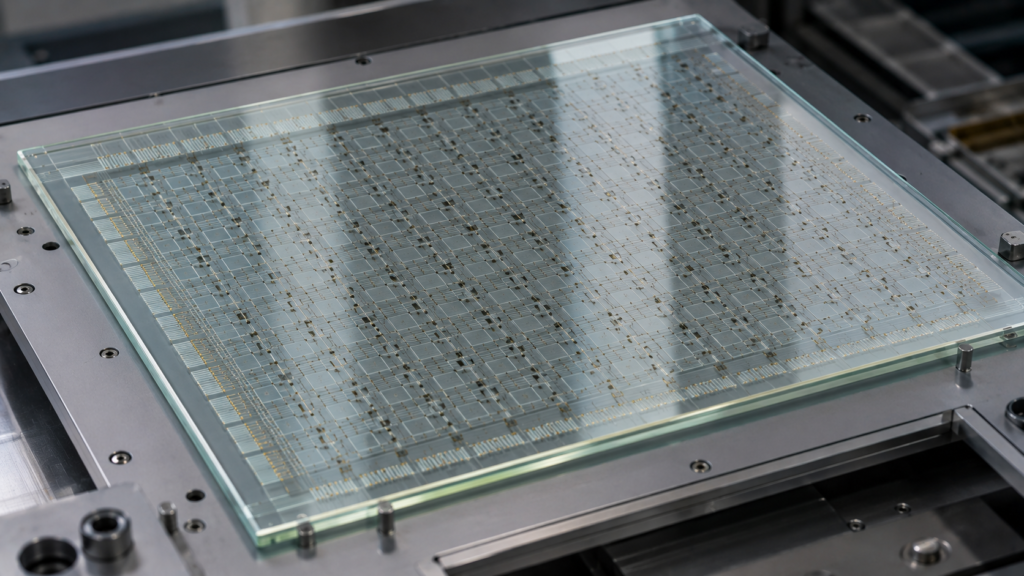
O processo de matriz é a base da fabricação de TFT-LCD. Neste estágio, uma matriz de transistor de filme fino é formada em um substrato de vidro. Essa matriz controla como os pixels respondem aos sinais elétricos.
O processo é conceitualmente semelhante à fabricação de semicondutores, mas é realizado em grandes substratos de vidro, em vez de wafers de silício. O vidro é limpo, revestido, padronizado, gravado e processado repetidamente para criar a estrutura necessária de transistor de filme fino, eletrodos, linhas de sinal e capacitores de armazenamento.
As etapas típicas de fabricação da matriz incluem:
Limpeza do substrato de vidro
Deposição de filme fino
Revestimento de fotorresiste
Exposição por máscara
Revelação
Gravação
Remoção do fotorresiste
Inspeção e teste elétrico
Essas etapas podem ser repetidas várias vezes porque a matriz TFT contém múltiplas camadas padronizadas. Cada camada deve se alinhar com precisão às camadas anteriores. Pequenos defeitos neste estágio podem afetar pixels, linhas, uniformidade, rendimento e confiabilidade do display.
Substrato de vidro da matriz TFT com fina grade de traços de pixel e pontos de transistor
Por que o Processo de Matriz é Importante
O processo de matriz determina a estrutura de controle elétrico do display. Se a matriz TFT tiver defeitos, o display finalizado pode apresentar pixels mortos, defeitos de linha, brilho instável, resposta de imagem ruim ou outros problemas visíveis.
Para compradores, este estágio explica por que a qualidade dos pixels e o rendimento do painel são importantes. Mesmo que o usuário final não veja a matriz TFT diretamente, ela é responsável pelo controle preciso dos pixels. Um backplane TFT de alta qualidade suporta exibição de imagem estável, maior resolução e desempenho mais consistente.
Na seleção prática de produtos, o comprador geralmente não controla o processo de matriz diretamente. No entanto, compreendê-lo ajuda a explicar por que módulos de display de diferentes fontes podem variar em consistência, rendimento e desempenho de longo prazo, mesmo que o tamanho básico e a resolução pareçam semelhantes.
Estágio 2: Fabricação do Filtro de Cor
Um TFT-LCD colorido também precisa de um substrato de filtro de cor. O vidro do filtro de cor contém padrões de filtro vermelho, verde e azul que permitem que o display crie imagens coloridas completas.
O processo do filtro de cor forma pequenas áreas vermelhas, verdes e azuis alinhadas com a estrutura dos pixels. Também inclui áreas de matriz preta que ajudam a separar os subpixels e melhorar o contraste. O substrato do filtro de cor deve ser posteriormente alinhado com o substrato da matriz TFT durante a montagem da célula.
A qualidade do filtro de cor afeta a aparência das cores, o brilho, o contraste e a uniformidade. Se o padrão do filtro de cor estiver mal alinhado ou inconsistente, a imagem final pode apresentar desvio de cor, nitidez reduzida ou defeitos ópticos.
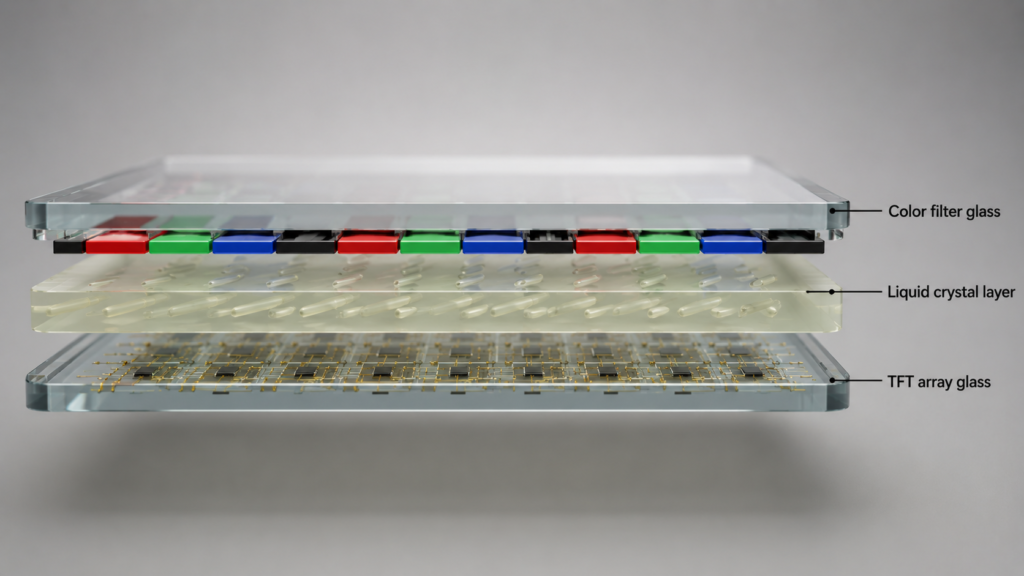
Seção transversal da montagem da célula LCD mostrando o vidro TFT, o vidro do filtro de cor e a camada de cristal líquido
Estágio 3: Montagem da Célula
O processo de célula combina o substrato da matriz TFT e o substrato do filtro de cor. O material de cristal líquido é colocado entre esses dois substratos de vidro, criando o núcleo óptico do LCD.
Etapas importantes da montagem da célula incluem:
Revestimento da camada de alinhamento
Tratamento de fricção ou alinhamento, dependendo do processo do painel
Distribuição de espaçadores para controlar o espaço da célula
Aplicação de selante
Alinhamento do substrato de vidro
Preenchimento de cristal líquido ou preenchimento por gota única
Selagem da célula
Corte ou riscagem em tamanhos de painel
Inspeção da célula
O espaço entre os dois substratos de vidro deve ser controlado cuidadosamente. Esse espaço da célula afeta o desempenho óptico, o comportamento de resposta, a uniformidade de cor e a qualidade de visualização. O material de cristal líquido também deve ser distribuído de forma consistente em toda a área ativa do display.
Por que a Montagem da Célula é Importante
O processo da célula é onde o display começa a se comportar como um LCD. Antes deste estágio, a matriz TFT e o filtro de cores são substratos de vidro separados. Após a montagem da célula, a estrutura pode modular a luz através da camada de cristal líquido.
A qualidade da montagem da célula pode afetar o ângulo de visão, o contraste, o tempo de resposta, mura, vazamento de luz e uniformidade. Muitos defeitos visíveis no display estão relacionados ao alinhamento do vidro, distribuição do cristal líquido, controle do espaçamento da célula, contaminação ou estresse mecânico.
Para projetos de displays embarcados e industriais, este estágio também explica por que a célula LCD deve ser protegida adequadamente durante a integração posterior. Pressão, flexão, impacto ou estresse mecânico irregular podem afetar a área do display e criar marcas ou defeitos visíveis.
Estágio 4: Fixação do Polarizador
Os polarizadores são fixados nas superfícies externas da célula LCD. Eles são essenciais porque os displays de cristal líquido funcionam controlando a polarização da luz.
Sem polarizadores, a camada de cristal líquido não pode formar uma imagem visível utilizável na estrutura normal do LCD. Os polarizadores devem ser aplicados de forma limpa e precisa. Poeira, bolhas, arranhões ou erros de alinhamento podem afetar a aparência e o rendimento.
A seleção do polarizador também afeta o ângulo de visão, o brilho, o contraste e a aparência da superfície. Em alguns projetos, filmes ópticos adicionais, camadas antirreflexo ou tratamentos de superfície podem ser utilizados dependendo da aplicação.
Estágio 5: Montagem do CI Driver
A célula LCD necessita de CIs drivers para enviar sinais elétricos aos pixels do display. A montagem do CI driver conecta o vidro do display à eletrônica que controla as linhas, colunas e sinais de imagem.
Métodos comuns de montagem incluem chip-on-glass, chip-on-film ou estruturas de montagem relacionadas, dependendo do design do módulo. A área de montagem deve ser confiável, pois uma montagem deficiente pode causar linhas ausentes, perda parcial de imagem, comportamento instável do display ou falha completa.
Para projetos B2B, este estágio está intimamente relacionado ao design da interface e do FPC. O módulo de display deve corresponder ao sistema hospedeiro ou placa controladora em resolução, formato de sinal, temporização, tensão, definição de pinos e requisitos de retroiluminação.
Estágio 6: Integração do FPC e Conector
Muitos módulos TFT-LCD utilizam um FPC, ou circuito impresso flexível, para conectar o display a uma placa-mãe ou placa controladora. O FPC pode transportar sinais de display, alimentação, conexões de retroiluminação, sinais de toque e linhas de controle, dependendo do design do módulo.
O design do FPC afeta a integração. Detalhes importantes incluem o tipo de conector, passo dos pinos, direção de flexão, comprimento do cabo, definição de pinos, folga mecânica e tolerância de montagem.
Para projetos de display personalizados, a personalização do FPC pode ser considerada quando o módulo padrão não se adequa à estrutura do produto. No entanto, alterações no FPC devem ser revisadas cuidadosamente, pois podem afetar a qualidade do sinal, a confiabilidade mecânica e o custo de produção.
Estágio 7: Montagem da Unidade de Retroiluminação
Como um TFT-LCD transmissivo não emite luz por si só, ele normalmente requer uma unidade de retroiluminação. Em módulos modernos, a retroiluminação é geralmente baseada em LEDs.
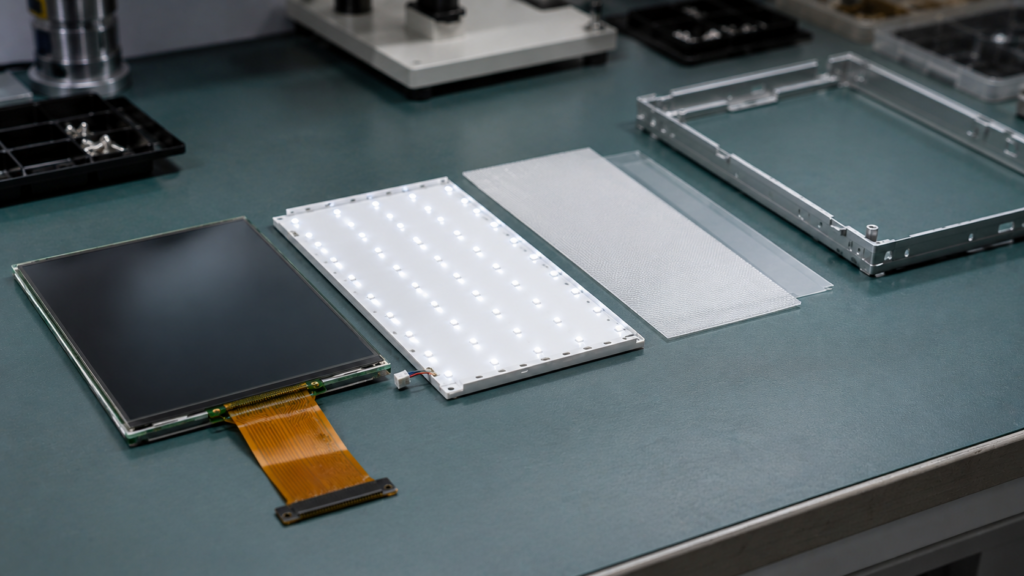
Uma unidade de retroiluminação típica pode incluir LEDs, guia de luz, folhas difusoras, filmes prismáticos, refletor, moldura e conexões elétricas relacionadas. O objetivo é distribuir a luz uniformemente por toda a área do display.
O design da retroiluminação afeta:
Brilho
Uniformidade
Consumo de energia
Geração de calor
Espessura do módulo
Conforto visual
Legibilidade externa ou semiexterna
Para aplicações de alto brilho ou industriais, o design da retroiluminação torna-se especialmente importante. Um brilho mais alto pode exigir mais potência e melhor design térmico. Não deve ser tratado apenas como um número simples de brilho.
Montagem do módulo TFT-LCD com célula LCD, retroiluminação LED, difusor, moldura e conector FPC
Estágio 8: Montagem do Módulo
A montagem do módulo transforma a célula LCD em um módulo TFT-LCD utilizável. Neste estágio, a célula LCD, polarizadores, CIs drivers, FPC, unidade de retroiluminação, moldura, peças adesivas e outros componentes mecânicos são montados juntos.
Dependendo do produto, a montagem do módulo também pode incluir a fixação do painel de toque, integração do vidro de cobertura, filme protetor, estrutura de montagem ou peças adaptadoras de interface.
Um módulo finalizado deve ser mecanicamente estável e eletricamente funcional. A montagem deve proteger a célula LCD, permitindo que o display se encaixe no produto ou equipamento de destino.
Estágio 9: Integração do Painel de Toque e Vidro de Cobertura
Muitos módulos TFT-LCD modernos são usados com painéis de toque. A camada de toque pode ser resistiva ou capacitiva, dependendo da aplicação. Um vidro de cobertura também pode ser adicionado para proteção, aparência e integração ao painel frontal.
A integração do toque e do vidro de cobertura deve considerar:
Touch type
Tamanho e formato do vidro de cobertura
Espessura do vidro e design das bordas
Posição do FPC
Método de montagem
Compatibilidade do controlador de toque
Requisitos para luvas, umidade ou ruído
Ajuste mecânico dentro do invólucro
O painel de toque não é apenas um acessório de superfície. Ele afeta a experiência do usuário, o design mecânico, os requisitos de interface, o suporte a firmware ou driver e a confiabilidade do produto final.
Estágio 10: Teste e Inspeção
Testes e inspeções são necessários ao longo de todo o processo de fabricação do TFT-LCD. Alguns testes ocorrem durante a produção da matriz e da célula. Outros ocorrem após a montagem do módulo.
Itens comuns de inspeção podem incluir:
Defeitos de pixel
Defeitos de linha
Brilho
Desempenho de cor e escala de cinza
Uniformidade da retroiluminação
Função do display
Conexão elétrica
Condição do FPC e conector
Resposta ao toque, se aplicável
Aparência visual
Ajuste mecânico
Os testes ajudam a detectar defeitos antes que o módulo seja enviado ou integrado ao produto do cliente. Para projetos B2B, os requisitos de teste devem corresponder à aplicação. Um display de consumo, uma IHM industrial, uma interface relacionada a dispositivos médicos e um dispositivo veicular podem não ter as mesmas prioridades de avaliação.
Como a Fabricação Afeta a Personalização de TFT-LCDs
Nem todas as características de um TFT-LCD são igualmente fáceis de personalizar. Algumas características estão vinculadas ao processo de fabricação original do painel LCD, enquanto outras podem ser ajustadas no nível do módulo ou da integração.
Para muitos projetos B2B, a personalização é mais prática quando se parte de um módulo de display existente e se ajustam as peças relacionadas ao seu redor. Isso pode incluir vidro de cobertura, retroiluminação, painel de toque, FPC, interface, placa controladora, firmware ou coordenação da estrutura mecânica.
Área de Personalização
Estágio Típico de Fabricação
Notas Práticas
Resolução
Design do painel e processo de matriz
Geralmente vinculado à plataforma de painel existente
Tamanho do display
Design do painel e plano de corte
Novos tamanhos do zero são complexos e nem sempre práticos
Brilho
Design da retroiluminação e do módulo
Frequentemente mais prático do que alterar a própria célula LCD
Formato ou pinagem do FPC
Montagem do módulo e design elétrico
Requer revisão de compatibilidade e confiabilidade
Painel de toque
Integração de módulo
Pode ser revisado com base no tipo de toque e ambiente de uso
Vidro de cobertura
Integração de módulo
Comum para requisitos de painel frontal e aparência do produto
Placa controladora
Integração de sistema
Depende da interface do painel, resolução, temporização, firmware e aplicação
Firmware
Nível de placa controladora e sistema
Dependente do projeto e requer comunicação técnica
Por que os compradores devem entender o processo de fabricação
A maioria dos compradores não precisa gerenciar todo o processo de produção de TFT-LCD. No entanto, entender o processo ajuda os compradores a fazer perguntas melhores e evitar expectativas irreais.
Por exemplo, alterar o vidro de cobertura é muito diferente de desenvolver um novo tamanho de painel LCD. Ajustar o brilho do backlight é diferente de alterar a resolução. Compatibilizar uma placa controladora é diferente de alterar a matriz TFT. Cada solicitação pertence a uma camada técnica diferente e pode ter implicações distintas de custo, prazo e viabilidade.
Entender o processo de fabricação ajuda os compradores a avaliar:
Quais especificações são fixas pelo painel LCD
Quais recursos podem ser personalizados no nível do módulo
Quais requisitos necessitam de suporte da placa controladora ou firmware
Por que a aprovação de amostras é importante antes da produção em massa
Por que as folhas de dados, desenhos e detalhes de interface são importantes
Por que o projeto mecânico deve ser revisado no início
Erros comuns ao discutir a fabricação de TFT-LCD
Um erro comum é assumir que todos os recursos do display podem ser alterados facilmente. Na realidade, resolução, área ativa, tamanho do vidro e estrutura de pixels geralmente estão vinculados à plataforma original do painel.
Outro erro é tratar o backlight como um acessório menor. O design do backlight afeta brilho, calor, consumo de energia, espessura e visibilidade. Para aplicações industriais e de alto brilho, é um fator de design importante.
Um terceiro erro é ignorar os detalhes do FPC e do conector. Mesmo que o tamanho e a resolução do display sejam compatíveis, um FPC, definição de pinos, requisito de tensão ou interface incompatíveis podem impedir que o módulo funcione com o sistema do cliente.
Um quarto erro é esperar até o final do desenvolvimento para considerar o design do painel de toque e do vidro de cobertura. O toque e o vidro de cobertura afetam a estrutura mecânica, a experiência do usuário, o desempenho óptico e o planejamento da montagem.
Quais informações os compradores devem fornecer para um projeto de TFT-LCD?
Para avaliar um projeto de TFT-LCD de forma eficiente, os compradores devem preparar informações técnicas suficientes antes da consulta. Quanto mais completas as informações, mais rápido um fornecedor pode confirmar a viabilidade.
Informações úteis do projeto incluem:
Tamanho alvo do display
Resolução
Requisitos de área ativa e tamanho externo
Tipo de interface
Requisito de brilho
Requisito de toque
Requisito de vidro de cobertura
Direção do FPC e requisito do conector
Requisito de tensão e corrente do backlight, se conhecido
Requisito de placa controladora
Requisito de firmware ou software
Operating environment
Desenho da estrutura mecânica ou invólucro
Indústria de aplicação
Quantidade de amostras
Demanda anual esperada
Cronograma de desenvolvimento alvo
Essas informações ajudam a esclarecer se o projeto pode usar um módulo existente, necessita de personalização no nível do módulo ou requer uma revisão de engenharia mais aprofundada.
Suporte da RJY Display para Módulos TFT-LCD e Projetos Personalizados
A RJY Display oferece suporte a módulos TFT LCD, placas controladoras e solução de display personalizado Discussões de soluções para projetos B2B orientados por engenharia. O caminho prático de engenharia geralmente é começar a partir de um módulo de display existente e revisar as áreas de personalização relacionadas ao seu redor.
O suporte ao projeto pode envolver seleção de tamanho do display, revisão de resolução, compatibilização de interface, personalização de brilho, revisão do backlight, integração do painel de toque, design do vidro de cobertura, discussão do FPC, compatibilização da placa controladora, suporte a firmware e coordenação da estrutura mecânica.
Se o seu projeto precisar de um módulo TFT-LCD, display touch, display de alto brilho, placa controladora ou suporte, prepare seus requisitos de display antes da consulta para que a revisão técnica possa começar com informações precisas do projeto. solução de display personalizado Envie os Requisitos do Seu Projeto de TFT-LCD.
Para compradores B2B, esse processo explica por que a seleção do display exige mais do que escolher um tamanho e resolução. Alguns recursos são definidos pela plataforma do painel, enquanto outros podem ser ajustados através do design do módulo, design do backlight, integração do toque, compatibilização da placa controladora ou suporte a firmware.
O projeto TFT-LCD certo começa com requisitos claros: tamanho, resolução, interface, brilho, toque, vidro de cobertura, FPC, backlight, placa controladora, firmware, ambiente operacional e expectativas de produção. Entender o processo de fabricação ajuda os compradores a comunicar esses requisitos de forma mais clara e a tomar melhores decisões sobre o display.
Quais são os principais processos de fabricação de TFT-LCDs?.
FAQ
Os principais processos de fabricação de TFT-LCD são fabricação da matriz, montagem da célula e montagem do módulo. A fabricação da matriz cria o backplane TFT, a montagem da célula forma a célula LCD, e a montagem do módulo integra o backlight, polarizadores, ICs drivers, FPC, moldura e partes relacionadas.
O que é o processo de matriz TFT?.
O processo de matriz TFT cria a matriz de transistores de filme fino em um substrato de vidro. Envolve etapas repetidas como limpeza, deposição, revestimento de fotorresiste, exposição, revelação, corrosão e inspeção.
O que é a montagem da célula LCD?.
A montagem da célula LCD combina o vidro da matriz TFT, o vidro do filtro de cores e o material de cristal líquido. Esta etapa forma o núcleo óptico do painel LCD.
O que acontece durante a montagem do módulo TFT-LCD?.
A montagem do módulo integra a célula LCD com polarizadores, ICs drivers, FPC, unidade de backlight, moldura e, às vezes, painel de toque ou vidro de cobertura. Isso transforma a célula LCD em um módulo de display utilizável.
A resolução do TFT-LCD pode ser personalizada facilmente?.
A resolução geralmente está vinculada à plataforma do painel LCD e ao design da matriz TFT. Para muitos projetos, é mais prático selecionar uma resolução existente e personalizar as partes relacionadas do módulo, como backlight, painel de toque, vidro de cobertura, FPC, placa controladora ou firmware.
Por que o design do backlight é importante na fabricação de TFT-LCD?.
O backlight afeta brilho, uniformidade, consumo de energia, calor, espessura e legibilidade. É especialmente importante para aplicações de display de alto brilho, industriais, externas ou semiexternas.
Quais informações são necessárias para um projeto personalizado de TFT-LCD?.
Informações úteis incluem tamanho do display, resolução, interface, brilho, requisito de toque, requisito de vidro de cobertura, requisito de FPC, requisito de backlight, requisito de placa controladora, ambiente operacional, estrutura mecânica, necessidades de amostra e volume de produção esperado.
Princípio de Fabricação e Introdução ao Processo de TFT LCD.