








In the evolving landscape of urban architecture, commercial real estate, and transit infrastructure across North America and Europe, static signage is effectively dead. The modern public space is expected to be dynamic, interactive, and endlessly adaptable. At the core of this digital transformation is a piece of hardware that has evolved from a simple consumer television into a ruggedized, hyper-bright piece of civic infrastructure: the big lcd display.
While Direct-View LED (dvLED) gets much of the media attention for massive stadium screens, the large-format LCD (typically ranging from 55 inches to 98 inches and above) remains the undisputed champion for environments where the audience is up close, where ultra-high definition (4K and 8K) is required, and where touch interactivity is paramount.
This comprehensive guide explores the strategic applications of deploying a big lcd display in public spaces. We will bypass the marketing fluff and dive straight into the operational realities, engineering challenges, and return on investment (ROI) metrics that AV integrators and procurement managers must understand.

1. Transportation Hubs: The Mission-Critical Display
Airports, train stations, and subway terminals are arguably the most punishing environments for digital signage. A display in these locations is not merely decorative; it is a vital operational tool.
Applications: FIDS and Wayfinding
- Flight/Passenger Information Display Systems (FIDS): A multi-screen video wall comprised of ultra-narrow bezel LCDs is the standard for FIDS. Passengers rely on these screens for real-time gate changes, delays, and boarding statuses.
- Interactive Wayfinding: A standalone, vertically oriented big lcd display equipped with PCAP (Projected Capacitive) touch allows travelers to map their route to a specific terminal, locate restrooms, or find a specific retail outlet.
The Engineering Reality
Deploying a big lcd display in a major transit hub like London Heathrow or Chicago O’Hare requires rigorous hardware specifications:
- 24/7/365 Operation: Consumer-grade televisions will burn out their power supplies within months if run continuously. Commercial LCDs feature heavy-duty capacitors, advanced thermal dissipation, and image-retention mitigation algorithms.
- Redundancy and Failover: If the primary media player crashes, the display must automatically switch to a backup input or display a cached emergency message. A blank screen in an airport creates immediate crowd-panic.
- High MTBF (Mean Time Between Failures): Procurement teams must specify displays with an MTBF of at least 50,000 hours to minimize maintenance disruptions in secure, hard-to-reach terminal areas.
2. Digital Out-of-Home (DOOH) & Smart City Furniture
The European and US outdoor advertising markets have shifted heavily toward programmatic DOOH. This means the billboard on the street corner is no longer selling a single ad for a month; it is cycling through targeted, time-of-day specific advertisements.
Applications: Street Kiosks and Transit Shelters
- Bus and Tram Shelters: A 75-inch or 86-inch big lcd display integrated into the side of a bus shelter provides dual value: real-time transit arrival data on the top third of the screen, and high-CPM (Cost Per Mille) advertising on the bottom two-thirds.
- Smart City Totems: Municipalities are deploying large LCD totems that provide free public Wi-Fi, emergency broadcast capabilities, and hyper-local civic information, subsidized entirely by the advertising space.
The Engineering Reality
Outdoor deployment is a brutal battle against the elements.
- The Solar Load Problem: If direct sunlight hits an unprotected LCD panel, the liquid crystals will physically boil and enter an “isotropic state,” turning the screen into a massive black blotch. An outdoor big lcd display must feature advanced HVAC (Heating, Ventilation, and Air Conditioning) or active fan cooling systems inside the enclosure to keep the panel below 85°C.
- Luminance Wars: An indoor display operates at around 350 to 500 nits. To be readable in direct summer sunlight in Madrid or Los Angeles, an outdoor LCD must push a minimum of 2,500 to 4,000 nits.
- IK10 Vandal Resistance: The glass protecting the display must be optically bonded, chemically strengthened, and rated IK10 to withstand a direct strike from a blunt object.
3. Retail Environments: Winning the Window
Brick-and-mortar retail in the post-e-commerce era must offer an experiential advantage. Retailers use large-format displays to bridge the gap between their digital brand and physical storefront.
Applications: Window Facing and Experiential Retail
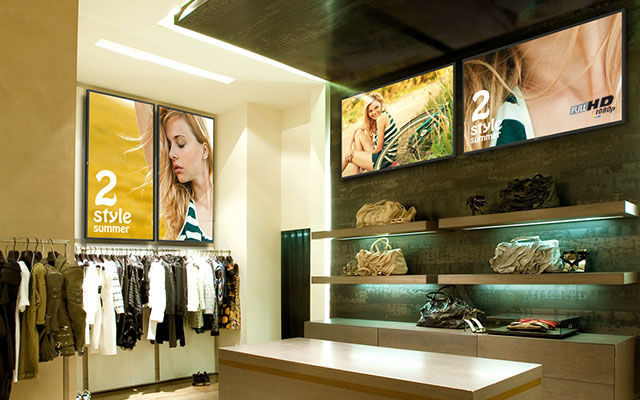
- Window-Facing Displays: A high-brightness big lcd display placed directly behind the storefront glass acts as a digital magnet, drawing foot traffic from the street.
- End-Cap and Feature Walls: Inside the store, large 4K LCDs display high-fidelity lifestyle videos (e.g., a fashion brand showing a runway loop) where color accuracy and contrast are paramount.
The Engineering Reality
- Combating Storefront Reflections: A display inside a glass window faces double reflection—glare from the store window itself, and glare off the LCD screen. High-brightness (3,000 nits) is required to “punch through” the reflections.
- Polarized Sunglass Viewability: Standard LCD panels emit polarized light. If a pedestrian wearing polarized sunglasses walks past a storefront, the screen may appear entirely black to them. Premium retail displays use a specialized Quarter Wave Plate (QWP) film to circularly polarize the light, ensuring the screen is visible regardless of the viewer’s eyewear.
4. Corporate Campuses & Higher Education
The modern corporate lobby or university student union is designed to impress visitors, attract talent, and communicate complex information rapidly.
Applications: Lobby Video Walls and Town Halls
- Architectural Video Walls: Tiling multiple ultra-narrow bezel (e.g., 0.88mm or 1.8mm bezel-to-bezel) LCD panels together creates a massive, seamless digital canvas. These are used to display corporate branding, real-time data dashboards, or digital art.
- Auditorium / Town Hall Displays: A 98-inch big lcd display is often replacing the traditional projector in medium-to-large conference rooms. Unlike projectors, LCDs are not washed out by ambient room lighting, allowing meetings to happen with the blinds open.
The Engineering Reality
- Color Calibration: When tiling multiple LCDs into a video wall, even a 2% difference in color temperature between the panels will look horrific to the human eye. Factory and on-site hardware color calibration is mandatory.
- EU Ecodesign & Energy Star: In the European market, large corporate deployments must strictly adhere to the updated Ecodesign Directive for electronic displays, which enforces stringent power consumption limits. Displays must feature ambient light sensors to automatically dim the backlight during the evening to remain compliant.
Strategic Procurement: Indoor vs. Outdoor Big LCD Displays
To simplify the procurement process, AV consultants use the following baseline matrix when specifying a big lcd display for a public space:
| Характеристика | Indoor Public Space (e.g., Mall, Airport) | Outdoor Public Space (e.g., Bus Shelter, Plaza) |
| Яркость | 500 – 700 Nits | 2,500 – 4,000 Nits (plus QWP film) |
| Operation Hours | 16/7 or 24/7 depending on usage | Круглосуточная работа 24/7/365 |
| Степень защиты оболочки (IP) | IP4X или IP5X (Защита от пыли) | IP56 или IP65 (Защита от воды и мелкой пыли) |
| Степень защиты от ударов (IK) | IK07 (Случайные удары) | IK10 (Вандалостойкое стекло) |
| Тепловой менеджмент | Пассивное охлаждение | Активное кондиционирование или воздухо-воздушные теплообменники |
| Технология панели | IPS или VA | IPS со сверхвысокой температурой Tni (110°C) |
5. Интеграция серверной части: Мозг большого ЖК-дисплея
Приобрести 98-дюймовый 4K экран — это просто. Вся скрытая сложность развертывания большого ЖК-дисплея в общественном пространстве полностью заключается в серверной части — программном обеспечении и медиаплеере, которые управляют его работой.
Подъем SoC (Система на кристалле)
Десять лет назад каждому коммерческому дисплею требовался громоздкий внешний ПК для вывода контента, подключенный через HDMI и спрятанный в перегретом AV-шкафу. Сегодня ведущие производители коммерческих ЖК-дисплеев (например, Samsung, LG, Philips) интегрируют мощную Систему на кристалле (SoC) непосредственно в дисплей.
Почему SoC важна
- Снижение точек отказа: Вы устраняете кабель HDMI, внешний блок питания и вентилятор внешнего ПК — все это распространенные точки отказа при круглосуточной работе.
- Экономическая эффективность: Вы больше не покупаете два устройства (экран и ПК), что значительно снижает себестоимость единицы продукции при развертывании сети из 50 экранов.
- Удаленное управление: Встроенные SoC обычно поставляются с надежным ПО для удаленного управления (например, Samsung MagicINFO или LG SuperSign). IT-менеджер в Лондоне может удаленно перезагрузить, обновить прошивку, контролировать внутреннюю температуру и изменить контент на дисплее, расположенном на станции метро в Париже, все через веб-браузер.
Заключение
Развертывание big lcd display в общественном пространстве больше не является экспериментом; это базовое ожидание современного потребителя, путешественника и сотрудника. Разница между успешной, окупаемой сетью цифровых вывесок и кошмаром постоянного обслуживания полностью сводится к выбору правильных аппаратных характеристик для среды эксплуатации.
Когда организация рассматривает 85-дюймовый ЖК-дисплей как промышленный инструмент, а не потребительскую игрушку — указывая корректную яркость, защиту от погодных условий, тепловой менеджмент и надежную интеграцию SoC — она открывает непревзойденную платформу для коммуникации, рекламных доходов и архитектурного улучшения.
Часто задаваемые вопросы (ЧЗВ)
В1: Можем ли мы просто купить самый большой потребительский телевизор в крупном магазине и повесить его в холле нашей компании, чтобы сэкономить?
О: Нет. Это самая распространенная и дорогостоящая ошибка, которую совершают компании. Потребительские телевизоры рассчитаны на работу 4-6 часов в день в темной гостиной. Если вы будете использовать их круглосуточно в ярко освещенном холле, блок питания выйдет из строя в течение года, на экране появится необратимое остаточное изображение (выгорание), а производитель мгновенно аннулирует гарантию, как только узнает, что устройство использовалось в коммерческих целях.
В2: Почему для навигации в торговом центре стоит выбрать большой ЖК-дисплей, а не видеостену на основе Direct-View LED (dvLED)?
О: Расстояние просмотра и плотность разрешения. 85-дюймовый 4K ЖК-дисплей имеет невероятно малый шаг пикселя (то есть вы можете стоять в метре от него и прекрасно читать мелкий текст). Чтобы достичь истинного разрешения 4K на видеостене dvLED, потребуются сотни тысяч долларов и огромная физическая площадь. Для интерактивных навигационных систем или розничной среды, где зритель находится вблизи, ЖК-дисплей остается намного превосходнее по четкости и стоимости.
В3: Что такое “Оптическое склеивание” и почему оно рекомендуется для уличных киосков?
О: Оптическое склеивание — это производственный процесс, при котором между ЖК-панелью и защитным стеклом заливается твердая прозрачная смола. Это устраняет воздушный зазор. Это дает два критических преимущества: Во-первых, это резко снижает внутренние блики, делая экран намного легче для чтения на солнце. Во-вторых, это предотвращает образование конденсата (тумана) внутри стекла в холодные утра, что губительно для электроники и портит впечатление от просмотра.
В4: Нам нужен уличный дисплей для Финикса, Аризона, где летние температуры достигают 115°F (46°C). Выдержит ли ЖК-дисплей?
О: Да, но только если вы выберете ЖК-дисплей с Панелью с высокой температурой Tni (Изотропная температура) и активно охлаждаемым корпусом со степенью защиты IP65. Стандартные жидкие кристаллы закипают и чернеют внутри при температуре около 85°C (185°F). Панели с высоким Tni могут выдерживать внутренние температуры до 110°C (230°F) до выхода из строя. В сочетании с внутренним блоком HVAC или высокоскоростными вентиляторами эти дисплеи специально разработаны для работы в условиях летней жары Ближнего Востока и юго-запада США.