¿Enfrenta un cuello de botella en su proyecto de pantalla integrada?
No permita que la integración compleja o los problemas de la cadena de suministro retrasen su tiempo de comercialización. Reserve una consulta gratuita con el equipo experto de RJY para obtener soporte personalizado en diseño y fabricación.
¿Cómo está compuesto un módulo LCD? Explicación de la estructura de un TFT LCD
Los LCD modernos son ensamblajes complejos de elementos ópticos, electrónicos y estructurales de precisión. Comprender las partes de un LCD no solo aclara cómo funcionan estas pantallas, sino que también ayuda a ingenieros y compradores a seleccionar la configuración adecuada para su aplicación.
Publicado:
Lectura de 14 minutos
Actualizado:
Un módulo LCD no es una sola pieza de vidrio. Es un conjunto de visualización en capas que combina materiales ópticos, control de cristal líquido, conmutación de transistores de película delgada, iluminación de retroiluminación, accionamiento de señales, soporte mecánico y, a veces, entrada táctil. Para ingenieros y compradores OEM, comprender cómo se compone un módulo LCD es útil porque cada capa afecta el rendimiento de la visualización, la dificultad de integración, el costo y las opciones de personalización.
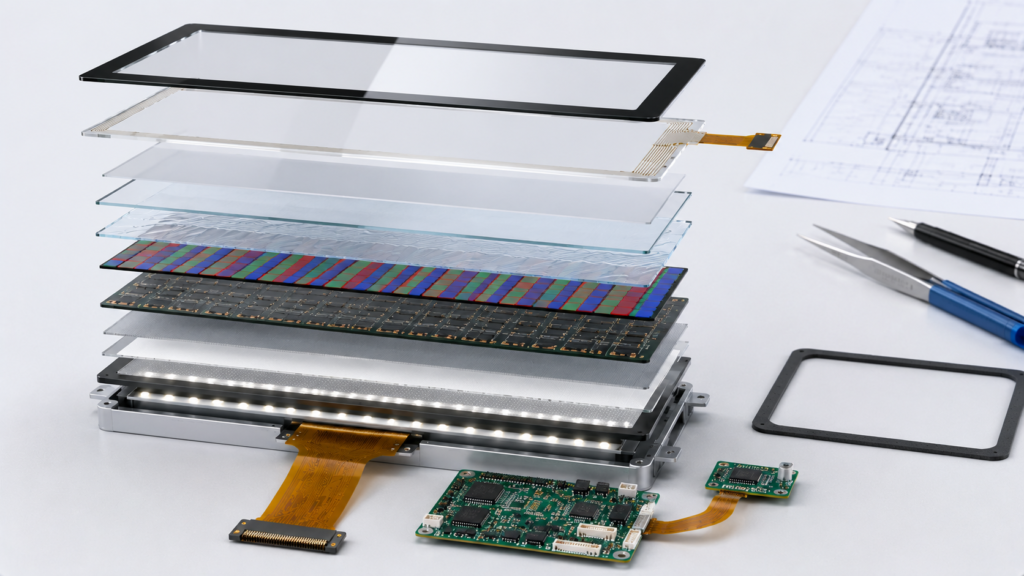
Un módulo TFT LCD típico puede incluir polarizadores, sustratos de vidrio, una capa de cristal líquido, un filtro de color, una matriz TFT, una unidad de retroiluminación, circuitos integrados de control, un cable FPC, conectores y, opcionalmente, un panel táctil o vidrio de cubierta. Corning describe un módulo LCD como una estructura TFT-LCD que incluye la matriz, el filtro de color y el cristal líquido, y también puede incluir retroiluminación y circuitos integrados de control, dependiendo de cómo se utilice el término.[1]
En el desarrollo de productos, esta estructura es importante porque un módulo LCD rara vez se selecciona solo por la resolución. El brillo, el ángulo de visión, la interfaz, el tipo táctil, el diseño de la retroiluminación, la posición del FPC, el vidrio de cubierta, el circuito integrado de control, la compatibilidad con la placa controladora y el ajuste mecánico influyen en si el módulo puede funcionar en el producto final.
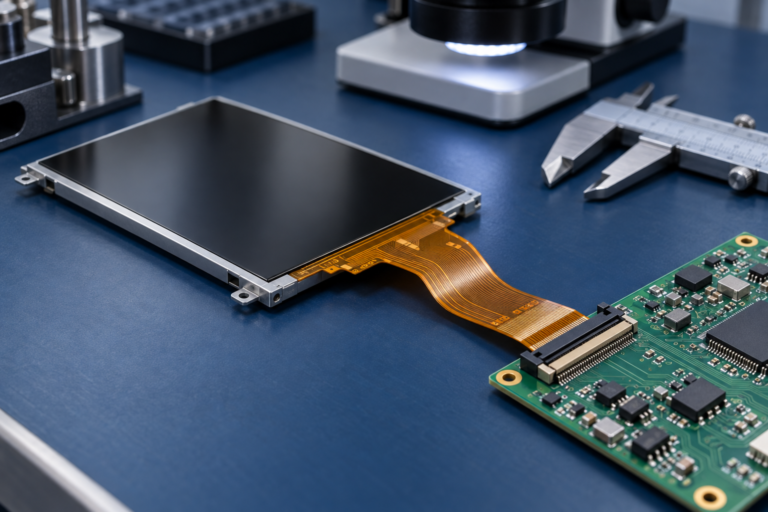
Composición de un módulo TFT LCD que muestra polarizador, capa de cristal líquido, filtro de color, retroiluminación, circuito integrado de control, FPC y panel táctil.
¿Qué es un módulo LCD?
Un módulo LCD, a menudo llamado LCM, es una unidad de visualización construida alrededor de un panel LCD y los componentes de soporte necesarios para que sea utilizable en un producto electrónico. El panel LCD en sí controla cómo pasa la luz a través de la estructura de píxeles, mientras que los componentes a nivel de módulo ayudan a proporcionar iluminación, conexión eléctrica, accionamiento de señales e integración mecánica.
Para dispositivos integrados simples, un módulo LCD puede ser una pantalla compacta con retroiluminación, circuito integrado de control y cable FPC. Para productos más complejos, el módulo LCD puede combinarse con un panel táctil, vidrio de cubierta, unión óptica, placa controladora, firmware personalizado o estructura de carcasa. Esta es la razón por la que dos módulos LCD con el mismo tamaño de pantalla y resolución pueden comportarse de manera muy diferente en aplicaciones reales.
Desde una perspectiva de ingeniería, el módulo LCD debe evaluarse como un sistema de visualización completo y no solo como un panel. Las capas internas determinan el rendimiento óptico, mientras que la conexión externa y la estructura mecánica deciden si la pantalla puede integrarse de manera confiable en el dispositivo final.
Polarizadores: Controlando la Trayectoria de la Luz
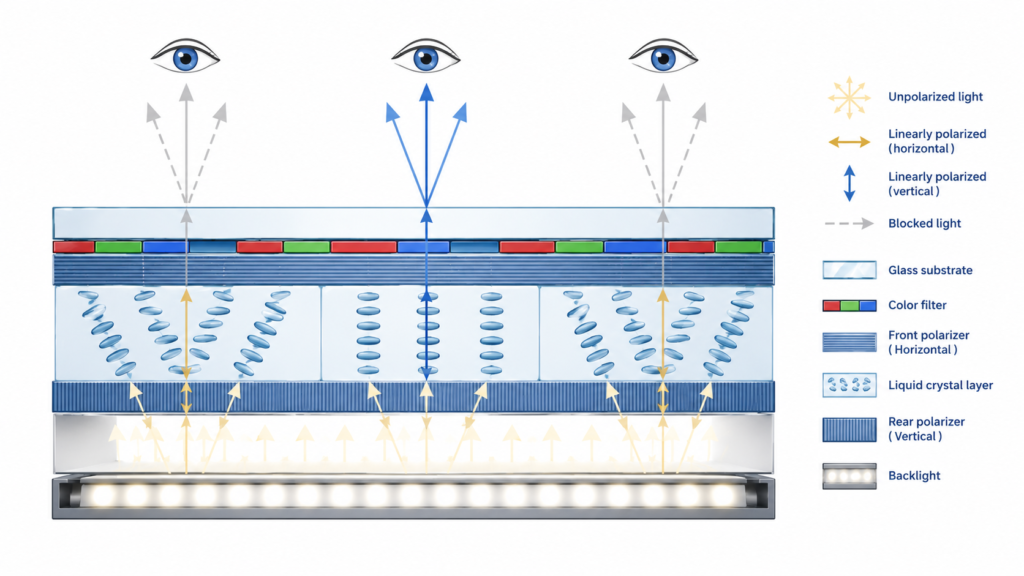
Los polarizadores son películas ópticas delgadas colocadas en los lados frontal y posterior de la celda LCD. Su función es controlar la dirección de las ondas de luz. Los LCD utilizan la interacción entre la luz polarizada y la orientación del cristal líquido para crear estados de brillo, oscuridad y escala de grises intermedios. Las referencias educativas de visualización comúnmente describen el funcionamiento del LCD como el uso de cristales líquidos junto con polarizadores para controlar los píxeles.[2]
El polarizador posterior recibe la luz del lado de la retroiluminación y la alinea antes de que entre en la capa de cristal líquido. El polarizador frontal filtra la luz después de que ha pasado a través de la capa de cristal líquido. Dependiendo del estado eléctrico del cristal líquido, puede pasar más o menos luz a través del polarizador frontal, creando un contraste visible.
Los polarizadores afectan directamente la legibilidad de la pantalla. Su calidad y coincidencia con la estructura LCD pueden influir en el contraste, el ángulo de visión, la eficiencia del brillo y el rendimiento con luz ambiental. Si un polarizador se raya, se delamina, se quema o se degrada por la exposición ambiental, la pantalla puede seguir encendiendo pero mostrar un contraste deficiente, color desigual o defectos superficiales visibles.
Para la mayoría de los módulos LCD, los polarizadores no se tratan como piezas reemplazables por el usuario. Si el polarizador está dañado, la reparación generalmente no es práctica a nivel de aplicación. Para productos industriales o para exteriores, la durabilidad del polarizador debe considerarse junto con el vidrio de cubierta, el tratamiento de superficie, la temperatura de funcionamiento y el riesgo de exposición a los rayos UV.
Sección transversal de un polarizador LCD que muestra cómo la luz polarizada pasa a través de la capa de cristal líquido.
Sustratos de Vidrio: La Base Estructural de la Celda LCD
La celda LCD se construye alrededor de dos sustratos de vidrio. Estas capas de vidrio proporcionan la estructura física que mantiene el material de cristal líquido en su lugar y soporta la arquitectura precisa de píxeles. Un sustrato lleva la matriz TFT, mientras que el otro lleva la estructura del filtro de color en un diseño TFT LCD típico.
El espacio entre los sustratos de vidrio debe controlarse cuidadosamente porque el grosor de la capa de cristal líquido afecta el comportamiento óptico. Si el espacio es desigual, la pantalla puede mostrar brillo no uniforme, variación de color o mura. Esta es una de las razones por las que la fabricación de LCD requiere un manejo, alineación y sellado precisos del vidrio.
Los sustratos de vidrio también influyen en la resistencia mecánica y el diseño del producto. Un panel LCD desnudo es frágil. Debe soportarse correctamente durante el ensamblaje del módulo y la integración final del dispositivo. La presión excesiva, la flexión, la tensión de la carcasa o un montaje incorrecto pueden dañar el vidrio, crear fugas de luz o afectar la uniformidad de la pantalla.
Cuando los ingenieros diseñan productos alrededor de un módulo LCD, deben evitar colocar presión sobre el área activa de la pantalla. La estructura mecánica debe soportar el módulo a través del marco, bisel o área de montaje recomendados, en lugar de forzar al vidrio del panel a soportar la carga estructural.
Capa de Cristal Líquido: La Válvula de Luz Central
La capa de cristal líquido es el núcleo funcional de un LCD. No genera luz por sí misma. En cambio, cambia cómo la luz polarizada pasa a través del panel. Cuando se aplica voltaje, la orientación de las moléculas de cristal líquido cambia, lo que altera la cantidad de luz transmitida a través de cada área de píxel.
Este comportamiento permite que el LCD controle el brillo, la escala de grises y el contraste. En un TFT LCD, cada subpíxel puede ser controlado por señales eléctricas a través de la matriz TFT. El resultado es una imagen completa formada por muchos subpíxeles rojos, verdes y azules controlados individualmente.
El modo de cristal líquido también influye en el ángulo de visión, el tiempo de respuesta, el contraste y la estabilidad del color. Las estructuras LCD TN, IPS y VA utilizan cristales líquidos, pero su alineación molecular y comportamiento de visualización son diferentes. Esta es la razón por la que seleccionar un módulo LCD requiere más que verificar el tamaño diagonal y la resolución. La tecnología del panel debe coincidir con el entorno de la aplicación y la posición de visualización del usuario.
Filtro de Color: Creando Subpíxeles Rojos, Verdes y Azules
Un TFT LCD a color utiliza una capa de filtro de color para convertir la retroiluminación controlada en imágenes a todo color. Cada píxel se divide típicamente en subpíxeles rojos, verdes y azules. Al ajustar la transmisión de luz de estos subpíxeles, la pantalla produce diferentes colores.
El filtro de color afecta la saturación del color, la uniformidad del color, la transmitancia y la calidad visual general. En una pantalla de estado simple, el rendimiento del color puede no ser el factor principal de selección. En un panel de control inteligente, una interfaz de dispositivo médico, una pantalla relacionada con vehículos o una HMI orientada al usuario, la consistencia del color puede volverse más importante.
El filtro de color también funciona junto con el espectro de la retroiluminación. Incluso si el panel LCD tiene un buen filtro de color, una mala selección de retroiluminación puede reducir la precisión del color o producir una apariencia inconsistente entre lotes. Para proyectos OEM, los requisitos de color de la pantalla deben discutirse temprano si la interfaz del producto depende de colores de marca precisos, indicadores de advertencia o diferenciación visual.
Matriz TFT: Control Eléctrico a Nivel de Píxel
La matriz TFT es la capa de control de matriz activa de un TFT LCD. Contiene transistores de película delgada que actúan como elementos de conmutación para subpíxeles individuales. Estos interruptores permiten que la pantalla controle cada área de píxel con mayor precisión que las tecnologías LCD de matriz pasiva más antiguas.
La matriz TFT es una de las razones por las que los módulos TFT LCD pueden soportar imágenes de alta resolución, actualizaciones rápidas de pantalla y control de escala de grises estable. Funciona con el circuito integrado de control para direccionar filas y columnas de píxeles según los datos de imagen proporcionados por el sistema anfitrión.
Para los ingenieros, la matriz TFT en sí misma generalmente no es un elemento personalizable a nivel de proyecto. Sin embargo, la tecnología del panel, la resolución, el ángulo de visión, el brillo, la interfaz y la configuración del controlador se ven afectados por el diseño del panel LCD. Un módulo que parece adecuado mecánicamente puede no cumplir con el proyecto si su interfaz, temporización o requisitos del controlador son incompatibles con el sistema anfitrión.
Unidad de Retroiluminación: La Fuente de Luz Detrás del LCD
Debido a que la mayoría de los LCD no emiten luz por sí mismos, necesitan una unidad de retroiluminación. La retroiluminación proporciona la iluminación que pasa a través de la estructura LCD y se convierte en la imagen visible. DigiKey describe las retroiluminaciones de pantalla como componentes utilizados para mejorar la visibilidad y legibilidad de la pantalla.[3]
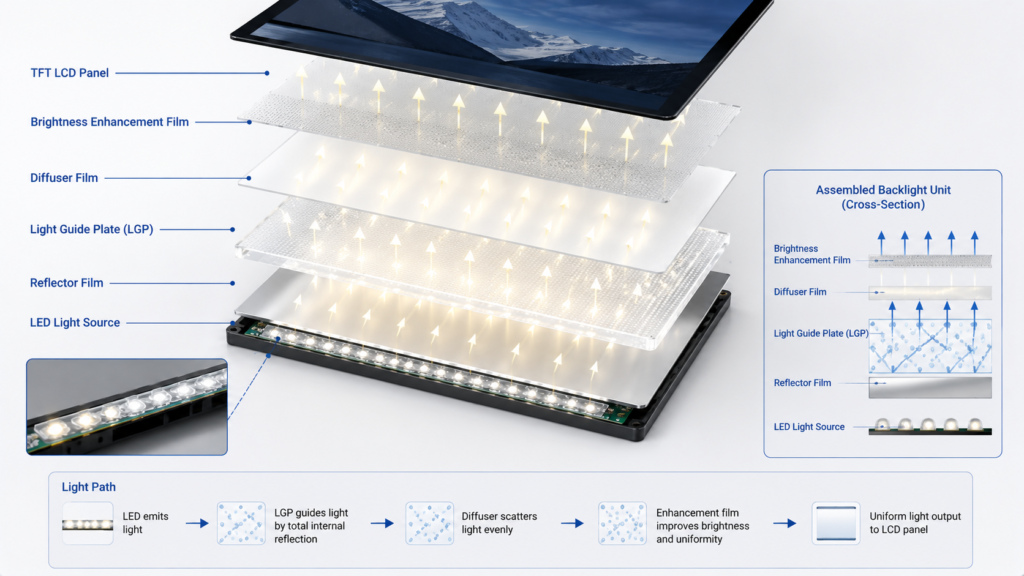
Una unidad de retroiluminación LCD típica puede incluir LED, una placa guía de luz, películas difusoras, películas reflectoras, películas de mejora de brillo y un FPC o estructura de conexión. El propósito es distribuir la luz de manera uniforme en toda el área de la pantalla. Un diseño de retroiluminación deficiente puede causar áreas oscuras, puntos brillantes, fugas en los bordes, color desigual o mala legibilidad.
El diseño de la retroiluminación afecta el brillo, el consumo de energía, el calor, el grosor, la vida útil y la legibilidad en exteriores. Una retroiluminación de alto brillo puede mejorar la visibilidad en condiciones de luz ambiental intensa, pero también puede aumentar el consumo de energía y la carga térmica. Para equipos sellados o compactos, la gestión del calor debe revisarse antes de aumentar el brillo.
Para dispositivos industriales, domóticos, de seguridad, relacionados con vehículos o para exteriores, la retroiluminación debe seleccionarse según el entorno operativo real. La pregunta no es simplemente qué tan brillante puede ser la pantalla. La mejor pregunta es si la pantalla permanece legible bajo las condiciones de iluminación esperadas sin crear problemas inaceptables de energía o térmicos.
Estructura de la unidad de retroiluminación LCD que muestra la fuente LED, la placa guía de luz, el difusor, el reflector y el panel TFT LCD.
Circuito Integrado de Control: Convirtiendo Datos de Imagen en Señales de Pantalla
El circuito integrado de control es el componente que controla cómo se aplican las señales eléctricas al panel de visualización. Traduce los datos de imagen y las señales de temporización en los patrones de voltaje requeridos por la matriz TFT y la capa de cristal líquido. Sin la configuración correcta del controlador, el panel LCD no puede mostrar la imagen prevista correctamente.
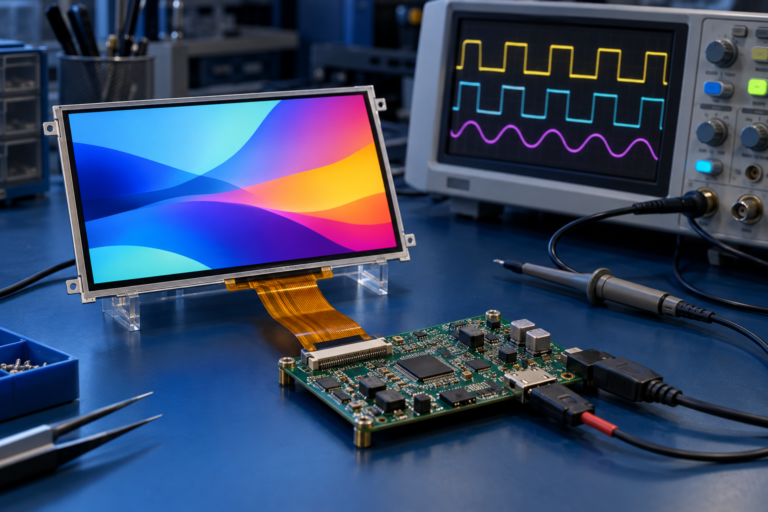
El circuito integrado de control está estrechamente relacionado con la resolución, la interfaz, el comportamiento de actualización, las características gamma, la secuencia de encendido y la temporización de la pantalla. En muchos módulos LCD compactos, el circuito integrado de control puede integrarse directamente en el vidrio o conectarse a través de la estructura FPC. En sistemas de visualización más grandes o complejos, pueden requerirse placas controladoras adicionales para convertir señales como HDMI, LVDS, MIPI, eDP, RGB u otras interfaces.
Para el desarrollo de productos, aquí es donde aparecen muchos problemas de compatibilidad. La pantalla puede tener el tamaño y la apariencia correctos, pero la placa base del cliente puede no soportar la interfaz o la temporización del panel. En estos casos, puede ser necesaria una placa controladora adecuada o una adaptación del firmware.
FPC y Conectores: El Puente Eléctrico hacia el Sistema
El FPC, o circuito impreso flexible, conecta el módulo LCD a la placa o controlador del cliente. Transporta señales de pantalla, alimentación, líneas de retroiluminación, señales táctiles o señales de control, dependiendo de la estructura del módulo.
El diseño del FPC afecta la integración del producto más de lo que muchos compradores esperan. Su longitud, dirección de curvatura, posición del conector, definición de pines, paso y diseño de refuerzo pueden determinar si la pantalla encaja en la carcasa final. Si el FPC sale en la dirección incorrecta, el producto puede requerir un rediseño mecánico incluso cuando la pantalla en sí es correcta.
Los conectores también son importantes. Un conector debe coincidir con el diseño de la PCB del cliente, el método de ensamblaje, las expectativas de confiabilidad y el proceso de producción. En equipos industriales o integrados, el enrutamiento del cable debe evitar curvas pronunciadas, piezas móviles, áreas de alto ruido y tensión mecánica excesiva.
Al solicitar un módulo LCD personalizado o de reemplazo, los compradores deben proporcionar el dibujo existente del FPC, la definición de pines, la información del conector y las restricciones mecánicas siempre que sea posible. Esto ayuda a reducir revisiones innecesarias de muestras.
Panel Táctil y Vidrio de Cubierta: Opcionales pero a Menudo Críticos
Muchos módulos LCD son solo de visualización. Otros están integrados con paneles táctiles y vidrio de cubierta. El panel táctil permite la entrada del usuario, mientras que el vidrio de cubierta protege la superficie de la pantalla y define la apariencia frontal del producto.
El táctil capacitivo proyectado, o PCAP, se usa ampliamente cuando el producto requiere una superficie de vidrio lisa, operación multitáctil y un comportamiento de interfaz moderno. El táctil resistivo sigue siendo útil en algunas aplicaciones que requieren entrada por presión, uso de lápiz óptico, operación con guantes o ciertas condiciones de funcionamiento robustas.
La personalización del vidrio de cubierta puede incluir tamaño, grosor, impresión de borde negro, área de logotipo, diseño de orificios, tratamiento de bordes y ajuste de forma. Debe diseñarse junto con la carcasa y los requisitos táctiles. El vidrio de cubierta grueso, los guantes, el agua o el ruido eléctrico pueden requerir ajuste táctil, especialmente para sistemas táctiles PCAP.
Para proyectos B2B, el táctil y el vidrio de cubierta no deben agregarse al final como accesorios cosméticos. Deben considerarse durante la etapa de selección de la pantalla porque pueden afectar el brillo, la sensibilidad táctil, la claridad óptica, el ajuste mecánico y el ensamblaje final del producto.
Cómo Func
An LCD module works because its layers are coordinated. The backlight creates illumination. The rear polarizer aligns light. The liquid crystal layer modulates the light under electrical control. The color filter creates RGB subpixels. The TFT array controls individual subpixels. The front polarizer filters the modulated light to produce contrast. The driver IC and FPC provide the electrical control path. The optional touch panel and cover glass add interaction and protection.
If one part is poorly matched, the final module performance can suffer. A strong backlight cannot fully solve poor viewing angle. A good LCD panel can still fail if the FPC position does not fit the housing. A high-quality touch panel may behave poorly if the cover glass thickness or controller tuning is wrong. A display with the correct resolution may still be unusable if the interface is incompatible with the customer’s board.
Componente
Función Principal
Engineering Impact
Polarizadores
Control polarized light transmission
Affect contrast, viewing angle, and readability
Sustratos de Vidrio
Support LCD cell structure and pixel alignment
Affect mechanical stability and display uniformity
Capa de Cristal Líquido
Modulate light under voltage control
Affect contrast, grayscale, response, and viewing behavior
Filtro de Color
Create red, green, and blue subpixels
Affect color performance and image quality
Matriz TFT
Control individual subpixels
Affect resolution, refresh behavior, and image precision
Unidad de Retroiluminación
Proporcionar iluminación detrás del panel LCD
Afectar el brillo, el consumo de energía, el calor y la legibilidad
IC Controlador
Convertir datos de imagen en señales de control de visualización
Afectar la interfaz, la sincronización, el gamma y la compatibilidad de visualización
FPC y Conector
Conectar el módulo al PCB o controlador del cliente
Afectar el ajuste mecánico, la definición de pines y la confiabilidad de la integración
Panel Táctil
Permitir la entrada del usuario
Afectar la interacción del usuario, el diseño del vidrio de cubierta y el ajuste del controlador
Vidrio de Cubierta
Proteger la superficie frontal y definir la apariencia
Afectar la durabilidad, el sellado, la claridad óptica y el diseño del producto
Qué deben verificar los ingenieros antes de seleccionar un módulo LCD
Antes de elegir un módulo LCD, los ingenieros deben confirmar tanto el rendimiento de visualización como los detalles de integración. Los parámetros básicos de visualización incluyen tamaño, resolución, área activa, brillo, ángulo de visión, contraste, interfaz, temperatura de funcionamiento y requisitos de retroiluminación. Estos parámetros determinan si el módulo puede cumplir con los requisitos visibles y eléctricos del producto.
Los detalles mecánicos y de integración son igualmente importantes. Los compradores deben verificar las dimensiones generales, el grosor, la posición del FPC, el tipo de conector, el espacio de montaje, los requisitos del vidrio de cubierta, la estructura táctil, el método de unión, el espacio libre del gabinete y el enrutamiento del cable. Si la pantalla debe conectarse a una placa base específica, la sincronización de la interfaz y los requisitos del controlador deben confirmarse antes del muestreo.
Para proyectos personalizados, también es importante definir si el cliente necesita un módulo LCD estándar, un módulo de pantalla táctil, una pantalla con vidrio de cubierta personalizado, una retroiluminación de alto brillo, modificación del FPC, soporte de placa controladora, adaptación de firmware o un ensamblaje de pantalla más completo. Los requisitos claros reducen el riesgo de seleccionar un módulo que parezca correcto pero que falle durante la integración del producto.
Opciones de personalización para módulos LCD
La personalización de módulos LCD suele ser más práctica cuando se parte de un módulo de pantalla existente y se modifica la estructura circundante. Las áreas comunes de personalización incluyen brillo, diseño de retroiluminación, FPC, interfaz, panel táctil, vidrio de cubierta, placa controladora, firmware y coordinación mecánica.
La personalización del brillo puede ser útil cuando la pantalla se utiliza en condiciones de alta luz ambiental. La personalización de la retroiluminación puede admitir diferentes requisitos de potencia o visibilidad. La personalización del FPC puede ayudar a que la pantalla se ajuste a un gabinete compacto. La personalización del vidrio de cubierta puede respaldar la apariencia del producto, la protección del panel frontal y la integración táctil. El soporte de la placa controladora puede ayudar a conectar el módulo LCD a HDMI, LVDS, MIPI, eDP, USB u otras interfaces del sistema según el proyecto.
No todos los componentes del LCD pueden cambiarse libremente sin costo o riesgo. Por ejemplo, cambiar el tamaño de la pantalla activa desde cero es muy diferente a modificar el vidrio de cubierta o la retroiluminación alrededor de un módulo existente. Los compradores deben discutir los objetivos de personalización temprano para que el proveedor pueda recomendar una estructura factible y una ruta de desarrollo.
Trabaje con RJY Display en la selección de módulos LCD
RJY Display proporciona productos TFT LCD, placas controladoras y soporte de personalización para proyectos de visualización B2B. Para equipos de producto que necesitan selección o personalización de módulos LCD, RJY Display puede ayudar a revisar el tamaño de la pantalla, la resolución, la interfaz, el brillo, el ángulo de visión, el requisito táctil, el diseño del FPC, el requisito de retroiluminación, la compatibilidad de la placa controladora y la estructura mecánica.
Si su proyecto requiere un módulo LCD TFT estándar, un módulo LCD táctil, una pantalla con vidrio de cubierta personalizado, una pantalla de alto brillo, una pantalla con soporte de placa controladora o personalización basada en un módulo LCD existente, contacte a RJY Display con los detalles de su proyecto. La información útil incluye tamaño de pantalla, resolución, interfaz, brillo, tipo táctil, entorno operativo, estructura del gabinete, demanda anual, requisito de muestra y cualquier modelo de referencia o ficha técnica.
Preguntas frecuentes
¿Cómo está compuesto un módulo LCD?
Un módulo LCD generalmente está compuesto por polarizadores, sustratos de vidrio, una capa de cristal líquido, un filtro de color, una matriz TFT, una unidad de retroiluminación, circuitos integrados controladores, un cable FPC, conectores y, opcionalmente, un panel táctil o vidrio de cubierta.
¿Cuál es la parte más importante de un módulo LCD?
Ninguna parte funciona por sí sola. La capa de cristal líquido, la matriz TFT, la retroiluminación, el circuito integrado controlador y los polarizadores son esenciales para la generación de imágenes, mientras que el FPC, el panel táctil y el vidrio de cubierta afectan la integración y la usabilidad.
¿Por qué un módulo LCD necesita una retroiluminación?
La mayoría de los LCD no emiten luz por sí mismos. La retroiluminación proporciona iluminación detrás del panel LCD para que la imagen pueda verse.
¿Qué hace la matriz TFT en un módulo LCD?
La matriz TFT controla subpíxeles individuales a través de transistores de película delgada. Esto permite que la pantalla muestre imágenes de alta resolución con un control preciso a nivel de píxel.
¿Se puede usar un módulo LCD sin un panel táctil?
Sí. Un panel táctil es opcional. Algunos productos utilizan módulos LCD solo de visualización, mientras que otros requieren táctil PCAP o resistivo según la interfaz de usuario y el entorno de aplicación.
¿Qué componentes del módulo LCD se pueden personalizar?
Las áreas comunes de personalización incluyen brillo, retroiluminación, FPC, interfaz, panel táctil, vidrio de cubierta, placa controladora, firmware y estructura mecánica. La viabilidad depende del módulo existente y los requisitos del proyecto.
¿Aún no sabe qué pantalla se adapta a su proyecto?
Hable con el equipo de ingeniería de RJY para obtener asesoramiento sobre compatibilidad de pantallas, revisión de placas controladoras y discusión sobre personalización.