Facing a bottleneck in your Embedded Display Project?
Don’t let complex integration or supply chain issues slow your time-to-market. Book a free consultation with the RJY expert team for tailored design and manufacturing support.

For procurement managers and supply chain executives navigating the high-stakes electronics markets, sourcing components is rarely just a transaction—it is a strategic alliance. You stand at the precise intersection where the engineering team’s impossible technical demands collide with the finance department’s impossible budget constraints. And when it comes to the "face" of your final product, nothing is more critical than the display. Choosing the right TFT LCD display manufacturer is a decision that will either secure your product’s market dominance or result in endless nights agonizing over Return Material Authorization (RMA) reports and sudden End-of-Life (EOL) notices.
Choosing a TFT LCD display manufacturer is not simply a matter of finding a company that can quote the required screen size. The supplier must be able to document the offered module, match it with the host system, control production revisions, support the required customization, and communicate changes before they disrupt the customer’s product.
The word “manufacturer” is also used broadly. One company may fabricate LCD panels, another may assemble modules around purchased panels, and another may coordinate displays, touchscreens, controller boards, firmware, and mechanical integration. The largest company or the company closest to the panel fabrication stage is not automatically the best supplier for an OEM project.
The correct choice depends on the work that must be completed, the evidence the supplier can provide, and the configuration the buyer needs to control from sampling through production.
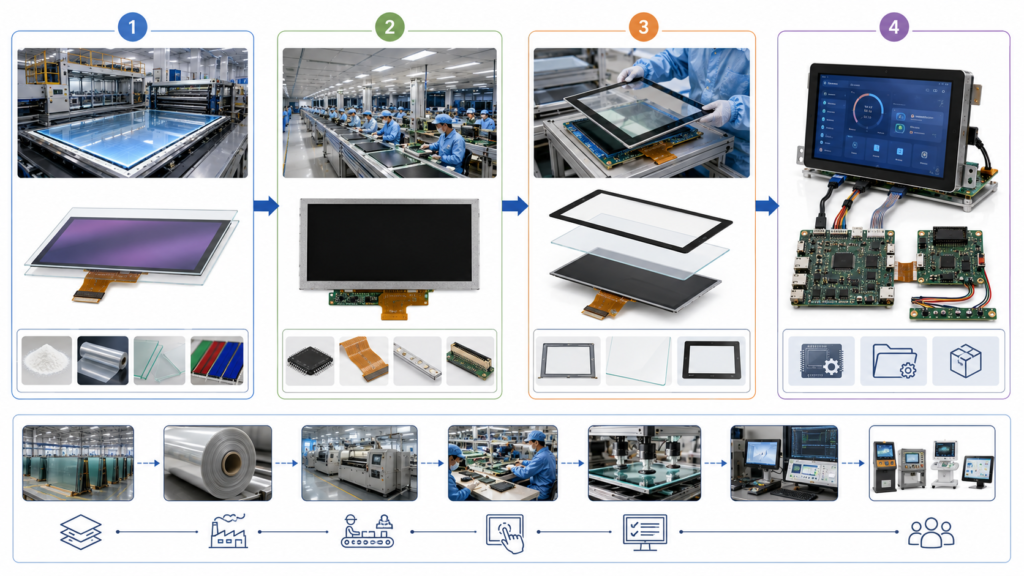
Before comparing companies, identify where the project sits in the display supply chain.
| Supplier Type | Typical Role | Best Fit | Potential Limitation |
|---|---|---|---|
| Panel manufacturer | Produces LCD cells or open-cell panels at large manufacturing scale | High-volume panel procurement and customers needing access to a defined panel platform | May not directly support small OEM quantities, custom FPCs, touch, controller boards, or application integration |
| LCD module manufacturer or integrator | Combines a panel with driver IC, FPC, backlight, frame, and other module components | OEM products requiring a complete TFT LCD module | Capabilities vary significantly by module size, process, engineering resources, and purchased components |
| Touch-display integrator | Combines an LCD with a touch sensor, controller, cover glass, and bonding structure | Projects in which the front lens and touch experience are central requirements | May not control the underlying LCD platform or host-side firmware |
| Display solution provider | Coordinates LCD selection, touch, controller board, firmware, cables, power, and mechanical integration | Embedded HMI and equipment projects needing system-level engineering support | Must clearly identify which manufacturing processes and components are internal, outsourced, or supplied by partners |
| Distributor or reseller | Provides access to existing products from one or more manufacturers | Standard products, replacement sourcing, samples, and established branded modules | May have limited authority over customization, BOM changes, firmware, or lifecycle policy |
None of these models is inherently unsuitable. The problem arises when the buyer expects one role while the supplier performs another. Ask who owns the product specification, who controls the BOM, who approves changes, who performs the customization, and who is responsible for engineering communication.
A supplier cannot be evaluated fairly against an incomplete requirement. If each company interprets “7-inch industrial touchscreen” differently, their samples and quotations will not represent the same product.
The initial requirement baseline should define:
Mark each requirement as mandatory, preferred, or flexible. This allows the supplier to propose an existing platform without quietly changing a critical product requirement.
Generic statements such as “supports MIPI,” “supports Android,” or “custom interface available” do not establish engineering capability. Give shortlisted suppliers an actual panel, host board, mechanical drawing, or compatibility problem and examine how they respond.
MIPI DSI is a defined host-to-display interface, but panel integration still depends on lane configuration, timing, operating mode, pixel format, initialization, power, and the physical connector implementation.[1]
NXP’s application note for a MIPI DSI display system demonstrates that integration involves panel power, reset, backlight GPIO, timing, signal polarity, pixel clock, D-PHY configuration, and a panel-specific driver.[2] A supplier that approves compatibility from interface name, resolution, and connector count alone has not completed an adequate review.
| Engineering Evidence | What a Useful Response Contains | Warning Sign |
|---|---|---|
| Datasheet review | Exact model, timing, pin definition, power, backlight, driver IC, and unresolved questions | Approval based only on size and resolution |
| Interface matching | Host and panel capabilities compared at board level | SoC capability used as proof that the actual board supports the panel |
| Mechanical review | Module outline, active area, FPC, connector, cover glass, and enclosure clearances | Fit approved from a product photograph |
| Touch review | Controller, interface, driver, coordinates, cover stack, and environment considered | Touch assumed to work because the LCD image works |
| Firmware scope | Supported board, image, panel, deliverables, revision limit, and validation method defined | Unlimited “custom firmware” promised without a controlled platform |
The objective is not to demand a complete design before placing an order. It is to determine whether the supplier identifies the real engineering dependencies and documents what remains unconfirmed.
The supplier should be able to identify exactly what will be sampled and exactly what will be delivered in production. A marketing product name is not sufficient configuration control.
Request a controlled specification package containing the applicable items:
Ask how document revisions are issued, approved, and linked to production. A supplier can have capable engineers and still create risk if drawings sent during sampling are not connected to the BOM and work instructions used for production.
ISO 9001 defines requirements for establishing, maintaining, and continually improving a quality management system. ISO also notes that certification is optional and that organizations or customers may audit the system themselves.[3]
A certificate can therefore be useful evidence, but it does not independently prove that a particular display meets the customer’s optical, electrical, mechanical, environmental, or lifecycle requirements.
If a supplier presents a quality certificate, verify:
| Certificate Item | Why It Matters |
|---|---|
| Legal organization name | Confirms the certified entity is the company or facility being evaluated |
| Site address | Shows which location falls within the certification scope |
| Standard and edition | Avoids relying on a generic “ISO certified” statement |
| Certification scope | Shows whether relevant display or electronics activities are included |
| Issuing certification body | Allows the buyer to examine certificate provenance |
| Validity and certificate status | Identifies expired, suspended, or superseded evidence |
Then examine how the system works for the proposed product. Useful evidence includes incoming-material controls, process instructions, inspection records, equipment calibration, operator training, nonconforming-material control, traceability, corrective action, and document revision history.
Do not impose one generic defect-rate target on every display project. Cosmetic acceptance, functional failures, sampling plans, test methods, and escalation rules should be agreed for the actual application.
A finished TFT LCD module contains purchased and processed elements that may include the LCD panel, driver IC, FPC, connector, backlight, frame, polarizers, touch controller, sensor, cover glass, adhesive, and cables. Final visual inspection alone cannot control every source of variation.
| Control Stage | Evidence to Request |
|---|---|
| Incoming control | Material identification, supplier status, inspection criteria, lot records, and nonconformance handling |
| Process control | Work instructions, controlled settings, operator authorization, equipment checks, and in-process records |
| Functional inspection | Display patterns, interface operation, backlight, touch, current, and project-specific functions |
| Cosmetic inspection | Lighting, viewing distance, inspection area, defect definitions, and acceptance criteria |
| Outgoing control | Lot release, model and revision check, quantity, packaging, labeling, and shipment traceability |
Ask for anonymized sample records if confidential production documents cannot be shared. The goal is to verify that controls exist and connect to the exact product, not to obtain another customer’s proprietary information.
There is no universal reliability test condition that qualifies every TFT LCD for every use. Temperature, humidity, vibration, shock, ESD, UV exposure, operating duration, mounting, and acceptance criteria depend on the product environment and applicable requirements.
IEC environmental-test standards illustrate why test claims need complete conditions. For example, IEC 60068-2-57 defines procedures for evaluating a specimen under specified transient-vibration severities.[4] A statement such as “vibration tested” is incomplete without the method, mounting, axes, profile, severity, duration, sample configuration, and pass/fail criteria.
For each required test, document:
Do not accept test data from a visually similar display as qualification for the proposed module unless the relationship between configurations is technically justified and approved.
Customization capability should be assessed against the work the supplier actually controls. A company that can prepare custom cover glass may not control LCD-cell design. A supplier that can modify an FPC may not be able to change the panel’s native resolution or driver architecture.
RJY Display’s practical customization scope is based on existing display modules. Depending on feasibility, a project can coordinate cover glass, touchscreen, backlight, FPC, interface, controller board, firmware, and mechanical structure. It should not be presented as unrestricted development of any new LCD size.
| Customization Area | Evidence to Request |
|---|---|
| Cover glass | Drawing, artwork, tolerance, edge details, bonding interface, sample approval, and cosmetic criteria |
| Touchscreen | Sensor and controller definition, FPC, host interface, driver, coordinate mapping, and validation plan |
| Backlight | Electrical requirements, driver path, dimming, power, thermal review, and confirmed brightness target |
| FPC | Schematic, pinout, layout, connector, orientation, mechanical envelope, and sample test |
| Controller board | Board revision, implemented interfaces, input modes, power, backlight, touch path, and firmware |
| Firmware | Supported platform, deliverables, source or binary status, revision scope, ownership, and validation |
Use the custom TFT LCD display guide to prepare the broader customization requirements before assessing suppliers.
A sample should not be approved only because it powers on. Record the exact hardware and software configuration used during evaluation.
The sample record should identify:
Once approved, determine how this configuration becomes the production reference. A retained golden sample can be useful, but it should be supported by controlled specifications and acceptance criteria. A physical sample alone cannot define hidden component revisions or firmware contents.
Ask how the supplier responds when a defect is discovered during incoming inspection, assembly, field use, or production. The exact corrective-action format can vary; the important point is whether the process contains evidence, containment, root-cause analysis, corrective action, verification, and recurrence prevention.
A useful problem report should identify:
Be cautious when every failure is attributed to user handling without inspection evidence, or when replacement units are offered without identifying whether the underlying production risk remains.
No supplier should be assumed to guarantee a display indefinitely. LCD panels, driver ICs, touch controllers, LEDs, connectors, memory, and other components can change or become unavailable.
Ask the supplier to explain its process for:
Do not assume a three-year, five-year, or ten-year supply guarantee unless it is provided for the exact model under a written agreement. Likewise, do not assume that an alternative panel or driver IC will be pin-compatible, mechanically compatible, or firmware-compatible.
If the current module is already unavailable, use a structured discontinued TFT LCD replacement process rather than accepting a substitute from its size and connector alone.
A display module does not automatically inherit every approval required by the finished equipment. Determine which material declarations, test reports, management-system certificates, traceability records, or customer-specific documents apply to the target product and market.
For each document, confirm:
| Document Check | Question |
|---|---|
| Entity | Which company or facility issued or holds the document? |
| Product coverage | Does it identify the exact component, family, material, or process? |
| Standard or regulation | Which edition, requirement, exemption, or market is referenced? |
| Date and validity | Is the document current for the proposed production configuration? |
| Revision relationship | Does a BOM or material change require a new declaration or test? |
| Finished-product responsibility | Which compliance activities remain with the equipment manufacturer? |
A supplier logo, website badge, or statement that a product is “medical,” “automotive,” or “industrial grade” is not a substitute for application-specific evidence.
Two suppliers can quote the same nominal display at different prices because their scope is different. Normalize the quotations before scoring commercial competitiveness.
| Commercial Item | What to Compare |
|---|---|
| Product configuration | LCD, touch, cover glass, FPC, cable, backlight, board, firmware, and packaging |
| NRE and tooling | Deliverables, ownership, revisions, maintenance, and refund or credit terms if applicable |
| Samples | Quantity, configuration, firmware, assembly, validation, and shipping |
| Production price | Same order quantity, currency, validity period, and component scope |
| MOQ | Standard module, each custom component, production order, and any annual commitment |
| Delivery basis | Incoterm, named place, freight, insurance, duties, taxes, and destination handling |
| Payment and warranty | Payment stages, inspection window, warranty scope, exclusions, and remedy |
ICC’s Incoterms rules define responsibilities, costs, and risk between buyer and seller in international transactions.[5] Record the selected rule and named place so that an apparent price difference is not merely a difference in freight or import responsibility.
RJY Display’s current FAQ gives a general reference that custom products typically require an MOQ of 500 units or more.[6] The actual MOQ must still be confirmed for the display and each custom component. Industry-wide MOQ averages should not be treated as promises from an individual supplier.
Good communication is not defined by response speed alone. A fast, unconditional “yes” can create more risk than a slower response that identifies missing information.
During supplier evaluation, examine whether the company:
For projects serving several countries, also determine how specifications, drawings, translations, and approvals will be controlled. A translated document should not become a different technical specification.
| Evaluation Area | Evidence to Collect | Decision Question |
|---|---|---|
| Supplier role | Legal entity, site, controlled processes, subcontracted work, and product responsibility | Does the business model fit the required project? |
| Engineering | Datasheet review, marked drawings, compatibility analysis, and unresolved-item list | Can the supplier evaluate the complete display system? |
| Documentation | Specification, drawing, pinout, timing, BOM control, and revision process | Can the production configuration be identified and reproduced? |
| Quality system | Applicable certificate, procedures, records, traceability, and audit results | Do documented controls operate on the proposed product? |
| Testing | Test plan, conditions, sample configuration, acceptance criteria, and reports | Does the evidence match the application requirements? |
| Customization | Existing base module, controlled changes, tooling, deliverables, and sample plan | Is the requested customization within demonstrated capability? |
| Lifecycle | PCN, EOL, substitution, last-time-buy, and replacement procedures | Can changes be managed before they disrupt production? |
| Corrective action | Example containment, root-cause, corrective-action, and effectiveness records | Can failures be investigated and prevented from recurring? |
| Commercial scope | Normalized quotation, MOQ, NRE, sample, delivery, payment, and warranty terms | Is the total project scope clear and comparable? |
| Communication | Response accuracy, revision discipline, meeting records, and escalation path | Can engineering and procurement decisions remain traceable? |
Use the matrix first as a pass-or-investigate tool. A weighted score can be added later based on the actual product risk; it should not hide a critical failure in compatibility, documentation, compliance, or change control.
Prepare a supplier package containing:
Ask each shortlisted supplier to respond to the same package. This produces comparable technical proposals and reveals where assumptions remain.
RJY Display can review an existing TFT LCD platform against your display, interface, touch, cover-glass, backlight, FPC, controller-board, firmware, mechanical, quantity, and documentation requirements.
Review RJY Display’s custom solution scope, view the factory information, or send your project documents for engineering review.
An LCD panel manufacturer produces the LCD cell or open-cell panel. A TFT LCD module manufacturer or integrator combines a panel with components such as the driver IC, FPC, backlight, frame, connector, and sometimes touch. Buyers should confirm which processes and product responsibilities the supplier actually controls.
No. ISO 9001 concerns the supplier’s quality management system. The certificate scope, site, status, and issuing body should be checked, but the display must still be validated against the project’s optical, electrical, mechanical, environmental, regulatory, and lifecycle requirements.
There is no industry-wide MOQ that applies to every supplier or project. RJY Display’s current general reference is that custom products typically require 500 units or more, but the actual MOQ depends on the base module, custom components, tooling, purchasing requirements, and project scope.
Provide a real project requirement and request marked drawings, a defined base module, engineering questions, customization deliverables, tooling scope, sample plan, firmware boundary, and validation method. General claims or equipment photographs do not prove that the supplier can complete the required configuration.
Record the LCD model and revision, touch controller, cover glass, FPC, cables, controller-board revision, firmware or driver version, power and backlight configuration, test application, mechanical assembly, known deviations, and the controlled documents used for approval.
Review the supplier’s PCN, component-substitution, EOL, last-time-buy, replacement, revision-control, and customer-approval procedures. Do not assume a fixed supply guarantee or advance-notice period unless it is stated for the exact product in a written agreement.
Share your display size, resolution, interface, brightness, touch requirement, controller board requirement, and application environment.
Continue reading related display technology guides and application references.
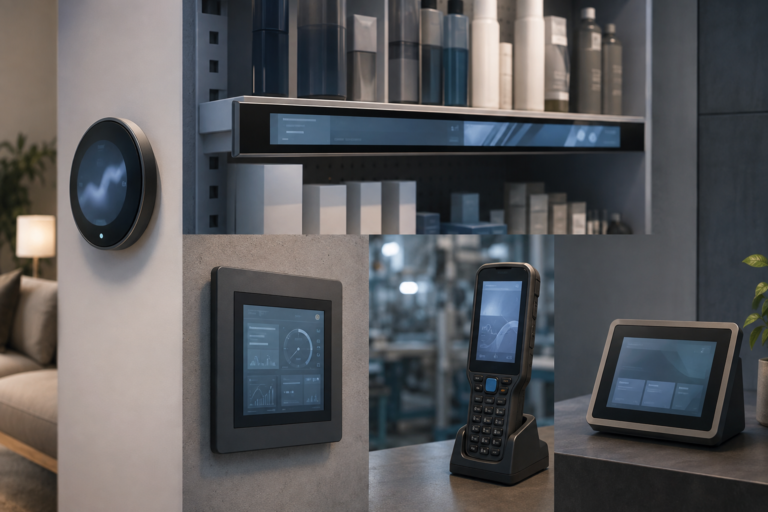


Explore product pages related to this article topic.

Talk to RJY’s engineering team for display matching, controller board review, and customization discussion.