








- 1. Transportation Hubs: The Mission-Critical Display
- 2. Digital Out-of-Home (DOOH) & Smart City Furniture
- 3. Retail Environments: Winning the Window
- 4. Corporate Campuses & Higher Education
- Strategic Procurement: Indoor vs. Outdoor Big LCD Displays
- 5. Integrazione del backend: Il cervello del grande LCD
- Conclusione
- Domande frequenti (FAQ)
- D1: Possiamo semplicemente acquistare il televisore consumer più grande da un grande rivenditore e appenderlo nell'atrio aziendale per risparmiare?
- D2: Perché dovrei scegliere un grande display LCD invece di una parete a LED a visione diretta (dvLED) per una mappa di un centro commerciale?
- Q3: What is "Optical Bonding," and why is it recommended for outdoor kiosks?
- D4: Abbiamo bisogno di un display esterno a Phoenix, Arizona, dove le temperature estive raggiungono i 115°F (46°C). Un LCD sopravvivrebbe?
In the evolving landscape of urban architecture, commercial real estate, and transit infrastructure across North America and Europe, static signage is effectively dead. The modern public space is expected to be dynamic, interactive, and endlessly adaptable. At the core of this digital transformation is a piece of hardware that has evolved from a simple consumer television into a ruggedized, hyper-bright piece of civic infrastructure: the big lcd display.
While Direct-View LED (dvLED) gets much of the media attention for massive stadium screens, the large-format LCD (typically ranging from 55 inches to 98 inches and above) remains the undisputed champion for environments where the audience is up close, where ultra-high definition (4K and 8K) is required, and where touch interactivity is paramount.
This comprehensive guide explores the strategic applications of deploying a big lcd display in public spaces. We will bypass the marketing fluff and dive straight into the operational realities, engineering challenges, and return on investment (ROI) metrics that AV integrators and procurement managers must understand.

1. Transportation Hubs: The Mission-Critical Display
Airports, train stations, and subway terminals are arguably the most punishing environments for digital signage. A display in these locations is not merely decorative; it is a vital operational tool.
Applications: FIDS and Wayfinding
- Flight/Passenger Information Display Systems (FIDS): A multi-screen video wall comprised of ultra-narrow bezel LCDs is the standard for FIDS. Passengers rely on these screens for real-time gate changes, delays, and boarding statuses.
- Interactive Wayfinding: A standalone, vertically oriented big lcd display equipped with PCAP (Projected Capacitive) touch allows travelers to map their route to a specific terminal, locate restrooms, or find a specific retail outlet.
The Engineering Reality
Deploying a big lcd display in a major transit hub like London Heathrow or Chicago O’Hare requires rigorous hardware specifications:
- 24/7/365 Operation: Consumer-grade televisions will burn out their power supplies within months if run continuously. Commercial LCDs feature heavy-duty capacitors, advanced thermal dissipation, and image-retention mitigation algorithms.
- Redundancy and Failover: If the primary media player crashes, the display must automatically switch to a backup input or display a cached emergency message. A blank screen in an airport creates immediate crowd-panic.
- High MTBF (Mean Time Between Failures): Procurement teams must specify displays with an MTBF of at least 50,000 hours to minimize maintenance disruptions in secure, hard-to-reach terminal areas.
2. Digital Out-of-Home (DOOH) & Smart City Furniture
The European and US outdoor advertising markets have shifted heavily toward programmatic DOOH. This means the billboard on the street corner is no longer selling a single ad for a month; it is cycling through targeted, time-of-day specific advertisements.
Applications: Street Kiosks and Transit Shelters
- Bus and Tram Shelters: A 75-inch or 86-inch big lcd display integrated into the side of a bus shelter provides dual value: real-time transit arrival data on the top third of the screen, and high-CPM (Cost Per Mille) advertising on the bottom two-thirds.
- Smart City Totems: Municipalities are deploying large LCD totems that provide free public Wi-Fi, emergency broadcast capabilities, and hyper-local civic information, subsidized entirely by the advertising space.
The Engineering Reality
Outdoor deployment is a brutal battle against the elements.
- The Solar Load Problem: If direct sunlight hits an unprotected LCD panel, the liquid crystals will physically boil and enter an “isotropic state,” turning the screen into a massive black blotch. An outdoor big lcd display must feature advanced HVAC (Heating, Ventilation, and Air Conditioning) or active fan cooling systems inside the enclosure to keep the panel below 85°C.
- Luminance Wars: An indoor display operates at around 350 to 500 nits. To be readable in direct summer sunlight in Madrid or Los Angeles, an outdoor LCD must push a minimum of 2,500 to 4,000 nits.
- IK10 Vandal Resistance: The glass protecting the display must be optically bonded, chemically strengthened, and rated IK10 to withstand a direct strike from a blunt object.
3. Retail Environments: Winning the Window
Brick-and-mortar retail in the post-e-commerce era must offer an experiential advantage. Retailers use large-format displays to bridge the gap between their digital brand and physical storefront.
Applications: Window Facing and Experiential Retail
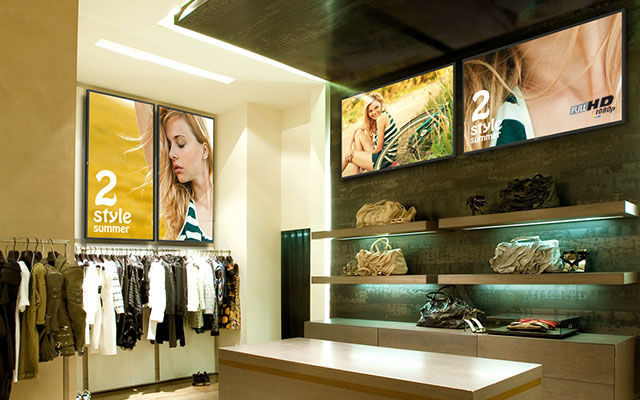
- Window-Facing Displays: A high-brightness big lcd display placed directly behind the storefront glass acts as a digital magnet, drawing foot traffic from the street.
- End-Cap and Feature Walls: Inside the store, large 4K LCDs display high-fidelity lifestyle videos (e.g., a fashion brand showing a runway loop) where color accuracy and contrast are paramount.
The Engineering Reality
- Combating Storefront Reflections: A display inside a glass window faces double reflection—glare from the store window itself, and glare off the LCD screen. High-brightness (3,000 nits) is required to “punch through” the reflections.
- Polarized Sunglass Viewability: Standard LCD panels emit polarized light. If a pedestrian wearing polarized sunglasses walks past a storefront, the screen may appear entirely black to them. Premium retail displays use a specialized Quarter Wave Plate (QWP) film to circularly polarize the light, ensuring the screen is visible regardless of the viewer’s eyewear.
4. Corporate Campuses & Higher Education
The modern corporate lobby or university student union is designed to impress visitors, attract talent, and communicate complex information rapidly.
Applications: Lobby Video Walls and Town Halls
- Architectural Video Walls: Tiling multiple ultra-narrow bezel (e.g., 0.88mm or 1.8mm bezel-to-bezel) LCD panels together creates a massive, seamless digital canvas. These are used to display corporate branding, real-time data dashboards, or digital art.
- Auditorium / Town Hall Displays: A 98-inch big lcd display is often replacing the traditional projector in medium-to-large conference rooms. Unlike projectors, LCDs are not washed out by ambient room lighting, allowing meetings to happen with the blinds open.
The Engineering Reality
- Color Calibration: When tiling multiple LCDs into a video wall, even a 2% difference in color temperature between the panels will look horrific to the human eye. Factory and on-site hardware color calibration is mandatory.
- EU Ecodesign & Energy Star: In the European market, large corporate deployments must strictly adhere to the updated Ecodesign Directive for electronic displays, which enforces stringent power consumption limits. Displays must feature ambient light sensors to automatically dim the backlight during the evening to remain compliant.
Strategic Procurement: Indoor vs. Outdoor Big LCD Displays
To simplify the procurement process, AV consultants use the following baseline matrix when specifying a big lcd display for a public space:
| Specifiche | Indoor Public Space (e.g., Mall, Airport) | Outdoor Public Space (e.g., Bus Shelter, Plaza) |
| Luminosità | 500 – 700 Nits | 2,500 – 4,000 Nits (plus QWP film) |
| Operation Hours | 16/7 or 24/7 depending on usage | Rigorosamente 24 ore su 24, 7 giorni su 7, 365 giorni l'anno |
| Grado di Protezione (IP) | IP4X o IP5X (Resistente alla polvere) | IP56 o IP65 (Impermeabile e protetto dalla polvere fine) |
| Protezione dagli urti (IK) | IK07 (Urto accidentale) | IK10 (Vetro anti-vandalismo) |
| Gestione termica | Raffreddamento passivo | Raffreddamento attivo AC o scambiatori di calore aria-aria |
| Tecnologia del pannello | IPS o VA | IPS con Tni ultra-alto (110°C) |
5. Integrazione del backend: Il cervello del grande LCD
Procurare uno schermo 4K da 98 pollici è la parte facile. La complessità nascosta della distribuzione di un grande display LCD in uno spazio pubblico risiede interamente nel backend—il software e il media player che gli dicono cosa fare.
L'ascesa del SoC (System on a Chip)
Dieci anni fa, ogni display commerciale richiedeva un ingombrante PC esterno per pilotare i contenuti, collegato via HDMI e nascosto in un armadio AV surriscaldato. Oggi, i principali produttori di LCD commerciali (ad es., Samsung, LG, Philips) integrano un potente System on a Chip (SoC) direttamente all'interno del display.
Perché il SoC è importante
- Riduzione dei punti di guasto: Si eliminano il cavo HDMI, l'alimentatore esterno e la ventola del PC esterno—tutti punti di guasto comuni nelle operazioni 24/7.
- Efficienza dei costi: Non si acquistano più due componenti hardware (uno schermo e un PC), riducendo significativamente il costo BOM per unità in un rollout di 50 schermi.
- Gestione remota: I SoC integrati sono solitamente dotati di un software di gestione remota robusto (come Samsung MagicINFO o LG SuperSign). Un responsabile IT a Londra può riavviare da remoto, aggiornare il firmware, monitorare la temperatura interna e cambiare i contenuti su un display situato in una stazione della metropolitana di Parigi, tutto da un browser web.
Conclusione
La distribuzione di un big lcd display in uno spazio pubblico non è più un esperimento; è l'aspettativa di base del consumatore, del viaggiatore e del dipendente moderni. La differenza tra una rete di digital signage di successo, con ROI positivo, e un incubo di manutenzione costante dipende interamente dalla selezione delle specifiche hardware giuste per l'ambiente.
Quando un'organizzazione tratta un LCD da 85 pollici come uno strumento industriale piuttosto che un giocattolo consumer—specificando la corretta luminosità, la resistenza agli agenti atmosferici, la gestione termica e una robusta integrazione SoC—sblocca una piattaforma senza pari per la comunicazione, i ricavi pubblicitari e il miglioramento architettonico.
Domande frequenti (FAQ)
D1: Possiamo semplicemente acquistare il televisore consumer più grande da un grande rivenditore e appenderlo nell'atrio aziendale per risparmiare?
A: No. Questo è l'errore più comune e costoso che le aziende commettono. I televisori consumer sono progettati per funzionare 4-6 ore al giorno in un salotto buio. Se li si fa funzionare 24/7 in un atrio luminoso, l'alimentatore si guasterà entro un anno, lo schermo soffrirà di ritenzione d'immagine permanente (burn-in) e il produttore annullerà immediatamente la garanzia non appena si renderà conto che è stato utilizzato in un contesto commerciale.
D2: Perché dovrei scegliere un grande display LCD invece di una parete a LED a visione diretta (dvLED) per una mappa di un centro commerciale?
A: Distanza di visione e densità di risoluzione. Un LCD 4K da 85 pollici ha una distanza tra pixel incredibilmente ridotta (significa che si può stare a un metro di distanza e leggere perfettamente testi piccoli). Per ottenere una vera risoluzione 4K su una parete dvLED, costerebbe centinaia di migliaia di dollari e richiederebbe un'enorme impronta fisica. Per mappe interattive o ambienti retail in cui lo spettatore è a distanza ravvicinata, l'LCD rimane di gran lunga superiore in termini di nitidezza e costo.
D3: Cos'è l“”Optical Bonding" e perché è consigliato per i chioschi esterni?
A: L'Optical Bonding è un processo produttivo che inietta una resina solida e trasparente tra il pannello LCD e il vetro di copertura protettivo. Elimina l'intercapedine d'aria. Questo fa due cose cruciali: primo, riduce drasticamente i riflessi interni, rendendo lo schermo molto più leggibile al sole. Secondo, impedisce la formazione di condensa (appannamento) all'interno del vetro nelle mattine fredde, che è letale per l'elettronica e rovina l'esperienza visiva.
D4: Abbiamo bisogno di un display esterno a Phoenix, Arizona, dove le temperature estive raggiungono i 115°F (46°C). Un LCD sopravvivrebbe?
A: Sì, ma solo se si specifica un LCD con un pannello ad alto Tni (Temperatura Isotropica) e un involucro IP65 a raffreddamento attivo. I cristalli liquidi standard bollono e diventano neri intorno agli 85°C (185°F) internamente. I pannelli ad alto Tni possono sopportare temperature interne fino a 110°C (230°F) prima di guastarsi. Combinati con un'unità HVAC interna o ventole ad alta velocità, questi display sono progettati specificamente per sopravvivere alle estati del Medio Oriente e degli Stati Uniti sud-occidentali.