








- Il Concetto Fondamentale: Cosa Compone uno Schermo LCD?
- The Physics of Light: Polarization
- Cosa Sono i Cristalli Liquidi?
- The Layer-by-Layer Anatomy of an LCD Panel
- Il Ruolo della Retroilluminazione negli Schermi LCD
- Come si Formano i Pixel nei Display LCD
- Come i Filtri Colore Creano l'Output RGB
- Filtro colore
- Diversi tipi di tecnologie LCD
- Driving the Display: Active Matrix vs. Passive Matrix
- Modern Innovations: LED, Mini-LED, and Beyond
- Why LCD Still Wins: Performance and Longevity
- Domande frequenti (FAQ)
- 12. Conclusion
- 13. References & Further Reading
From the digital watch on your wrist to the massive 8K commercial digital signage in city centers, flat-panel displays dominate our visual landscape. But despite interacting with them daily, many professionals and tech enthusiasts still find themselves asking: how does an LCD display work?
At its core, LCD stands for Liquid Crystal Display. It is a flat-panel display technology that utilizes a unique, intermediate state of matter—liquid crystals—to modulate light. Unlike emissive display technologies such as OLED (Organic Light Emitting Diode) or legacy CRTs (Cathode Ray Tubes), LCDs do not produce their own light. Instead, they operate as highly sophisticated optical shutters. They manipulate a constant backlight through controlled polarization, electrical fields, and color filtering to render visible, high-definition images.
In this comprehensive guide, we will deconstruct the LCD panel layer by layer, exploring the physics of light polarization, the molecular magic of liquid crystals, and the electronic wizardry of Thin-Film Transistor (TFT) arrays. Whether you are an electronics procurement manager or a curious engineer wondering exactly how do lcd panels work, this guide will provide the definitive answers.
Il Concetto Fondamentale: Cosa Compone uno Schermo LCD?
To understand come funzionano gli schermi lcd, we must first understand the behavior of light. Light is a transverse electromagnetic wave, meaning its electric and magnetic fields oscillate perpendicular to the direction the light is traveling.
Natural light, or the raw white light generated by an LED backlight, is “unpolarized.” This means its waves are vibrating in multiple random directions (up and down, side to side, and every diagonal in between).
The Role of the Polarizer: Filtering the Chaos A polarizing filter acts like a microscopic picket fence. If you have a vertical picket fence, only waves vibrating perfectly vertically can pass through it; horizontal waves crash into the fence and are blocked.
In an LCD screen, two polarizing layers are fundamental to the operation. These two filters are placed at opposite ends of the display stack and are aligned perpendicular (at a 90-degree angle) to one another. If you simply placed two crossed polarizers on top of each other, no light would pass through at all—the first would block all horizontal light, and the second would block the remaining vertical light, resulting in pitch black.
The entire engineering marvel of an LCD is based on finding a way to twist the light between these two crossed polarizers so it can escape.
In linea generale, ogni pannello LCD è composto da:
- A una sorgente di retroilluminazione
- A strato di cristalli liquidi racchiusa tra elettrodi
- Due filtri polarizzatori
- A un substrato di vetro integrato con transistor a film sottile (TFT)
- Filtri colore (per la resa RGB)
Questi elementi lavorano insieme per controllare quanta luce raggiunge ciascun pixel—e di quale colore deve essere.
👉 Lettura correlata: Struttura e principio di funzionamento del display a cristalli liquidi TFT
The Physics of Light: Polarization
To understand come funzionano gli schermi lcd, we must first understand the behavior of light. Light is a transverse electromagnetic wave, meaning its electric and magnetic fields oscillate perpendicular to the direction the light is traveling.
Natural light, or the raw white light generated by an LED backlight, is “unpolarized.” This means its waves are vibrating in multiple random directions (up and down, side to side, and every diagonal in between).
The Role of the Polarizer: Filtering the Chaos A polarizing filter acts like a microscopic picket fence. If you have a vertical picket fence, only waves vibrating perfectly vertically can pass through it; horizontal waves crash into the fence and are blocked.
In an LCD screen, two polarizing layers are fundamental to the operation. These two filters are placed at opposite ends of the display stack and are aligned perpendicular (at a 90-degree angle) to one another. If you simply placed two crossed polarizers on top of each other, no light would pass through at all—the first would block all horizontal light, and the second would block the remaining vertical light, resulting in pitch black.
The entire engineering marvel of an LCD is based on finding a way to twist the light between these two crossed polarizers so it can escape.
Cosa Sono i Cristalli Liquidi?
I cristalli liquidi sono materiali che presentano proprietà intermedie tra quelle dei liquidi convenzionali e dei cristalli solidi. Nella tecnologia LCD, i cristalli liquidi nematici sono il tipo più comunemente utilizzato.
La loro caratteristica chiave è che possono riorientare il loro allineamento molecolare quando esposti a un campo elettrico. Questo cambiamento influenza il modo in cui la luce attraversa lo strato, consentendo agli LCD di controllare luminosità e contrasto a livello di pixel.
In assenza di un campo elettrico, le molecole sono allineate in una struttura a torsione, ruotando la luce polarizzata e permettendole di passare attraverso il polarizzatore finale. Quando viene applicata una tensione, la struttura si raddrizza e blocca la luce, creando pixel più scuri.
As polarized light enters this twisted molecular structure, the light waves are guided along the spiral, physically twisting their polarization angle by exactly 90 degrees. This allows the light to perfectly slip through the final polarizing filter. When a voltage is applied, the electrical field forces the molecules to stand straight up (untwist). The light is no longer guided, retains its original polarization, and smashes into the final filter, creating a dark pixel. This is the fundamental mechanism of how does lcd work.
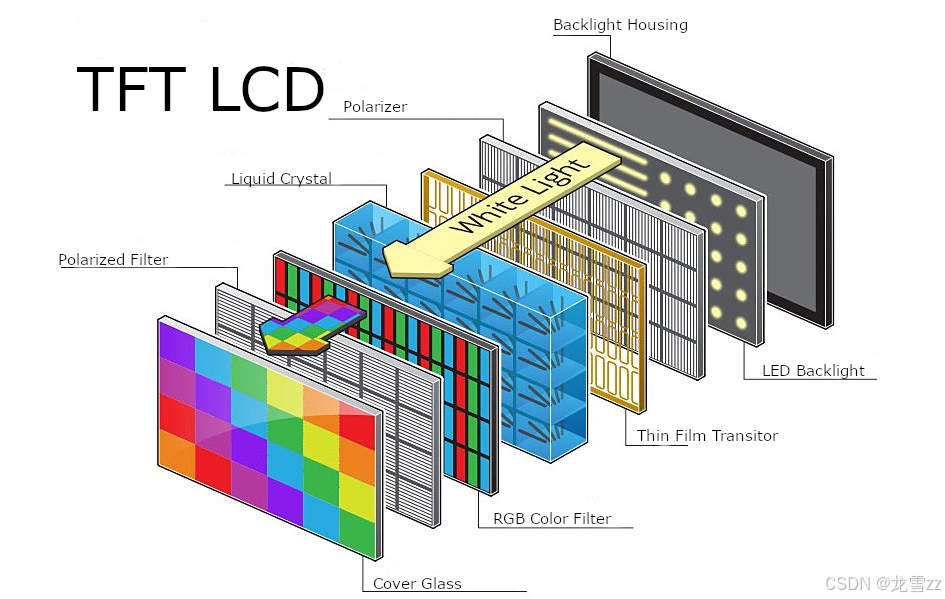
The Layer-by-Layer Anatomy of an LCD Panel
At a high level, to answer lcd screen how it works, we must look at the physical stack. Every modern LCD panel consists of several ultra-thin layers sandwiched together.
The Backlight Unit (BLU)
Since liquid crystals cannot emit light on their own, a robust backlight source is essential. The BLU is located at the very back of the module and consists of LEDs (typically white), light guide plates (LGP) to distribute the light evenly, diffusers, and prism sheets. Its goal is to create a perfectly uniform sheet of white light.
The Rear Polarizer
Attached to the back of the primary glass substrate, this layer takes the unpolarized white light from the BLU and linearizes it, usually orienting the light waves vertically.
The TFT Glass Substrate
This is the electronic backbone of the display. Embedded into this thin sheet of glass is a microscopic grid of Thin-Film Transistors (TFTs). These transistors act as precise electrical switches for every single subpixel on the screen, delivering exact voltages to manipulate the liquid crystals. The electrodes here are made of Indium Tin Oxide (ITO), a rare material that is both electrically conductive and optically transparent.
The Liquid Crystal Layer
Sandwiched in a gap typically only a few micrometers wide, this layer contains the nematic liquid crystals. Spacers (microscopic glass or plastic beads) are used to maintain a perfectly uniform gap between the front and rear glass plates.
The Color Filter Array (CFA)
Sitting on the front glass substrate, this layer is responsible for translating white light into colors. It features a microscopic mosaic of Red, Green, and Blue (RGB) filters precisely aligned over the TFT subpixels.
The Front Polarizer
The final layer the light passes through before hitting your eye. It is oriented horizontally (90 degrees to the rear polarizer) to complete the optical shutter mechanism.
Il Ruolo della Retroilluminazione negli Schermi LCD
Poiché i cristalli liquidi non possono emettere luce autonomamente, la retroilluminazione è essenziale. L'unità di retroilluminazione (BLU) si trova tipicamente dietro la cella LCD ed è composta da:
- LED (più comunemente LED bianchi)
- Piastre guida luce (LGP)
- Diffusori e fogli prismatici
L'obiettivo è creare un campo luminoso uniforme e brillante su tutto il display. Questa luce verrà poi selettivamente bloccata o trasmessa dai cristalli liquidi sovrastanti, a seconda del contenuto dell'immagine desiderato.
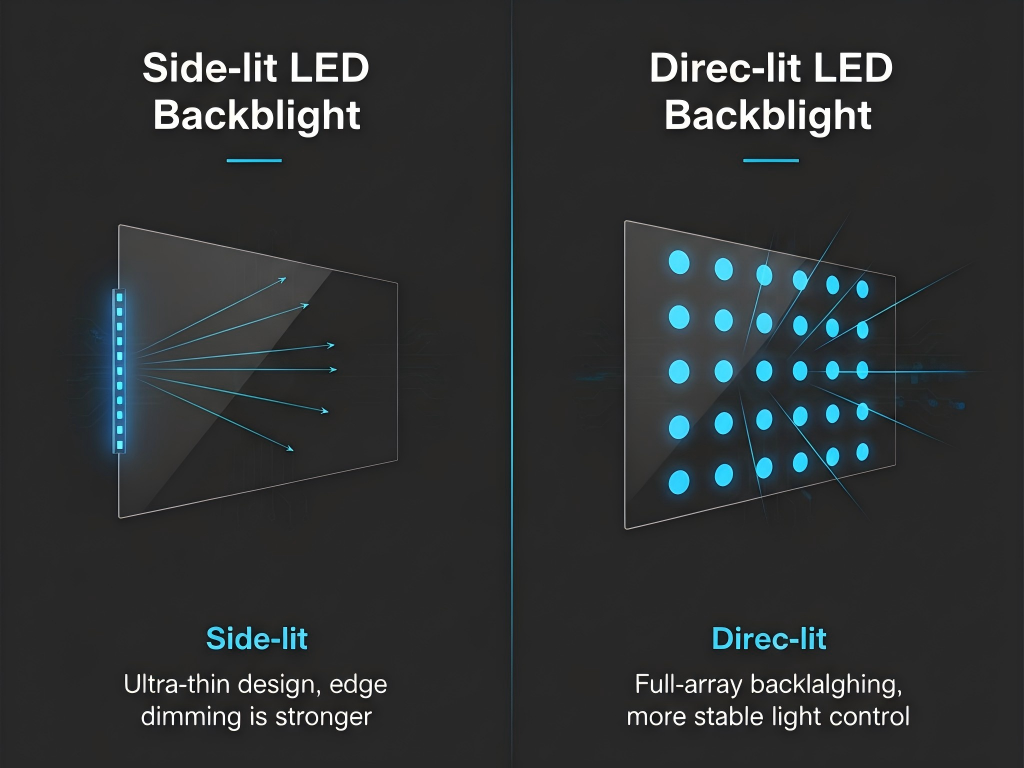
Gli LCD moderni utilizzano configurazioni di LED a illuminazione laterale (edge-lit) o o a illuminazione diretta (direct-lit) , e alcuni pannelli di fascia alta impiegano l'attenuazione locale (local dimming) per migliorare il contrasto.
Come si Formano i Pixel nei Display LCD
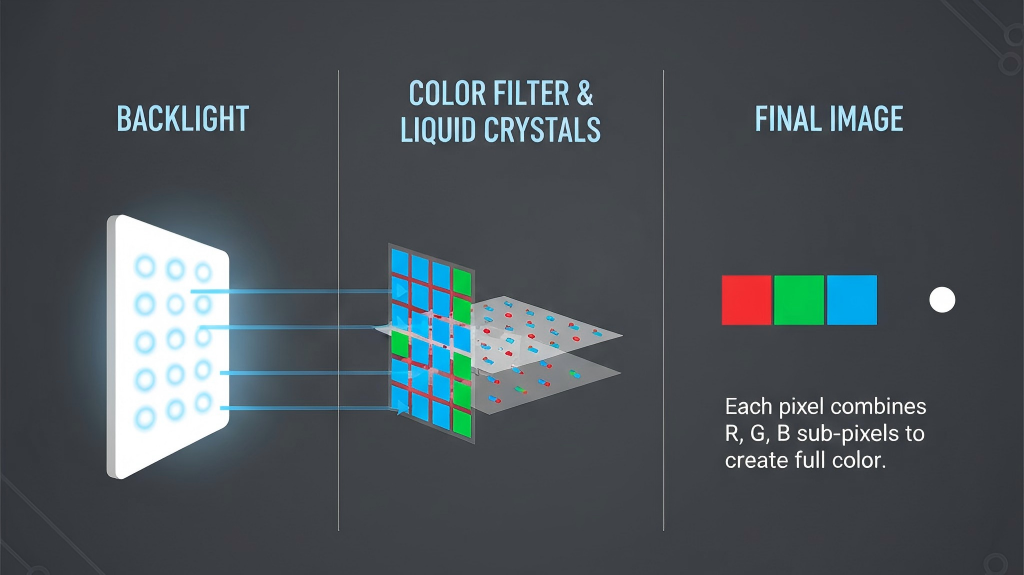
Ogni schermo LCD è composto da milioni di minuscole unità chiamate pixel. pixel. Un pixel in un LCD non è un singolo elemento—consiste di tre sottopixel: rosso, verde e blu. Questi sottopixel sono controllati individualmente per miscelarsi e creare un output a colori completi.
Al centro del controllo dei pixel c'è l'array di Transistor a Film Sottile (TFT), che funziona come una griglia di interruttori elettronici. Ogni sottopixel è indirizzato dal suo corrispondente TFT, che regola la tensione applicata ai cristalli liquidi.
Maggiore è la tensione applicata, più i cristalli liquidi si allineano e bloccano la luce—rendendo quel sottopixel più scuro. Al contrario, meno tensione permette a più luce di passare. Variando questo tra i sottopixel, gli LCD possono visualizzare milioni di combinazioni di colori.
Come i Filtri Colore Creano l'Output RGB
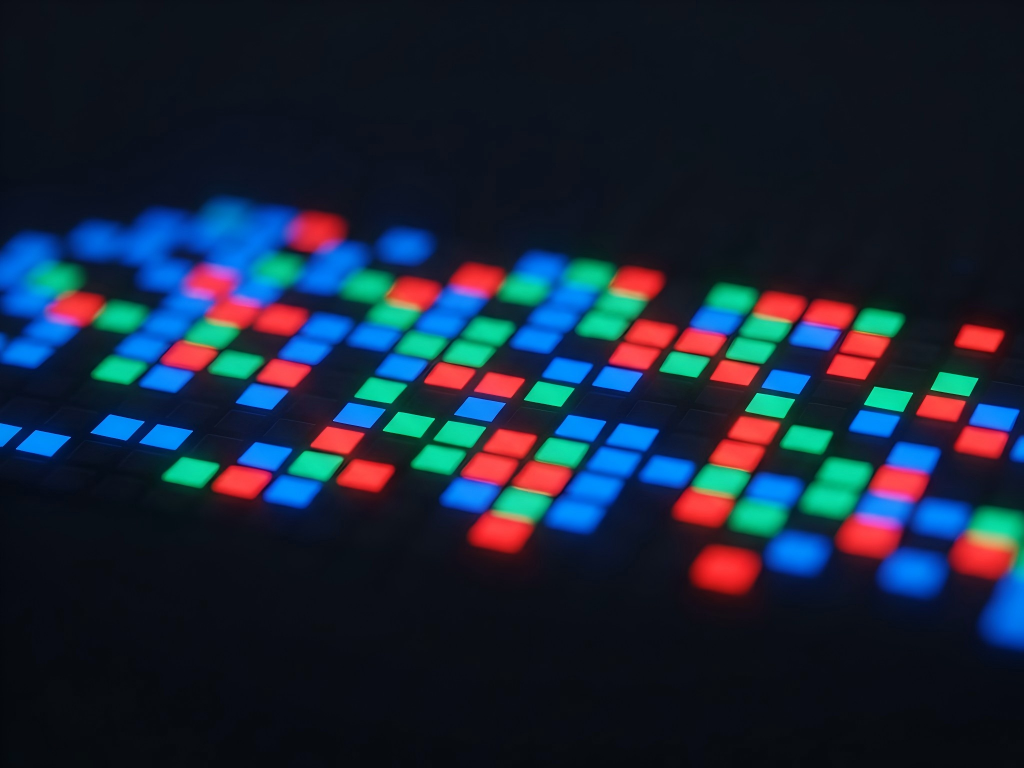
Poiché la retroilluminazione è tipicamente bianca, i filtri colore sono necessari per produrre immagini a colori completi. Questi sono disposti sul display in una sequenza fissa—solitamente strisce o disposizioni a delta di rosso, verde e blu.
Each singular “pixel” you see on your screen is not a single element. It actually consists of three independent, microscopic structures called subpixels: one red, one green, and one blue. These are arranged in various patterns (like stripes or delta layouts).
Each subpixel is driven by its own dedicated TFT switch. By applying varying degrees of voltage, the display doesn’t just turn a subpixel “on” or “off”—it can open the liquid crystal shutter partially. In a standard 8-bit panel, the TFT can apply 256 different voltage levels to each subpixel, allowing for 256 levels of brightness for Red, 256 for Green, and 256 for Blue.
When you multiply these together ($256 \times 256 \times 256$), you get 16.7 million distinct color combinations.
For instance, to create the color yellow on the screen:
Blue subpixel: TFT applies maximum voltage $\rightarrow$ liquid crystals straighten $\rightarrow$ light is blocked by the polarizer $\rightarrow$ blue is turned off.Because the subpixels are so microscopic, the human eye cannot differentiate them and blends the red and green light together to perceive a bright yellow pixel.
Red subpixel: TFT applies minimum voltage $\rightarrow$ maximum light passes through the red filter.
Green subpixel: TFT applies minimum voltage $\rightarrow$ maximum light passes through the green filter.
Filtro colore
Il Ruolo dei Filtri Polarizzatori.
La polarizzazione è essenziale per il funzionamento dell'LCD. Due strati polarizzatori—uno anteriore e uno posteriore—sono allineati perpendicolarmente l'uno all'altro. Nello stato, di riposo (off) viene applicata una tensione, I cristalli si distendono, bloccando la luce polarizzata al secondo filtro. Questo meccanismo consente al display di scurire o illuminare selettivamente i subpixel in base al segnale elettrico.
In “Normally black” Nei pannelli (comuni nei display IPS), la tensione attiva la luminosità. Nei pannelli "normally white" (normalmente bianchi), la tensione blocca la luce. La scelta dipende dalle esigenze applicative in termini di contrasto e comportamento energetico.
Diversi tipi di tecnologie LCD
SNot all LCDs are created equal. Engineers have manipulated the geometry of the electrodes and the initial alignment of the liquid crystals to create different panel types optimized for specific needs.
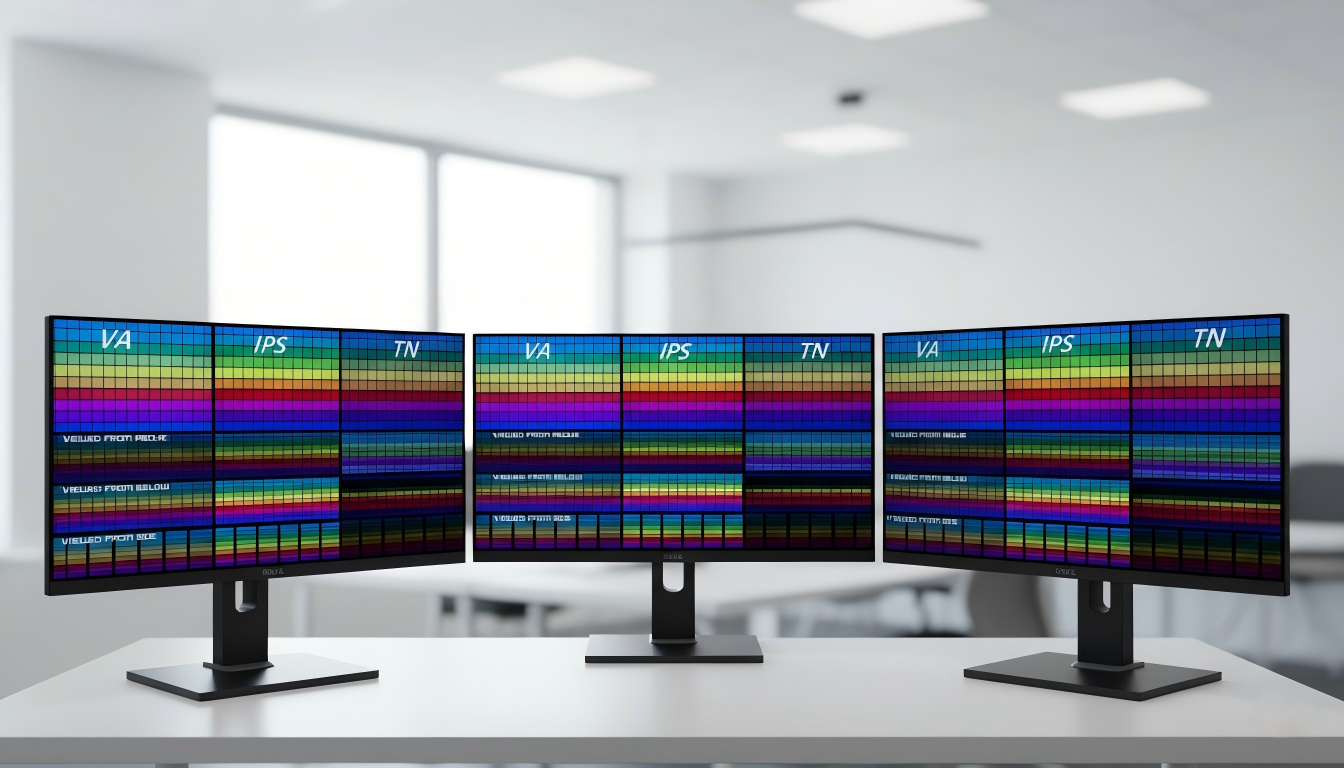
TN (Nematico Contorto)
The oldest and most common early LCD tech.
- How it works: Uses the standard 90-degree twist mechanism described earlier.
- Vantaggi: Extremely fast response times (great for competitive gaming) and very low manufacturing cost.
- Svantaggi: Severe color shifting and contrast loss when viewed from an angle.
IPS (commutazione in piano)
Developed to solve TN’s viewing angle limitations.
- How it works: Instead of placing electrodes on opposite glass panels (forcing molecules to stand up), both the positive and negative electrodes are placed on the bottom TFT glass. When voltage is applied, the liquid crystal molecules rotate parallel (in-plane) to the glass.
- Vantaggi: Because the molecules don’t stand upright, light isn’t scattered awkwardly. This results in excellent color consistency and near 178-degree wide viewing angles.
- Svantaggi: Slightly slower response times and lower native contrast than VA panels. Common in smartphones, professional monitors, and marine equipment.
VA (Allineamento verticale)
The middle ground between TN and IPS, heavily favored in modern televisions.
- How it works: When no voltage is applied, the molecules are aligned vertically (perpendicular to the substrate), blocking light almost completely and creating incredibly deep blacks. Applying voltage tilts the molecules to let light through.
- Vantaggi: Exceptional native contrast ratios (often 3000:1, compared to IPS’s 1000:1) and deep blacks.
- Svantaggi: Viewing angles are worse than IPS, though better than TN.
LCD trasflettivi
Vantaggi: In bright direct sunlight, it reflects ambient light to illuminate the screen, drastically saving battery. In the dark, the backlight kicks in. Ideal for outdoor instruments and aviation displays.
How it works: Combines transmissive (backlit) and reflective properties. A semi-reflective layer sits behind the liquid crystals.
👉 Lettura correlata: Quali sono le differenze tra TN, VA e IPS?
Driving the Display: Active Matrix vs. Passive Matrix
When people ask come funzionano gli schermi lcd, they often overlook the sheer processing power required to update millions of pixels 60 times a second.
Early displays used Passive Matrix addressing. A grid of conductive rows and columns intersected at each pixel. To turn on a pixel, current was sent down the entire row and column. This was slow, caused ghosting (blurriness), and was incapable of handling high resolutions.
Modern screens rely entirely on Active Matrix addressing, made possible by the TFT (Thin-Film Transistor) array. At the heart of pixel control, the TFT acts like an isolated electronic switch for every single subpixel. Additionally, a microscopic capacitor is paired with each transistor.
When the display processor wants to update a pixel, it activates that specific TFT, fills the capacitor with the exact required voltage, and turns the TFT off. The capacitor holds the voltage steady, keeping the liquid crystals perfectly aligned while the rest of the screen is updated. This allows for the crystal-clear, high-refresh-rate images we expect today.
Modern Innovations: LED, Mini-LED, and Beyond
The evolution of how does an lcd display work over the last decade has largely been the evolution of backlighting. Since liquid crystals don’t emit light, the quality of an LCD is inherently tied to the quality of its BLU (Backlight Unit).
Older LCDs used CCFLs (Cold Cathode Fluorescent Lamps), which were thick, consumed high power, and contained mercury. Today, LEDs rule the market.
- Edge-Lit vs. Direct-Lit: Edge-lit panels place LEDs along the bezel and use a light guide plate to throw light across the screen, allowing for ultra-thin monitors. Direct-lit panels place a grid of LEDs directly behind the LCD layer, providing better uniformity.
- FALD (Full Array Local Dimming): High-end LCD TVs group direct-lit LEDs into “zones.” If a scene shows a bright moon in a dark night sky, the TV actually turns off the backlight zones behind the dark sky, dramatically improving contrast and mimicking OLED’s deep blacks.
- Mini-LED: An evolution of FALD. By shrinking the LEDs to microscopic sizes, manufacturers can pack thousands of dimming zones into a single panel, drastically reducing the “halo” or “blooming” effect seen around bright objects on dark backgrounds.
- Quantum Dots (QLED): Instead of using white LEDs (which actually emit blue light covered in a yellow phosphor), QLED screens use pure blue LEDs. The light passes through a film of Quantum Dots—nanocrystals that emit incredibly pure red and green light when excited. This expands the color gamut of the LCD, allowing it to display significantly more vibrant and accurate colors.
👉 Lettura correlata: Le 5 Principali Innovazioni dei Moduli TFT del Decennio: Una Guida Strategica per gli OEM Hardware
Why LCD Still Wins: Performance and Longevity
With the rise of OLED and Micro-LED, one might wonder about the future of LCDs. Yet, understanding how do lcd panels work reveals inherent engineering advantages that keep it dominant in 2026.
Unlike OLED, where the organic compounds that generate light degrade over time (leading to permanent “burn-in” of static images), liquid crystals are non-emissive inorganic materials. An LCD can display a static commercial digital sign or an airplane’s artificial horizon 24/7 for a decade without permanent image retention. Furthermore, because the backlight is a separate component, LCDs can easily achieve blindingly high brightness levels (2,000+ nits) for outdoor, sunlight-readable applications at a fraction of the cost of competing technologies.
Domande frequenti (FAQ)
What is the exact role of polarizing filters in an LCD screen? Polarizing filters control the passage of light based on its wave orientation. LCDs use two crossed polarizers (set at 90 degrees to each other). The liquid crystal layer sandwiched between them twists the light to allow it to pass through both filters. By applying voltage, the twisting stops, and the second polarizer blocks the light, enabling absolute brightness control at the pixel level.
Why is backlighting completely necessary in LCD screens? Because liquid crystals are merely optical modulators; they don’t emit any light photons themselves. The backlighting (usually a complex array of LEDs) provides a constant, uniform light source that is selectively blocked or transmitted by the liquid crystal shutter system to form visible images. Without a backlight, the screen would be entirely black.
How does an LCD screen produce different colors if the backlight is white? Through an intricate Color Filter Array. Every individual pixel is divided into Red, Green, and Blue subpixels. Each subpixel has its own color filter and its own TFT transistor to control its brightness. By selectively mixing the intensity of light passing through these three subpixels, the human eye blends them to perceive millions of distinct colors.
What are the primary advantages of LCD technology over emissive displays like OLED? LCDs are highly cost-effective to manufacture at scale, possess immense longevity, and are virtually immune to “burn-in” (image retention). Because the light source is separate from the pixel array, they can also be engineered to reach incredibly high peak brightness, making them the superior choice for outdoor displays, avionics, and marine technology.
What are the functional differences between the different types of LCD screens?
- TN (Nematico Contorto) is budget-friendly and fast but suffers from poor viewing angles.
- IPS (commutazione in piano) rotates molecules parallel to the glass, offering professional-grade color accuracy and extremely wide viewing angles.
- VA (Allineamento verticale) aligns molecules vertically to block light tightly, offering superior native contrast and deep blacks for home cinema use.
- Transflettivo combines reflective materials with a backlight, specifically engineered for ultra-low power consumption and visibility in direct sunlight.
12. Conclusion
The modern Liquid Crystal Display is a triumph of interdisciplinary engineering, seamlessly blending quantum physics, optics, chemistry, and microelectronics. By mastering the manipulation of light waves through crossed polarizers and leveraging the unique dielectric properties of nematic liquid crystals, engineers have created a display architecture that is reliable, incredibly versatile, and continually evolving. From the integration of quantum dots to the microscopic precision of Mini-LED backlighting, the fundamental mechanics of how does an lcd display work will continue to drive the visual interfaces of tomorrow’s technology.
13. References & Further Reading
DisplayMate Technologies: Optical Architectures of IPS vs. VA Panel Technologies.
Society for Information Display (SID): Foundations of Liquid Crystal Display Technology.
Institute of Electrical and Electronics Engineers (IEEE): The Evolution of Thin-Film Transistor Backplanes.