








In the evolving landscape of urban architecture, commercial real estate, and transit infrastructure across North America and Europe, static signage is effectively dead. The modern public space is expected to be dynamic, interactive, and endlessly adaptable. At the core of this digital transformation is a piece of hardware that has evolved from a simple consumer television into a ruggedized, hyper-bright piece of civic infrastructure: the big lcd display.
While Direct-View LED (dvLED) gets much of the media attention for massive stadium screens, the large-format LCD (typically ranging from 55 inches to 98 inches and above) remains the undisputed champion for environments where the audience is up close, where ultra-high definition (4K and 8K) is required, and where touch interactivity is paramount.
This comprehensive guide explores the strategic applications of deploying a big lcd display in public spaces. We will bypass the marketing fluff and dive straight into the operational realities, engineering challenges, and return on investment (ROI) metrics that AV integrators and procurement managers must understand.

1. Transportation Hubs: The Mission-Critical Display
Airports, train stations, and subway terminals are arguably the most punishing environments for digital signage. A display in these locations is not merely decorative; it is a vital operational tool.
Applications: FIDS and Wayfinding
- Flight/Passenger Information Display Systems (FIDS): A multi-screen video wall comprised of ultra-narrow bezel LCDs is the standard for FIDS. Passengers rely on these screens for real-time gate changes, delays, and boarding statuses.
- Interactive Wayfinding: A standalone, vertically oriented big lcd display equipped with PCAP (Projected Capacitive) touch allows travelers to map their route to a specific terminal, locate restrooms, or find a specific retail outlet.
The Engineering Reality
Deploying a big lcd display in a major transit hub like London Heathrow or Chicago O’Hare requires rigorous hardware specifications:
- 24/7/365 Operation: Consumer-grade televisions will burn out their power supplies within months if run continuously. Commercial LCDs feature heavy-duty capacitors, advanced thermal dissipation, and image-retention mitigation algorithms.
- Redundancy and Failover: If the primary media player crashes, the display must automatically switch to a backup input or display a cached emergency message. A blank screen in an airport creates immediate crowd-panic.
- High MTBF (Mean Time Between Failures): Procurement teams must specify displays with an MTBF of at least 50,000 hours to minimize maintenance disruptions in secure, hard-to-reach terminal areas.
2. Digital Out-of-Home (DOOH) & Smart City Furniture
The European and US outdoor advertising markets have shifted heavily toward programmatic DOOH. This means the billboard on the street corner is no longer selling a single ad for a month; it is cycling through targeted, time-of-day specific advertisements.
Applications: Street Kiosks and Transit Shelters
- Bus and Tram Shelters: A 75-inch or 86-inch big lcd display integrated into the side of a bus shelter provides dual value: real-time transit arrival data on the top third of the screen, and high-CPM (Cost Per Mille) advertising on the bottom two-thirds.
- Smart City Totems: Municipalities are deploying large LCD totems that provide free public Wi-Fi, emergency broadcast capabilities, and hyper-local civic information, subsidized entirely by the advertising space.
The Engineering Reality
Outdoor deployment is a brutal battle against the elements.
- The Solar Load Problem: If direct sunlight hits an unprotected LCD panel, the liquid crystals will physically boil and enter an “isotropic state,” turning the screen into a massive black blotch. An outdoor big lcd display must feature advanced HVAC (Heating, Ventilation, and Air Conditioning) or active fan cooling systems inside the enclosure to keep the panel below 85°C.
- Luminance Wars: An indoor display operates at around 350 to 500 nits. To be readable in direct summer sunlight in Madrid or Los Angeles, an outdoor LCD must push a minimum of 2,500 to 4,000 nits.
- IK10 Vandal Resistance: The glass protecting the display must be optically bonded, chemically strengthened, and rated IK10 to withstand a direct strike from a blunt object.
3. Retail Environments: Winning the Window
Brick-and-mortar retail in the post-e-commerce era must offer an experiential advantage. Retailers use large-format displays to bridge the gap between their digital brand and physical storefront.
Applications: Window Facing and Experiential Retail
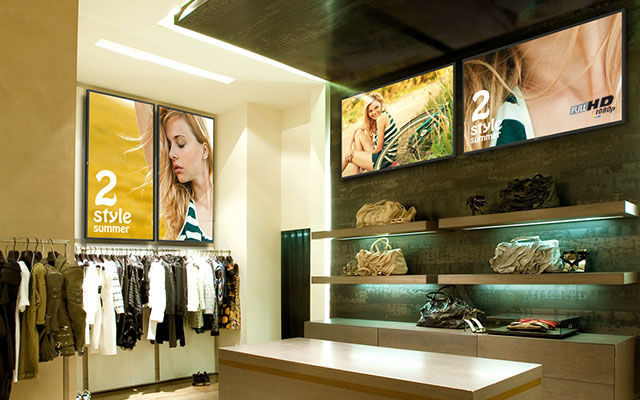
- Window-Facing Displays: A high-brightness big lcd display placed directly behind the storefront glass acts as a digital magnet, drawing foot traffic from the street.
- End-Cap and Feature Walls: Inside the store, large 4K LCDs display high-fidelity lifestyle videos (e.g., a fashion brand showing a runway loop) where color accuracy and contrast are paramount.
The Engineering Reality
- Combating Storefront Reflections: A display inside a glass window faces double reflection—glare from the store window itself, and glare off the LCD screen. High-brightness (3,000 nits) is required to “punch through” the reflections.
- Polarized Sunglass Viewability: Standard LCD panels emit polarized light. If a pedestrian wearing polarized sunglasses walks past a storefront, the screen may appear entirely black to them. Premium retail displays use a specialized Quarter Wave Plate (QWP) film to circularly polarize the light, ensuring the screen is visible regardless of the viewer’s eyewear.
4. Corporate Campuses & Higher Education
The modern corporate lobby or university student union is designed to impress visitors, attract talent, and communicate complex information rapidly.
Applications: Lobby Video Walls and Town Halls
- Architectural Video Walls: Tiling multiple ultra-narrow bezel (e.g., 0.88mm or 1.8mm bezel-to-bezel) LCD panels together creates a massive, seamless digital canvas. These are used to display corporate branding, real-time data dashboards, or digital art.
- Auditorium / Town Hall Displays: A 98-inch big lcd display is often replacing the traditional projector in medium-to-large conference rooms. Unlike projectors, LCDs are not washed out by ambient room lighting, allowing meetings to happen with the blinds open.
The Engineering Reality
- Color Calibration: When tiling multiple LCDs into a video wall, even a 2% difference in color temperature between the panels will look horrific to the human eye. Factory and on-site hardware color calibration is mandatory.
- EU Ecodesign & Energy Star: In the European market, large corporate deployments must strictly adhere to the updated Ecodesign Directive for electronic displays, which enforces stringent power consumption limits. Displays must feature ambient light sensors to automatically dim the backlight during the evening to remain compliant.
Strategic Procurement: Indoor vs. Outdoor Big LCD Displays
To simplify the procurement process, AV consultants use the following baseline matrix when specifying a big lcd display for a public space:
| Especificación | Indoor Public Space (e.g., Mall, Airport) | Outdoor Public Space (e.g., Bus Shelter, Plaza) |
| Brillo | 500 – 700 Nits | 2,500 – 4,000 Nits (plus QWP film) |
| Operation Hours | 16/7 or 24/7 depending on usage | Strictly 24/7/365 |
| Ingress Protection (IP) | IP4X or IP5X (Dust resistant) | IP56 or IP65 (Water and fine dust proof) |
| Impact Protection (IK) | IK07 (Accidental bumps) | IK10 (Anti-vandal glass) |
| : Optimizar el uso de energía es vital, especialmente para dispositivos alimentados por batería, para extender la vida operativa. | Passive cooling | Active AC or Air-to-Air Heat Exchangers |
| Panel Technology | IPS or VA | Ultra-high Tni (110°C) IPS |
5. Integrating the Backend: The Brain of the Big LCD
Procuring a 98-inch 4K screen is the easy part. The hidden complexity of deploying a big lcd display in a public space lies entirely in the backend—the software and media player that tell it what to do.
The Rise of SoC (System on a Chip)
Ten years ago, every commercial display required a bulky external PC to drive the content, connected via HDMI and tucked away in an overheated AV closet. Today, the leading commercial LCD manufacturers (e.g., Samsung, LG, Philips) integrate a powerful System on a Chip (SoC) directly inside the display.
Why SoC Matters
- Point of Failure Reduction: You eliminate the HDMI cable, the external power supply, and the external PC fan—all common failure points in 24/7 operations.
- Cost Efficiency: You are no longer buying two pieces of hardware (a screen and a PC), significantly reducing the per-unit BOM cost across a 50-screen rollout.
- Remote Management: Built-in SoCs usually come with robust remote management software (like Samsung MagicINFO or LG SuperSign). An IT manager in London can remotely reboot, update firmware, monitor the internal temperature, and change the content on a display located in a Paris subway station, all from a web browser.
Conclusión
The deployment of a big lcd display in a public space is no longer an experiment; it is the baseline expectation of the modern consumer, traveler, and employee. The difference between a successful, ROI-positive digital signage network and a constant maintenance nightmare comes down entirely to selecting the right hardware specifications for the environment.
When an organization treats an 85-inch LCD like an industrial tool rather than a consumer toy—specifying correct brightness, weatherproofing, thermal management, and robust SoC integration—they unlock an unparalleled platform for communication, advertising revenue, and architectural enhancement.
Preguntas frecuentes (FAQ)
Q1: Can we just buy the largest consumer TV from a big-box retailer and hang it in our corporate lobby to save money?
R: No. This is the single most common and expensive mistake businesses make. Consumer TVs are designed to run for 4 to 6 hours a day in a dark living room. If you run them 24/7 in a bright lobby, the power supply will fail within a year, the screen will suffer from permanent image retention (burn-in), and the manufacturer will instantly void the warranty the moment they realize it was used in a commercial setting.
Q2: Why would I choose a big lcd display over a Direct-View LED (dvLED) wall for a shopping mall directory?
R: Viewing distance and resolution density. An 85-inch 4K LCD has incredibly tight pixel pitch (meaning you can stand three feet away and read fine text perfectly). To achieve true 4K resolution on a dvLED wall, it would cost hundreds of thousands of dollars and require a massive physical footprint. For interactive directories or retail environments where the viewer is up close, LCD remains vastly superior in clarity and cost.
Q3: What is “Optical Bonding,” and why is it recommended for outdoor kiosks?
R: Optical bonding is a manufacturing process that injects a solid, transparent resin between the LCD panel and the protective cover glass. It eliminates the air gap. This does two critical things: First, it drastically reduces internal glare, making the screen much easier to read in the sun. Second, it prevents condensation (fog) from forming inside the glass on cold mornings, which is lethal to electronics and ruins the viewing experience.
Q4: We need an outdoor display in Phoenix, Arizona, where summer temperatures reach 115°F (46°C). Will an LCD survive?
R: Yes, but only if you specify an LCD with a High Tni (Isotropic Temperature) panel and an actively cooled IP65 enclosure. Standard liquid crystals boil and turn black around 85°C (185°F) internally. High Tni panels can withstand internal temperatures up to 110°C (230°F) before failing. Combined with an internal HVAC unit or high-velocity fans, these displays are specifically engineered to survive Middle Eastern and Southwestern US summers.