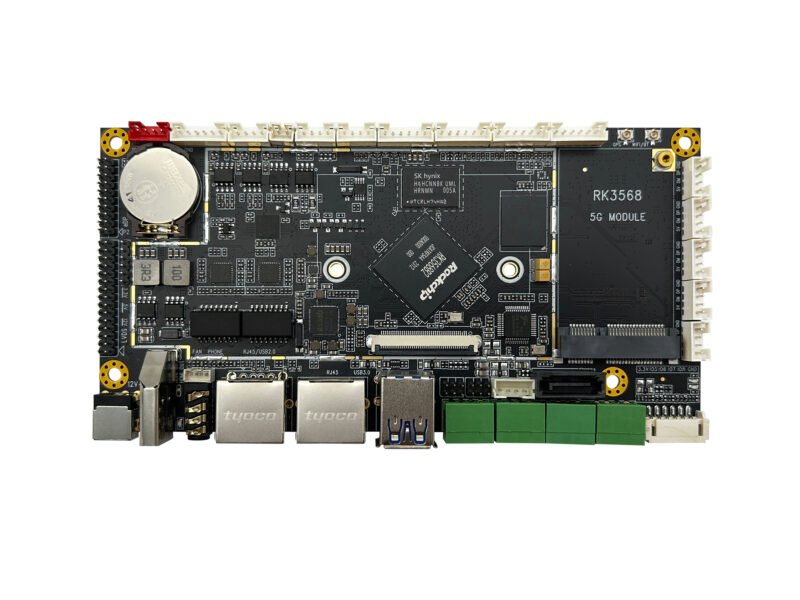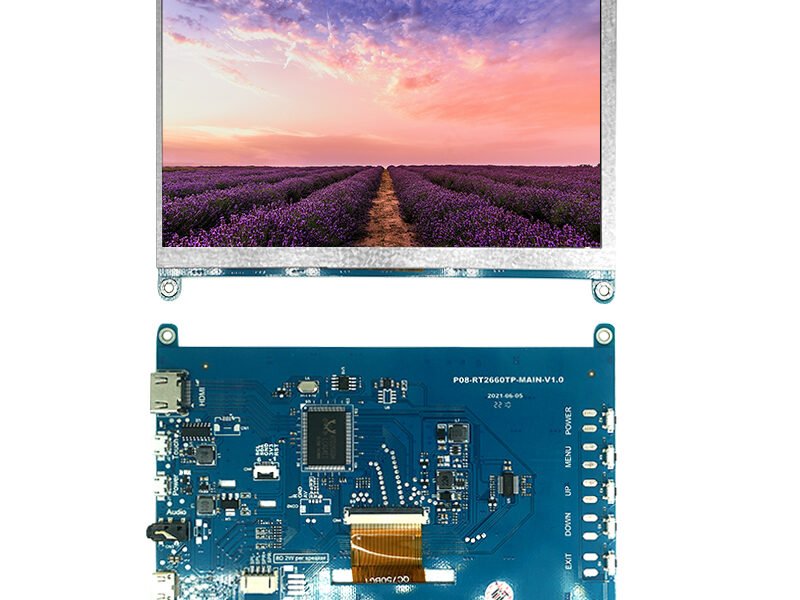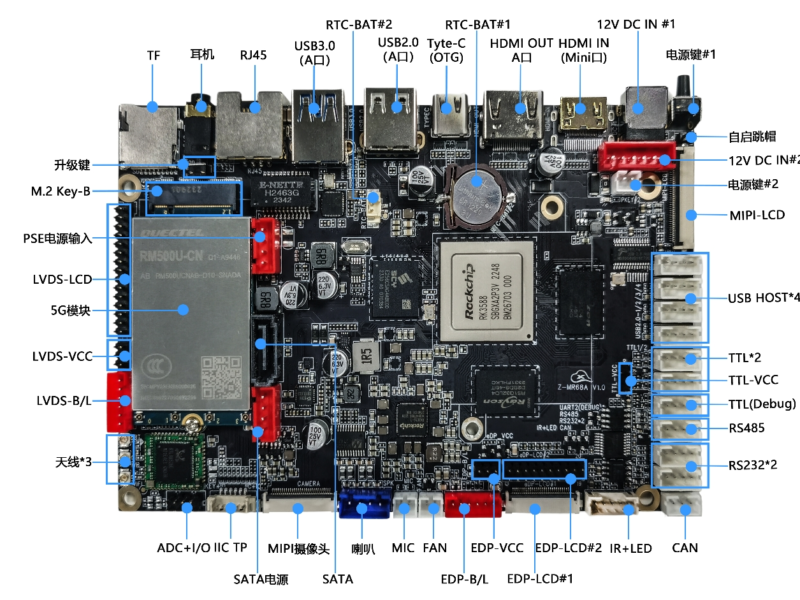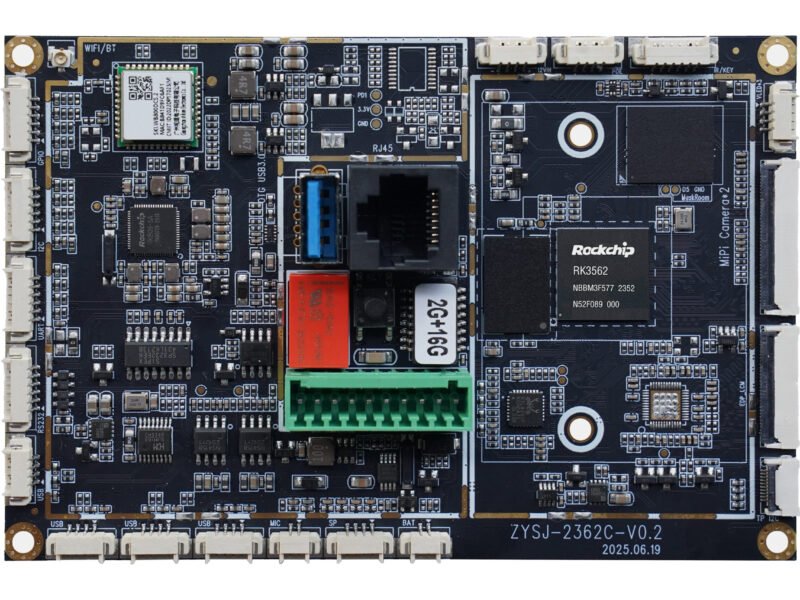











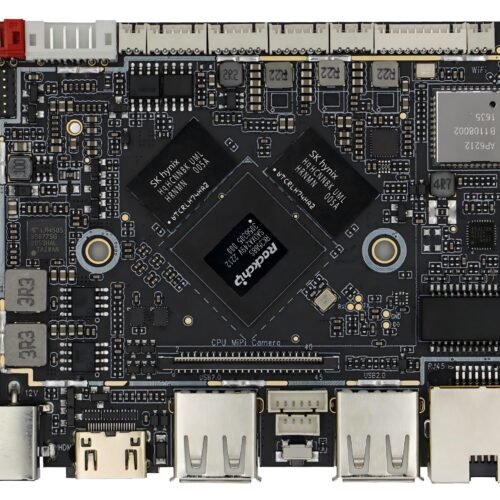
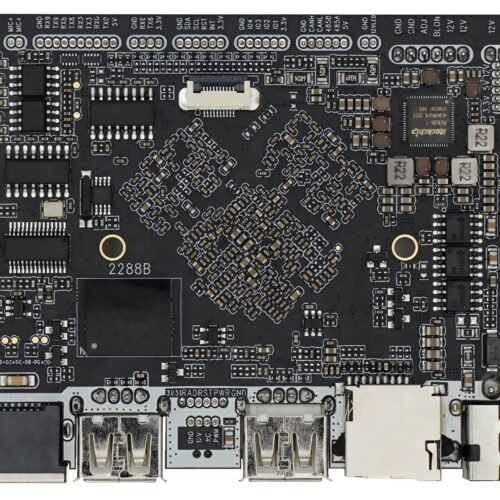
Panoramica del prodotto
Il RJY-2288B high-performance motherboard is powered by Rockchip’s next-generation flagship RK3588S AIoT processor, supporting Android 12.0, Linux, Ubuntu 20.04, and other operating systems. The RK3588S is built on LP a 8 nm e presenta un CPU ottacore a 64 bit with a con architettura Cortex-A76 + A55, reaching a maximum frequency of 2.4 GHz. It delivers exceptional general-purpose computing performance.
La GPU è un'unità di fascia alta Mali-G610 quad-core, e la CPU integra un'unità di elaborazione neurale per l'IA (NPU) che supporta il calcolo a precisione mista IN4 / IN8 / INT16 , raggiungendo una potenza di calcolo di, achieving up to . La piattaforma è compatibile con vari strumenti e interfacce di sviluppo per l'IA, supportando la. The platform supports multiple AI development tools and interfaces, enabling seamless integration with frameworks such as TensorFlow, Caffe, MxNet, PyTorch, and provides APIs including Android NN API, RKNN cross-platform API, and TensorFlow development interfaces.
la visualizzazione indipendente multi-schermo , output LVDS 1080P a 6/8 bit, LVDS 1080P output, , output HDMI 8K, e e input HDMI 4K. It also offers a rich set of interfaces and features, including Gigabit Ethernet, Wi-Fi/Bluetooth, USB expansion, gravity sensor, CAN, RS232/RS485, I/O expansion, fill light, I2C expansion, MIPI camera input, and infrared remote control.
With its powerful octa-core AI processor and extensive connectivity, the ZYSJ-2288B is ideal for applications in AI robotics, cloud servers, smart NVRs, intelligent cockpits, ARM PCs, facial payment devices, security, medical, transportation, finance, industrial control, smart education, and intelligent retail. piattaforma hardware e intelligenza software e consente un'esperienza fluida di enables an optimal human-machine interaction experience and seamless integration with networked devices.
Specifiche tecniche
| Categoria | Specifiche |
|---|---|
| Sistema Operativo | Android 12.0 / Linux / Ubuntu 20.04 |
| Processore (CPU) | Rockchip RK3588S (8nm LPP)Octa-core 64-bit CPU: 4 × Cortex-A76 + 4 × Cortex-A55, up to 2.4 GHz |
| Grafica (GPU) | Mali-G610 MP4 (quad-core)Supports OpenGL ES 3.2, OpenVG 1.1, OpenCL 2.2, 450 GFLOPS |
| Neural Network Processor (NPU) | Supports IN4 / IN8 / INT16 / FP16 computationUp to 6.0 TOPSCompatible with Caffe, MxNet, TensorFlow, TFLite, ONNX, DarknetProvides AI development tools and fast model conversion |
| Memoria (RAM) | LPDDR4 4GB (optional 8GB / 16GB / 32GB) |
| Immagazzinamento | eMMC 32GB (optional 64GB / 128GB / 256GB)TF Card expansion (optional) |
| Rete | 1 × Ethernet 10/100/1000 MbpsWi-Fi 2.4 GHz 802.11b/g/n (5 GHz optional)Bluetooth V2.1+EDR / 3.0 / 3.0+HS / 4.1 / 4.2 / BLE |
| Display e Video | 1 × eDP 1.3 (4 lanes, 5.4 Gbps, 3.3V/5V)1 × LVDS (single/dual, 6/8-bit, 1080P60, 3.3V/5V/12V)1 × HDMI 2.1 (8K60Hz, HDMI/eDP selectable)1 × MIPI (supports 5.7 Gbps)Supports multi-screen independent displayOnboard backlight control 12V |
| Audio | 1 × Speaker output (2 × 18W, 4Ω)1 × Microphone input |
| Fotocamera | 2 × MIPI camera input (up to 48 MP, optional)Supports USB cameras (optional) |
| RTC | External RTC battery, supports scheduled power on/off |
| Interfacce USB | 4 × USB 2.0 HOST1 × CPU USB 2.01 × USB 2.0 OTG |
| Infrared | 1 × IR receiver, supports remote control |
| LED | 1 × Power LED (red)1 × System LED (blue, blinking) |
| Pulsanti | 1 × Reset1 × Power1 × Upgrade |
| Serial Ports | 4 × RS2321 × UART TTL1 × RS485 |
| I/O & Expansion | 4 × GPIO (10-pin)1 × CAN1 × I2C1 × AD interfaceFan connector supports 5V/12V |
| Alimentazione | AC 100–240 V, 50–60 Hz inputDC 12V / 5.5 mm inner 2.1 mm, 2–5A outputSurge voltage <18V, ripple <100 mVSupports auto power-on or button startup |
| Condizioni operative | Temperature: -10°C ~ 70°CStorage: -20°C ~ 70°CHumidity: 10%–80% |
| Board Dimensions | 100 × 70 × 11 mm |
| Multimedia | Supports 8K60fps H.265/H.264 decoding8K30fps H.265/H.264 encodingSimultaneous encode/decodeUp to 32 × 1080P30fps decoding, 16 × 1080P60fps encoding |
| Language & Input | Multilingual supportStandard Android keyboard, optional third-party keyboards (Chinese/Korean/Japanese)Native Android with root access for custom development |
| Gestione Sistema | Real-time remote monitoringSystem crash auto-recovery7×24h unattended operationSupports OTA upgradesWi-Fi Display supportSoftware watchdog |