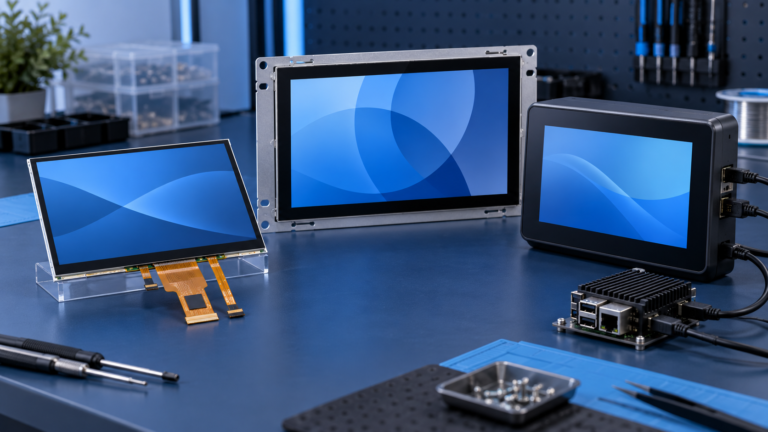
過去10年間におけるトップ5のTFTモジュール革新:ハードウェアOEM向け戦略的ガイド

In the high-stakes arena of global hardware manufacturing, display technology is often the most heavily scrutinized component on the Bill of Materials (BOM). Over the past decade, consumer media has been captivated by the rise of OLED and foldable screens. However, for hardware engineers, product managers, and procurement executives in the European and North American markets—particularly those developing for industrial automation, medical devices, automotive interiors, and smart home appliances—the true revolution has quietly occurred elsewhere: within the architecture of the TFT module.

For nearly thirty years, the Thin-Film Transistor (TFT) Liquid Crystal Display (LCD) has been the workhorse of the global electronics industry. But today’s TFT module is practically unrecognizable compared to the generic, low-contrast, thick panels of the early 2010s. Driven by the relentless pressure to match OLED’s visual performance while maintaining the rugged durability, low cost, and long product lifecycles demanded by professional industries, display fabs have engineered extraordinary innovations.

This consulting brief deconstructs the top five TFT module innovations of the past decade. It provides a technical analysis of how these advancements operate, their strategic implications for your supply chain, and actionable advice on how to specify them for your next hardware platform.


Innovation 1: The Ascent of IGZO and High-Mobility Metal Oxide Backplanes

For decades, the standard substrate for a TFT module was Amorphous Silicon (a-Si). While cost-effective to manufacture in massive volumes, a-Si suffers from a fatal flaw in an era demanding ultra-high resolutions and lower power consumption: low electron mobility. The transistors on an a-Si backplane must be physically large to allow enough current to flow, which blocks the backlight (reducing the aperture ratio), leading to a dimmer screen that requires more power to illuminate.

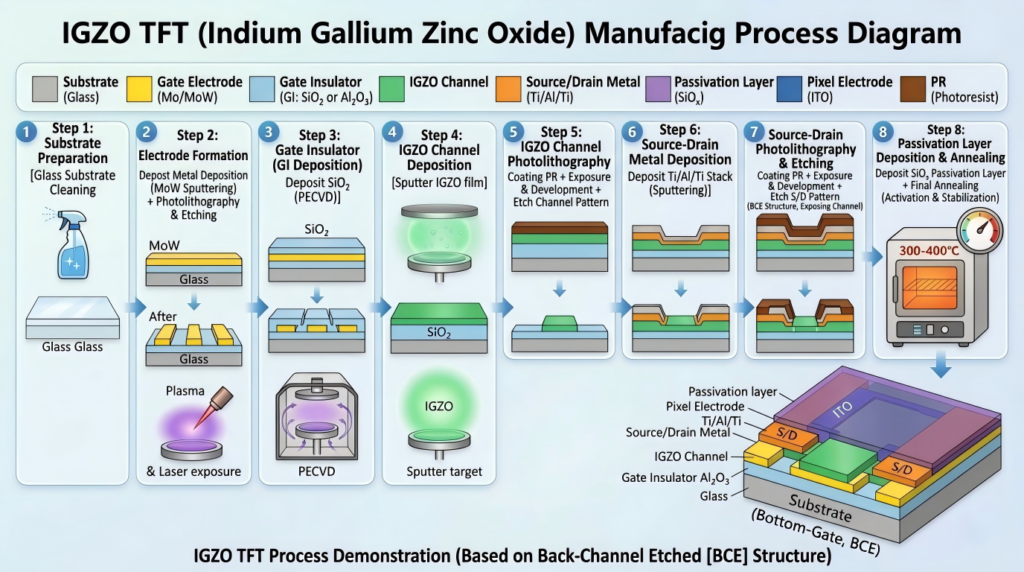
The introduction and subsequent maturation of IGZO (Indium Gallium Zinc Oxide) technology over the last decade fundamentally altered the power-to-performance ratio of the TFT module.

Gemini Generated Image i8kddji8kddji8kd 2 1 - RJY Display
過去10年間の主要5つのTFTモジュール革新:ハードウェアOEM向け戦略ガイド 6

The Technical Breakthrough

IGZO is a transparent amorphous oxide semiconductor. Its primary advantage is its electron mobility, which is 20 to 50 times higher than that of traditional a-Si. This hyper-efficiency allows display engineers to drastically shrink the physical size of the transistors on the glass.

  • Higher Aperture Ratio: Smaller transistors mean more light passes through the pixel. This allows you to either achieve a much brighter screen using the same backlight power, or achieve standard brightness while drastically reducing battery drain.
  • Zero-Flicker Static Display: Unlike a-Si, which constantly leaks current and requires the display to be refreshed 60 times a second (60Hz) even if the image is static, an IGZO TFT module can hold its electrical charge for an extended period. The refresh rate can be dropped dynamically to 1Hz (one frame per second) for static images, cutting the display panel’s power consumption by up to 80%.

Strategic Implication for OEMs

If your product operates on battery power (e.g., portable medical diagnostics, logistics scanners, smart wearables) and primarily displays static dashboards, an IGZO TFT module is a mandatory specification. While the initial component cost is marginally higher than an a-Si module, the savings in battery capacity (allowing you to specify a smaller, cheaper lithium-ion cell) often result in a net-negative impact on your total BOM cost, while simultaneously enabling a thinner, lighter product design.


Innovation 2: Mini-LED Local Dimming Architectures

The most persistent criticism of the standard TFT module has been its contrast ratio. Because an LCD panel relies on a continuously illuminated LED backlight, “true black” is impossible to achieve; some light inevitably bleeds through the liquid crystals, resulting in a dark gray appearance in dimly lit environments. This limitation drove premium laptops and automotive displays toward OLED—until the commercialization of Mini-LED backlighting.

Gemini Generated Image 58nuw958nuw958nu1 1 - RJY Display
過去10年間のトップ5 TFTモジュール革新:ハードウェアOEM向け戦略ガイド 7

The Technical Breakthrough

A traditional TFT module utilizes edge-lit LEDs or a sparse array of direct-lit LEDs (perhaps 10 to 50 diodes) that illuminate the entire screen simultaneously.

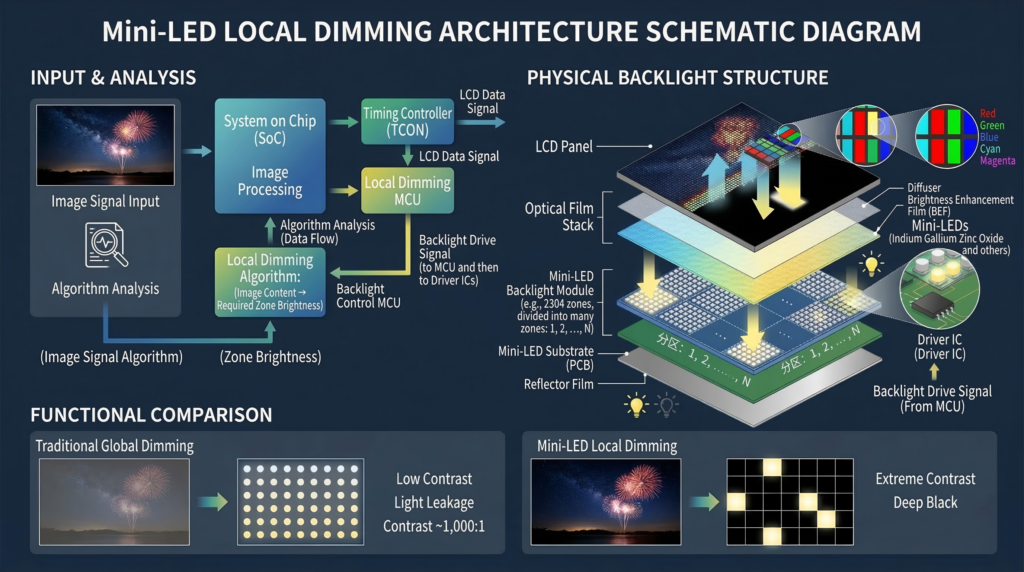
について Mini-LED revolution replaces this simple backlight unit (BLU) with a densely packed matrix of microscopic LEDs—often numbering in the thousands or tens of thousands. More importantly, these LEDs are divided into hundreds of independent “Local Dimming Zones.” When a section of the image is supposed to be black (e.g., the night sky in a video, or the black background of an automotive instrument cluster), the TFT controller physically turns off the LEDs directly behind those specific pixels.

  • OLED-Level Contrast: This achieves contrast ratios exceeding 1,000,000:1, effectively eliminating the “halo effect” and backlight bleed.
  • Extreme Luminance: Unlike OLEDs, which suffer from burn-in and thermal degradation when driven at peak brightness, a Mini-LED TFT module can comfortably sustain 1,000 to 2,500 nits of brightness.

Strategic Implication for OEMs

Mini-LED has salvaged the TFT module’s dominance in the automotive and medical imaging sectors. In the European market, where medical displays must comply with strict DICOM (Digital Imaging and Communications in Medicine) standards for grayscale accuracy in X-ray and MRI diagnostics, the high contrast and zero-burn-in reliability of Mini-LED TFT modules make them the superior choice over OLED. Similarly, for outdoor digital signage or marine chartplotters exposed to direct sunlight, Mini-LED provides the necessary luminance without sacrificing deep black levels.


Innovation 3: In-Cell and On-Cell Touch Integration

Historically, adding a touch screen to a TFT module was a cumbersome, multi-layered process. You started with the LCD module, added a discrete layer of sensor glass or film (the touch panel), and then added the protective cover glass (the G+G or G+F architecture). This multi-component stack was thick, heavy, prone to optical reflections between the layers, and required complex supply chain logistics (buying the LCD from one vendor, the touch panel from another, and paying a third to bond them together).

The last decade saw the aggressive shift toward In-Cell and On-Cell touch technologies, representing a masterclass in semiconductor integration.

InCell OnCell OGS - RJY Display
過去10年間における主要5つのTFTモジュールイノベーション:ハードウェアOEM向け戦略ガイド 8

The Technical Breakthrough

Instead of adding an external sensor layer, display fabricators figured out how to embed the capacitive touch sensors directly into the TFT array itself.

  • On-Cell: The Indium Tin Oxide (ITO) touch sensors are deposited on the outer surface of the TFT module’s color filter glass.
  • In-Cell: The touch sensors are embedded entirely inside the liquid crystal cell, often sharing the very same electrodes used to manipulate the liquid crystals via time-division multiplexing (switching rapidly between driving the display and scanning for touches).

Strategic Implication for OEMs

For North American and European hardware designers, In-Cell technology is a supply chain miracle.

  1. Optical Perfection: By eliminating the external touch layers and the adhesive that bonds them, light transmittance increases by roughly 10%, making the display brighter and more vibrant.
  2. Ultra-Thin Form Factors: In-Cell TFT modules shave critical millimeters off the product’s thickness, essential for modern handheld point-of-sale (POS) systems and premium smart home control panels.
  3. Procurement Simplicity: You no longer manage multiple vendors. You purchase a single, fully integrated TFT module from the fab, complete with a single FPC (Flexible Printed Circuit) that carries both display data and touch coordinates. This drastically reduces assembly time and points of failure on your manufacturing line.

Innovation 4: Free-Form CNC Cutting and Gate-On-Array (GOA)

For the first forty years of its existence, the TFT module was rigidly restricted to a single geometric shape: the rectangle. This was due to the complex routing of the Gate and Source driver circuits that sat on the physical borders of the glass, as well as the limitations of glass-cutting machinery. This forced industrial designers to create boxy, unimaginative product enclosures.

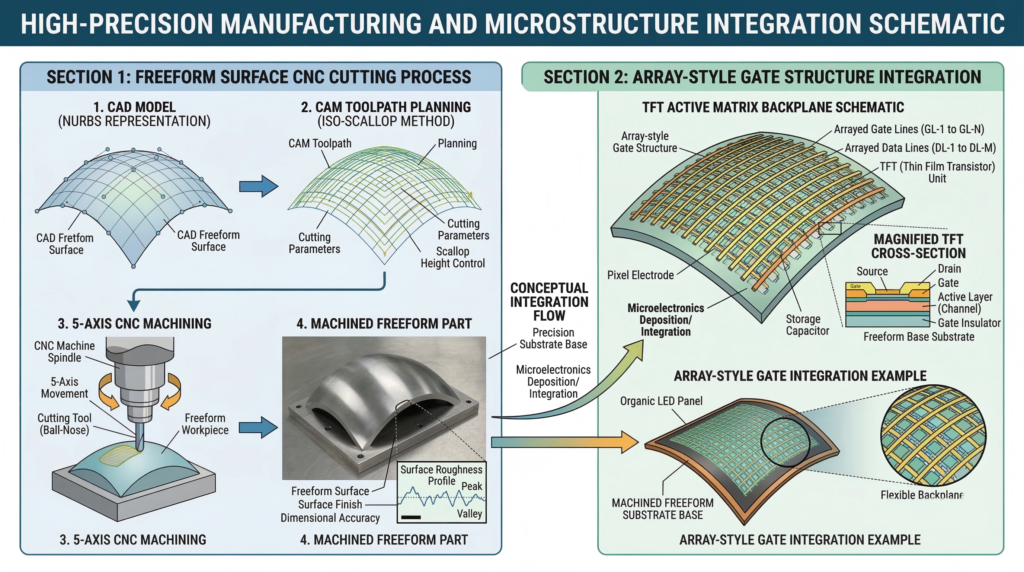
The simultaneous maturation of Free-Form CNC Glass Cutting そして Gate-On-Array (GOA) technology has finally broken the tyranny of the rectangle.

The Technical Breakthrough

  • Gate-On-Array (GOA): Previously, the driver ICs required to scan the rows of pixels were mounted on a physical ledge outside the active display area, creating thick, asymmetrical bezels. GOA technology moves these scanning circuits directly into the active matrix area of the TFT backplane. This allows for “borderless” or ultra-narrow bezel designs (often less than 1.5mm).
  • Free-Form Cutting: Advanced laser and CNC chamfering techniques now allow fabs to cut the TFT module glass into circles, ovals, or complex polygons with physical cutouts (holes) directly through the active screen area without fracturing the glass or breaking the liquid crystal seal.
Gemini Generated Image n3ylp0n3ylp0n3yl - RJY Display
過去10年間における主要なTFTモジュール革新トップ5:ハードウェアOEM向け戦略ガイド 9

Strategic Implication for OEMs

This innovation has been driven heavily by the European automotive sector (e.g., Mercedes-Benz, BMW), which demands sweeping, curved, non-rectangular digital dashboards that blend seamlessly into the car’s interior architecture.

For consumer appliance and smart home device manufacturers, circular TFT modules 現在、高級サーモスタット、スマートダイヤル、およびウェアラブルデバイスにおいてゴールドスタンダードとなっています。工業デザインチームが長方形画面の制約に悩んでいる場合、フリーフォームGOAパネルについてディスプレイメーカーに相談してください。カスタムガラスカットのNRE(非反復エンジニアリング)金型コストは高額ですが、競争の激しい市場において提供する美的差別化はしばしば比類のないものです。.


イノベーション5:次世代光学接合と耐環境強化

シリコン自体のイノベーションではありませんが、TFTモジュールのパッケージングと保護方法の進歩は、これらの画面が設置可能な場所を根本的に拡大しました。10年前、大型TFTモジュールを直射日光の当たる屋外や高振動の重機械環境に設置することは災難の元でした。カバーガラスの裏側に結露が発生し、ディスプレイは日光で白く飛び、内部の偏光板は剥がれていました。.

の完成により 光学接合(OCA/OCR) および紫外線耐性材料の進化により、標準TFTモジュールは耐環境強化された軍用グレードの部品へと変貌を遂げました。.

The Technical Breakthrough

光接合 は、TFTモジュールと保護カバーガラスの間に光学グレードの液体樹脂(OCR)または固体フィルム接着剤(OCA)を注入し、空気層を完全に除去するプロセスです。.
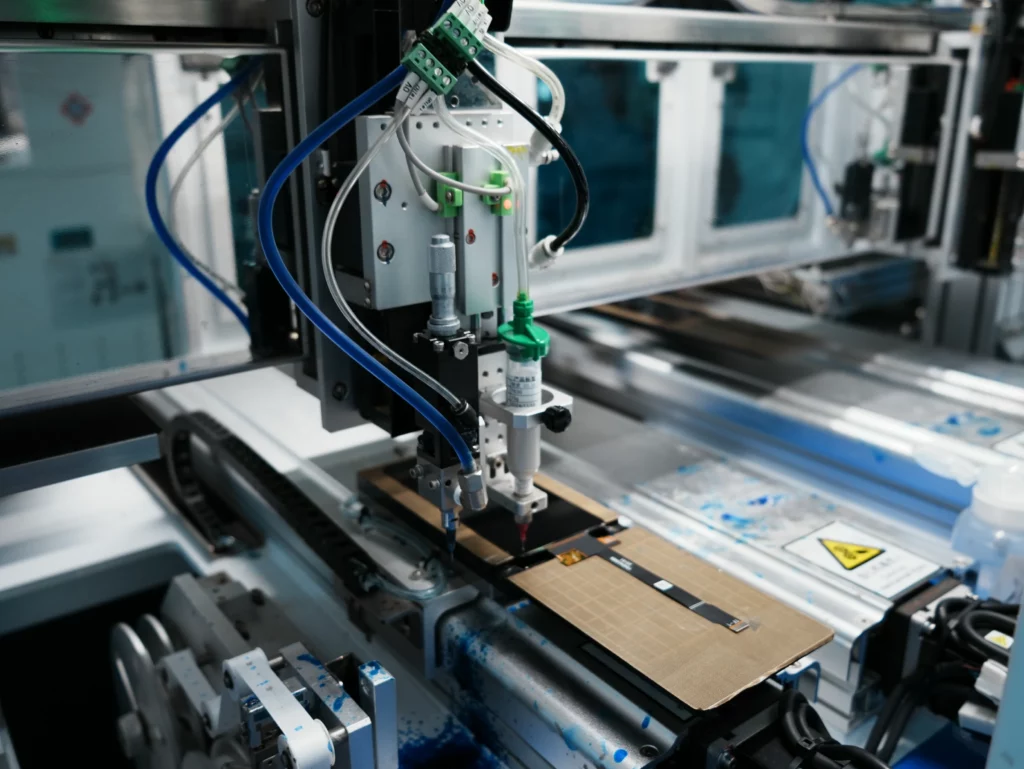
  • 光学性能の向上: 空気層は内部での光反射を引き起こし、周囲の太陽光をユーザーの目に跳ね返らせ、画面を白く霞ませます。この隙間をガラスの屈折率に一致する接着剤で充填することで、内部反射を最大90%低減し、「描き込まれたような」外観を実現します。バックライトの電力を増やすことなく、太陽光下での視認性を大幅に改善します。.
  • 構造的完全性: 硬化した樹脂の固体ブロックが運動エネルギーを吸収し、ディスプレイの耐衝撃性を劇的に向上させます。また、湿気の侵入や結露の可能性を完全に排除します。これは海洋、農業、軍事用途において極めて重要です。.
  • 先進的なシリコーン: 初期の光学接着剤(基本的なアクリル樹脂など)は、紫外線に長時間曝露すると黄変やひび割れを起こしていました。現代の紫外線安定性シリコーンは、アリゾナやスペインの過酷な太陽光の下でも、10年以上の光学クリア性を保証します。.
DSC01699 - RJY Display
過去10年間のTFTモジュール主要5大イノベーション:ハードウェアOEM向け戦略ガイド 10

Strategic Implication for OEMs

製品が屋外、工場フロア、または無菌医療環境(過酷な化学薬品で常に拭き掃除される場所)に設置される場合、TFTモジュールに光学接着を指定することは、もはや任意ではなく、基本的なエンジニアリング要件です。これは、画面の結露や衝撃損傷に関連するRMA(返品材料承認)を削減し、信頼性におけるブランドの評判を保護します。.


コンサルティングの要点:次の10年を乗り切るために

TFTモジュールが、単純な受動部品から高度に統合されたインテリジェントな電気光学システムへと進化するにつれ、欧米のハードウェア企業は調達と設計へのアプローチを転換する必要があります。.

  1. 過剰な仕様指定を止める: 工場のHMIやEV充電ステーションにOLEDディスプレイは必要ありません。Mini-LEDまたは高輝度IPS TFTモジュールは、優れた長寿命、焼き付きリスクゼロ、そしてはるかに優れたユニット経済性を提供します。.
  2. 早期に統合する: 製品筐体を設計した後で「合う画面を探す」ことをしてはいけません。工業デザイン段階の最初から、一流のTFTモジュールメーカーと協力してください。彼らのIn-CellやGOAの技術を活用して、製品の占有面積を縮小しましょう。.
  3. BOMではなくTCOを重視する: 光学接着を施したカスタムIGZO TFTモジュールは、一般的な空気層接着のa-Siモジュールよりも初期のユニットコストは高くなります。しかし、バッテリーサイズの縮小(省電力による)、外部タッチパネル組立コストの排除、現場故障と保証請求の劇的減少を考慮すると、総所有コスト(TCO)は高度な技術を強く支持します。.

TFTモジュールは時代遅れなどではありません。プロのハードウェアエンジニアにとって、それは依然として地球上で最も汎用性が高く、信頼性があり、継続的に革新を続けるディスプレイ技術です。.


よくある質問(FAQ)

Q1: 産業用製品でOLEDディスプレイではなくTFTモジュールを選ぶべき理由は?

A: OLEDディスプレイは、産業環境において2つの重大な欠点があります:「焼き付き」(静的なUI要素を長時間表示した際の永続的な残像)と熱劣化(高輝度または高温で連続動作させると寿命が大幅に短縮)。最新のTFTモジュール、特にIPSバックプレーンとMini-LEDバックライトを備えたものは、静的な画像や極端な温度に関係なく、50,000〜100,000時間を超える寿命で同等の視覚性能を提供します。.

Q2: カスタムのフリーフォームTFTモジュールの典型的なNRE(金型)コストは?

A: これはカスタマイズのレベルに大きく依存します。標準的な長方形のTFTモジュールを採用し、メーカーに保護カバーガラスをユニークな形状にカスタムカットするよう依頼するだけなら、NREは比較的低く抑えられます(通常、2,000〜5,000米ドル)。しかし、実際の有源LCDガラスを非長方形形状に切断する必要がある場合(レベル3のカスタマイズ)、ファブに新しいフォトマスクを作成してもらうための費用が発生します。このNREは容易に50,000米ドルから200,000米ドル以上に達する可能性があり、大量生産される民生品や自動車向けの生産ロットでのみ採算が取れます。.

Q3: 屋外で使用した際のディスプレイの「白く霞んだ」見た目を解決するには?

A: 輝度と反射の両方に対処する必要があります。まず、高輝度バックライト(最低800ニト、理想的には1,000ニト以上)を備えたTFTモジュールを指定します。次に、最も重要なこととして、**光学接着を必須とすることです**。カバーガラスとTFTモジュールの間に空気層がある場合、バックライトの輝度をどれだけ上げても、内部のガラス表面で跳ね返る太陽光のまぶしさを完全に打ち消すことはできません。 光学ボンディング. .

Q4: In-Cellタッチディスプレイは、従来のG+G(ガラス+ガラス)ディスプレイよりも壊れやすいですか?

A: In-Cell TFTモジュール自体は、厚い二重ガラスのセンサー構造と比べて薄く、構造的にはわずかに脆弱です。しかし、製品の最終的な耐久性はカバーガラス(CG)によって決定されます。In-Cell TFTモジュールが、化学強化された厚いカバーガラス(コーニング ゴリラガラスやドラゴントレイルなど)に光学接着されると、その結果として得られるアセンブリは非常に頑丈になり、標準的な工業用落下試験や鋼球衝撃試験を容易に通過します。.

Q5: IGZOへの移行には、マザーボードやソフトウェアの変更が必要ですか?

A: 一般的には、必要ありません。信頼できるディスプレイメーカーは、必要な駆動ICをTFTモジュールのFPC上に直接統合します。お客様のマイクロコントローラー(MCU)またはマイクロプロセッサー(MPU)は、古いa-Siディスプレイと同様に、標準的なプロトコル(MIPI DSI、LVDS、SPIなど)を使用してIGZOディスプレイとインターフェースします。ただし、IGZOの省電力機能を活用するためには、ソフトウェアチームが、画面が静止画を表示しているときにリフレッシュレートを動的に下げるロジックを記述する必要があります。.