








In the evolving landscape of urban architecture, commercial real estate, and transit infrastructure across North America and Europe, static signage is effectively dead. The modern public space is expected to be dynamic, interactive, and endlessly adaptable. At the core of this digital transformation is a piece of hardware that has evolved from a simple consumer television into a ruggedized, hyper-bright piece of civic infrastructure: the big lcd display.
While Direct-View LED (dvLED) gets much of the media attention for massive stadium screens, the large-format LCD (typically ranging from 55 inches to 98 inches and above) remains the undisputed champion for environments where the audience is up close, where ultra-high definition (4K and 8K) is required, and where touch interactivity is paramount.
This comprehensive guide explores the strategic applications of deploying a big lcd display in public spaces. We will bypass the marketing fluff and dive straight into the operational realities, engineering challenges, and return on investment (ROI) metrics that AV integrators and procurement managers must understand.

1. Transportation Hubs: The Mission-Critical Display
Airports, train stations, and subway terminals are arguably the most punishing environments for digital signage. A display in these locations is not merely decorative; it is a vital operational tool.
Applications: FIDS and Wayfinding
- Flight/Passenger Information Display Systems (FIDS): A multi-screen video wall comprised of ultra-narrow bezel LCDs is the standard for FIDS. Passengers rely on these screens for real-time gate changes, delays, and boarding statuses.
- Interactive Wayfinding: A standalone, vertically oriented big lcd display equipped with PCAP (Projected Capacitive) touch allows travelers to map their route to a specific terminal, locate restrooms, or find a specific retail outlet.
The Engineering Reality
Deploying a big lcd display in a major transit hub like London Heathrow or Chicago O’Hare requires rigorous hardware specifications:
- 24/7/365 Operation: Consumer-grade televisions will burn out their power supplies within months if run continuously. Commercial LCDs feature heavy-duty capacitors, advanced thermal dissipation, and image-retention mitigation algorithms.
- Redundancy and Failover: If the primary media player crashes, the display must automatically switch to a backup input or display a cached emergency message. A blank screen in an airport creates immediate crowd-panic.
- High MTBF (Mean Time Between Failures): Procurement teams must specify displays with an MTBF of at least 50,000 hours to minimize maintenance disruptions in secure, hard-to-reach terminal areas.
2. Digital Out-of-Home (DOOH) & Smart City Furniture
The European and US outdoor advertising markets have shifted heavily toward programmatic DOOH. This means the billboard on the street corner is no longer selling a single ad for a month; it is cycling through targeted, time-of-day specific advertisements.
Applications: Street Kiosks and Transit Shelters
- Bus and Tram Shelters: A 75-inch or 86-inch big lcd display integrated into the side of a bus shelter provides dual value: real-time transit arrival data on the top third of the screen, and high-CPM (Cost Per Mille) advertising on the bottom two-thirds.
- Smart City Totems: Municipalities are deploying large LCD totems that provide free public Wi-Fi, emergency broadcast capabilities, and hyper-local civic information, subsidized entirely by the advertising space.
The Engineering Reality
Outdoor deployment is a brutal battle against the elements.
- The Solar Load Problem: If direct sunlight hits an unprotected LCD panel, the liquid crystals will physically boil and enter an “isotropic state,” turning the screen into a massive black blotch. An outdoor big lcd display must feature advanced HVAC (Heating, Ventilation, and Air Conditioning) or active fan cooling systems inside the enclosure to keep the panel below 85°C.
- Luminance Wars: An indoor display operates at around 350 to 500 nits. To be readable in direct summer sunlight in Madrid or Los Angeles, an outdoor LCD must push a minimum of 2,500 to 4,000 nits.
- IK10 Vandal Resistance: The glass protecting the display must be optically bonded, chemically strengthened, and rated IK10 to withstand a direct strike from a blunt object.
3. Retail Environments: Winning the Window
Brick-and-mortar retail in the post-e-commerce era must offer an experiential advantage. Retailers use large-format displays to bridge the gap between their digital brand and physical storefront.
Applications: Window Facing and Experiential Retail
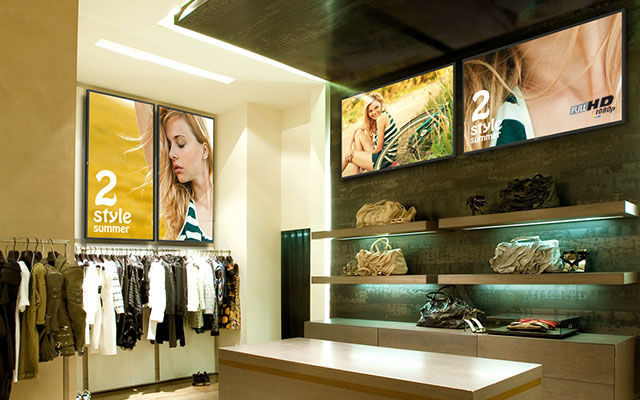
- Window-Facing Displays: A high-brightness big lcd display placed directly behind the storefront glass acts as a digital magnet, drawing foot traffic from the street.
- End-Cap and Feature Walls: Inside the store, large 4K LCDs display high-fidelity lifestyle videos (e.g., a fashion brand showing a runway loop) where color accuracy and contrast are paramount.
The Engineering Reality
- Combating Storefront Reflections: A display inside a glass window faces double reflection—glare from the store window itself, and glare off the LCD screen. High-brightness (3,000 nits) is required to “punch through” the reflections.
- Polarized Sunglass Viewability: Standard LCD panels emit polarized light. If a pedestrian wearing polarized sunglasses walks past a storefront, the screen may appear entirely black to them. Premium retail displays use a specialized Quarter Wave Plate (QWP) film to circularly polarize the light, ensuring the screen is visible regardless of the viewer’s eyewear.
4. Corporate Campuses & Higher Education
The modern corporate lobby or university student union is designed to impress visitors, attract talent, and communicate complex information rapidly.
Applications: Lobby Video Walls and Town Halls
- Architectural Video Walls: Tiling multiple ultra-narrow bezel (e.g., 0.88mm or 1.8mm bezel-to-bezel) LCD panels together creates a massive, seamless digital canvas. These are used to display corporate branding, real-time data dashboards, or digital art.
- Auditorium / Town Hall Displays: A 98-inch big lcd display is often replacing the traditional projector in medium-to-large conference rooms. Unlike projectors, LCDs are not washed out by ambient room lighting, allowing meetings to happen with the blinds open.
The Engineering Reality
- Color Calibration: When tiling multiple LCDs into a video wall, even a 2% difference in color temperature between the panels will look horrific to the human eye. Factory and on-site hardware color calibration is mandatory.
- EU Ecodesign & Energy Star: In the European market, large corporate deployments must strictly adhere to the updated Ecodesign Directive for electronic displays, which enforces stringent power consumption limits. Displays must feature ambient light sensors to automatically dim the backlight during the evening to remain compliant.
Strategic Procurement: Indoor vs. Outdoor Big LCD Displays
To simplify the procurement process, AV consultants use the following baseline matrix when specifying a big lcd display for a public space:
| 仕様 | Indoor Public Space (e.g., Mall, Airport) | Outdoor Public Space (e.g., Bus Shelter, Plaza) |
| 明るさ | 500 – 700 Nits | 2,500 – 4,000 Nits (plus QWP film) |
| Operation Hours | 16/7 or 24/7 depending on usage | 厳格な24時間365日稼働 |
| 侵入保護(IP) | IP4XまたはIP5X(防塵) | IP56またはIP65(防水・防微塵) |
| 衝撃保護(IK) | IK07(偶発的衝突) | IK10(防犯ガラス) |
| 熱管理 | パッシブ冷却 | アクティブACまたは空気対空気熱交換器 |
| パネル技術 | IPSまたはVA | 超高Tni(110°C)IPS |
5. バックエンドの統合:大型LCDの頭脳
98インチ4Kスクリーンの調達は簡単な部分である。公共空間に大型LCDディスプレイを設置する際の隠れた複雑さは、完全にバックエンド、つまりディスプレイに指示を与えるソフトウェアとメディアプレーヤーにある。.
SoC(システム・オン・チップ)の台頭
10年前、すべての商用ディスプレイはコンテンツを駆動するためにかさばる外部PCを必要とし、HDMIで接続され、過熱したAVクローゼットに隠されていた。今日、主要な商用LCDメーカー(例:サムスン、LG、フィリップス)は強力な システム・オン・チップ(SoC) をディスプレイ内部に直接統合している。.
SoCが重要な理由
- 故障点の削減: HDMIケーブル、外部電源、外部PCファン、これら24時間365日稼働における一般的な故障点を排除できる。.
- コスト効率: 2つのハードウェア(スクリーンとPC)を購入する必要がなくなり、50台規模の展開における単体のBOMコストを大幅に削減できる。.
- リモート管理: 内蔵SoCには通常、堅牢なリモート管理ソフトウェア(サムスンMagicINFOやLG SuperSignなど)が付属する。ロンドンのIT管理者は、ウェブブラウザから、パリの地下鉄駅にあるディスプレイをリモートで再起動し、ファームウェアを更新し、内部温度を監視し、コンテンツを変更することができる。.
結論
公共空間における big lcd display の設置はもはや実験ではない。現代の消費者、旅行者、従業員の基本的な期待となっている。成功し、ROIがプラスのデジタルサイネージネットワークと、絶え間ないメンテナンスの悪夢との違いは、完全に環境に適した正しいハードウェア仕様を選択することにかかっている。.
組織が85インチLCDを消費者の玩具ではなく産業用ツールとして扱い、適切な輝度、耐候性、熱管理、堅牢なSoC統合を指定するとき、彼らはコミュニケーション、広告収入、建築的強化のための比類ないプラットフォームを手に入れる。.
よくある質問(FAQ)
Q1: コスト削減のため、大型量販店で最大の民生用TVを購入し、会社のロビーに吊り下げることはできますか?
A: いいえ。これは企業が犯す最も一般的でかつ高くつく間違いです。民生用TVは、暗いリビングルームで1日4〜6時間稼働するように設計されています。明るいロビーで24時間365日稼働させると、1年以内に電源が故障し、画面は永久的な画像残留(焼き付き)を起こし、メーカーは商業用途で使用されたと気付いた瞬間に保証を無効にします。.
Q2: ショッピングモールの案内には、ダイレクトビューLED(dvLED)ウォールではなく、大型LCDディスプレイを選ぶ理由は何ですか?
A: 視聴距離と解像度密度です。85インチ4K LCDは非常に狭いピクセルピッチを有しており(つまり、3フィート離れた位置から細かい文字を完璧に読むことができる)。dvLEDウォールで真の4K解像度を実現するには、数十万ドルの費用と巨大な物理的設置面積が必要です。視聴者が近接するインタラクティブな案内や小売環境では、明瞭さとコストの点でLCDが依然として圧倒的に優れています。.
Q3: 「光学接合」とは何ですか?また、屋外キオスクに推奨される理由は?
A: 光学接合は、LCDパネルと保護カバーガラスの間に固体の透明樹脂を注入する製造プロセスです。これにより空気層が排除されます。これには2つの重要な効果があります:第一に、内部の映り込みを大幅に低減し、日光の下でも画面をはるかに読みやすくします。第二に、寒い朝にガラス内部で結露(曇り)が発生するのを防ぎます。これは電子機器にとって致命的であり、視聴体験を台無しにします。.
Q4: 夏季の気温が115°F(46°C)に達するアリゾナ州フェニックスに屋外ディスプレイが必要です。LCDは耐えられますか?
A: はい、ただし、 高Tni(等方性温度)パネル とアクティブ冷却式IP65筐体を備えたLCDを指定した場合に限ります。標準的な液晶は内部温度約85°C(185°F)で沸騰し黒くなります。高Tniパネルは、故障する前に内部温度110°C(230°F)まで耐えることができます。内部のHVACユニットまたは高速ファンと組み合わせることで、これらのディスプレイは中東や米国南西部の夏を生き延びるために特別に設計されています。.