Enfrentando um gargalo no seu Projeto de Display Incorporado?
Não deixe que a integração complexa ou problemas na cadeia de abastecimento atrasem o seu tempo de colocação no mercado. Marque uma consulta gratuita com a equipa de especialistas da RJY para apoio personalizado em design e fabrico.
A Tela do Arquiteto: Aplicações Estratégicas para um Grande Display LCD em Espaços Públicos Modernos
Publicado:
Leitura de 8 min
Atualizado:
No cenário em constante mudança da arquitetura urbana, da propriedade comercial e da infraestrutura de transporte na América do Norte e na Europa, a sinalização estática tornou-se efetivamente obsoleta. Os espaços públicos modernos exigem dinamismo, interatividade e adaptabilidade ilimitada. No centro dessa transformação digital está um equipamento que evoluiu de um simples televisor de consumo para um ativo robusto de infraestrutura pública de alto brilho: o display LCD de grande formato.
Embora o LED de Visão Direta (dvLED) receba grande atenção da mídia para telas de estádios de grande porte, o LCD de grande formato (tipicamente variando de 55 polegadas a 98 polegadas ou mais) continua sendo o campeão indiscutível para ambientes onde o público está próximo, onde é necessária resolução ultra-alta (4K e 8K) e onde a interatividade por toque é primordial.
Este guia abrangente explora as aplicações estratégicas da implantação de um display LCD grande em espaços públicos. Vamos ignorar o marketing superficial e mergulhar diretamente nas realidades operacionais, nos desafios de engenharia e nas métricas de retorno sobre o investimento (ROI) que integradores de AV e gerentes de aquisição devem compreender.
A Tela do Arquiteto: Aplicações Estratégicas para um Grande Display LCD em Espaços Públicos Modernos 3
1. Centros de Transporte: O Display de Missão Crítica
Aeroportos, estações de trem e terminais de metrô são, sem dúvida, os ambientes mais severos para sinalização digital. Um display nesses locais não é meramente decorativo; é uma ferramenta operacional vital.
Aplicações: FIDS e Orientação (Wayfinding)
Sistemas de Informação de Voos/Passageiros (FIDS): Uma videowall de múltiplas telas composta por LCDs de moldura ultraestreita é o padrão para FIDS. Os passageiros dependem dessas telas para informações em tempo real sobre mudanças de portão, atrasos e status de embarque.
Orientação Interativa (Wayfinding): Um display LCD grande, autônomo e de orientação vertical, equipado com toque PCAP (Projetivo Capacitivo), permite que os viajantes tracem sua rota para um terminal específico, localizem banheiros ou encontrem um ponto de venda específico.
A Realidade da Engenharia
Implantar um display LCD grande em um grande centro de transporte como Londres Heathrow ou Chicago O'Hare exige especificações rigorosas de hardware:
Operação 24/7/365: Televisores de nível consumidor queimarão suas fontes de alimentação em poucos meses se operados continuamente. LCDs comerciais possuem capacitores de alta resistência, dissipação térmica avançada e algoritmos de mitigação de retenção de imagem.
Redundância e Failover: Se o player de mídia principal falhar, o display deve alternar automaticamente para uma entrada de backup ou exibir uma mensagem de emergência em cache. Uma tela em branco em um aeroporto cria pânico imediato na multidão.
Alto MTBF (Tempo Médio Entre Falhas): As equipes de aquisição devem especificar displays com um MTBF de pelo menos 50.000 horas para minimizar interrupções de manutenção em áreas terminais seguras e de difícil acesso.
2. Publicidade Digital Exterior (DOOH) e Mobiliário Urbano Inteligente
Os Estados Unidos e a Europa publicidade externa Os mercados migraram fortemente para o DOOH programático. Isso significa que o outdoor na esquina não está mais vendendo um único anúncio por mês; ele está exibindo anúncios segmentados e específicos para cada horário do dia.
Aplicações: Quiosques de Rua e Abrigos de Transporte
Abrigos de Ônibus e Bondes: Um display LCD grande de 75 ou 86 polegadas integrado à lateral de um abrigo de ônibus oferece valor duplo: dados de chegada de trânsito em tempo real no terço superior da tela e publicidade de alto CPM (Custo Por Mil) nos dois terços inferiores.
Totens de Cidade Inteligente: Municípios estão implantando grandes totens LCD que fornecem Wi-Fi público gratuito, capacidade de transmissão de emergência e informações cívicas hiperlocais, subsidiados inteiramente pelo espaço publicitário.
A Tela do Arquiteto: Aplicações Estratégicas para um Grande Display LCD em Espaços Públicos Modernos 4
A Realidade da Engenharia
A implantação externa é uma batalha brutal contra os elementos.
O Problema da Carga Solar: Se a luz solar direta incidir sobre um painel LCD desprotegido, os cristais líquidos literalmente ferverão e entrarão em um “estado isotrópico”, transformando a tela em uma mancha preta enorme. Um display LCD externo de grande porte deve contar com sistemas avançados de HVAC (Aquecimento, Ventilação e Ar Condicionado) ou sistemas ativos de resfriamento por ventoinha dentro do gabinete para manter o painel abaixo de 85°C.
A Guerra da Luminância: Um display interno opera em torno de 350 a 500 nits. Para ser legível sob luz solar direta de verão em Madri ou Los Angeles, um LCD externo deve atingir um mínimo de 2.500 a 4.000 nits.
Resistência a Vandalismo IK10: O vidro que protege o display deve ser opticamente colado (optical bonding), quimicamente temperado e classificado como IK10 para suportar um golpe direto de um objeto contundente.
3. Ambientes de Varejo: Conquistando a Vitrine
O varejo físico na era pós-comércio eletrônico deve oferecer uma vantagem experiencial. Os varejistas usam displays de grande formato para preencher a lacuna entre sua marca digital e sua loja física.
Aplicações: Vitrines e Varejo Experiencial
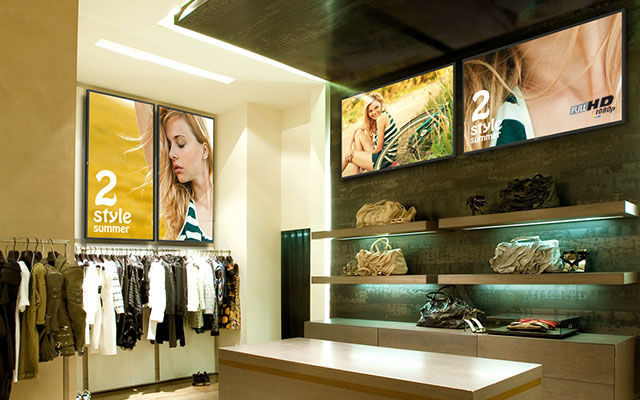
Displays Voltados para a Vitrine: Um display LCD grande de alta luminosidade colocado diretamente atrás do vidro da vitrine atua como um ímã digital, atraindo o tráfego de pedestres da rua.
Pontos de Gôndola e Paredes de Destaque: Dentro da loja, grandes LCDs 4K exibem vídeos de estilo de vida de alta fidelidade (por exemplo, uma marca de moda mostrando um loop de passarela) onde a precisão de cores e o contraste são primordiais.
A Realidade da Engenharia
Combatendo Reflexos na Vitrine: Um display dentro de uma vitrine de vidro enfrenta reflexão dupla — o reflexo da própria vitrine e o reflexo da tela LCD. Alta luminosidade (3.000 nits) é necessária para “atravessar” os reflexos.
Visibilidade com Óculos de Sol Polarizados: Painéis LCD padrão emitem luz polarizada. Se um pedestre usando óculos de sol polarizados passar por uma vitrine, a tela pode parecer completamente preta para ele. Displays de varejo premium usam um filme especial de Placa de Onda de Quarto de Onda (QWP) para polarizar circularmente a luz, garantindo que a tela seja visível independentemente dos óculos do espectador.
4. Campi Corporativos e Ensino Superior
O lobby corporativo moderno ou o centro de estudantes universitários é projetado para impressionar visitantes, atrair talentos e comunicar informações complexas rapidamente.
Aplicações: Videowalls em Lobbies e Auditórios
Videowalls Arquitetônicas: Unir vários painéis LCD de moldura ultraestreita (por exemplo, 0,88 mm ou 1,8 mm de moldura a moldura) cria uma tela digital maciça e contínua. Elas são usadas para exibir marcas corporativas, painéis de dados em tempo real ou arte digital.
Displays para Auditórios / Reuniões Gerais: Um display LCD grande de 98 polegadas está frequentemente substituindo o projetor tradicional em salas de conferência de médio a grande porte. Ao contrário dos projetores, os LCDs não são prejudicados pela iluminação ambiente da sala, permitindo que as reuniões ocorram com as persianas abertas.
A Realidade da Engenharia
Calibração de Cores: Ao unir múltiplos LCDs em uma videowall, mesmo uma diferença de 2% na temperatura de cor entre os painéis parecerá horrível ao olho humano. A calibração de cores de hardware na fábrica e no local é obrigatória.
Ecodesign da UE e Energy Star: No mercado europeu, grandes implantações corporativas devem aderir estritamente à Diretiva de Ecodesign atualizada para displays eletrônicos, que impõe limites rigorosos de consumo de energia. Os displays devem apresentar sensores de luz ambiente para diminuir automaticamente o brilho da retroiluminação durante a noite para permanecerem em conformidade.
Aquisição Estratégica: Displays LCD Grandes para Uso Interno vs. Externo
Para simplificar o processo de aquisição, os consultores de AV usam a seguinte matriz de base ao especificar um display LCD grande para um espaço público:
Especificação
Espaço Público Interno (ex.: Shopping, Aeroporto)
Espaço Público Externo (ex.: Abrigo de Ônibus, Praça)
Brilho
500 – 700 Nits
2.500 – 4.000 Nits (mais filme QWP)
Horas de Operação
16/7 ou 24/7 dependendo do uso
Rigorosamente 24 horas por dia, 7 dias por semana, 365 dias por ano
Grau de Proteção (IP)
IP4X ou IP5X (Resistente à poeira)
IP56 ou IP65 (À prova de água e poeira fina)
Proteção contra Impactos (IK)
IK07 (Impactos acidentais)
IK10 (Vidro anti-vandalismo)
Gestão térmica
Refrigeração passiva
Refrigeração ativa por CA ou Trocadores de Calor Ar-Ar
Tecnologia de Painel
IPS ou VA
IPS com Tni ultra-alto (110°C)
5. Integração do Backend: O Cérebro do Grande LCD
Adquirir uma tela de 98 polegadas 4K é a parte fácil. A complexidade oculta da implantação de um grande display LCD em um espaço público reside inteiramente no backend — o software e o reprodutor de mídia que dizem o que ele deve fazer.
A Ascensão do SoC (Sistema em um Chip)
Há dez anos, todos os monitores comerciais precisavam de um computador externo volumoso para processar o conteúdo, conectado via HDMI, e então alojado em salas de áudio e vídeo superaquecidas. Hoje, os principais fabricantes de monitores LCD comerciais (como Samsung, LG e Philips) integraram um poderosoSystem-on-a-Chip (SoC)diretamente no interior do monitor.
Por que o SoC é Importante
Redução de Ponto de Falha: Você elimina o cabo HDMI, a fonte de alimentação externa e a ventoinha do PC externo — todos pontos comuns de falha em operações 24/7.
Eficiência de Custos: Você não está mais comprando dois equipamentos (uma tela e um PC), reduzindo significativamente o custo de BOM por unidade em uma implantação de 50 telas.
Gerenciamento Remoto: SoCs integrados geralmente vêm com software robusto de gerenciamento remoto (como Samsung MagicINFO ou LG SuperSign). Um gerente de TI em Londres pode reiniciar remotamente, atualizar o firmware, monitorar a temperatura interna e alterar o conteúdo em um display localizado em uma estação de metrô em Paris, tudo a partir de um navegador web.
Conclusão
A implantação de um display LCD grande em um espaço público não é mais um experimento; é a expectativa básica do consumidor, viajante e funcionário modernos. A diferença entre uma rede de sinalização digital bem-sucedida, com ROI positivo, e um pesadelo de manutenção constante depende inteiramente da seleção das especificações de hardware corretas para o ambiente.
Quando uma organização trata um LCD de 85 polegadas como uma ferramenta industrial e não como um brinquedo de consumo — especificando brilho correto, proteção contra intempéries, gerenciamento térmico e integração robusta de SoC — ela desbloqueia uma plataforma incomparável para comunicação, receita publicitária e valorização arquitetônica.
Perguntas frequentes (FAQ)
Q1: Podemos simplesmente comprar a maior TV de consumo de uma grande varejista e instalá-la no saguão corporativo para economizar dinheiro?
R: Não. Este é o erro mais comum e caro que as empresas cometem. TVs de consumo são projetadas para funcionar de 4 a 6 horas por dia em uma sala de estar escura. Se operadas 24/7 em um saguão iluminado, a fonte de alimentação falhará em menos de um ano, a tela sofrerá retenção permanente de imagem (burn-in) e o fabricante anulará instantaneamente a garantia ao perceber que foi usada em um ambiente comercial.
Q2: Por que escolher um grande display LCD em vez de uma parede de LED de visão direta (dvLED) para um diretório de shopping center?
R: Distância de visualização e densidade de resolução. Um LCD 4K de 85 polegadas tem um *pixel pitch* incrivelmente apertado (significando que você pode ficar a um metro de distância e ler textos pequenos perfeitamente). Para alcançar resolução 4K verdadeira em uma parede dvLED, custaria centenas de milhares de dólares e exigiria uma enorme pegada física. Para diretórios interativos ou ambientes de varejo onde o espectador está próximo, o LCD permanece vastamente superior em clareza e custo.
Q3: O que é “Laminagem Óptica” e por que é recomendada para quiosques externos?
R: Laminagem óptica é um processo de fabricação que injeta uma resina sólida e transparente entre o painel LCD e a vidraça de proteção. Ele elimina o espaço de ar. Isso faz duas coisas críticas: Primeiro, reduz drasticamente o brilho interno, tornando a tela muito mais legível ao sol. Segundo, evita a formação de condensação (embaçamento) dentro do vidro em manhãs frias, o que é letal para a eletrônica e arruína a experiência de visualização.
Q4: Precisamos de um display externo em Phoenix, Arizona, onde as temperaturas de verão atingem 115°F (46°C). Um LCD sobreviverá?
R: Sim, mas apenas se você especificar um LCD com um Painel de Alto Tni (Temperatura Isotrópica) e um gabinete IP65 com refrigeração ativa. Cristais líquidos padrão fervem e ficam pretos por volta de 85°C (185°F) internamente. Painéis de Alto Tni podem suportar temperaturas internas de até 110°C (230°F) antes de falhar. Combinados com uma unidade de HVAC interna ou ventiladores de alta velocidade, esses displays são especificamente projetados para sobreviver aos verões do Oriente Médio e do Sudoeste dos EUA.
↗
Planejando um Projeto de Display?
Compartilhe o tamanho do display, resolução, interface, brilho, requisito de toque, requisito de placa controladora e ambiente de aplicação.