The world’s leading display manufacturers possess enormous production capacity, advanced process technology, extensive patent portfolios, and access to major consumer-electronics markets. For televisions, smartphones, laptops, vehicles, and other high-volume products, their scale is a decisive advantage.
Yet that advantage does not automatically make a top-tier panel manufacturer the best partner for every display project.
Small and medium-sized enterprises often approach the market with a different set of needs. They may require hundreds or thousands of displays rather than millions. They may need a modified cover glass, a different backlight, an unusual FPC direction, touch integration, a controller board, firmware adaptation, or assistance fitting an existing LCD into a new enclosure.
These requirements can be commercially important to the equipment developer while remaining too small, fragmented, or engineering-intensive for a large panel manufacturer’s standard operating model.
This creates a paradox at the center of the display industry. Scale makes advanced displays affordable and widely available, but the organizational systems required to achieve that scale can make low-volume differentiation harder to support. The more efficiently a manufacturer is optimized around standardized production, the less attractive a small, highly customized project may become.
This does not mean leading LCD brands are technically incapable of supporting smaller businesses. It means their factories, sales structures, development priorities, and return requirements may not align with the economics of an SME project. Understanding this distinction helps startups, R&D teams, and equipment manufacturers choose the right type of display partner.
The Important Distinction: Panel Manufacturer, Module Supplier, and Solution Partner
The term “LCD manufacturer” is used loosely in the market, but it can describe several very different roles.
A panel manufacturer operates the highly capital-intensive production processes that create display panels. Its work may include thin-film transistor arrays, color filters, liquid-crystal cells, OLED structures, cutting, testing, and other processes performed at industrial scale.
A module supplier works closer to the usable display assembly. Depending on its scope, it may combine a panel with a driver arrangement, backlight, frame, FPC, connector, touch panel, cover glass, or other integration elements.
A display solution partner works closer still to the customer’s final product. It may help evaluate whether an existing module fits the enclosure, whether the host interface is appropriate, whether a controller board is required, how touch should be integrated, or how the FPC and mechanical structure should be coordinated.
One company can operate across more than one of these layers. Several major display groups have expanded beyond panel production and now promote integrated systems, vertical-market applications, and display-centered solutions. AUO, for example, describes a transformation from a panel supplier toward a display-centered solution provider spanning display, mobility, and vertical solutions.1
Even so, the commercial path available to a global automotive customer or major consumer-electronics brand may be very different from the path available to a startup ordering its first production batch.
The buyer should therefore ask more than, “Who manufactured the panel?” A more useful question is, “Who will take responsibility for helping this panel function inside my product?”
Why Scale Is So Powerful in the Display Industry
Modern display production rewards scale. Large fabrication plants, specialized equipment, process control, material purchasing, yield management, and research programs require substantial investment. High production volume allows these fixed costs to be distributed across more panels.
Scale can provide several advantages:
- Lower unit cost for established high-volume products
- More mature process control and manufacturing data
- Access to advanced display technologies
- Large research and intellectual-property portfolios
- Capacity to serve global consumer-electronics programs
- Strong bargaining power within the upstream supply chain
BOE’s corporate history illustrates the scale of this model. The company describes the construction and mass production of multiple high-generation TFT-LCD production lines and reports more than 100,000 independently filed patent applications as of 2025.2
LG Display’s recent strategy similarly emphasizes an OLED-centered business structure and a larger share of premium products. OLED products accounted for 56% of its revenue in the second quarter of 2025, according to the company’s results announcement.3
These are rational strategies for companies managing large capital investments. A production line cannot be operated as if every order were a laboratory experiment. Materials, equipment time, engineering resources, quality systems, and customer programs must be allocated toward opportunities capable of producing an appropriate return.
From the large manufacturer’s perspective, standardization is not a lack of customer focus. It is one of the mechanisms that makes the display industry economically possible.
The First Paradox: SMEs Need Differentiation, but Scale Rewards Standardization
Many smaller equipment brands cannot compete through manufacturing volume. They compete by serving narrower markets, solving specialized problems, moving quickly, or creating a product experience that large brands have overlooked.
The display is often central to that differentiation. A smart-home company may need a circular front panel. A laboratory-equipment developer may need a compact screen integrated into an existing instrument. A security-device manufacturer may need a narrow status display. A hospitality startup may want distinctive cover glass and a customized interface.
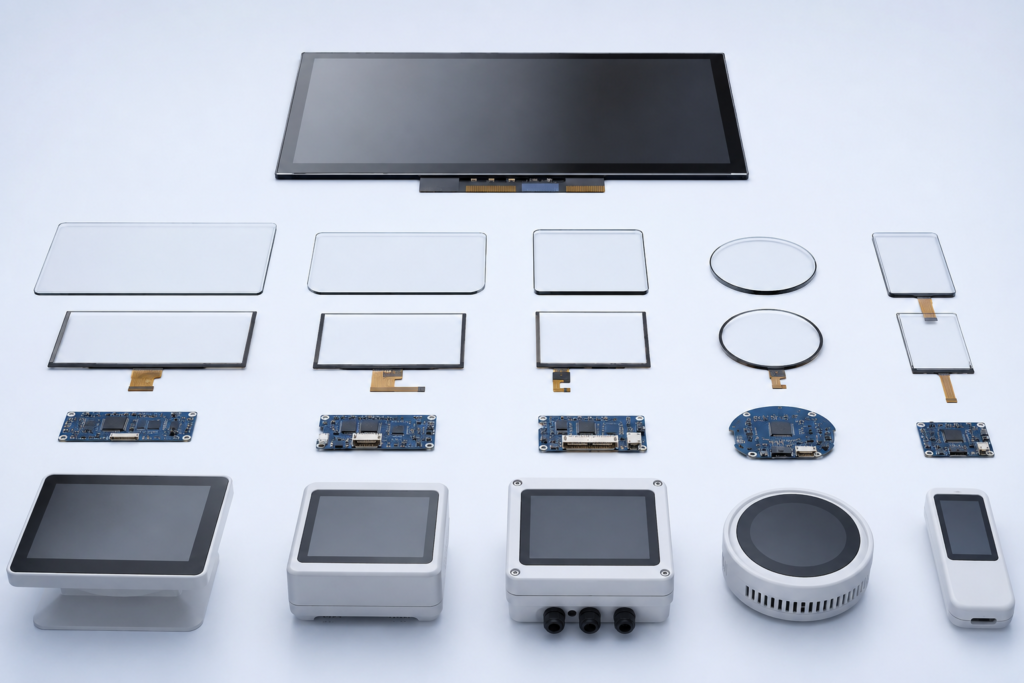
For the SME, these details are not cosmetic. They may determine whether the product fits its enclosure, communicates its value, or appears sufficiently different from competing equipment.
For a large-scale panel manufacturer, however, each variation can introduce complexity:
- A separate engineering review
- New drawings and documentation
- Additional material or component qualification
- Changes to tooling or production processes
- Different inspection requirements
- Separate inventory and forecasting
- More project-management communication
If the expected order is small, the revenue may not justify this complexity. The manufacturer may offer only its existing standard catalog, require a high minimum order, route the buyer through a distributor, or decline the project.
The result is a fundamental mismatch: the SME needhe Middle Layer: Ws customization because it lacks scale, while the large manufacturer needs scale before customization becomes commercially attractive.
The Second Paradox: SMEs Need Flexibility Before Their Demand Is Predictable
A mature global product program may provide detailed forecasts, approved specifications, defined production locations, validated firmware, and a multi-year purchasing plan. A new SME project often begins with uncertainty.
The developer may still be deciding:
- Which display size fits the industrial design
- Whether the product needs touch
- Which processor or operating system to use
- How much brightness the environment requires
- Whether the interface should be MIPI, LVDS, eDP, RGB, or another option
- How customers will respond to the first prototype
- What the first-year production quantity will be
This is exactly when engineering support has the greatest value. It is also when purchasing forecasts are least reliable.
A large manufacturer may reasonably want forecast certainty before allocating engineering resources. The SME needs engineering resources in order to create the product that might eventually generate a reliable forecast. Each party is waiting for evidence that the other party cannot yet provide.
A more flexible module or solution supplier can sometimes bridge this gap by starting from an existing display platform, building a sample configuration, and narrowing the technical uncertainty before mass-production commitments are made.
This does not eliminate commercial risk. It divides the risk into smaller and more manageable decisions.
The Third Paradox: SMEs Want Lower MOQs but More Engineering Attention
Order quantity and engineering workload do not always move in the same direction.
A small company may order only 500 customized displays, yet require several discussions about the cover glass, FPC, touch controller, host processor, backlight, firmware, enclosure, and sample behavior. A major customer ordering hundreds of thousands of units may have greater total requirements, but it may also have a dedicated engineering organization and well-established specifications.
From the supplier’s perspective, the smaller project can require more communication per unit sold.
This is why low MOQ should not be understood as a simple act of generosity. It is an economic model that must account for:
- Engineering review time
- Non-recurring development work
- Sample preparation
- Component purchasing constraints
- Tooling or fixture requirements
- Production-line setup
- Inspection and documentation
- Risk that the project never reaches repeat production
A serious SME buyer should not expect extensive customization to be priced like an off-the-shelf component. The real goal is not “customization with no cost.” It is a development structure in which the cost is visible, proportionate, and compatible with the opportunity.
RJY Display’s customization projects typically start from an MOQ of around 500 units, depending on the module, customization scope, materials, and project requirements. This is not a universal commitment for every configuration, but it illustrates a business model positioned between one-off hobby supply and mass-market panel production.
Why a Famous Panel Brand Does Not Guarantee a Complete Product Solution
SME buyers sometimes assume that obtaining a panel from a leading brand will solve most of their display-development risk. Panel origin matters, but it does not answer every integration question.
The finished product may still require decisions about:
- Backlight design and power
- FPC layout and connector location
- Display timing and initialization
- Touch-panel selection
- Touch-controller communication
- Cover-glass shape and printing
- Optical and mechanical assembly
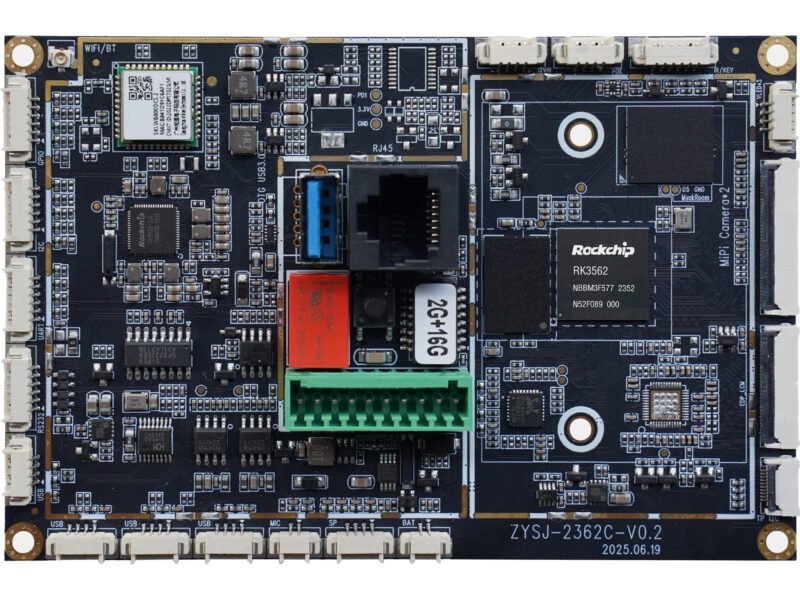
- Controller-board compatibility
- Firmware or operating-system behavior
- Enclosure tolerances and mounting
A panel can be technically excellent and still be difficult to use in a specific product. The issue may have nothing to do with panel quality. The interface may not match the host, the FPC may exit in the wrong direction, the active area may not align with the enclosure, or the available controller board may not support the required timing.
These are module and system-integration problems rather than panel-manufacturing problems.
This explains why a supplier with less global brand recognition can sometimes create more practical value for an SME project. The smaller supplier is not necessarily producing a more advanced panel. It may simply be operating at the layer where the customer’s actual problems occur.
Customization Is Not One Thing
Buyers often ask for a “custom LCD” without distinguishing among several very different levels of customization.
Level 1: Selecting a different standard module
The lowest-risk option may be to identify an existing module whose size, resolution, interface, brightness, viewing direction, and temperature requirements already fit the product. No physical change is required.
Level 2: Customizing components around an existing LCD
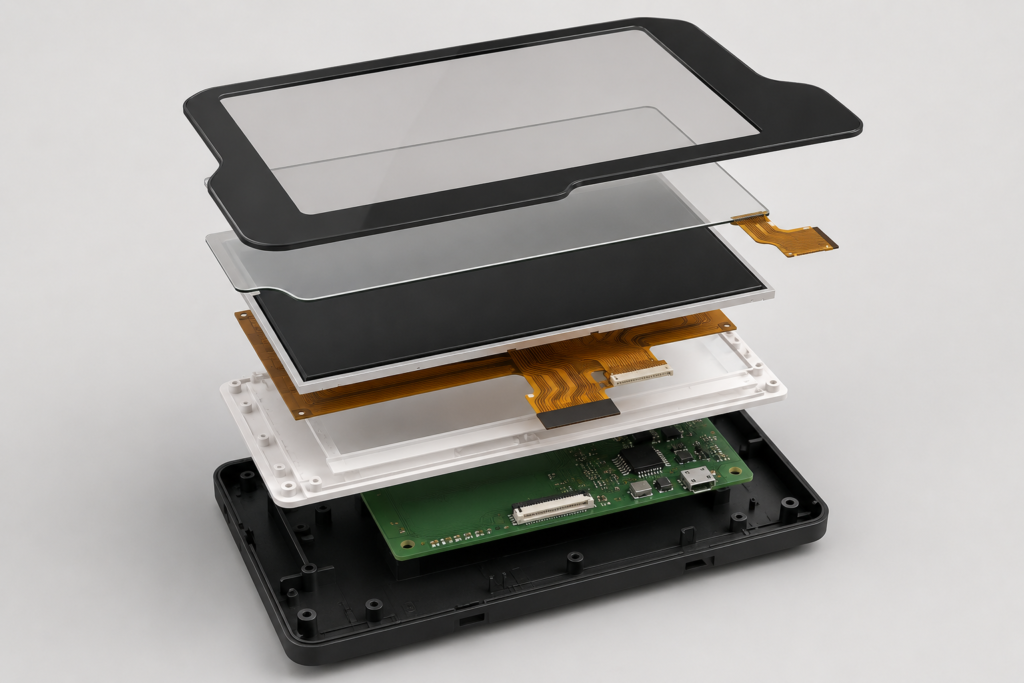
The core display remains unchanged, but the supplier modifies the surrounding assembly. Possible items include the cover glass, touch panel, backlight, FPC, connector arrangement, controller board, firmware, or related mechanical structure.
This is often the most practical level for SME projects because it provides meaningful product differentiation without requiring a completely new display-panel process.
Level 3: Modifying the module architecture
More extensive changes may affect multiple components or require new tooling and validation. Feasibility depends on the selected panel, available materials, production quantity, schedule, and technical risk.
Level 4: Developing a completely new LCD panel
A new active area, cell design, pixel structure, driver arrangement, or panel geometry is a fundamentally different undertaking. It can involve substantial non-recurring cost, high volume expectations, long development work, and process-specific feasibility constraints.
Many SMEs do not actually need Level 4. They need Level 2 presented clearly and implemented competently.
Confusing these levels creates poor supplier selection. A buyer may reject a practical existing-module solution because it does not sound “fully custom,” or approach a panel factory with a project that would be better served through cover-glass, touch, interface, and mechanical adaptation.
Where SMEs Usually Need Differentiation
For many equipment developers, visible product differentiation occurs above and around the LCD rather than inside the liquid-crystal cell.
Cover glass and front-panel identity
Cover glass can influence the apparent shape of the interface, border design, brand presentation, opening positions, and integration with the enclosure. A standard rectangular LCD can support a distinctive product appearance when the front panel is designed well.
The exact glass material, thickness, surface treatment, hardness, printing, and bonding method must be confirmed for the project. These properties should never be assumed from the phrase “custom cover glass.”
Touchscreen configuration
Touch can replace physical controls and allow one hardware platform to support multiple interfaces. However, the touch sensor, controller, cover glass, firmware, operating system, grounding, enclosure, and use environment affect the final result.
Touch customization is therefore a system-integration task, not simply an option added to an LCD part number.
Brightness and backlight
A display used in a controlled indoor environment has different visibility requirements from one installed near a window or inside illuminated equipment. Backlight adaptation may help a module better suit its environment, but brightness, power, heat, optical construction, and expected operation must be reviewed together.
FPC and interface coordination
The location and direction of a flexible cable can determine whether a display fits inside a compact enclosure. Interface selection also affects processor choice, controller-board requirements, signal integrity, firmware, and cable design.
Controller board and firmware
An SME may have a selected LCD but no direct way to drive it from its preferred host. A controller-board project requires more than matching connector types. Panel model, resolution, interface, pin definition, timing, driver IC when available, backlight, touch, operating system, firmware, and environment must be reviewed before compatibility is confirmed.
Mechanical coordination
A display assembly interacts with the bezel, mounting points, gasket, cables, thermal design, buttons, speakers, sensors, and product housing. Display-related mechanical coordination can prevent late-stage interference, but it should not be confused with unlimited industrial-design or full-device manufacturing services.
Why Large Manufacturers Cannot Simply Create a Small-Team Department
It may appear that a global manufacturer could solve the SME problem by assigning a small sales and engineering team to lower-volume accounts. Some major companies and their distribution networks already offer programs serving broader customer groups. However, organizational scale cannot be separated easily from manufacturing scale.
A small-project department would still depend on the larger company’s:
- Approved materials and suppliers
- Production-planning rules
- Quality-management procedures
- Engineering-change systems
- Legal and commercial review
- Customer qualification processes
- Minimum economic return requirements
The account may be small, but the organization processing it remains large.
Major manufacturers also face an opportunity-cost problem. An engineer working on a low-volume custom module is not working on a global automotive platform, next-generation OLED product, or strategic consumer-electronics program. The smaller project must compete internally for scarce technical attention.
This is particularly relevant as major display companies emphasize premium technologies and vertical-market transformation. LG Display has publicly emphasized its OLED-centered structure, while AUO has described “Go Premium” and “Go Vertical” strategies intended to increase the value of display technology and deepen vertical applications.4
These strategies show that leading companies recognize the limits of undifferentiated panel production. They do not, however, mean every small OEM can directly access a custom solution with the same commercial terms as a strategic high-volume customer.
The Role of Distributors—and Their Limits
Distributors make large manufacturers’ products accessible to a wider customer base. They can provide local inventory, smaller order quantities, commercial support, logistics, and access to multiple brands.
For an SME seeking a standard display, a distributor may be the correct choice. The customer can compare available modules, purchase samples, and avoid direct factory minimums.
Distribution becomes less complete when the project requires changes beyond the catalog item. Not every distributor can develop a custom backlight, coordinate touch and cover glass, modify an FPC, adapt firmware, or take responsibility for a display-and-controller combination.
The distinction is not between “good factory” and “bad distributor.” It is between transactional availability and engineering accountability.
A useful supplier-selection process asks:
- Can the supplier only sell the standard part?
- Can it obtain accurate panel documentation?
- Can it explain what can and cannot be modified?
- Can it coordinate the touch, controller, firmware, and mechanical requirements?
- Who owns the technical review if the complete system does not work?
A distributor may remain part of the supply chain while a specialized solution partner handles integration. The appropriate structure depends on the project.
The Middle Layer: Why Specialized Display Suppliers Exist
The gap between large panel production and small equipment development creates a market for specialized display suppliers.
These suppliers generally do not attempt to reproduce the capital scale or advanced process development of a major panel manufacturer. Their value comes from combining existing display technology with a more flexible commercial and engineering model.
A specialized supplier may create value by:
- Searching across existing modules for a closer fit
- Supporting sample-stage evaluation
- Aggregating demand for panels and components
- Customizing selected parts of the module assembly
- Coordinating third-party touch, cover-glass, or board resources
- Communicating with a smaller customer’s engineering team
- Managing the transition from prototype to repeat production
This role is sometimes misunderstood as simple reselling. A supplier that only forwards part numbers is indeed performing a limited commercial function. A capable module or solution provider performs engineering selection, integration coordination, risk clarification, and project management around the core display.

The value of this middle layer increases as the customer’s product becomes more specialized and its internal display expertise becomes more limited.
Customization Based on Existing Modules: A Practical SME Strategy
For many SMEs, the strongest product-development strategy is not to create a new panel. It is to begin with a suitable existing module and concentrate investment on the elements customers can see, use, or depend upon.
This approach offers several benefits.
It reduces technical uncertainty
An existing panel platform already has a defined active area, resolution, interface, driver architecture, and physical outline. The project begins with more known information than an entirely new display development.
It keeps differentiation focused
The company can invest in cover glass, touch behavior, interface design, enclosure, firmware, application software, and the overall product experience rather than spending most of its budget recreating display technology.
It makes sampling more realistic
A prototype based on the intended module provides better evidence about mechanical fit, readability, interface performance, and user experience than a generic development screen that will later be replaced.
It creates a clearer path to production
The project still requires validation and supply planning, but fewer foundational elements must change between the prototype and production stages.
It can make development cost more controllable
The customer can separate standard component costs from non-recurring customization work. This does not guarantee a low total cost, but it makes the sources of cost easier to understand and manage.
There are limits. The available module may not match every desired dimension, resolution, interface, or optical requirement. The buyer must be willing to adjust the industrial design when the cost of a perfect display geometry exceeds the value it creates.
Standardization and Differentiation Are Not Opposites
SMEs sometimes fear that using an existing display module will make their product look generic. This assumes that product identity comes primarily from the hidden origin of the LCD panel.
In practice, customers interact with a complete system. They see:
- The shape and finish of the front panel
- The proportion of the screen to the enclosure
- The graphical interface
- The responsiveness of touch
- The quality of animations and transitions
- The mounting and mechanical details
- The functions enabled by the software
- The consistency of the overall product experience
Two products can use related display technology and still feel entirely different.
This suggests a more efficient innovation model: standardize the component layers customers do not need to distinguish, and differentiate the layers that influence use, integration, and brand identity.
A smart-control panel may not need a unique liquid-crystal cell. It may need a shaped cover glass, a responsive touch interface, a carefully proportioned enclosure, and software designed for its specific workflow.
That is not compromised innovation. It is the allocation of limited development resources toward the parts of the product that create the most value.
When an SME Should Approach a Major Panel Manufacturer Directly
A specialized supplier is not always the correct answer. Direct engagement with a major panel manufacturer may be appropriate when the project has characteristics such as:
- Very high and credible annual demand
- A multi-year platform plan
- Requirements tied to advanced panel technology
- Strong internal display-engineering resources
- A clear specification that is unlikely to change
- Commercial capacity to support tooling and development cost
- Qualification processes appropriate for a strategic program
A large consumer-electronics, vehicle, notebook, or television program may benefit directly from the scale, process depth, technology roadmap, and long-term capacity planning of a top panel company.
An SME may also become strategically important if its application provides access to a new market or a technology the manufacturer wants to develop. Company size alone does not determine whether direct collaboration is possible.
The key is alignment. If the opportunity fits the manufacturer’s technology roadmap, revenue expectations, and resource priorities, a smaller company can still become a valuable partner.
When a Specialized Module or Solution Supplier Is More Appropriate
A specialized supplier is generally more relevant when the project needs:
- Selection among existing compact TFT LCD modules
- Moderate production volume
- Sample-stage technical communication
- Custom cover glass or touchscreen integration
- Backlight, FPC, or interface adaptation
- A controller board matched to the selected panel
- Firmware coordination
- Display-related mechanical support
- A practical transition from prototype to production
The customer should still evaluate the supplier carefully. Flexibility without engineering discipline can create inconsistent documentation, unclear responsibility, or poorly controlled changes.
A credible supplier should explain its boundaries. It should distinguish standard products from custom work, state when a conclusion requires the actual panel datasheet, avoid claiming universal controller-board compatibility, and clarify whether development is based on an existing module.
A supplier willing to say “this must be verified” can be more useful than one promising that every request is easy.
How SMEs Should Evaluate a Custom Display Supplier
1. Ask where the customization occurs
Does the supplier propose a new panel, a modified module, or customization around an existing display? The answer determines cost, risk, MOQ, and development time.
2. Ask what information is needed before feasibility can be confirmed
A serious technical review should request the target size, resolution, interface, brightness, touch, environment, enclosure constraints, sample quantity, and expected production demand.
For controller-board work, the panel model, datasheet, pin definition, backlight, touch interface, firmware, operating system, and input requirements are also important.
3. Separate verified facts from proposals
A proposed brightness target is not a verified result. A planned controller path is not confirmed compatibility. A conceptual enclosure is not a production-ready structure. The supplier should label each stage accurately.
4. Review change control
Ask how drawings, samples, firmware versions, approved materials, and configuration changes will be documented. Smaller projects still need a stable reference when they move into repeat production.
5. Evaluate communication quality
Fast replies are useful, but technical clarity matters more. Look for answers that connect recommendations to the display, host, enclosure, environment, and quantity.
6. Compare total project cost
Unit price should be considered together with tooling, engineering charges, sample revisions, controller boards, cables, software work, installation risk, and potential redesign.
7. Test the actual configuration
Do not approve production based solely on a similar module or generic demonstration board. Evaluate the intended LCD, touch, cover glass, controller, firmware, enclosure, and use environment together.
What the Large Manufacturer–SME Gap Means for the Display Market
The market is not dividing neatly into “advanced large manufacturers” and “flexible small suppliers.” Instead, companies are moving toward overlapping layers.
Major display groups are expanding into premium products, integrated systems, mobility, retail, and other vertical solutions. AUO Display Plus, for example, has promoted integrated retail display solutions rather than only individual panels.5
At the same time, specialized module suppliers are offering controller boards, touch assemblies, firmware coordination, and mechanical support. Distributors are adding design services, while equipment manufacturers are building more display expertise internally.
This creates competition around integration ownership. The winning supplier may not be the company with the largest factory or the broadest catalog. It may be the company that can reduce the distance between a display specification and a working product.
For SMEs, this is positive. More supply-chain layers are attempting to solve application problems. It also makes supplier evaluation more difficult because the word “solution” can describe anything from a standard module kit to a deeply coordinated hardware platform.
Buyers must examine the actual scope behind the marketing language.
The Strategic Opportunity for SMEs
The scale disadvantage of an SME can become an innovation advantage when the company organizes its product development intelligently.
A smaller team can often:
- Target an underserved device category
- Make decisions with fewer organizational layers
- Test a specialized user interface quickly
- Adapt an existing module creatively
- Serve production volumes too small for a global platform
- Work closely with early customers
- Change its product before major capital is committed
The objective should not be to imitate the purchasing model of a multinational consumer-electronics company. It should be to build a supply chain appropriate to the SME’s scale.
That may involve a standard panel made by a leading manufacturer, a module assembled through another supplier, a customized touch and cover-glass solution, a project-specific controller board, and an enclosure developed by the equipment company.
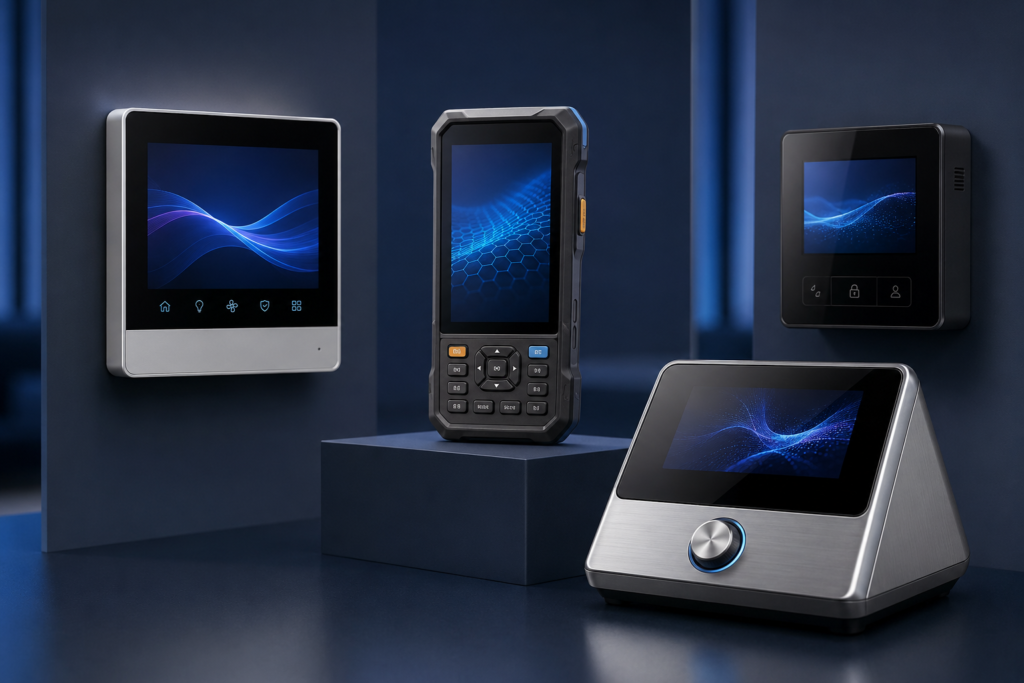
This layered structure is not inherently inefficient. It becomes efficient when responsibilities, specifications, and validation points are clear.
How RJY Display Positions Its Role
RJY Display does not attempt to replace the technological scale of the world’s leading panel manufacturers. Its role is closer to the engineering and module-integration layer required by R&D teams, startups, and equipment manufacturers.
RJY supports TFT LCD products, controller boards, and customization based mainly on existing display modules. Depending on the selected module and project scope, support may include:
- Display-module selection
- Cover-glass customization
- Touchscreen configuration
- Brightness and backlight requirements
- FPC and interface adaptation
- Controller-board review
- Firmware coordination
- Display-related housing and mechanical coordination
This scope should not be interpreted as an ability to develop any new LCD size from scratch. The practical starting point is usually an existing module whose core optical, electrical, and mechanical properties are sufficiently close to the product requirement.
Customization projects typically begin at an MOQ of around 500 units, depending on the display, components, engineering work, and project conditions. Standard modules and sample-stage requirements should be discussed separately.
For controller-board projects, compatibility is confirmed only after reviewing the actual panel model, resolution, interface, pin definition, driver information when available, backlight, touch requirements, host input, firmware or operating system, and operating environment.
A Better Way to Prepare an SME Display Project
Before contacting a display supplier, prepare a brief that distinguishes essential requirements from preferences.
Essential requirements
- Target product and application
- Available display space
- Required active area or minimum readable area
- Content and user-interface orientation
- Host processor and operating system
- Required display and touch interfaces
- Installation and operating environment
- Expected sample and production quantities
Preferred requirements
- Exact diagonal size
- Preferred resolution
- Cover-glass shape and appearance
- Connector position
- Target brightness
- Enclosure concept
- Optional controller-board functions
This separation gives the supplier room to identify an existing module that may solve the application more economically. If every dimension is treated as fixed before module selection, the project may unintentionally require expensive new development.
Include an enclosure drawing, concept image, reference product, panel datasheet, or block diagram when available. Visual and technical context can eliminate misunderstandings that are difficult to resolve through a short list of specifications.
Conclusion: The Best Display Partner Is the One Whose Economics Match Your Project
Top LCD brands do not fail SMEs because they lack technology, manufacturing quality, or business competence. The mismatch occurs because their greatest strengths—scale, standardization, process efficiency, and strategic resource allocation—are not always the strengths a smaller equipment project needs most.
An SME may need a supplier willing to examine a 500-unit opportunity, compare several existing modules, modify a cover glass, adjust an FPC, coordinate a touch controller, review a host interface, and discuss the enclosure with a small engineering team.
Those tasks may be minor compared with developing a next-generation OLED platform, but they can determine whether the SME’s product reaches the market.
The right sourcing strategy therefore combines the strengths of different supply-chain layers. Major panel manufacturers provide industrial scale and core technology. Distributors provide access and logistics. Specialized display suppliers help translate existing display technology into project-specific assemblies. Equipment developers contribute the application knowledge and final product design.
Differentiation and scale are not mutually exclusive when they occur at different layers. The panel can be standardized while the touch, cover glass, interface, controller, firmware, enclosure, and user experience are adapted around it.
If your company is developing an embedded display product and needs support beyond a standard panel purchase, review RJY custom display solutions or contact RJY Display with your module, touch, controller-board, firmware, and mechanical requirements.
Frequently Asked Questions
Why do major LCD manufacturers often require high order volumes?
Large display manufacturers operate capital-intensive production systems optimized for scale, process stability, and major customer programs. Small customized orders may require engineering, material, production-planning, and administrative work that is disproportionate to their commercial value. Requirements vary by manufacturer and product.
Does buying from a smaller display supplier mean using a lower-quality panel?
No. A specialized supplier may use panels originating from established panel manufacturers while adding module selection, touch, cover glass, backlight, FPC, controller-board, firmware, or mechanical support. Panel origin and integration capability should be evaluated separately.
Can an SME obtain a completely custom TFT LCD?
It depends on what “completely custom” means. Customizing cover glass, touch, backlight, FPC, interface, controller board, firmware, or mechanical integration around an existing module is often practical. Developing a completely new LCD panel size requires a separate feasibility, cost, volume, and schedule assessment.
What is the most economical customization strategy for an SME?
For many projects, the most economical strategy is to select an existing LCD module that meets the core optical and electrical requirements, then customize the user-facing and integration layers. This reduces foundational development while preserving meaningful product differentiation.
When should an SME work directly with a major panel manufacturer?
Direct engagement may be appropriate when the project has substantial and credible volume, a clear multi-year roadmap, advanced panel-technology requirements, strong internal engineering resources, and the commercial capacity to support development and qualification.
What information does RJY need to review a custom display project?
RJY typically needs the target application, display size, resolution, interface, brightness, touch, cover glass, FPC, backlight, host platform, controller-board or firmware requirements, operating environment, enclosure constraints, sample quantity, annual demand, and project schedule.
References
- AUO Corporation, 2026 Shareholder Letter: display-centered transformation and operating pillars
- BOE Technology Group, Company History and Overview
- LG Display, Second Quarter 2025 Results
- AUO Corporation, Go Premium and Go Vertical Transformation Strategy
- AUO Display Plus, Integrated Smart Retail Display Solutions at ISE 2026