¿Enfrenta un cuello de botella en su proyecto de pantalla integrada?
No permita que la integración compleja o los problemas de la cadena de suministro retrasen su tiempo de comercialización. Reserve una consulta gratuita con el equipo experto de RJY para obtener soporte personalizado en diseño y fabricación.
El lienzo del arquitecto: Aplicaciones estratégicas para una pantalla LCD grande en espacios públicos modernos
Publicado:
8 minutos de lectura
Actualizado:
En el panorama en constante cambio de la arquitectura urbana, la propiedad comercial y la infraestructura de transporte en América del Norte y Europa, la señalización estática se ha vuelto efectivamente obsoleta. Los espacios públicos modernos requieren dinamismo, interactividad y una adaptabilidad ilimitada. En el centro de esta transformación digital se encuentra un componente de hardware que ha evolucionado de un simple televisor de consumo a un activo robusto de infraestructura pública de alto brillo: la pantalla LCD de gran formato.
Si bien el LED de visión directa (dvLED) acapara la atención mediática para las pantallas masivas de estadios, el LCD de gran formato (que típicamente va de 55 pulgadas a 98 pulgadas y más) sigue siendo el campeón indiscutible para entornos donde la audiencia está cerca, donde se requiere ultra alta definición (4K y 8K) y donde la interactividad táctil es primordial.
Esta guía completa explora las aplicaciones estratégicas de implementar una pantalla LCD grande en espacios públicos. Evitaremos el marketing superficial y nos sumergiremos directamente en las realidades operativas, los desafíos de ingeniería y las métricas de retorno de inversión (ROI) que los integradores AV y los gerentes de adquisiciones deben comprender.
El lienzo del arquitecto: Aplicaciones estratégicas para una pantalla LCD grande en espacios públicos modernos 3
1. Centros de Transporte: La Pantalla de Misión Crítica
Los aeropuertos, estaciones de tren y terminales de metro son, sin duda, los entornos más exigentes para la señalización digital. Una pantalla en estas ubicaciones no es meramente decorativa; es una herramienta operativa vital.
Aplicaciones: FIDS y Señalización de Rutas
Sistemas de Información de Vuelos/Pasajeros (FIDS): Un videowall de múltiples pantallas compuesto por LCDs de bisel ultraestrecho es el estándar para FIDS. Los pasajeros dependen de estas pantallas para conocer cambios de puerta en tiempo real, retrasos y estados de embarque.
Señalización Interactiva de Rutas: Una pantalla LCD grande, independiente y de orientación vertical, equipada con táctil PCAP (Capacitiva Proyectada), permite a los viajeros trazar su ruta hacia una terminal específica, localizar baños o encontrar un punto de venta determinado.
La Realidad de la Ingeniería
Implementar una pantalla LCD grande en un centro de transporte importante como Londres Heathrow o Chicago O’Hare requiere especificaciones de hardware rigurosas:
Operación 24/7/365: Los televisores de grado de consumo quemarán sus fuentes de alimentación en cuestión de meses si funcionan de forma continua. Los LCDs comerciales cuentan con condensadores de servicio pesado, disipación térmica avanzada y algoritmos de mitigación de retención de imagen.
Redundancia y Conmutación por Fallo: Si el reproductor multimedia principal falla, la pantalla debe cambiar automáticamente a una entrada de respaldo o mostrar un mensaje de emergencia en caché. Una pantalla en blanco en un aeropuerto genera pánico inmediato entre la multitud.
Alto MTBF (Tiempo Medio Entre Fallos): Los equipos de adquisiciones deben especificar pantallas con un MTBF de al menos 50,000 horas para minimizar las interrupciones de mantenimiento en áreas de terminal seguras y de difícil acceso.
2. Publicidad Exterior Digital (DOOH) y Mobiliario Urbano Inteligente
Los mercados europeos y estadounidenses de publicidad exterior han migrado fuertemente hacia el DOOH programático. Esto significa que la valla publicitaria en la esquina ya no vende un único anuncio durante un mes; sino que reproduce anuncios segmentados y específicos según la hora del día.
Aplicaciones: Quioscos Callejeros y Paradas de Tránsito
Paradas de Autobús y Tranvía: Una pantalla LCD grande de 75 o 86 pulgadas integrada en el costado de una parada de autobús proporciona un doble valor: datos de llegada de tránsito en tiempo real en el tercio superior de la pantalla y publicidad de alto CPM (Costo por Mil) en los dos tercios inferiores.
Tótems de Ciudad Inteligente: Los municipios están implementando grandes tótems LCD que proporcionan Wi-Fi público gratuito, capacidades de transmisión de emergencia e información cívica hiperlocal, subsidiados completamente por el espacio publicitario.
El Lienzo del Arquitecto: Aplicaciones Estratégicas de una Pantalla LCD Grande en Espacios Públicos Modernos 4
La Realidad de la Ingeniería
La implementación en exteriores es una batalla brutal contra los elementos.
El Problema de la Carga Solar: Si la luz solar directa incide sobre un panel LCD sin protección, los cristales líquidos literalmente hervirán y entrarán en un “estado isotrópico”, convirtiendo la pantalla en una enorme mancha negra. Una pantalla LCD grande para exteriores debe contar con sistemas avanzados de climatización (HVAC, por sus siglas en inglés) o sistemas de refrigeración activa por ventiladores dentro del gabinete para mantener el panel por debajo de los 85 °C.
La Guerra del Brillo: Una pantalla de interior opera alrededor de 350 a 500 nits. Para ser legible bajo la luz solar directa del verano en Madrid o Los Ángeles, un LCD exterior debe alcanzar un mínimo de 2,500 a 4,000 nits.
Resistencia a Vandalismo IK10: El vidrio que protege la pantalla debe estar pegado ópticamente, reforzado químicamente y clasificado IK10 para soportar un golpe directo de un objeto contundente.
3. Entornos Comerciales: Conquistando el Escaparate
El comercio minorista físico en la era posterior al comercio electrónico debe ofrecer una ventaja experiencial. Los minoristas utilizan pantallas de gran formato para cerrar la brecha entre su marca digital y su tienda física.
Aplicaciones: Escaparates y Comercio Experiencial
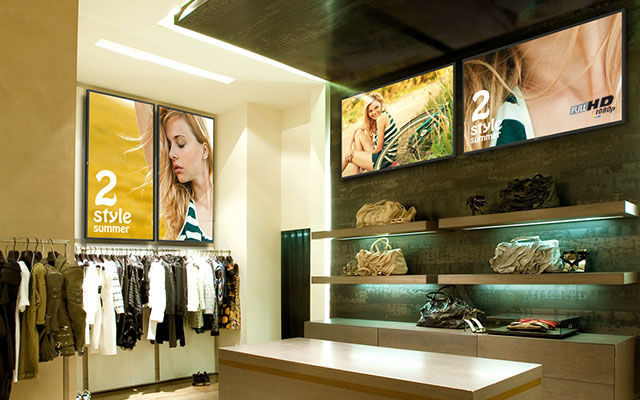
Pantallas Orientadas al Escaparate: Una pantalla LCD grande de alto brillo colocada directamente detrás del vidrio del escaparate actúa como un imán digital, atrayendo tráfico peatonal desde la calle.
Muros de Cabecera y Paredes Destacadas: Dentro de la tienda, grandes pantallas LCD 4K muestran videos de estilo de vida de alta fidelidad (por ejemplo, una marca de moda mostrando un bucle de pasarela) donde la precisión del color y el contraste son primordiales.
La Realidad de la Ingeniería
Combatiendo los Reflejos del Escaparate: Una pantalla dentro de un escaparate de vidrio enfrenta un doble reflejo: el deslumbramiento de la propia ventana y el deslumbramiento de la pantalla LCD. Se requiere un alto brillo (3,000 nits) para “atravesar” los reflejos.
Visibilidad con Gafas de Sol Polarizadas: Los paneles LCD estándar emiten luz polarizada. Si un peatón que usa gafas de sol polarizadas pasa frente a un escaparate, la pantalla puede aparecer completamente negra para él. Las pantallas comerciales premium utilizan una película especializada de Placa de Cuarto de Onda (QWP) para polarizar la luz de forma circular, asegurando que la pantalla sea visible independientemente de las gafas del espectador.
4. Campus Corporativos y Educación Superior
El vestíbulo corporativo moderno o el centro de estudiantes universitario está diseñado para impresionar a los visitantes, atraer talento y comunicar información compleja rápidamente.
Aplicaciones: Videowalls en Vestíbulos y Salones de Actos
Videowalls Arquitectónicos: Unir múltiples paneles LCD de bisel ultraestrecho (por ejemplo, de 0.88 mm o 1.8 mm de bisel a bisel) crea un lienzo digital masivo y sin costuras. Se utilizan para mostrar marca corporativa, paneles de datos en tiempo real o arte digital.
Pantallas para Auditorios / Salones de Actos: Una pantalla LCD grande de 98 pulgadas está reemplazando a menudo al proyector tradicional en salas de conferencias medianas y grandes. A diferencia de los proyectores, los LCDs no se ven afectados por la luz ambiental de la sala, permitiendo que las reuniones se realicen con las persianas abiertas.
La Realidad de la Ingeniería
Calibración de Color: Al unir múltiples LCDs en un videowall, incluso una diferencia del 2% en la temperatura de color entre los paneles se verá horrible para el ojo humano. La calibración de color de hardware en fábrica y en el sitio es obligatoria.
Ecodiseño de la UE y Energy Star: En el mercado europeo, las grandes implementaciones corporativas deben cumplir estrictamente con la Directiva de Ecodiseño actualizada para pantallas electrónicas, que impone límites estrictos de consumo de energía. Las pantallas deben contar con sensores de luz ambiental para atenuar automáticamente la retroiluminación durante la noche y así cumplir con la normativa.
Adquisición Estratégica: Pantallas LCD Grandes para Interiores vs. Exteriores
Para simplificar el proceso de adquisición, los consultores de AV utilizan la siguiente matriz de referencia al especificar una pantalla LCD grande para un espacio público:
Especificación
Espacio Público Interior (p. ej., centro comercial, aeropuerto)
Espacio Público Exterior (p. ej., marquesina de autobús, plaza)
Brillo
500 – 700 Nits
2.500 – 4.000 Nits (más película QWP)
Horas de Operación
16/7 o 24/7 según el uso
Estrictamente 24/7/365
Protección de Ingreso (IP)
IP4X o IP5X (Resistente al polvo)
IP56 o IP65 (A prueba de agua y polvo fino)
Protección contra Impactos (IK)
IK07 (Golpes accidentales)
IK10 (Cristal antivandálico)
: Optimizar el uso de energía es vital, especialmente para dispositivos alimentados por batería, para extender la vida operativa.
Refrigeración pasiva
Aire acondicionado activo o intercambiadores de calor aire-aire
Tecnología del Panel
IPS o VA
IPS de Tni ultra alto (110°C)
5. Integración del Backend: El Cerebro de la Pantalla LCD Grande
Adquirir una pantalla de 98 pulgadas 4K es la parte fácil. La complejidad oculta de desplegar una pantalla LCD grande en un espacio público reside completamente en el backend: el software y el reproductor multimedia que le indican qué hacer.
El Auge del SoC (Sistema en un Chip)
Hace diez años, todos los monitores comerciales requerían una computadora externa voluminosa para reproducir el contenido, conectada a través de HDMI y luego alojada en salas de audio y video sobrecalentadas. Hoy en día, los principales fabricantes de monitores LCD comerciales (como Samsung, LG y Philips) han integrado potentessistemas en un chip (SoC)directamente dentro del monitor.
Por Qué el SoC es Importante
Reducción de Puntos de Falla: Se elimina el cable HDMI, la fuente de alimentación externa y el ventilador de la PC externa, todos puntos de falla comunes en operaciones 24/7.
Eficiencia de Costos: Ya no se compran dos piezas de hardware (una pantalla y una PC), reduciendo significativamente el costo de la lista de materiales por unidad en un despliegue de 50 pantallas.
Gestión Remota: Los SoC integrados suelen incluir software de gestión remota robusto (como Samsung MagicINFO o LG SuperSign). Un gerente de TI en Londres puede reiniciar remotamente, actualizar el firmware, monitorear la temperatura interna y cambiar el contenido en una pantalla ubicada en una estación de metro de París, todo desde un navegador web.
Conclusión
El despliegue de una pantalla LCD grande en un espacio público ya no es un experimento; es la expectativa básica del consumidor, viajero y empleado modernos. La diferencia entre una red de señalización digital exitosa, con retorno de inversión positivo, y una pesadilla de mantenimiento constante depende completamente de seleccionar las especificaciones de hardware correctas para el entorno.
Cuando una organización trata una LCD de 85 pulgadas como una herramienta industrial en lugar de un juguete de consumo, especificando el brillo correcto, la resistencia a la intemperie, la gestión térmica y una integración robusta de SoC, desbloquea una plataforma incomparable para la comunicación, los ingresos publicitarios y el realce arquitectónico.
Preguntas frecuentes (FAQ)
P1: ¿Podemos simplemente comprar el televisor de consumo más grande en una tienda minorista y colocarlo en nuestro vestíbulo corporativo para ahorrar dinero?
R: No. Este es el error más común y costoso que cometen las empresas. Los televisores de consumo están diseñados para funcionar de 4 a 6 horas al día en una sala de estar oscura. Si se usan 24/7 en un vestíbulo luminoso, la fuente de alimentación fallará en menos de un año, la pantalla sufrirá retención permanente de imagen (quemado), y el fabricante anulará la garantía al instante en cuanto sepa que se usó en un entorno comercial.
P2: ¿Por qué elegiría una pantalla LCD grande en lugar de un muro de LED de visión directa (dvLED) para un directorio de centro comercial?
R: Distancia de visualización y densidad de resolución. Una LCD de 85 pulgadas 4K tiene un paso de píxel increíblemente estrecho (lo que significa que se puede estar a un metro de distancia y leer texto fino perfectamente). Lograr una verdadera resolución 4K en una pared dvLED costaría cientos de miles de dólares y requeriría una enorme huella física. Para directorios interactivos o entornos minoristas donde el espectador está muy cerca, la LCD sigue siendo muy superior en claridad y costo.
P3: ¿Qué es el “Encapsulado Óptico” y por qué se recomienda para quioscos exteriores?
R: El encapsulado óptico es un proceso de fabricación que inyecta una resina sólida y transparente entre el panel LCD y el cristal protector de cubierta. Elimina el espacio de aire. Esto hace dos cosas críticas: Primero, reduce drásticamente el reflejo interno, haciendo la pantalla mucho más legible bajo el sol. Segundo, evita que se forme condensación (empañamiento) dentro del cristal en mañanas frías, lo cual es letal para la electrónica y arruina la experiencia de visualización.
P4: Necesitamos una pantalla exterior en Phoenix, Arizona, donde las temperaturas de verano alcanzan los 115°F (46°C). ¿Sobrevivirá un LCD?
R: Sí, pero solo si se especifica una LCD con un panel de Tni alto (Temperatura Isotrópica) y una carcasa IP65 con refrigeración activa. Los cristales líquidos estándar hierven y se vuelven negros alrededor de los 85°C (185°F) internamente. Los paneles de Tni alto pueden soportar temperaturas internas de hasta 110°C (230°F) antes de fallar. Combinados con una unidad HVAC interna o ventiladores de alta velocidad, estas pantallas están específicamente diseñadas para sobrevivir a los veranos de Medio Oriente y el suroeste de Estados Unidos.
↗
¿Planificando un proyecto de pantalla?
Comparta el tamaño de su pantalla, resolución, interfaz, brillo, requisitos táctiles, requisitos de la placa controladora y el entorno de aplicación.
¿Aún no sabe qué pantalla se adapta a su proyecto?
Hable con el equipo de ingeniería de RJY para obtener asesoramiento sobre compatibilidad de pantallas, revisión de placas controladoras y discusión sobre personalización.