Una pantalla LCD TFT personalizada debe resolver un problema de integración definido. No debe comenzar como una solicitud abierta para crear un nuevo tamaño de panel, resolución o arquitectura de píxeles.
Para muchos proyectos OEM, la ruta práctica es identificar un módulo LCD TFT existente cuya área activa, resolución, interfaz, temporización, comportamiento óptico y envolvente mecánica sean adecuados. El proyecto puede entonces evaluar cambios alrededor de esa plataforma, incluyendo la pantalla táctil, el vidrio de cubierta, la retroiluminación, el FPC, el conector, la placa controladora, el firmware, la estructura de unión y el gabinete.
Esta distinción afecta la viabilidad, el alcance del desarrollo, la documentación, el moldeo, la validación y el control del ciclo de vida. También ayuda a los equipos de ingeniería a comparar propuestas que pueden describirse todas como “pantallas personalizadas” pero que implican trabajos muy diferentes.
¿Qué es una pantalla LCD TFT personalizada?
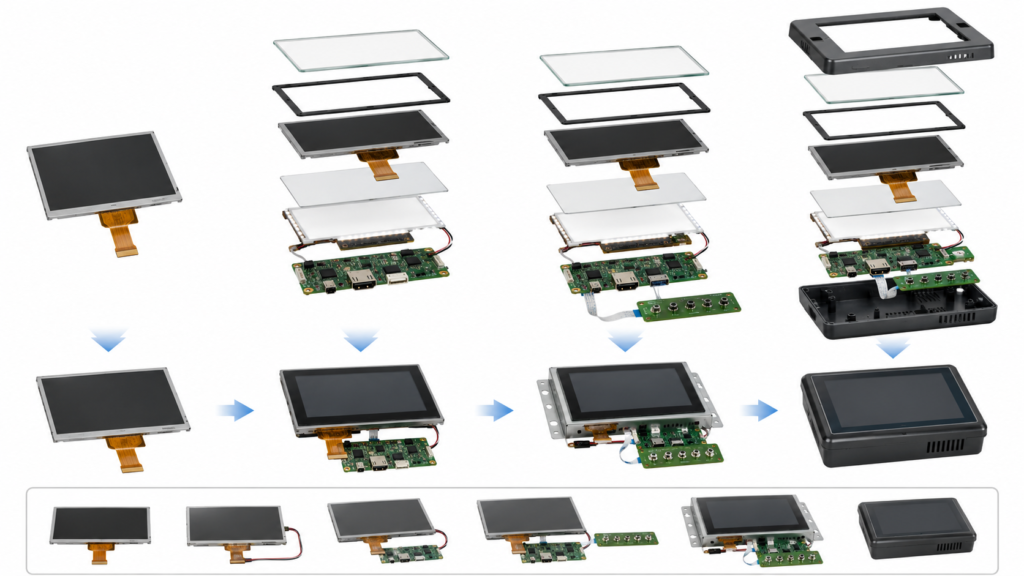
Una pantalla LCD TFT personalizada es una plataforma de pantalla existente coordinada o modificada para cumplir con los requisitos de un producto específico. El alcance puede variar desde un dibujo diferente del vidrio de cubierta hasta un ensamblaje completo de pantalla, táctil, placa controladora, firmware y mecánica.
| Nivel del proyecto | Alcance típico | Trabajo de ingeniería principal |
|---|---|---|
| Módulo estándar | Se utiliza un LCD TFT existente sin modificación física | Compatibilidad con el host, cable, alimentación, retroiluminación, firmware, táctil y validación mecánica |
| Módulo configurado | Un LCD existente se combina con una configuración disponible de táctil, cubierta, cable o controlador | Selección de configuración, dibujos, controladores, ensamblaje y pruebas completas de la muestra |
| Pantalla semicustomizada | El LCD principal permanece mientras las partes circundantes se adaptan | Vidrio de cubierta, táctil, retroiluminación, FPC, conector, unión, firmware, moldeo y coordinación mecánica |
| Sistema de pantalla integrado | Un LCD existente se suministra con una placa controladora o de cómputo e integración específica del producto | Salida de pantalla, controlador del panel, entrada táctil, alimentación, retroiluminación, software, cables y validación del gabinete |
| Solicitud de nueva plataforma de panel | El tamaño, la matriz activa o la resolución requeridos no están disponibles en una plataforma existente | Evaluación separada de viabilidad, volumen, inversión, calificación, suministro y ciclo de vida |
La ruta práctica de personalización de RJY Display comienza con un módulo de pantalla existente. No debe interpretarse como un desarrollo sin restricciones de cualquier tamaño, resolución, área activa o arquitectura de panel LCD TFT arbitraria.
¿Cuándo es realmente necesaria la personalización?
La personalización no es automáticamente mejor que un módulo estándar. Si una pantalla existente cumple con los requisitos obligatorios eléctricos, ópticos, mecánicos, táctiles, ambientales, de software y de ciclo de vida, utilizarla sin cambios puede reducir el alcance del proyecto.
La personalización se vuelve relevante cuando un requisito documentado no puede ser satisfecho por la configuración estándar preferida.
| Problema observado | Posible respuesta del proyecto | Evidencia necesaria |
|---|---|---|
| El diseño frontal requiere un contorno diferente o un borde impreso distinto | Vidrio de cubierta personalizado basado en el LCD y la estructura táctil seleccionados | Dibujo de la cubierta, materiales, tolerancias, criterios de apariencia, área de unión y CAD del gabinete |
| El FPC de la pantalla entra en conflicto con el PCB o el gabinete | Evaluar un módulo alternativo, adaptador, cable o un cambio viable del FPC | Distribución de pines del LCD, definición del conector, diseño del PCB, requisitos de señal y envolvente mecánica |
| La pantalla terminada es difícil de leer en su entorno previsto | Revisar la retroiluminación, la pila de cubierta, el tratamiento de superficie, la unión, la interfaz de usuario y la instalación | Condición de luz ambiental, dirección de visualización, pila óptica, presupuesto de potencia y prueba de muestra física |
| El host no implementa la interfaz del panel | Seleccionar otro LCD, revisar el host o evaluar un controlador activo o puente | Revisión de placa, información esquemática, modos de salida compatibles, temporización del panel, distribución de pines y firmware |
| El comportamiento táctil requerido no es compatible | Revisar el sensor, controlador, firmware, vidrio de cubierta, conexión a tierra y controlador del host | Herramienta de entrada, número de contactos, entorno, datos del controlador, estructura de cubierta y prueba de aceptación |
| El módulo no encaja en el ensamblaje | Comparar otra plataforma existente antes de iniciar la personalización mecánica | Dibujo completo de la pantalla, apilamiento de tolerancias, PCB, cubierta, cable y CAD del gabinete |
Un requisito debe clasificarse como obligatorio, preferente o negociable. Esto evita que una preferencia estética genere trabajo de herramientas o firmware que no aporte ningún beneficio útil al producto.
Establezca la línea base de requisitos antes de seleccionar la pantalla
Una revisión útil de un TFT LCD personalizado comienza con el producto, no con una especificación genérica de pantalla.
| Área de requisitos | Preguntas por resolver |
|---|---|
| Aplicación | ¿Qué hace el producto, quién lo utiliza y qué información o controles deben permanecer disponibles? |
| Geometría de la pantalla | ¿Qué área activa, área de visualización, contorno, orientación, grosor y envolvente de componentes traseros puede aceptar el producto? |
| Interfaz de usuario | ¿Qué resolución, tamaño físico de texto, carga gráfica, idiomas, advertencias y estados del sistema se requieren? |
| Plataforma del host | ¿Qué MCU, procesador de aplicaciones, módulo de cómputo, placa controladora o fuente de video impulsará la pantalla? |
| Entrada táctil | ¿Qué comportamiento de dedo, guante, lápiz óptico, número de contactos, gesto, humedad y falsa activación debe validarse? |
| Entorno de visualización | ¿Qué condiciones de luz ambiental, distancia de visualización, ángulo de montaje, atenuación, reflexión y temperatura aplican? |
| Ensamblaje mecánico | ¿Dónde se encuentran el bisel, la cubierta, los soportes, el adhesivo, el FPC, el conector, la PCB, los sujetadores, los cables y las fuentes de calor? |
| Ciclo de vida | ¿Qué procesos de prototipo, piloto, producción, control de revisiones, notificación de cambios y reemplazo se requieren? |
Proporcionar arte y dibujos de IU representativos desde el inicio. El tamaño diagonal por sí solo no define la imagen física, el contorno del módulo, la abertura visible, la carga de píxeles ni la geometría del objetivo táctil.
Seleccione la plataforma LCD TFT existente
El módulo base determina qué cambios posteriores son realistas. Utilizar la hoja de datos controlada actual y el dibujo mecánico en lugar de un resumen de página de producto.
Comparar candidatos utilizando:
- Modelo exacto, revisión, IC controlador y estado actual de suministro
- Área activa, área de visualización, contorno del módulo, grosor y orientación nativa
- Resolución, formato de píxeles, temporización nativa y requisitos de inicialización
- Interfaz, niveles eléctricos, carriles o canales, distribución de pines y conector
- Requisitos eléctricos de retroiluminación, habilitación, atenuación y comportamiento térmico
- Posición del FPC, dirección de contacto, refuerzo, componentes y zona segura de curvatura
- Características ópticas y condiciones de visualización previstas
- Límites de funcionamiento y almacenamiento documentados para la configuración exacta
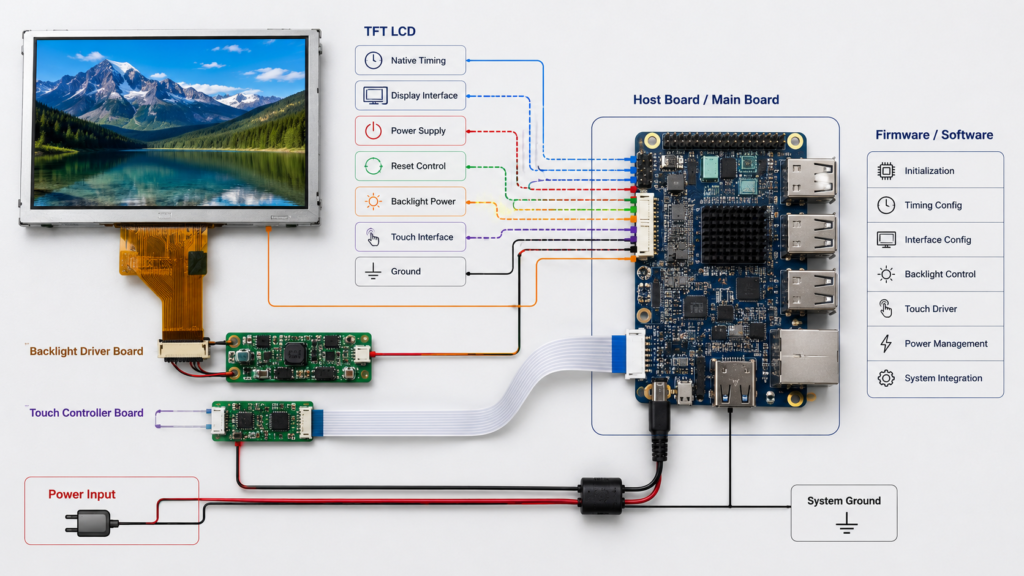
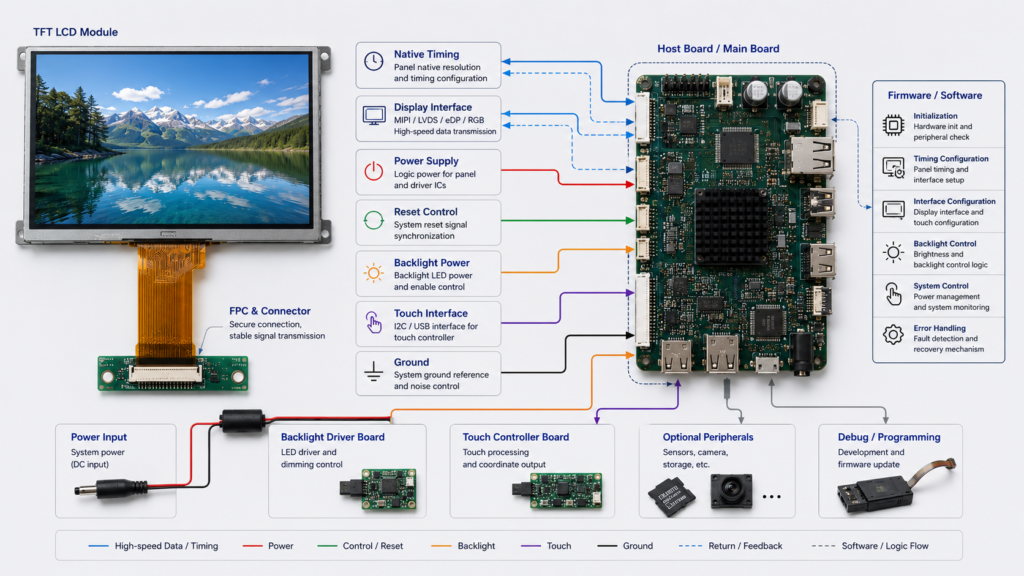
El ejemplo del sistema de visualización integrado de NXP muestra que una ruta LCD funcional requiere coordinación de temporización nativa, polaridad de señal, alimentación, reinicio, control de retroiluminación, relojes de interfaz y un controlador específico del panel.[1] Por lo tanto, una resolución o etiqueta de interfaz coincidente no es suficiente para aprobar un módulo base.
Utilice la Guía de selección de módulos LCD TFT Para una revisión más profunda de candidatos, luego explorar el portafolio actual de módulos de visualización para plataformas existentes.
Personalice la pantalla táctil y el vidrio de cubierta de forma conjunta
El sensor táctil, el controlador táctil, el vidrio de cubierta, la estructura de unión, la pantalla, el controlador del host, la conexión a tierra y el gabinete forman un sistema de entrada único. Un cambio en la lente frontal puede alterar el diseño táctil incluso cuando el LCD permanece sin cambios.
| Área táctil o de cubierta | Qué definir |
|---|---|
| Tecnología táctil | Capacitiva proyectada, resistiva u otra configuración de entrada compatible |
| Controlador táctil | Controlador exacto, firmware, interfaz del host, voltaje, reinicio, interrupción, contactos y controlador |
| Herramientas de entrada | Dedo desnudo, guante especificado, lápiz pasivo, lápiz activo o entrada basada en presión |
| Vidrio de cubierta | Contorno, grosor, apertura, borde impreso, material, detalles de borde, requisitos de superficie y área adhesiva |
| Unión | Estructura con entrehierro o unida, adhesivo, alineación, apariencia, tolerancias y requisitos de retrabajo |
| Comportamiento del software | Rango de coordenadas, origen, escala, rotación, asociación de visualización, suspensión, activación y recuperación |
| Entorno | Humedad, limpieza, estructuras metálicas, ruido eléctrico, operación en bordes y criterios de toque falso |
Microchip describe el desarrollo de sensores táctiles capacitivos como un problema de diseño combinado mecánico y eléctrico, e incluye específicamente los efectos de la cubierta táctil dentro del proceso de diseño.[2] Esto significa que un vidrio de cubierta personalizado no debe liberarse de forma independiente a la revisión del controlador del sensor.
En sistemas Android, la configuración táctil también puede controlar la asociación de visualización, la calibración y el mapeo de coordenadas sensible a la orientación.[3] Valide el firmware del controlador aprobado y el software del host con la rotación final, el vidrio de cubierta, el bisel, la conexión a tierra y el gabinete.
Para una selección táctil detallada, consulte Guía de módulo TFT LCD con pantalla táctil.
Personalice la retroiluminación a partir de requisitos ópticos y de potencia
Una solicitud de retroiluminación debe comenzar con el requisito de visualización del producto terminado. El brillo máximo disponible no es automáticamente el objetivo correcto.
Revisión:
- Condiciones requeridas de luz ambiental y visualización
- Apilamiento de LCD, polarizador, táctil, unión, vidrio de cubierta y tratamiento de superficie
- Configuración de LED y datos eléctricos de retroiluminación
- Circuito de controlador disponible, corriente, señal de habilitación y método de atenuación
- Presupuesto de energía y estados operativos
- Calentamiento local y temperatura del gabinete terminado
- Comportamiento de atenuación de bajo nivel y control de aplicación
- Criterios de apariencia y consistencia para la muestra aprobada
No infiera legibilidad a la luz solar, idoneidad para exteriores, rendimiento térmico o vida útil operativa a partir de un valor de brillo nominal. Estas conclusiones requieren datos específicos de configuración y validación del producto terminado.
Coordine la interfaz, el FPC, el conector y la placa principal
La personalización de la interfaz no es simplemente cambiar el nombre impreso junto a un conector. El LCD y el host deben coincidir eléctrica, lógica, mecánicamente y en software.
| Área de integración | Elementos a confirmar |
|---|---|
| Interfaz de pantalla | RGB, MIPI DSI, LVDS, eDP, SPI u otra ruta implementada y su configuración completa |
| Temporización nativa | Dimensiones activas, reloj de píxeles, sincronización, porches, rango de actualización, formato y polaridad |
| Definición de pines del FPC | Cada conexión de visualización, control, alimentación, tierra, reinicio, retroiluminación y táctil |
| Conector | Número de pieza, paso, lado de contacto, altura, dirección de inserción, pieza de acoplamiento y acceso |
| Mecánica del FPC | Dirección de salida, longitud, refuerzo, región de curvatura, envolvente de componentes, retención y secuencia de ensamblaje |
| Ruta de alta velocidad | Placa, conector, FPC, cable, conexión a tierra, ruta de retorno y revisión de integridad de señal cuando corresponda |
| Software | Controlador de panel, inicialización, reguladores, GPIOs, orientación, suspensión, activación y recuperación de errores |
La Alianza MIPI define MIPI DSI como una interfaz serial de alta velocidad entre un procesador host y un módulo de pantalla.[4] Una etiqueta DSI común no prueba que un host y un panel compartan los carriles, el modo de operación, la temporización, los comandos, la secuencia de alimentación, el conector o el soporte de software requeridos.
Un FPC personalizado puede redirigir señales compatibles o mejorar la integración mecánica. No puede crear un controlador de visualización ausente, agregar carriles no soportados, corregir niveles de voltaje incompatibles ni reemplazar firmware de panel faltante.
Utilice la Guía de interfaz de pantalla LCD para antecedentes entre interfaces y el guía personalizada de TFT LCD MIPI para integración específica de DSI.
Defina las responsabilidades de la placa controladora y el firmware
Un controlador o placa de computación debe evaluarse a nivel de placa. Una hoja de datos de procesador puede enumerar interfaces que el PCB terminado no expone o que la imagen de software actual no soporta.
Registre:
- Modelo exacto de placa, configuración de memoria y revisión de hardware
- Salida de visualización y conector implementados
- Temporización nativa soportada y configuración del panel
- Circuitos de alimentación del panel, reinicio, habilitación y retroiluminación
- Entrada táctil y ruta del controlador
- Versión de Android, Linux, RTOS, SDK de MCU, kernel, BSP o bootloader
- Entregables de controlador de panel e inicialización
- Fuente, binario, configuración, compilación y límites de propiedad
- Comportamiento de actualización, recuperación, suspensión, activación e interrupción de alimentación
“Firmware personalizado” no es un entregable ilimitado. Un alcance válido identifica la placa, el LCD, el controlador táctil, la plataforma de software, la versión, el comportamiento requerido, los entregables, la propiedad y las pruebas de aceptación.
Para proyectos Android, siga la guía para emparejar un módulo LCD TFT con una placa de control Android. Las rutas de productos actuales a nivel de placa están disponibles en Módulos de computación.
Coordine la estructura mecánica antes del moldeo
El dibujo del LCD, el dibujo de la cubierta, el sensor táctil, el FPC, el PCB, el cable, los soportes, el adhesivo, los sujetadores y el CAD de la carcasa deben revisarse como una sola pila de tolerancias.
| Elemento mecánico | Requisito de revisión |
|---|---|
| Áreas activas y de visualización | Alineación con la abertura del bisel, la impresión de la cubierta, el área táctil y la interfaz de usuario |
| Envolvente del módulo | Vidrio LCD, retroiluminación, marco, adhesivo, FPC, refuerzo y componentes traseros |
| Soporte y retención | Zonas aprobadas de soporte, adhesivo, soporte y sujetador sin carga localizada sobre el vidrio |
| Trayectoria del cable | Alcance del FPC, curvatura, acceso al conector, retención, calor, piezas móviles y secuencia de ensamblaje |
| Alineación de cubierta y táctil | Abertura, borde impreso, adhesivo, estructura de referencia y tolerancias acumuladas |
| Acceso de servicio | Operación del conector, inspección, reemplazo y protección del conjunto de visualización |
No libere la carcasa basándose únicamente en las dimensiones nominales de la pantalla. Utilice el dibujo controlado e incluya condiciones de material máximo y tolerancias de ensamblaje cuando corresponda.
Utilice un proceso controlado de desarrollo de pantallas personalizadas
| Etapa | Resultado requerido | Pregunta de aprobación |
|---|---|---|
| Definición de requisitos | Requisitos obligatorios, preferentes y negociables del producto | ¿La especificación describe el producto y las condiciones de aceptación? |
| Selección del módulo base | Hojas de datos candidatas, dibujos, revisión de compatibilidad y problemas abiertos | ¿Es técnicamente adecuada una plataforma LCD existente? |
| Revisión de viabilidad | Límite de personalización, responsabilidades, herramientas, software, plan de pruebas y supuestos comerciales | ¿Es viable y controlado cada cambio solicitado? |
| Liberación de dibujo y configuración | Definiciones de LCD, táctil, cubierta, FPC, conector, placa, firmware y mecánicas | ¿Están todas las partes revisando la misma revisión? |
| Construcción de muestras | Muestras de hardware y software trazables con desviaciones registradas | ¿Representa la muestra la configuración de producción propuesta? |
| Validación del sistema | Resultados de pruebas contra criterios de aceptación acordados | ¿Funciona el producto completo bajo las condiciones requeridas? |
| Liberación de producción | Configuración aprobada, criterios de inspección, empaque, control de revisiones y cierre de elementos abiertos | ¿Es el producto liberado la misma configuración que fue validada? |
No inicie el herramental simplemente porque una pantalla puede mostrar una imagen en una placa de evaluación. La operación eléctrica es solo una parte de la aprobación.
Valide la muestra completa de la pantalla LCD TFT personalizada
| Área de validación | Revisión mínima |
|---|---|
| Identidad y documentación | Modelo de LCD, IC controlador, dibujo, controlador táctil, revisión de placa, firmware, cables y desviaciones |
| Imagen de la pantalla | Temporización nativa, patrones de pantalla completa, orientación, colores, pantallas de interfaz de usuario, inicio, suspensión, activación y reinicio |
| Entrada táctil | Coordenadas, bordes, rotación, herramientas de entrada requeridas, vidrio de cubierta, ruido, criterios de humedad, suspensión y activación |
| Rendimiento óptico | Interfaz de usuario requerida, luz ambiental, direcciones de visualización, pila de cubierta, reflejos, atenuación y apariencia |
| Alimentación y retroiluminación | Inicio, operación normal, habilitación, atenuación, apagado, interrupción de energía y temperatura de la carcasa |
| Software | Bootloader, controlador de panel, BSP o SDK, aplicación, actualización, recuperación y estados de error |
| Ensamblaje mecánico | Alineación, soporte, enrutamiento del FPC, acceso al conector, adhesivo, pila de tolerancias, retención y procedimiento de servicio |
| Entorno | Condiciones de temperatura, limpieza, humedad, mecánicas, luz ambiental y eléctricas definidas por la aplicación |
| Control de configuración | Lista de materiales aprobada completa, planos, firmware, imagen de software, registro de pruebas y problemas no resueltos |
Aprobar la configuración completa en lugar de solo el modelo de LCD. Un cambio posterior en el IC del controlador de panel, controlador táctil, vidrio de cubierta, FPC, revisión de placa, firmware, adhesivo, retroiluminación, cable o carcasa puede requerir una revalidación parcial.
Prepare una solicitud de cotización (RFQ) completa para la pantalla LCD TFT personalizada
Proporcionar:
- Producto objetivo, usuarios, flujo de trabajo y mercados de destino
- Área activa requerida, resolución, orientación, contorno y envolvente mecánica
- Arte de interfaz de usuario a escala completa representativo y carga de trabajo gráfica
- MCU exacto, procesador, placa controladora, módulo de cómputo o fuente de video
- Revisión de placa, salida de pantalla implementada, conector y plataforma de software
- Tecnología táctil, controlador, herramientas de entrada, número de contactos y requisitos ambientales
- Plano del vidrio de cubierta, material, espesor, impresión, borde, aberturas y requisitos de superficie
- Retroiluminación, atenuación, alimentación, luz ambiental y requisitos de visualización
- Dirección del FPC, posición del conector, diseño de PCB, cable y restricciones de ensamblaje
- Firmware, controlador, BSP, cargador de arranque, actualización y alcance de recuperación
- CAD de la carcasa e información de tolerancias
- Pruebas requeridas, normas, informes, declaraciones y partes responsables
- Prototipo, piloto, producción y cantidades anuales esperadas
- Ciclo de vida, revisión, notificación de cambios y expectativas de reemplazo
- Documentación de pantalla existente al reemplazar otro módulo
Para preparación específica de costos, consulte la guía de precios de pantallas TFT LCD personalizadas.
Solicite una revisión de ingeniería de la pantalla LCD TFT personalizada
RJY Display puede revisar una plataforma TFT LCD existente frente a sus requisitos de táctil, vidrio de cubierta, retroiluminación, FPC, interfaz, placa controladora, firmware, alimentación, óptica y mecánica.
Explorar los módulos de pantalla actuales, revisar El alcance de la solución personalizada de RJY Display, I²C, SPI envíe sus documentos de pantalla, placa, interfaz de usuario y carcasa para revisión de ingeniería.
Preguntas frecuentes
¿Qué es una pantalla TFT LCD personalizada?
Una pantalla TFT LCD personalizada es normalmente una plataforma de pantalla existente configurada o modificada para un producto específico en áreas como táctil, vidrio de cubierta, retroiluminación, FPC, interfaz, placa controladora, firmware, unión o estructura mecánica.
¿Puede RJY Display desarrollar cualquier tamaño o resolución nueva de LCD?
No. La ruta práctica de personalización comienza con un módulo de pantalla existente. Una solicitud de un tamaño, matriz activa, resolución o arquitectura de panel no disponible requiere una revisión de viabilidad separada y no debe asumirse como disponible.
¿Qué partes de un módulo TFT LCD se pueden personalizar?
Dependiendo del módulo base seleccionado y la viabilidad del proyecto, el trabajo puede incluir vidrio de cubierta, pantalla táctil, unión, retroiluminación, FPC, conector, coordinación de interfaz, placa controladora, firmware y estructura mecánica.
¿Cambiar el FPC hace que cualquier LCD sea compatible con mi placa?
No. Un FPC puede enrutar señales compatibles y mejorar el ajuste mecánico, pero no puede agregar un controlador de pantalla faltante, crear carriles no soportados, corregir voltaje o temporización incompatibles, ni reemplazar firmware de panel ausente.
¿Qué se debe probar en una muestra de pantalla personalizada?
Pruebe la temporización e imagen de pantalla documentadas, comportamiento táctil, pila de cubierta, rendimiento óptico, alimentación y retroiluminación, firmware, inicio y recuperación, carga de trabajo de la aplicación, ensamblaje mecánico, condiciones ambientales requeridas e identidad completa de la configuración.
¿Qué información se necesita para una cotización de TFT LCD personalizado?
Proporcione la aplicación, geometría de pantalla, resolución, arte de interfaz de usuario, placa anfitriona, interfaz, requisitos de táctil y vidrio de cubierta, necesidades de retroiluminación y alimentación, restricciones de FPC y conector, alcance del firmware, planos de carcasa, requisitos de validación, cantidades y expectativas de ciclo de vida.
Referencias
- NXP Semiconductors, “AN12940: Caso de Uso del Sistema de Pantalla LCD RT1170 Basado en MIPI DSI.” https://www.nxp.com/docs/en/application-note/AN12940.pdf
- Microchip Technology, “AN2934: Diseño de Sensor Táctil Capacitivo,” 24 de julio de 2020. https://www.microchip.com/en-us/application-notes/an2934
- Proyecto de código abierto de Android, “Dispositivos táctiles.” https://source.android.com/docs/core/interaction/input/touch-devices
- MIPI Alliance, “Interfaz Serial de Pantalla MIPI (MIPI DSI).” https://www.mipi.org/specifications/dsi