임베디드 디스플레이 프로젝트에 병목 현상을 겪고 계신가요?
복잡한 통합 작업이나 공급망 문제로 출시 시기가 지연되지 않도록 하십시오. 맞춤형 설계 및 제조 지원을 위해 RJY 전문가 팀과의 무료 상담을 예약하세요.

Companion robots are moving beyond the idea of a novelty device. In Europe, their opportunity lies in creating useful, respectful, and approachable interactions at home, in hospitality settings, in education, and in selected service environments. The robot may provide reminders, communicate status, guide simple routines, support entertainment, or create a more engaging interface for connected services.
For a companion robot OEM, the product experience is not determined by artificial intelligence, mobility, audio, or sensors alone. The visible interface often shapes the first impression. A carefully integrated companion robot display can make the robot feel understandable, responsive, and intentional. It can communicate presence, show simple expressions, provide immediate feedback, and make setup or daily interaction less intimidating.
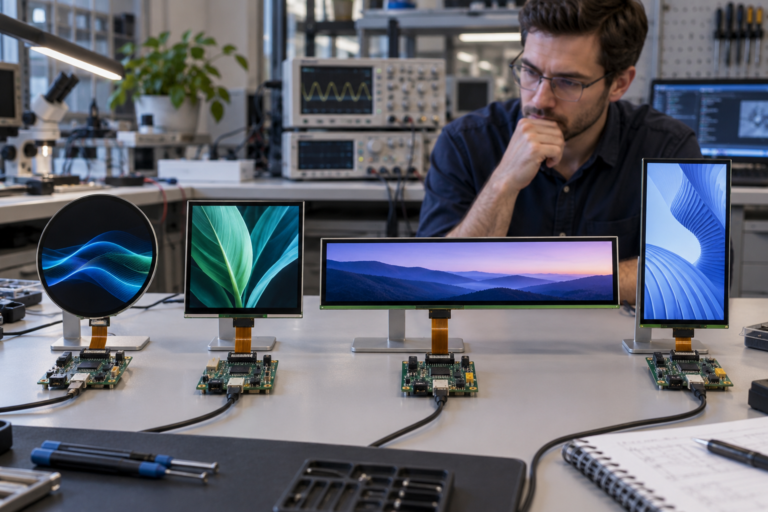
That is where a custom LCD assembly becomes important. A standard TFT LCD module may be a useful starting point, but the final product experience depends on the display’s shape, cover glass, visible area, touch behavior, brightness configuration, FPC routing, controller-board path, and fit with the robot enclosure.
Europe offers a meaningful long-term context for companion and interactive robot development. On 1 January 2025, people aged 65 and over represented 22% of the EU population, while people aged 80 and over represented 6%.[1] This demographic change does not mean that every older person needs or wants a robot. It does, however, increase the importance of accessible digital products, intuitive home interfaces, and technologies that can be used comfortably by people with different levels of confidence in digital devices.
European buyers are also likely to assess a companion robot as a complete experience rather than a collection of technical functions. Industrial design, privacy expectations, transparency, setup simplicity, interaction style, and visual communication all influence whether the product feels appropriate in a home or public-facing environment.
For AI-enabled products, transparency is increasingly part of this trust equation. The European Commission states that Article 50 transparency obligations under the AI Act began to apply from 2 August 2026, including the requirement that people be informed when they are directly interacting with an AI system in relevant cases.[2] A display does not create legal compliance by itself, but it can provide a clear, human-readable channel for communicating robot state, interaction context, and user choices.
In a product-design context, emotional value does not mean that a robot replaces human relationships or delivers a therapeutic outcome. It means that the product can feel less mechanical, easier to understand, and more pleasant to interact with during ordinary use.
A display contributes to this experience in several practical ways:
The strongest designs do not overload the screen with dashboards. A companion robot is usually experienced at close range and in short interactions. The display should prioritize clear visual cues, simple interaction states, and a coherent relationship between the robot’s voice, movement, sound, and visible feedback.
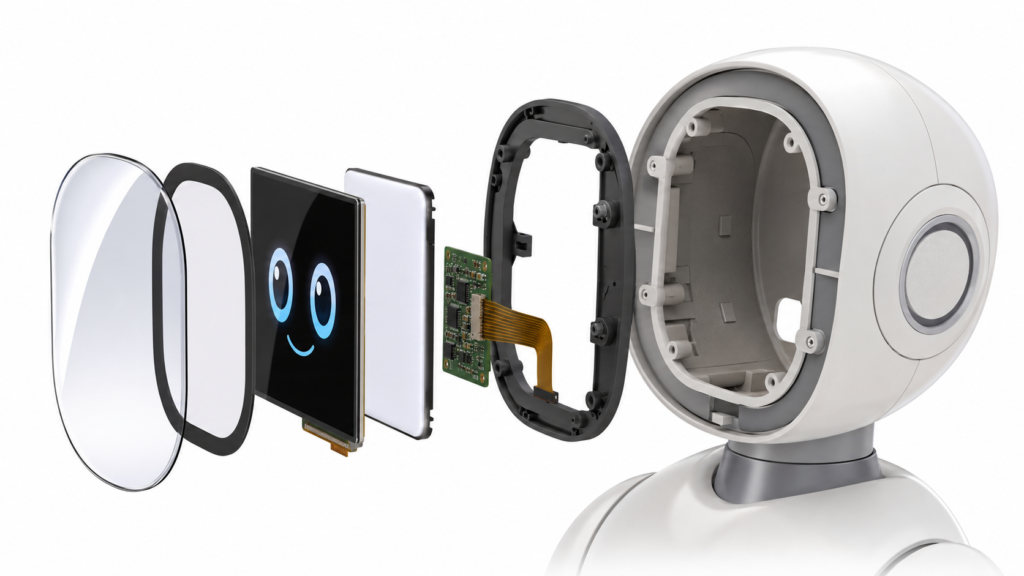
A face display is often the most recognizable implementation. It may show abstract eyes, an animated expression, a listening state, or an interaction cue. In this role, the display is part of the robot’s character design as well as its HMI design.
The engineering challenge is to make the display fit naturally inside a shaped head enclosure. The visible area, black border, cover glass contour, display curvature requirements, mounting frame, and FPC exit direction should be evaluated as one assembly.
A body-mounted display can support setup, task confirmation, charging status, device settings, or service access. This can be useful when the face display is intentionally kept minimal and expressive rather than informational.
The display location should be reviewed for user height, viewing angle, accidental contact, enclosure clearance, cable routing, and access during assembly or repair.
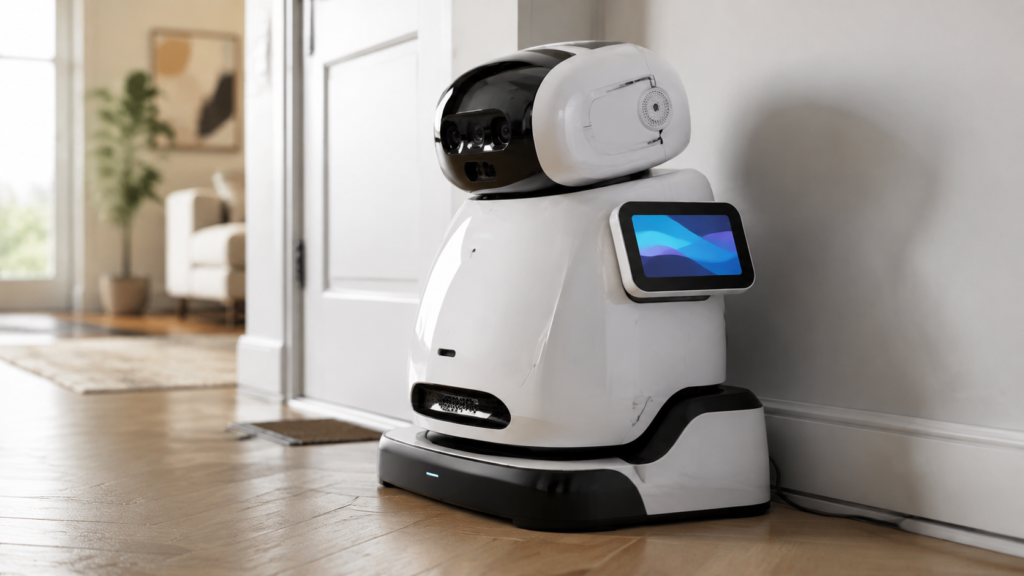
Not every companion robot needs a large display on its body. Some products may benefit from a display integrated into a charging dock, base station, or external control device. This can separate daily information and maintenance tasks from the robot’s expressive interface.
Companion robots often use rounded, compact, or character-driven enclosures. A standard rectangular LCD may technically work but still look visually disconnected from the product. A custom cover glass, printed border, and visible-area arrangement can help the display blend with the robot’s face or body structure.
Touch can support setup, settings, simple choices, and service workflows. However, touch should be considered with the complete interaction model. The touch panel, controller, cover glass, host interface, software driver, and coordinate mapping need to be evaluated together.
For some companion robots, physical buttons, voice input, or a mobile-app route may be more appropriate for frequent commands. Touch should be used where it improves clarity rather than being added as a default feature.
A companion robot may be used in a bright living room, low-light evening environment, office reception area, or hospitality space. Readability depends on the complete optical stack: panel characteristics, backlight configuration, cover glass, reflections, display angle, visual design, and enclosure geometry.
A display should not be described as suitable for any lighting condition without project-specific review. Instead, the OEM should define expected environments and determine how the selected display assembly will support the intended visual experience.
In a compact robot, the display must coexist with speakers, microphones, cameras, batteries, sensors, controller boards, and moving mechanical parts. FPC direction, connector access, bend radius, mounting points, heat sources, and repair access can be as important as display size and resolution.
Starting with an existing display module and adapting the surrounding assembly is often a practical way to reduce development risk while improving product fit.
디스플레이 경로는 로봇의 실제 전자 아키텍처와 일치해야 합니다. 프로젝트에 따라 임베디드 프로세서, Android 또는 Linux 플랫폼, 전용 컨트롤러 보드, 또는 맞춤형 시스템 보드가 포함될 수 있습니다.
디스플레이-컨트롤러 구성이 확정되기 전에, 프로젝트는 LCD 패널 모델, 해상도, 인터페이스, 핀 정의 또는 데이터시트, 백라이트 정보, 터치 요구사항, 호스트 입력, 펌웨어 또는 운영체제 요구사항, 그리고 예상 작동 환경을 제공해야 합니다. 호환성은 가정이 아닌 실제 프로젝트 데이터를 기반으로 검증되어야 합니다.
RJY Display는 주로 기존 디스플레이 모듈을 기반으로 한 프로젝트별 맞춤화를 지원합니다. 실질적인 범위는 선택된 모듈과 검토를 위해 제공된 기술 정보에 따라 달라집니다.
RJY Display는 본 서비스를 완전히 새로운 LCD 패널 크기를 처음부터 개발하는 것으로 간주하지 않습니다. 실질적인 경로는 기존 TFT LCD 플랫폼을 선택한 후, 제품의 시각적, 전기적, 기계적 요구사항에 맞춰 디스플레이 어셈블리를 맞춤화하는 것입니다.
완전한 브리프는 설계 반복을 줄이고 보다 유용한 기술 검토를 지원합니다. 다음을 제공해 주십시오:
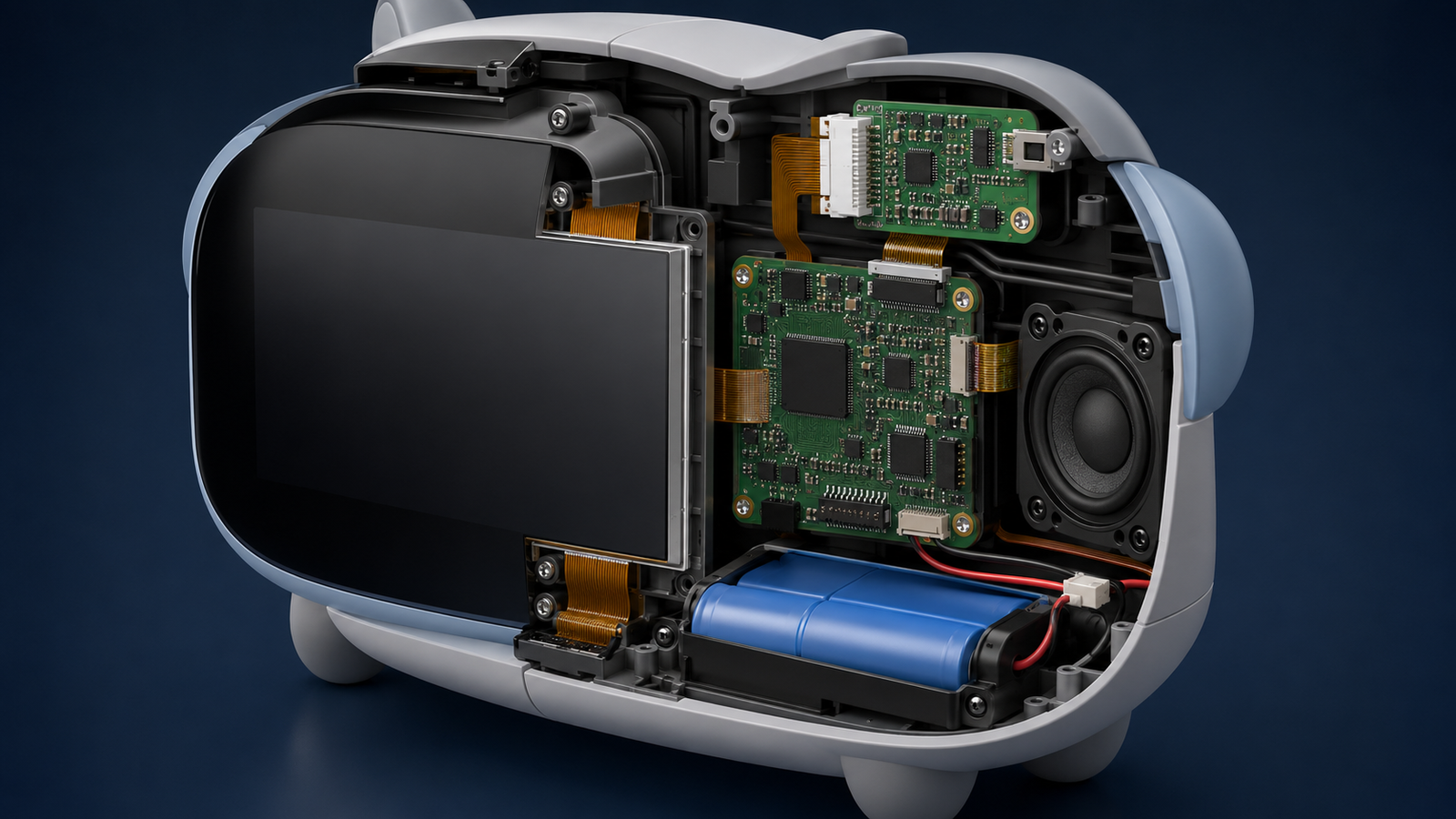
RJY Display는 동반 로봇 개발자가 기존 디스플레이 모듈을 기반으로 한 맞춤형 TFT LCD 어셈블리를 평가할 수 있도록 지원할 수 있습니다. 산업 디자인 참조, 디스플레이 역할, 인클로저 요구사항, 호스트 인터페이스, 및 의도된 맞춤화 범위를 공유하여, 구성이 제안되기 전에 디스플레이, 터치, 커버 글라스, 백라이트, FPC, 컨트롤러 보드, 펌웨어, 및 기계적 통합 요구사항이 검토될 수 있도록 하십시오.
맞춤화 프로젝트는 일반적으로 제품 유형과 프로젝트 요구사항에 따라 약 500대의 MOQ에서 시작됩니다.
LCD 디스플레이는 동반 로봇이 표정, 상호작용 상태, 충전 상태, 간단한 선택, 및 피드백을 전달하는 데 도움이 될 수 있습니다. 그 가치는 로봇의 행동을 더 이해하기 쉽게 만들고 제품 디자인과 시각적으로 더 일관성 있게 만드는 데 있습니다.
항상 그런 것은 아닙니다. 얼굴 디스플레이는 표현적 상호작용에 유용할 수 있지만, 일부 제품은 본체 디스플레이, 도킹 스테이션 디스플레이, 물리적 컨트롤, 음성 상호작용, 또는 모바일 애플리케이션을 대신 사용할 수 있습니다. 올바른 선택은 제품의 의도된 상호작용 모델에 따라 달라집니다.
RJY Display는 기존 디스플레이 모듈을 기반으로 한 맞춤화에 중점을 둡니다. 지원에는 커버 글라스, 터치스크린, 백라이트, 인터페이스, FPC, 컨트롤러 보드, 펌웨어, 및 디스플레이 관련 기계적 조정이 포함될 수 있습니다. 완전히 새로운 LCD 패널 크기는 가정해서는 안 됩니다.
선택된 LCD 패널 모델, 해상도, 인터페이스, 핀 정의 또는 데이터시트, 백라이트 정보, 터치 요구사항, 호스트 입력, 펌웨어 또는 운영체제 요구사항, 및 애플리케이션 환경을 제공해 주십시오. 호환성은 기술 검토 후 확인되어야 합니다.
맞춤 설정 프로젝트는 일반적으로 제품 유형 및 프로젝트 요구 사항에 따라 약 500대의 MOQ에서 시작됩니다. 최종 MOQ는 디스플레이 구성 및 맞춤 설정 범위가 정의된 후 확인되어야 합니다.
디스플레이 크기, 해상도, 인터페이스, 밝기, 터치 요구 사항, 컨트롤러 보드 요구 사항 및 적용 환경을 공유해 주십시오.
관련 디스플레이 기술 가이드 및 응용 참고 자료를 계속 읽어보십시오.