

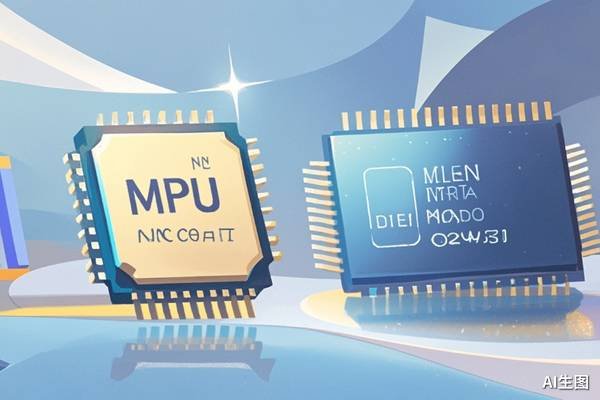
The Rise of the “Constrained” NPU: Why It’s Not About TOPS
In the server and smartphone worlds, Neural Processing Units (NPUs) chase raw Tera-Operations Per Second (TOPS). In the MCU world, the logic is different: NPU integration is about system determinism and power efficiency.
1. Compute Isolation and Real-Time Control
In industrial motor control or automotive ADAS, tasks must be completed within microsecond windows. If a CPU handles both AI inference and control loops, the AI workload can “jitter” the timing of critical interrupts. By integrating a dedicated NPU, manufacturers achieve compute isolation. The CPU handles the deterministic control, while the NPU manages the stochastic AI inference.
2. The Power Budget Paradox
Edge devices often run on batteries for years. Dedicated NPUs use systolic arrays and optimized MAC (Multiply-Accumulate) units that provide predictable power consumption. Current MCU NPUs are “restrained”—ranging from tens to hundreds of GOPS—because over-provisioning compute leads to thermal issues that violate embedded design principles.
How the “Big Five” Titans are Navigating the NPU Revolution
Each major semiconductor player—TI, Infineon, NXP, ST, and Renesas—has taken a distinct path to integrate AI into their silicon.
| Manufacturer | Core Strategy | Flagship Series | Key Feature |
| TI | Deep fusion of AI & Real-time Control | TMS320F28P55x | C28x DSP + Integrated NPU for ASIL D safety. |
| Infineon | Arm Ecosystem & Low Power | PSOC Edge E8x | Cortex-M55 + Ethos-U55 NPU for HMI/IoT. |
| NXP | Flexibility & Software Stacks | eIQ Neutron NPU | Scalable NPU architecture supporting CNN/RNN/Transformers. |
| ST | High Performance & Vision | STM32N6 | Neural-ART Accelerator with 600 GOPS for edge vision. |
| Renesas | Security-First & Heterogeneous | RA8P1 / RZ/G3E | Cortex-M85 + Ethos-U55 with robust TrustZone security. |
The Bottleneck: Why Traditional Flash is Dying
As NPUs push MCUs toward advanced process nodes (22nm, 16nm, and beyond), embedded Flash (eFlash) has hit a wall.
- Scalability: eFlash is difficult to shrink below 40nm.
- Endurance: AI models require frequent Over-the-Air (OTA) updates; Flash wears out too quickly.
- Performance: Flash reading speeds are too slow for the “instant-on” requirements of modern industrial AI.
This has necessitated the rise of Emerging Non-Volatile Memory (eNVM).
The Four Paths of Emerging Memory
The industry is currently split across four primary technology routes, each championed by different giants.
1. MRAM (Magnetoresistive RAM): The Automotive Gold Standard
MRAM uses electron spin rather than electrical charge to store data. It offers nearly infinite endurance and high-speed writes.
- Champions: NXP (16nm FinFET eMRAM) and Renesas (22nm eMRAM).
- Best For: Software-Defined Vehicles (SDV) and industrial predictive maintenance.
2. RRAM/ReRAM (Resistive RAM): Efficiency & AI Synergy
RRAM stores data by changing the resistance of a dielectric material. Its simple structure makes it ideal for In-Memory Computing.
- Champions: Infineon (partnering with TSMC for 28nm/22nm RRAM) and TI (licensing Weebit Nano technology).
- Best For: “Always-on” IoT sensors and ultra-low-power wearables.
3. PCM (Phase-Change Memory): High Density for Big Data
PCM leverages the state change of chalcogenide glass. It offers the highest storage density among emerging types.
- Champion: STMicroelectronics (collaborating with Samsung on 18nm FD-SOI ePCM).
- Best For: Large firmware stacks and complex edge AI models in high-end MCUs.
4. FRAM (Ferroelectric RAM): The Low-Power Speedster
FRAM combines the speed of RAM with the non-volatility of Flash, requiring no charge pump for writes.
- Champion: TI (The long-term leader with the MSP430FR series).
- Best For: High-frequency data logging and energy-harvesting applications.
Conclusion: The Evolution into “System-on-MCU”
We are witnessing the second revolution in embedded systems. The MCU is no longer just a controller; it is evolving into a micro-sized, deterministic, low-power system-level compute platform.
The moat for semiconductor companies has shifted from “who has the fastest core” to “who has the best integration of NPU, memory, and process node.” For developers, this means the ability to run sophisticated AI—like predictive maintenance, gesture recognition, and real-time anomaly detection—without ever touching the cloud.
The transition from 40nm Flash to 16nm MRAM/RRAM isn’t just a technical upgrade; it’s a fundamental rewrite of how the world at the edge thinks.


 English
 Français
 Deutsch
 日本語
日本語 한국어
한국어 Italiano
 Português
 Español