Facing a bottleneck in your Embedded Display Project?
Don’t let complex integration or supply chain issues slow your time-to-market. Book a free consultation with the RJY expert team for tailored design and manufacturing support.


Twisted Nematic (TN) LCD technology has long been a cornerstone of the display industry, offering a reliable, cost-effective solution for applications where speed and simplicity are prioritized. This article explores how TN LCDs work, their advantages and drawbacks, and how they compare to other display technologies.
Twisted Nematic LCD, usually shortened to TN LCD, is one of the most established liquid crystal display technologies. It uses a twisted arrangement of liquid crystal molecules to control how polarized light passes through the display. Because of its mature structure, relatively simple manufacturing process, fast switching behavior, and cost efficiency, TN technology has been widely used in calculators, instruments, consumer devices, industrial control panels, embedded displays, and early TFT LCD products.
For modern product development, TN LCD should not be understood as an outdated technology that has no value. It should be understood as a specific LCD structure with clear advantages and limitations. TN displays can still be practical when the product has a fixed viewing position, cost-sensitive design target, simple visual content, or low-power requirement. However, when wide viewing angle, color stability, or multi-user readability is important, IPS or VA TFT LCD technologies may be more suitable.
This article explains how Twisted Nematic LCD technology works, what its strengths and weaknesses are, and how engineers should decide whether a TN TFT LCD module is the right choice for an embedded or industrial display project.
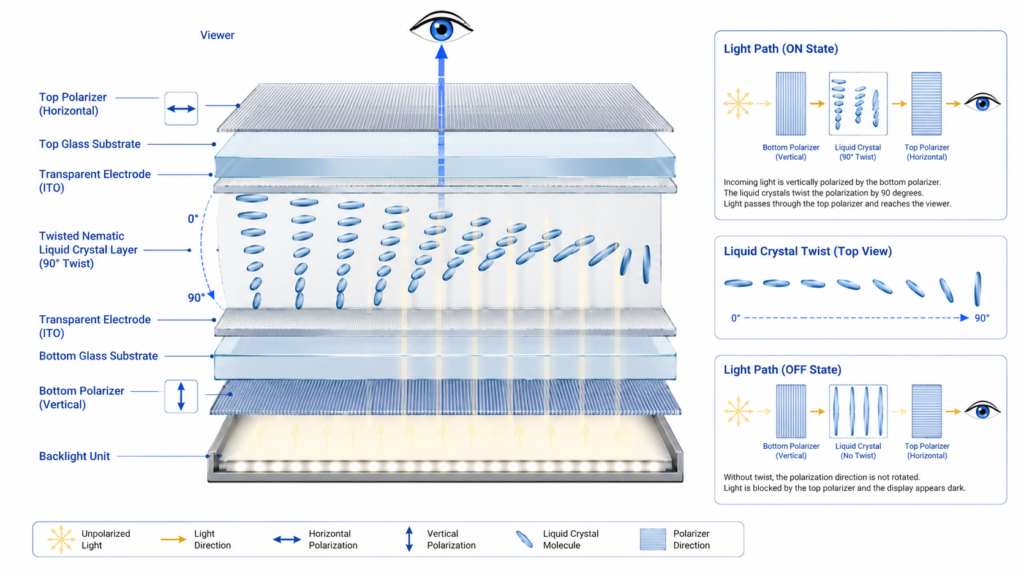
Twisted Nematic LCD is a liquid crystal display technology based on the twisted nematic effect. In a TN cell, the liquid crystal molecules are arranged in a twisted structure between two glass substrates. Merck describes TN flat screens as using an ultra-thin liquid crystal layer twisted by 90° between glass plates with clear electrodes, with polarizing filters on the outside of the glass plates.[1]
The term “nematic” refers to the rod-like alignment behavior of liquid crystal molecules. The term “twisted” describes how these molecules rotate gradually through the thickness of the liquid crystal layer. This twisted molecular arrangement is what allows the LCD to control polarized light and form visible bright and dark pixel states.
TN technology became important because it made LCDs practical for many low-power and flat-panel applications. Merck’s LCD history notes that the twisted nematic cell was developed around 1971 by James Fergason, Martin Schadt, and Wolfgang Helfrich, marking a major step in the development of nematic liquid crystal displays.[2]
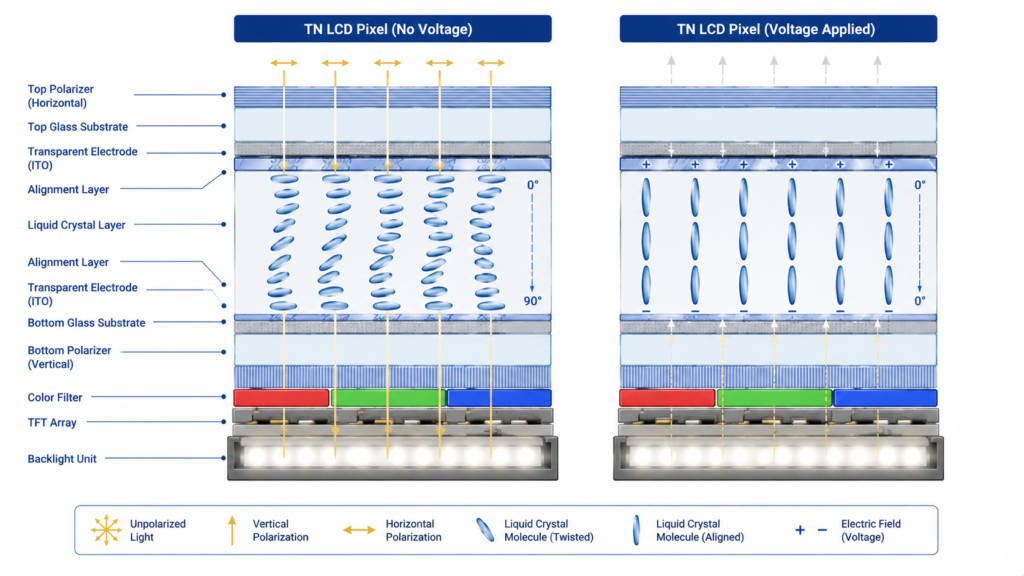
A TN LCD controls light rather than emitting light directly. In a typical transmissive TN LCD, a backlight provides illumination, and the LCD cell controls whether that light can pass through the polarizers and reach the viewer.
The basic structure includes two polarizers, two glass substrates, transparent electrodes, alignment layers, and a thin twisted nematic liquid crystal layer. In color TFT LCD designs, the structure also includes a TFT array, color filter, driver IC, backlight unit, FPC cable, and related module-level components.
When no voltage is applied, the liquid crystal molecules remain in their twisted arrangement. Light passing through the first polarizer follows the twist of the liquid crystal layer and can pass through the second polarizer. In this common operating mode, the pixel appears bright. When voltage is applied, the liquid crystal molecules align more vertically relative to the glass substrates. The light is no longer rotated in the same way and is blocked by the second polarizer, making the pixel appear dark.[1]
This light-control behavior is why TN LCDs are often described as optical valves. The pixel is not generating light by itself. It is controlling how much backlight can pass through the display stack.
A TN LCD panel is built from multiple optical and electrical layers. The exact structure depends on whether it is a simple monochrome TN display or a color active-matrix TN TFT LCD, but the core operating principle remains similar.
| Component | Main Function | Engineering Relevance |
|---|---|---|
| Front and rear polarizers | Control polarized light transmission | Affect contrast, brightness, and readability |
| Glass substrates | Support the LCD cell structure | Affect mechanical stability and cell gap precision |
| Transparent electrodes | Apply voltage across the liquid crystal layer | Control pixel bright and dark states |
| Alignment layers | Set the initial orientation of liquid crystal molecules | Define the twisted molecular structure |
| Twisted nematic liquid crystal layer | Modulate polarized light according to voltage | Core of TN display operation |
| TFT array | Control individual pixels in active-matrix TN TFT LCDs | Affect resolution, refresh behavior, and image control |
| Color filter | Create red, green, and blue subpixels | Enables full-color display output |
| Backlight unit | Provide illumination behind the LCD panel | Affect brightness, power consumption, and thermal design |
| Driver IC and FPC | Connect the LCD module to the host system | Affect interface compatibility and product integration |
In a TFT TN LCD module, the TFT array is especially important because it allows individual pixel-level control. This is different from simple segmented TN displays used in basic calculators or watches. A TN TFT LCD can show complex images, icons, graphics, and user interface content, but its viewing-angle behavior still follows the limitations of TN liquid crystal alignment.
The main advantage of TN LCD technology is practical efficiency. TN panels are mature, widely available, and cost-effective. For many embedded display projects, this matters because the display is only one part of the total product cost.
TN displays are also known for fast response characteristics. Newhaven Display describes TN displays as offering low power consumption, high response, and high refresh rates compared with IPS displays, while also noting that TN technology is widely used where speed or budget is more important than color accuracy.[3]
Another advantage is lower power consumption in many applications. Since LCDs use liquid crystal light modulation and only require limited current in the cell itself, TN displays can be efficient for portable instruments, handheld devices, measurement tools, home appliances, and compact embedded products.
TN LCDs can also be suitable when the viewing position is predictable. If the user normally looks at the screen from one fixed direction, the narrow viewing angle may not create a serious problem. This is common in some meters, handheld instruments, control panels, and simple equipment displays.
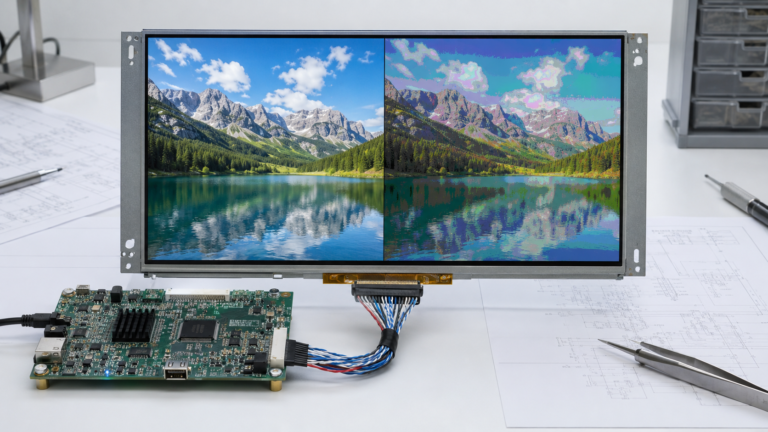
The most important limitation of TN LCD technology is viewing angle. A TN display usually has a preferred viewing direction. When viewed outside that direction, the image may show contrast loss, grayscale inversion, color shift, or reduced readability. This is especially noticeable in the vertical viewing direction.
Winstar explains that traditional TN TFT LCD panels are often designed with a fixed viewing direction, such as 6 o’clock or 12 o’clock, and that TN displays are more sensitive to viewing position changes than VA or IPS technologies.[4]
Color consistency is another limitation. TN panels are usually not the first choice for applications where accurate color reproduction or stable image appearance from multiple angles is required. This is why IPS displays are commonly preferred for devices such as smart control panels, medical equipment interfaces, vehicle displays, and user-facing HMI systems where visual consistency matters.
TN displays may also have lower perceived contrast than VA panels in applications where black level is important. For simple industrial data display, this may not matter. For image-rich interfaces, video content, or high-end visual products, the limitation becomes more visible.
One of the most important engineering details in TN LCD selection is viewing direction. Many TN LCDs are specified with a preferred viewing direction such as 6 o’clock or 12 o’clock. This does not refer to time. It refers to the direction from which the screen is expected to be viewed most clearly.
A 6 o’clock viewing direction usually means the display is optimized for viewing from below the screen center. A 12 o’clock viewing direction usually means it is optimized for viewing from above the screen center. The correct option depends on how the final product is installed.
For example, a handheld instrument may be viewed from slightly below eye level. A wall-mounted control panel may be viewed from slightly below or from the side. A display mounted on a tabletop device may be viewed from above. If the TN LCD viewing direction does not match the real installation angle, the user may see poor contrast or inverted grayscale even when the display is technically working.
This is why TN LCD selection should include mechanical installation review. The display cannot be evaluated only by diagonal size, resolution, and interface. Viewing direction should be checked before sample approval.
TN LCD technology remains useful in applications where cost, response speed, low power consumption, and fixed viewing position are more important than wide viewing angle or premium color consistency.
Common examples include basic industrial control panels, handheld instruments, measurement equipment, home appliances, compact embedded systems, portable tools, digital meters, simple medical or testing devices, calculators, watches, and budget-sensitive electronic products.
For industrial use, TN should be selected carefully. It can be a good fit for single-user equipment with predictable viewing position and simple interface content. It is less suitable for multi-user HMI systems, wide-angle monitoring panels, high-end touch terminals, or applications where operators may view the screen from different directions.
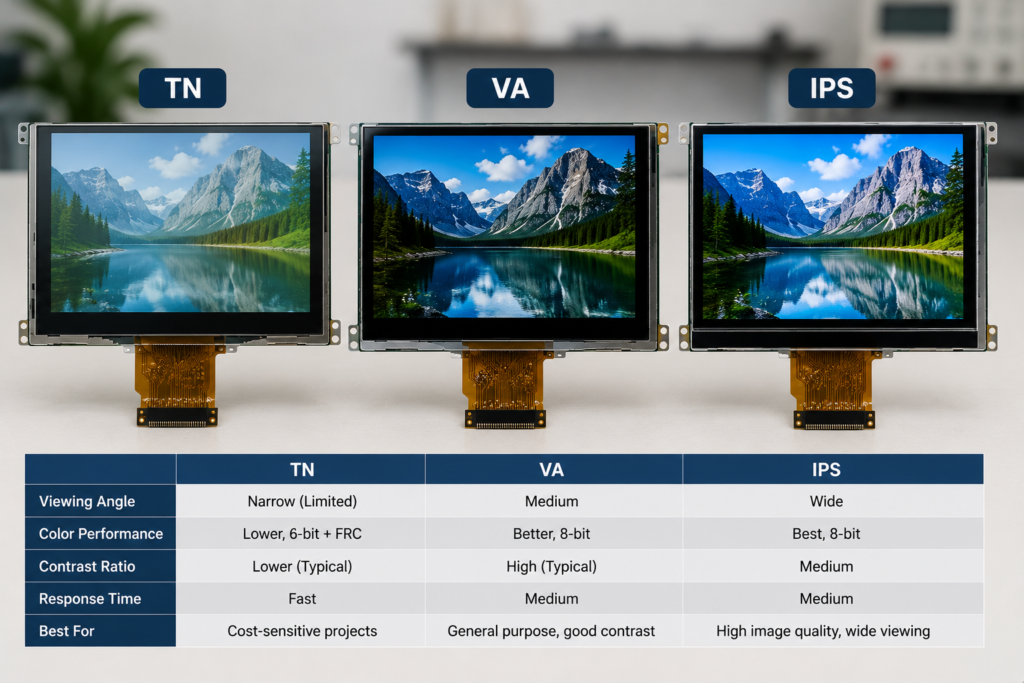
TN, IPS, and VA are not interchangeable labels. They describe different liquid crystal alignment structures, and each structure creates different optical behavior. Merck lists TN, VA, IPS, FFS, and other LCD technologies and notes that the technology best suited for a display depends on the requirements of the end device.[5]
| Technology | Main Strength | Main Limitation | Best-Fit Use Case |
|---|---|---|---|
| TN LCD | Cost efficiency, fast response, mature availability | Narrower viewing angle and weaker color consistency | Fixed-view, cost-sensitive, simple display applications |
| IPS LCD | Wide viewing angle and stable color performance | Usually higher cost than TN | HMI panels, smart terminals, medical interfaces, shared-view displays |
| VA LCD | Higher contrast and improved black level | Viewing behavior and response depend on panel design | Displays requiring stronger contrast and better visual stability than TN |
For product engineers, the right question is not “Which LCD technology is best?” The better question is “Which display technology matches the viewing position, cost target, interface, brightness requirement, operating environment, and user interface content of this product?”
If the product has a fixed viewing angle, simple graphics, and strict cost target, TN may be suitable. If the product requires wide viewing angle, consistent color, or multiple viewing positions, IPS is usually safer. If contrast and black level matter more than the fastest switching behavior, VA may be worth evaluating.
TN LCD technology can still be a reasonable choice for new product development, but it should be selected deliberately. It is not ideal for every modern display project, but it remains useful when its strengths match the product requirement.
TN is more suitable when the display is used by one primary user, the viewing direction is predictable, the interface content is simple, the product is cost-sensitive, and wide-angle color consistency is not a key requirement. It may also be useful when low power consumption or fast pixel response is important.
TN is less suitable when the display is mounted in a location where users view it from multiple angles, when the product requires a premium touch interface, when the interface uses detailed color graphics, or when the screen must remain readable from the side, above, and below.
Before approving a TN TFT LCD module, engineers should check the sample in the real installation position. A panel that looks acceptable on a desk may not be acceptable once it is installed into a housing or viewed from the user’s actual angle.
When evaluating a TN LCD module, the buyer should confirm more than size and resolution. Important questions include: What is the preferred viewing direction? What is the expected installation angle? Will the display be viewed by one user or multiple users? Is the content simple text, icons, color UI, or moving graphics? What brightness level is needed? What interface does the host system support? Is touch required? Will the display need a controller board?
Mechanical design should also be reviewed. The FPC exit direction, connector position, cover glass, housing depth, bezel structure, and mounting angle can all affect whether the display performs well in the final product.
For industrial or embedded projects, sample testing should include the real viewing position, operating environment, brightness condition, and interface connection. This is the most practical way to decide whether TN is sufficient or whether IPS or VA should be considered.
RJY Display provides TFT LCD products, controller boards, and customization support for B2B display projects. For projects that may use TN TFT LCD modules, RJY Display can help review display size, resolution, viewing direction, interface, brightness, touch requirements, FPC position, controller board compatibility, and mechanical installation conditions.
If your project requires a cost-sensitive display module, a fixed-view industrial screen, a compact embedded TFT LCD, or an alternative to an existing TN display, contact RJY Display with your project requirements. Useful information includes display size, resolution, interface, viewing direction, brightness requirement, touch requirement, operating environment, installation angle, annual demand, and any available reference model or datasheet.
Twisted Nematic LCD is a liquid crystal display technology that uses a 90° twisted liquid crystal structure between glass substrates to control polarized light and create bright and dark pixel states.
A TN LCD works by changing the orientation of liquid crystal molecules with voltage. Without voltage, the twisted molecules allow polarized light to pass through. With voltage, the molecules align differently and block light through the second polarizer.
TN LCDs are mature, cost-effective, fast in response, and power-efficient in many applications. They are suitable for fixed-view, cost-sensitive, and simple embedded display products.
The main disadvantages are narrow viewing angle, weaker color consistency, possible grayscale inversion, and lower visual stability when viewed from off-axis positions.
TN LCDs are usually more cost-effective and fast in response, but they have narrower viewing angles. IPS LCDs provide wider viewing angles and more stable color performance, making them better for HMI, smart terminal, and shared-view applications.
Yes. TN LCDs are still used in industrial and embedded applications where the viewing position is fixed, the product is cost-sensitive, and wide-angle visual consistency is not required.
Share your display size, resolution, interface, brightness, touch requirement, controller board requirement, and application environment.
Continue reading related display technology guides and application references.
Explore product pages related to this article topic.
Talk to RJY’s engineering team for display matching, controller board review, and customization discussion.