L'évolution de l'écran TFT LCD personnalisé pour voiturette de golf est étroitement liée à la transformation plus large des véhicules électriques à faible vitesse en plateformes de mobilité intelligentes. Ce qui n'était autrefois qu'un simple tableau de bord analogique indiquant la vitesse et le niveau de batterie est devenu une interface homme-machine centralisée intégrant le contrôle du véhicule, les diagnostics système, la navigation et la communication au niveau de la flotte.
Cette évolution n'est pas cosmétique. Elle reflète un changement structurel dans la conception, le déploiement et la gestion des voiturettes de golf dans des environnements commerciaux tels que les complexes hôteliers, les aéroports, les campus et les parcs industriels. À mesure que ces véhicules deviennent électrifiés et de plus en plus connectés, le système d'affichage passe d'un indicateur passif à une interface informatique active.
D'un point de vue technique, cette transition introduit une nouvelle catégorie d'exigences que les panneaux TFT grand public conventionnels ne peuvent satisfaire. L'écran doit désormais fonctionner comme partie intégrante d'un système embarqué plus vaste, étroitement couplé aux contrôleurs du véhicule, aux systèmes de gestion de batterie et aux modules de communication. C'est là que la conception d'un écran TFT LCD personnalisé devient essentielle, et non optionnelle.
Du simple combiné d'instruments à l'interface embarquée du véhicule
Dans les architectures traditionnelles des voiturettes de golf, le tableau de bord était isolé de la logique de contrôle du véhicule. La vitesse, l'état de charge et les indicateurs d'avertissement étaient gérés par des circuits analogiques discrets. Cependant, cette architecture devient insuffisante lorsque les flottes s'agrandissent et que la complexité opérationnelle augmente.
Les exploitants de flottes modernes exigent une visibilité centralisée sur l'état des véhicules, une capacité de diagnostic à distance et une interaction utilisateur standardisée entre différents modèles de véhicules. Ces exigences favorisent l'adoption de tableaux de bord numériques à base de TFT, où l'écran n'est plus un périphérique mais l'interface centrale du système du véhicule.
L'implication pour les concepteurs OEM est significative. Un l'écran TFT LCD personnalisé pour voiturette de golf écran TFT LCD personnalisé doit désormais être conçu dans le cadre d'une architecture système incluant l'informatique embarquée, l'acquisition de données en temps réel et les protocoles de communication industriels. Cela modifie non seulement la sélection du matériel, mais aussi les contraintes de conception logicielle et mécanique.
Contraintes environnementales et exigences d'ingénierie optique
Contrairement aux panneaux HMI industriels intérieurs, les écrans de voiturettes de golf fonctionnent dans des environnements extérieurs non contrôlés. L'exposition directe au soleil, les variations d'humidité, les vibrations dues aux terrains accidentés et les longues périodes d'inactivité sous des températures extrêmes contribuent toutes à une dégradation accélérée si le système d'affichage n'est pas correctement conçu.
Le défi le plus immédiat est la performance optique. La lisibilité en plein soleil n'est pas simplement une question d'augmentation de la luminosité ; elle implique un équilibre entre la consommation d'énergie du rétroéclairage, la gestion thermique et les techniques de liaison optique qui réduisent la réflexion interne. Sans une optimisation optique appropriée, même un panneau TFT haute résolution devient inutilisable en conditions diurnes.
Tout aussi importante est la stabilité thermique. Les voiturettes de golf sont souvent garées à l'extérieur pendant de longues périodes, exposant le module d'affichage à une accumulation significative de chaleur. Cela nécessite une sélection minutieuse des matériaux à cristaux liquides, des systèmes de rétroéclairage et des circuits intégrés de pilotage capables de fonctionner de manière stable dans des conditions thermiques fluctuantes. Dans les systèmes conçus sur mesure, cela est généralement traité au niveau de l'intégration du module plutôt qu'au seul niveau du panneau.
Architecture système d'un écran HMI moderne pour voiturette de golf
Un système d'affichage moderne pour voiturette de golf doit être compris comme une architecture en couches plutôt que comme un composant unique. À la base se trouve le module TFT LCD responsable de la sortie visuelle. Au-dessus se trouve l'interface tactile, qui peut utiliser la détection capacitive pour une interaction de type grand public ou la technologie résistive pour les environnements industriels compatibles avec les gants.
Cependant, la véritable transformation se produit au niveau de la couche de contrôle. Au lieu de tableaux de bord simples pilotés par microcontrôleur, de nombreuses conceptions OEM intègrent désormais des plateformes informatiques embarquées telles que les systèmes basés sur Android. Cela permet une interface utilisateur entièrement graphique, la prise en charge d'applications de navigation, la connectivité IoT et la visualisation de données en temps réel.
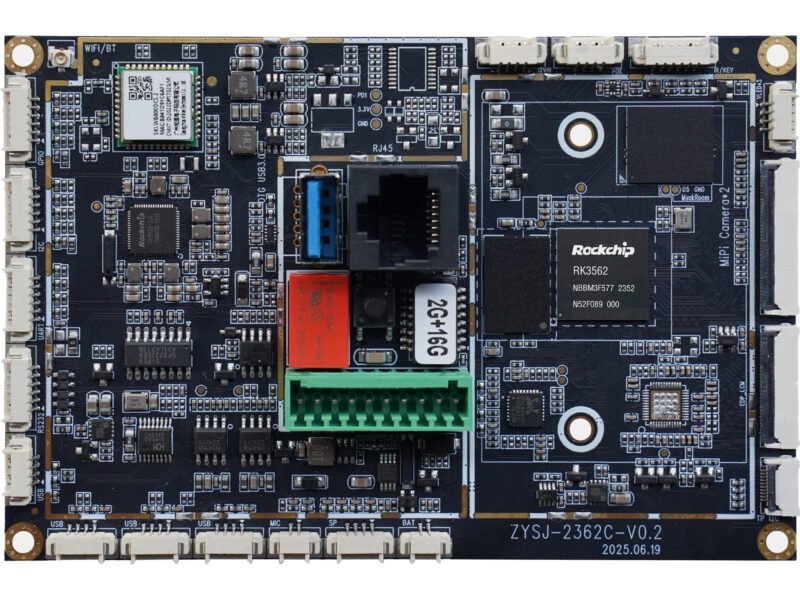
Dans ce contexte, des plateformes comme le carte de contrôle Android RK3566 de RJY écran TFT LCD personnalisé deviennent centrales dans la conception du système. Elles comblent le fossé entre le matériel d'affichage et le réseau de contrôle du véhicule, permettant un système HMI unifié qui peut évoluer des tableaux de bord de base aux terminaux de gestion de flotte entièrement connectés.
Défis de conception d'interface et d'intégration électrique
L'un des aspects les plus sous-estimés de la conception d'écrans pour voiturettes de golf est la compatibilité des interfaces. Bien que les panneaux TFT puissent sembler standardisés en surface, leur complexité d'intégration varie considérablement selon que le système utilise une signalisation RGB, LVDS, MIPI ou HDMI.
Chaque interface introduit des contraintes différentes en termes d'intégrité du signal, de tolérance de longueur de câble, de sensibilité aux interférences électromagnétiques et de consommation d'énergie au niveau système. Par exemple, les interfaces MIPI sont très efficaces pour les systèmes embarqués compacts mais nécessitent un contrôle strict de la disposition, tandis que le LVDS offre une plus grande robustesse pour un routage de câbles plus long dans les environnements véhiculaires.
Dans les applications de voiturettes de golf, cette décision est rarement isolée. Elle est étroitement liée à la conception du boîtier mécanique, à la stratégie de disposition du circuit imprimé et à la sélection de la carte de contrôle. Une inadéquation à ce niveau peut introduire une instabilité difficile à diagnostiquer après l'assemblage, c'est pourquoi la planification de l'interface est généralement abordée lors de la phase de conception OEM précoce plutôt que lors de l'intégration ultérieure.
Évolution de la conception vers des écrans multifonctions pour véhicules
La tendance la plus visible dans les systèmes d'affichage pour voiturettes de golf est la transition vers des interfaces multifonctions. Au lieu de combinés d'instruments à usage unique, les fabricants mettent désormais en œuvre des tableaux de bord numériques centralisés qui consolident l'état du véhicule, l'interaction utilisateur et le contrôle système en une couche visuelle unifiée.
Cette tendance est en partie motivée par les attentes en matière d'expérience utilisateur et en partie par les exigences d'efficacité opérationnelle. Les exploitants de flottes bénéficient d'interfaces standardisées qui simplifient la formation, la maintenance et la surveillance à distance. Les utilisateurs finaux bénéficient de systèmes de retour d'information plus clairs et de dispositions de contrôle plus intuitives.
D'un point de vue conception produit, cette évolution ouvre également de nouvelles possibilités en matière d'innovation de facteur de forme d'affichage. Les écrans TFT LCD circulaires sont de plus en plus utilisés dans les modèles de voiturettes de golf haut de gamme pour créer une esthétique plus inspirée de l'automobile. Dans d'autres cas, des écrans allongés de type barre sont adoptés pour optimiser l'espace du tableau de bord dans les conceptions de véhicules compacts. Ces variations reflètent non seulement des choix esthétiques mais aussi des contraintes d'intégration mécanique.
Pour les implémentations d'interface circulaire, des solutions telles que Écran LCD rond de 8 pouces ou Écran LCD TFT rond de 7 pouces l'écran TFT LCD personnalisé sont souvent évaluées dans le cadre de l'exploration de conception OEM, en particulier dans les plateformes de mobilité haut de gamme.
Considérations d'ingénierie dans la personnalisation OEM
Développer un écran personnalisé fiable pour voiturette de golf n'est pas une question de sélection d'une spécification de panneau dans un catalogue. Cela nécessite une ingénierie coordonnée couvrant la conception optique, l'architecture électrique, l'intégration mécanique et la planification de l'approvisionnement à long terme.
Les équipes OEM doivent généralement évaluer non seulement la taille et la résolution de l'écran, mais aussi les profils d'exposition environnementale, les cycles de service attendus, les modèles d'interaction utilisateur et l'architecture d'alimentation au niveau système. Dans de nombreux cas, l'écran doit également s'intégrer aux systèmes de gestion de batterie et aux réseaux de contrôle du véhicule, ce qui ajoute une couche supplémentaire de complexité à la validation du système.
Dans les configurations plus avancées, des écrans de type barre tels que Écran LCD barre de 11,65 pouces l'écran TFT LCD personnalisé sont sélectionnés pour s'aligner sur des géométries de tableau de bord contraintes ou pour prendre en charge des dispositions d'informations segmentées pour les systèmes de surveillance de flotte.
Valeur au niveau système d'un écran personnalisé Intégration
La valeur principale d'un la conception d'un écran TFT LCD personnalisé écran personnalisé dans les applications de voiturettes de golf ne réside pas dans l'écran lui-même, mais dans la réduction du risque d'intégration système. Lorsque le matériel d'affichage, la logique de contrôle et la structure mécanique sont conçus de manière isolée, les OEM sont souvent confrontés à des problèmes de compatibilité tardifs qui impactent directement les délais de production.
Une solution personnalisée correctement conçue aligne ces domaines dès le départ. Cela réduit le besoin de cycles de reconception itératifs et améliore la maintenabilité à long terme sur les générations de produits. Pour les exploitants de flottes, cela se traduit par des coûts de cycle de vie inférieurs et des performances plus stables sur l'ensemble des unités déployées.
Conclusion
La transformation des tableaux de bord des voiturettes de golf en systèmes embarqués intelligents reflète une évolution plus large dans la conception des interfaces véhiculaires. À mesure que les plateformes de mobilité deviennent plus connectées et axées sur les données, l'écran évolue pour devenir une interface informatique centrale plutôt qu'un dispositif de sortie passif.
Dans ce contexte, un l'écran TFT LCD personnalisé pour voiturette de golf écran TFT LCD personnalisé n'est pas un composant autonome mais une décision au niveau système qui influence l'architecture électrique, la conception mécanique et l'expérience utilisateur. Une mise en œuvre réussie nécessite un alignement d'ingénierie précoce entre la technologie d'affichage, les plateformes de contrôle embarquées et l'architecture du système du véhicule.
Demander une solution d'écran personnalisé pour voiturette de golf
RJY accompagne les équipes OEM dans la conception et l'intégration de systèmes d'affichage embarqués pour les véhicules électriques et les plateformes de mobilité industrielle. La consultation d'ingénierie commence généralement par les exigences système telles que la géométrie de l'écran, la sélection de l'interface, les conditions environnementales et l'échelle de production attendue.
Parlez à un ingénieur RJY pour évaluer votre architecture d'écran TFT LCD personnalisé pour voiturette de golf.