Vous rencontrez un goulot d'étranglement dans votre projet d'affichage embarqué ?
Ne laissez pas l'intégration complexe ou les problèmes de chaîne d'approvisionnement ralentir votre mise sur le marché. Réservez une consultation gratuite avec l'équipe d'experts RJY pour un accompagnement sur mesure en conception et fabrication.
Quelle est la différence entre l'IPS et le TFT LCD ?
Publié :
Lecture de 13 minutes
Mis à jour :
La différence entre IPS et TFT LCD est souvent mal comprise. De nombreux acheteurs recherchent “ IPS vs TFT ” comme si IPS et TFT étaient deux technologies d’affichage distinctes. Techniquement, cette comparaison n’est pas précise.
TFT LCD signifie affichage à cristaux liquides à transistor en couche mince. Il décrit une structure LCD à matrice active où les pixels sont contrôlés par des transistors en couche mince. L’IPS, ou commutation dans le plan, est une technologie spécifique de panneau LCD utilisée pour améliorer l’angle de vision et la stabilité des couleurs. Dans la plupart des discussions sur les produits modernes, un écran IPS est généralement un IPS TFT LCD.
En termes simples : L’IPS n’est pas l’opposé du TFT. L’IPS est un type de technologie de panneau TFT LCD.
Cette distinction est importante pour les ingénieurs, les équipes d’approvisionnement et les développeurs de produits qui sélectionnent des écrans pour les IHM industrielles, les panneaux domotiques, les dispositifs liés aux véhicules, les interfaces médicales, les équipements de sécurité et les systèmes embarqués. Choisir le bon écran nécessite plus que la simple lecture de l’étiquette. Les acheteurs doivent évaluer le type de panneau, l’angle de vision, la luminosité, la résolution, l’interface, les besoins tactiles, la compatibilité de la carte contrôleur, l’adaptation mécanique et l’environnement d’exploitation.
IPS et TFT LCD : Quelle est la relation ?
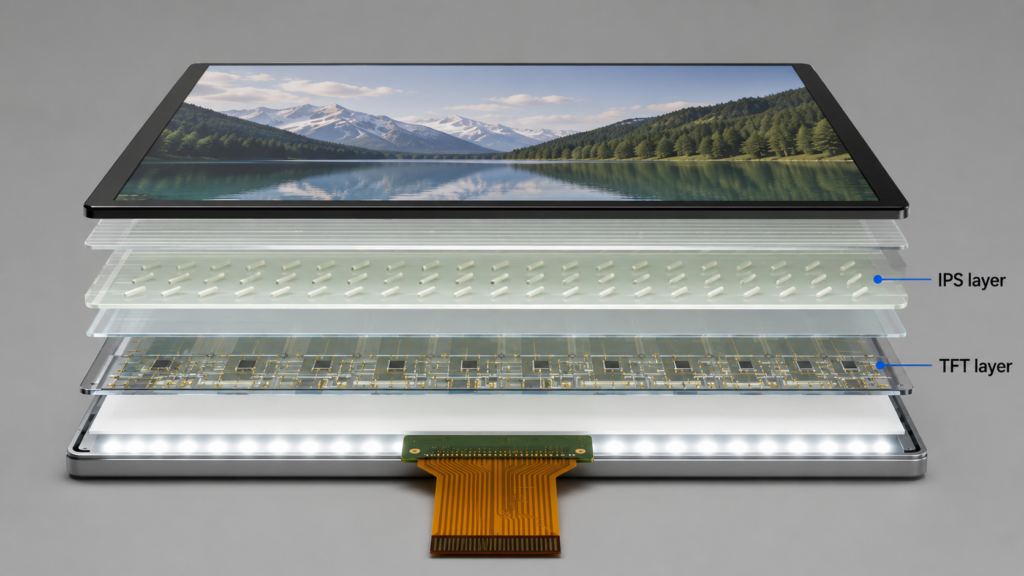
Le TFT LCD est une vaste catégorie d’affichage. Il désigne un panneau LCD qui utilise une matrice active à transistor en couche mince pour contrôler les pixels. La couche TFT permet à l’écran d’adresser les pixels avec plus de précision que les anciennes conceptions LCD à matrice passive.
L’IPS est une technologie de panneau au sein de la famille LCD. Elle décrit la manière dont les molécules de cristaux liquides se déplacent à l’intérieur du panneau. Dans un panneau IPS, les cristaux liquides tournent dans un plan qui aide à maintenir des couleurs et un contraste plus cohérents lorsque l’écran est vu sous différents angles.
Coupe transversale d’un IPS TFT LCD montrant la couche de cristaux liquides IPS et la couche de matrice active TFT
La relation peut être résumée clairement :
Le TFT décrit la structure de contrôle des pixels.
L’IPS décrit la méthode d’alignement des cristaux liquides.
Un écran IPS utilisé dans les modules LCD modernes est généralement un IPS TFT LCD.
L’IPS et le TFT ne sont pas des technologies concurrentes au même niveau.
La comparaison plus précise est IPS TFT LCD vs TN TFT LCD ou VA TFT LCD.
Pourquoi la question “ IPS vs TFT ” est trompeuse
L’expression “ IPS vs TFT ” est trompeuse car elle compare deux termes issus de couches techniques différentes. Le TFT est la technologie de fond de matrice active. L’IPS est le mode de panneau à cristaux liquides.
Un écran peut être à la fois TFT et IPS. Les descriptions de produits utilisent souvent des termes tels que “ IPS TFT LCD ”, “ écran TFT IPS ” ou “ module IPS LCD ” pour indiquer que le panneau combine le contrôle par matrice active TFT avec les performances d’angle de vision de l’IPS.
Lorsqu’un acheteur demande si l’IPS est meilleur que le TFT, la véritable question est généralement l’une des suivantes :
L’IPS TFT LCD est-il meilleur que le TN TFT LCD pour cette application ?
Ai-je besoin d’angles de vision plus larges ?
Les utilisateurs regarderont-ils l’écran de côté ?
La stabilité des couleurs est-elle importante ?
Le produit utilise-t-il un panneau tactile ?
L’écran est-il utilisé dans une position de vision fixe unique ou dans un environnement multi-utilisateurs ?
Le projet nécessite-t-il un contrôle des coûts plutôt que des performances d’angle de vision larges ?
Ces questions sont plus utiles qu’une simple comparaison “ IPS vs TFT ”.
Qu'est-ce que le TFT LCD ?
TFT LCD signifie affichage à cristaux liquides à transistor en couche mince. C’est un type de LCD à matrice active. Dans un TFT LCD, les transistors en couche mince aident à contrôler les pixels ou sous-pixels individuels, permettant à l’écran d’afficher des images avec une meilleure stabilité, des détails et un temps de réponse que de nombreux anciens LCD à matrice passive.
Un TFT LCD a toujours besoin d’un rétroéclairage car le matériau à cristaux liquides n’émet pas de lumière par lui-même. Le rétroéclairage fait passer la lumière à travers la structure LCD, tandis que la couche de cristaux liquides et les filtres de couleur contrôlent la formation de l’image.
La technologie TFT LCD est largement utilisée dans les produits embarqués car elle offre un équilibre pratique entre qualité d’affichage, coût, disponibilité des tailles, options d’interface et flexibilité de personnalisation.
Points forts courants du TFT LCD
Adapté aux interfaces utilisateur graphiques en couleur
Disponible dans de nombreuses tailles et résolutions
Prend en charge les interfaces d’affichage courantes selon le module et la carte contrôleur
Peut être intégré avec des panneaux tactiles et du verre de protection
Fonctionne bien pour de nombreuses applications d’affichage embarquées et industrielles
Peut être sélectionné dans différents types de panneaux, y compris TN, IPS et VA
Qu’est-ce que l’IPS LCD ?
IPS signifie commutation dans le plan. C’est une technologie de panneau utilisée dans les écrans LCD. L’IPS a été développé pour améliorer certaines limitations des structures de panneaux LCD antérieures, notamment l’angle de vision et le décalage des couleurs.
Dans un panneau IPS, les molécules de cristaux liquides se déplacent de manière plus parallèle à la surface de l’écran. Cette structure aide l’écran à maintenir des couleurs et un contraste plus stables lorsqu’il est vu sous différents angles.
Pour les produits embarqués et les interfaces industrielles, l’IPS est souvent choisi lorsque les utilisateurs doivent lire l’écran sous des angles latéraux, lorsque plusieurs opérateurs peuvent visualiser le même écran, ou lorsque l’interface utilise des couleurs qui doivent rester compréhensibles depuis différentes positions.
Points forts courants de l’IPS TFT LCD
Angle de vision plus large que de nombreux panneaux TN TFT LCD
Apparence des couleurs plus stable depuis des positions de vision latérales
Meilleure adaptabilité aux environnements de visualisation multi-utilisateurs
Utile pour les écrans tactiles, les panneaux intelligents, les IHM et les interfaces d’équipement
Bon choix lorsque la lisibilité de l’interface utilisateur importe depuis différentes positions d’opérateur
IPS TFT LCD vs TN TFT LCD
La comparaison la plus utile n’est pas IPS vs TFT. C’est généralement IPS TFT LCD vs TN TFT LCD.
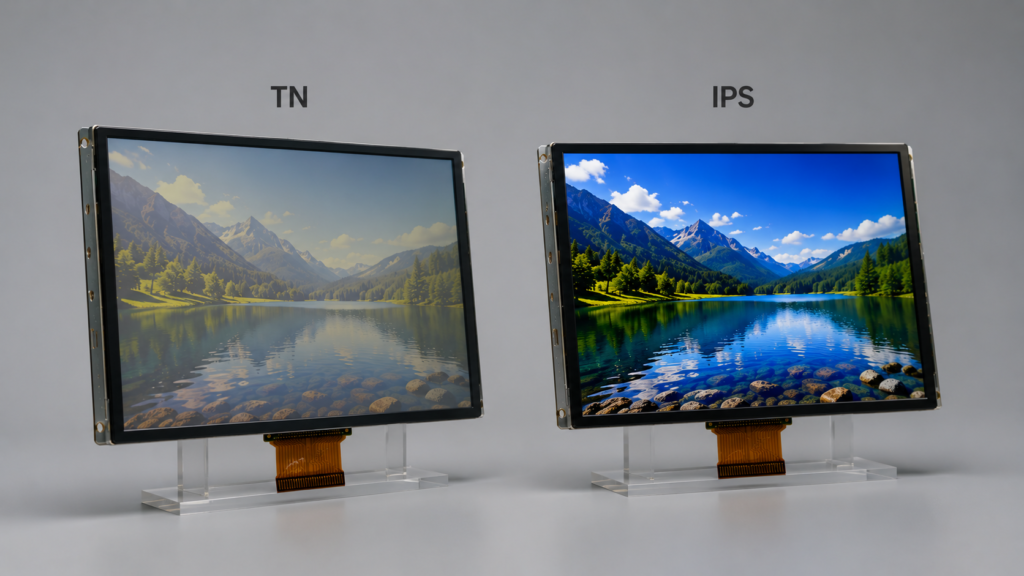
TN signifie nématique torsadé. TN est un autre mode de panneau LCD. Les panneaux TN TFT LCD peuvent être rentables et offrir une réponse rapide dans certaines applications, mais ils ont généralement des angles de vision plus étroits et un décalage des couleurs plus visible que les panneaux IPS.
Comparaison de l’angle de vision entre TN et IPS TFT LCD avec différence de stabilité des couleurs en vision latérale
Les panneaux IPS TFT LCD sont généralement préférés lorsque l’écran doit rester lisible sous plusieurs angles, lorsque la cohérence des couleurs est importante, ou lorsque le produit sera utilisé comme interface tactile dans un environnement d’exploitation réel.
Fonctionnalité
LCD TFT TN
LCD TFT IPS
Couche technique
TFT LCD avec mode cristaux liquides TN
TFT LCD avec mode cristaux liquides IPS
Angle de vision
Plus limité, surtout depuis certaines directions
Plus large et plus stable en utilisation typique
Changement de couleur
Plus probable sous des angles de vision latéraux
Généralement moins perceptible
Coût
Souvent plus économique
Souvent plus élevé que les options TN de base
Adéquation pour les écrans tactiles
Utilisable, mais l'angle de vision doit être vérifié
Souvent privilégié pour les panneaux tactiles et la vision multi-angle
Meilleure adéquation
Interfaces simples, produits à vue unique, applications sensibles aux coûts
VA signifie alignement vertical. VA est un autre mode de panneau LCD utilisé dans certains produits TFT LCD. Les panneaux VA sont souvent considérés lorsque le contraste est important, mais leur comportement de vision et leurs caractéristiques de réponse dépendent de la conception spécifique du panneau.
Pour de nombreux projets d'affichage B2B, la comparaison pratique se fait entre les panneaux TFT LCD TN, IPS et VA. Chaque type de panneau présente des compromis. L'IPS n'est pas toujours la seule réponse correcte, mais c'est souvent un choix solide lorsque l'angle de vision et la stabilité des couleurs sont importants.
Type de panneau
Principal avantage
Limitation principale
Adéquation applicative typique
LCD TFT TN
Économique et simple
Angle de vision plus étroit et davantage de dérive des couleurs
Commandes de base, dispositifs à vue unique, produits sensibles aux coûts
LCD TFT IPS
Grand angle de vision et apparence stable des couleurs
Les performances dépendent fortement de la conception du panneau
Applications où le contraste est une priorité
L’IPS est-il toujours meilleur que le TFT ?
Non. Cette question est techniquement incorrecte car l'IPS est généralement un type de TFT LCD. Une meilleure question est de savoir si un TFT LCD IPS est meilleur qu'un TFT LCD TN ou qu'un TFT LCD VA pour l'application cible.
L'IPS est souvent meilleur lorsque l'écran sera vu sous différents angles, lorsque le produit possède une interface utilisateur graphique, lorsque plusieurs utilisateurs peuvent regarder l'écran, ou lorsque la cohérence des couleurs est importante. Cependant, le TFT LCD TN peut encore être pratique pour les interfaces simples, les applications à vue unique et les projets avec des objectifs de coûts stricts.
Le choix correct dépend de l'application, et non d'une simple étiquette d'affichage.
Quand choisir l'écran IPS TFT LCD ?
Le TFT LCD IPS est généralement une bonne direction lorsque la lisibilité de l'écran et l'angle de vision sont importants. Il est particulièrement utile lorsque les utilisateurs ne se tiennent pas toujours directement devant l'écran.
Envisagez le TFT LCD IPS pour :
Panneaux IHM industriels vus depuis différentes positions d'opérateur
Panneaux de contrôle domotique avec interaction tactile
Interfaces de dispositifs médicaux où la visibilité stable est importante
Équipements de sécurité avec interfaces d'affichage graphiques
Écrans d'équipement liés aux véhicules vus depuis des positions inclinées
Électronique grand public où l'apparence visuelle affecte l'expérience utilisateur
Produits embarqués avec icônes, graphiques, menus ou éléments d'interface utilisateur basés sur des images
L'IPS peut également être utile lorsqu'un écran est installé dans un panneau vertical, un dispositif mural, un tableau de bord ou un environnement de contrôle partagé où l'angle de vision n'est pas fixe.
Quand un TFT LCD non-IPS peut-il être suffisant ?
L'IPS n'est pas nécessaire pour chaque projet. Un TN ou un autre TFT LCD non-IPS peut suffire lorsque l'utilisateur regarde l'écran directement de face, que l'interface utilisateur est simple, que le produit est sensible aux coûts et que la stabilité des couleurs n'est pas une exigence majeure.
Les options TFT LCD non-IPS peuvent être envisagées pour :
Indicateurs d'état simples
Affichages de base d'équipement
Dispositifs mono-utilisateur avec position de vision fixe
Produits embarqués sensibles aux coûts
Interfaces avec un contenu limité en termes de couleurs critiques
Applications où l'angle d'affichage est contrôlé par la conception du boîtier
La clé est de tester l'écran dans les conditions de vision réelles. Un panneau qui semble acceptable sur un bureau peut se comporter différemment après installation dans un boîtier ou une armoire d'équipement.
L’IPS affecte-t-il les performances de l’écran tactile ?
L'IPS lui-même ne définit pas la technologie tactile. Les performances tactiles dépendent du panneau tactile, du contrôleur tactile, du verre de protection, de la structure de liaison, du firmware, de la mise à la terre et de l'environnement d'exploitation.
Cependant, le TFT LCD IPS est souvent un bon choix pour les produits à écran tactile car les écrans tactiles sont généralement vus et utilisés sous différents angles. Un utilisateur peut se tenir sur le côté, atteindre le panneau ou regarder l'écran tout en interagissant avec l'équipement. Dans ces situations, un comportement de vision plus large peut améliorer la convivialité.
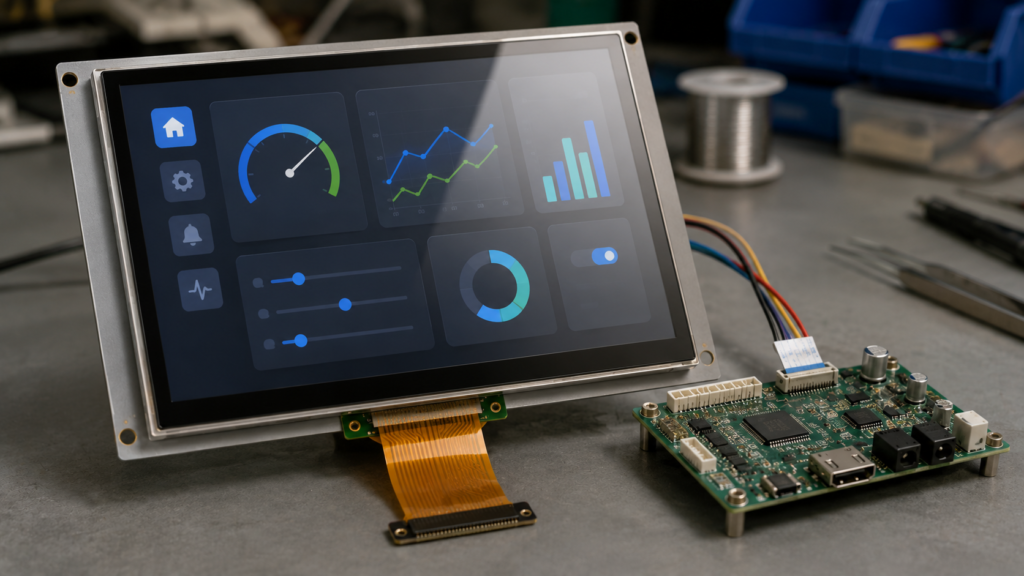
Pour les projets tactiles, les acheteurs doivent évaluer les performances du panneau IPS conjointement avec le verre de protection, le type tactile capacitif ou résistif, la carte contrôleur, l'interface tactile, l'utilisation de gants, l'exposition à l'humidité et la structure mécanique.
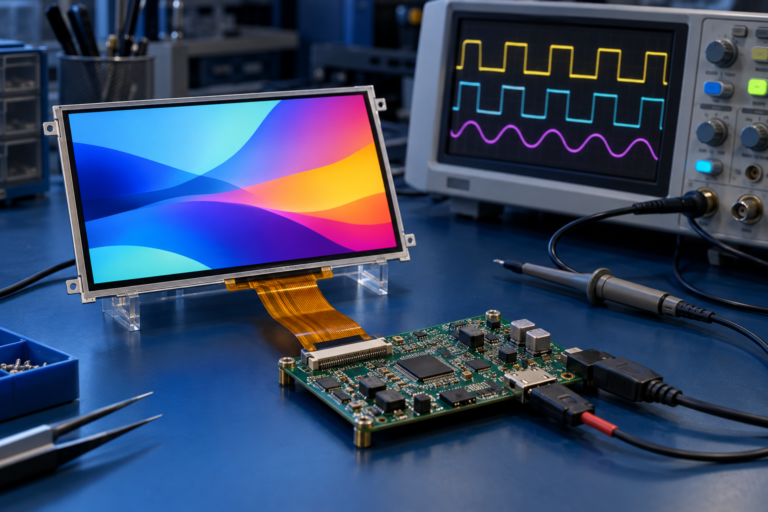
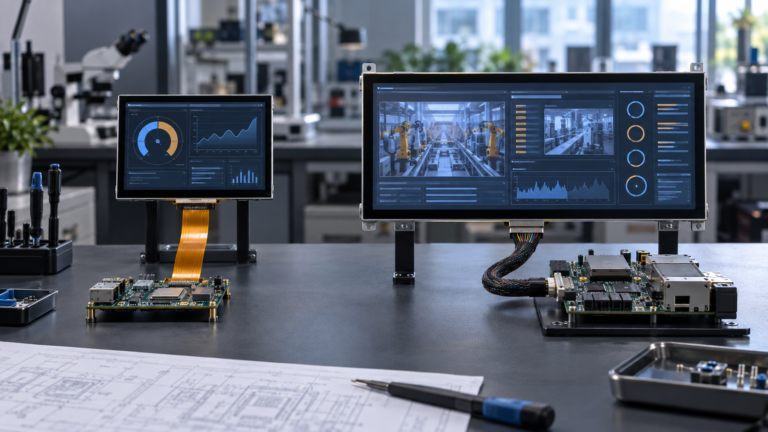
Configuration d'évaluation du module TFT LCD IPS avec carte contrôleur, câble FPC et fiche technique
L’IPS affecte-t-il la luminosité et la consommation d’énergie ?
La luminosité et la consommation d'énergie ne sont pas déterminées uniquement par l'IPS. Elles dépendent du panneau LCD, de la conception du rétroéclairage, des films optiques, de la taille de l'écran, de l'objectif de luminosité, des conditions de pilotage et de la configuration de la carte contrôleur.
Étant donné que les LCD nécessitent un rétroéclairage, celui-ci représente souvent une part majeure du budget énergétique. Un TFT LCD IPS à haute luminosité peut nécessiter une conception soignée du rétroéclairage et de la thermique, en particulier dans les boîtiers compacts ou les équipements alimentés par batterie.
Pour une utilisation en extérieur ou semi-extérieur, ne choisissez pas l'IPS uniquement en raison de l'angle de vision. Vérifiez également la luminosité, la réflexion du verre de protection, le traitement antireflet, la température de fonctionnement, le courant du rétroéclairage, la chaleur du boîtier et la conception de l'alimentation électrique.
Comment interpréter “ TFT IPS ” dans une fiche technique
Certaines fiches techniques ou listes de produits utilisent des termes tels que “ TFT IPS ”, “ IPS TFT ” ou “ IPS LCD ”. Ces termes signifient généralement que l'écran est un module TFT LCD utilisant la technologie de panneau IPS.
Pour l'approvisionnement et l'examen technique, l'étiquette n'est que le point de départ. Les acheteurs doivent encore confirmer :
Taille d'affichage
Résolution
Type d'écran
Informations sur la direction ou l'angle de vision
Luminosité
Type d'interface
Détails du FPC et du connecteur
Tension et courant du rétroéclairage
Exigence de panneau tactile
La compatibilité de la carte contrôleur
Environnement d’exploitation
Dimensions mécaniques
Une courte étiquette de produit ne peut pas remplacer un examen complet des spécifications.
Guide de sélection : IPS TFT LCD ou TFT LCD standard ?
Exigence du projet
Orientation recommandée
Raison
Vision latérale large requise
LCD TFT IPS
Meilleure stabilité de vision sous différents angles
Affichage d'état simple orienté vers l'avant
TN ou TFT LCD standard peut suffire
Le coût et la simplicité peuvent être plus importants qu'un large angle de vision
Panneau de commande tactile
Le TFT LCD IPS est souvent privilégié
Les utilisateurs peuvent interagir depuis différentes positions
Interface utilisateur sensible aux couleurs
LCD TFT IPS
Apparence des couleurs plus stable que de nombreuses options TN
Objectif de coût strict
Comparer les options TN, IPS et VA
L'IPS peut ne pas être nécessaire si l'angle de vision est contrôlé
Utilisation en extérieur ou en haute luminosité
Examiner le rétroéclairage et la structure optique
Le type de panneau seul ne détermine pas la lisibilité en plein soleil
Produit basé sur une carte contrôleur
Confirmer la compatibilité entre l'écran LCD et le contrôleur
L'interface, le timing, le firmware et le rétroéclairage doivent correspondre
Erreurs courantes lors de la comparaison entre IPS et TFT LCD
Une erreur courante est de supposer que l'IPS et le TFT sont des technologies opposées. Ce n'est pas le cas. L'IPS peut faire partie d'un module LCD TFT.
Une autre erreur est de supposer que tous les écrans LCD TFT ont de mauvais angles de vision. Ce n'est pas exact. Le LCD TFT est une catégorie large. Les panneaux LCD TFT IPS sont spécifiquement utilisés pour améliorer le comportement de vision par rapport à de nombreux panneaux TN.
Une troisième erreur est de supposer que l'IPS résout automatiquement tous les problèmes d'affichage. L'IPS améliore l'angle de vision et la stabilité des couleurs, mais ne garantit pas automatiquement la lisibilité en extérieur, une faible consommation d'énergie, la fiabilité tactile, les performances à large plage de température ou la compatibilité avec la carte contrôleur.
Une quatrième erreur est de choisir un panneau uniquement en fonction de l'angle de vision. La sélection de l'affichage doit également inclure la taille, la résolution, la luminosité, l'interface, le rétroéclairage, le tactile, l'ajustement mécanique, le firmware, l'environnement d'exploitation et les considérations d'approvisionnement.
Support de RJY Display pour les projets IPS TFT LCD
RJY Display prend en charge les modules TFT LCD, les cartes contrôleurs et solution d'affichage personnalisée Discussions de solutions pour les projets axés sur l'ingénierie. Le LCD TFT IPS peut être examiné lorsqu'un projet nécessite un comportement de vision plus large, une interaction tactile, une interface utilisateur graphique ou un affichage installé dans un environnement de vision multi-angle.
Pour les projets personnalisés, la voie pratique consiste généralement à partir d'un module d'affichage existant et à ajuster les pièces connexes autour de celui-ci, telles que le verre de protection, le rétroéclairage, l'écran tactile, le FPC, l'interface, la carte contrôleur, le firmware ou la coordination de la structure mécanique.
Si votre projet nécessite un LCD TFT IPS, un LCD TFT TN, un écran tactile, un affichage haute luminosité, une correspondance de carte contrôleur, ou solution d'affichage personnalisée un support, préparez votre taille d'affichage, résolution, interface, exigence de luminosité, exigence tactile, environnement d'exploitation et demande prévue avant la demande.
La différence entre l'IPS et le LCD TFT n'est pas une différence entre deux technologies d'affichage concurrentes. Le TFT décrit la structure de transistors à matrice active utilisée pour contrôler les pixels. L'IPS décrit un mode de panneau à cristaux liquides qui améliore l'angle de vision et la stabilité des couleurs.
Un écran IPS utilisé dans les modules LCD modernes est généralement un LCD TFT IPS. La véritable comparaison est généralement entre le LCD TFT IPS et le LCD TFT TN ou le LCD TFT VA.
Le LCD TFT IPS est souvent un choix solide pour les IHM industrielles, les panneaux domestiques intelligents, les écrans tactiles, les interfaces d'équipement et les produits visualisés sous plusieurs angles. Les options TN ou autres LCD TFT peuvent encore convenir pour des applications simples, à vision unique ou sensibles au coût.
La décision correcte concernant l'affichage doit être basée sur les exigences complètes du produit : taille d'affichage, résolution, angle de vision, luminosité, interface, tactile, verre de protection, carte contrôleur, firmware, ajustement mécanique, environnement d'exploitation et plan de production.
FAQ
Quelle est la différence entre l'IPS et le LCD TFT ?
Le LCD TFT est une technologie LCD à matrice active qui utilise des transistors en couches minces pour contrôler les pixels. L'IPS est un type de technologie de panneau LCD utilisé pour améliorer l'angle de vision et la stabilité des couleurs. La plupart des modules LCD IPS sont également des LCD TFT.
L'IPS est-il meilleur que le TFT ?
Cette question n'est pas techniquement précise car l'IPS est généralement un type de LCD TFT. Le LCD TFT IPS est souvent meilleur que le LCD TFT TN pour l'angle de vision et la stabilité des couleurs, mais le bon choix dépend de l'application.
IPS est-il identique à TFT ?
Non. Le TFT décrit la structure de contrôle des pixels. L'IPS décrit la méthode d'alignement des cristaux liquides. Un écran peut être à la fois IPS et TFT.
Que signifie IPS TFT ?
IPS TFT signifie généralement un module LCD TFT qui utilise la technologie de panneau IPS. Il combine le contrôle des pixels à matrice active TFT avec les performances d'angle de vision de l'IPS.
Le LCD TFT IPS est-il bon pour l'IHM industrielle ?
Le LCD TFT IPS est souvent adapté aux applications IHM industrielles où les utilisateurs peuvent visualiser l'écran sous différents angles ou interagir avec une interface tactile. Le choix final doit également prendre en compte la luminosité, le type de tactile, l'interface, la carte contrôleur et l'environnement d'exploitation.
Un écran LCD IPS a-t-il besoin d'un rétroéclairage ?
Oui. L'écran LCD IPS reste une technologie LCD, il nécessite donc normalement un rétroéclairage pour rendre l'image visible.
Quand dois-je choisir un LCD TFT TN plutôt qu'un IPS ?
Le LCD TFT TN peut être envisagé lorsque l'écran est principalement visualisé de face, que l'interface utilisateur est simple et que le contrôle des coûts est plus important qu'un large angle de vision ou une stabilité des couleurs.
Comment choisir entre un LCD TFT IPS, TN et VA ?
Choisissez en fonction de l'angle de vision, du contraste, des exigences de couleur, de l'objectif de coût, de l'exigence tactile, de la luminosité, de l'interface, de la compatibilité de la carte contrôleur, de l'environnement d'exploitation et de la conception mécanique.
Partagez la taille de votre écran, sa résolution, son interface, sa luminosité, ses exigences tactiles, les besoins en carte contrôleur et l'environnement d'application.