Facing a bottleneck in your Embedded Display Project?
Don’t let complex integration or supply chain issues slow your time-to-market. Book a free consultation with the RJY expert team for tailored design and manufacturing support.

The European e-bike market has developed from a niche category into a substantial product segment with increasingly differentiated commuter, trekking, cargo, mountain, and connected-bike platforms. This does not mean every market is currently in uninterrupted high-growth mode. The post-pandemic period has included inventory correction and changing retail demand. However, the e-bike remains a structurally important product category, and manufacturers are competing through product integration, usability, serviceability, and system-level design rather than motor support alone.
For an e-bike OEM, the handlebar display is not simply a small screen added at the end of product development. It is the rider-facing part of the electrical system: a visual interface between the rider, the control system, and the product’s physical design. A properly specified LCD display for e-bike projects can affect cockpit layout, cable routing, user interaction, display readability, housing design, and the technical work needed to integrate the complete bike system.
In the EU27+UK, 5.1 million e-bikes were sold in 2023, according to the Confederation of the European Bicycle Industry (CONEBI).[1] Germany illustrates the continued importance of the category: e-bikes represented 53% of its bicycle and e-bike unit sales in 2024, while annual e-bike sales remained at approximately 2.1 million units.[2]
As e-bike platforms become more differentiated, the cockpit must support a particular rider experience and fit a particular mechanical architecture. A city e-bike, cargo e-bike, trekking e-bike, and performance-oriented platform may all require different priorities for display size, mounting, visible area, button arrangement, cable exit, and information hierarchy.
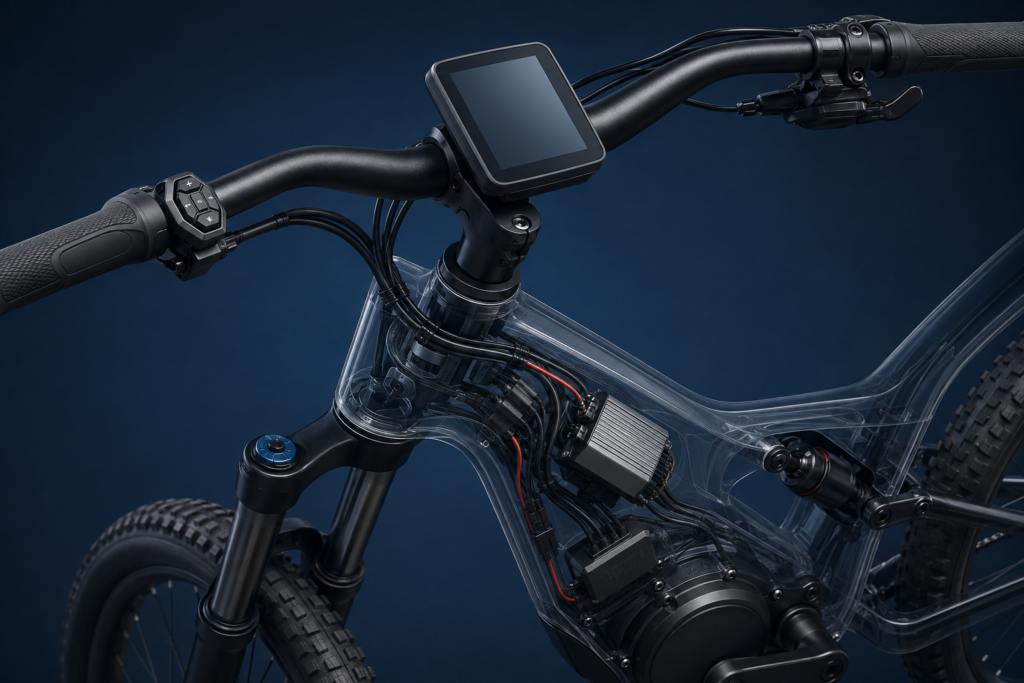
The display assembly can be expected to work alongside a vehicle-specific electrical architecture. Before a display is selected or customized, the OEM should define the display’s role in the product: whether it is primarily an information screen, a compact control interface, a touch-enabled HMI, or part of a larger connected-bike system. The display module, housing, wiring, input method, and software behavior should then be reviewed together.
This is why an off-the-shelf display may be useful as a development starting point but insufficient as a final product solution. The final e-bike cockpit is constrained by handlebars, stems, cable paths, rider ergonomics, enclosure shape, service access, and the intended use environment.
Europe’s e-bike opportunity is not one uniform market. Product categories, rider expectations, distribution channels, and local operating conditions vary by country and use case. Still, the direction is clear: e-bike makers need product platforms that are easier to differentiate and easier for riders to understand.
The display contributes to that differentiation in practical ways. It can influence how compact the cockpit appears, how easily a rider can access relevant information, how well the screen fits the frame and handlebar design, and how consistently the user interface is presented across a product family.
Market data also requires careful interpretation. In 2023, the EU produced 9.7 million bicycles, down from 12.7 million in 2022, reflecting a wider period of inventory and production adjustment rather than a simple measure of e-bike adoption.[3] For OEM display projects, this makes development efficiency especially important: use an existing display platform where possible, then customize the elements that determine system fit and product differentiation.
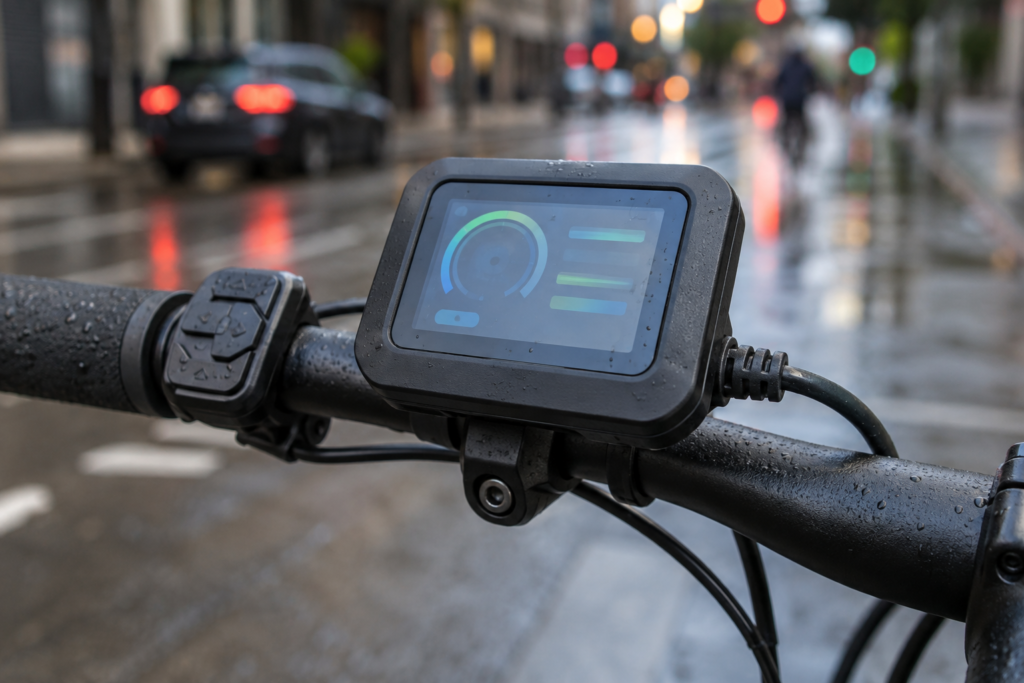
An e-bike display may be used in changing daylight, cloudy weather, night conditions, and rapidly changing rider viewpoints. Readability depends on the complete display stack rather than on one specification alone. Relevant factors may include panel characteristics, backlight configuration, cover glass, viewing angle, surface reflections, UI contrast, and the physical angle of the display on the bike.
Brightness requirements should therefore be defined around the intended product and use environment. A display should not be described as sunlight-readable, high-brightness, or suitable for a specific outdoor condition unless the selected configuration has been defined and validated for that purpose.
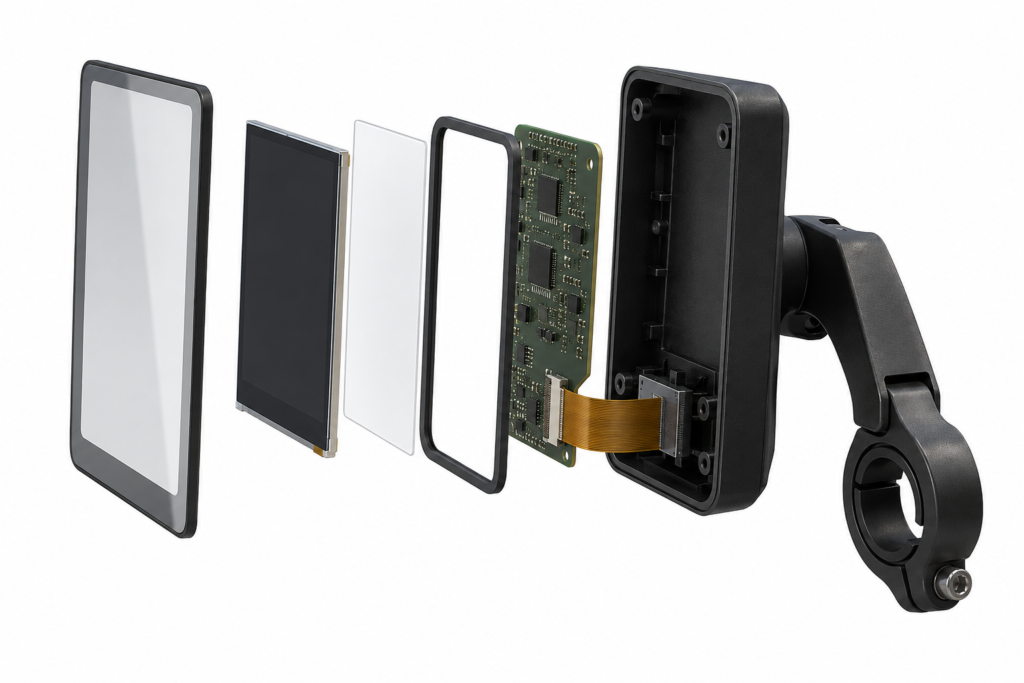
The LCD is only one layer in a rider-facing assembly. The surrounding housing, front cover, gasket arrangement, mounting method, connector position, and cable exit can have as much impact on product integration as the panel itself. These decisions affect handlebar clearance, cable bend radius, strain relief, installation sequence, and long-term service access.
For this reason, the display should be evaluated with the handlebar drawing, cockpit geometry, harness route, and mounting concept—not only from a front-view industrial-design image.
Some e-bike projects use a separate handlebar remote; others place physical controls around the display, while some may require touch interaction. The appropriate approach depends on the user-interface concept, operating context, glove use, expected riding conditions, housing design, and the host-system architecture.
Touchscreen support, physical buttons, and display-controller behavior should be confirmed as a complete configuration. It is not safe to assume that a touch panel, interface, or controller solution will work with every display or e-bike control system without technical review.
An e-bike display must be coordinated with the project’s actual electrical and software requirements. This review may include display size, resolution, interface, pin definition, power and backlight requirements, wiring arrangement, required input devices, and firmware behavior. If a controller board is involved, its compatibility must be assessed using the real panel documentation and system requirements.
RJY Display supports controller-board and firmware customization on a project basis. However, software adaptation is a project-specific engineering task, not a universal plug-and-play process.
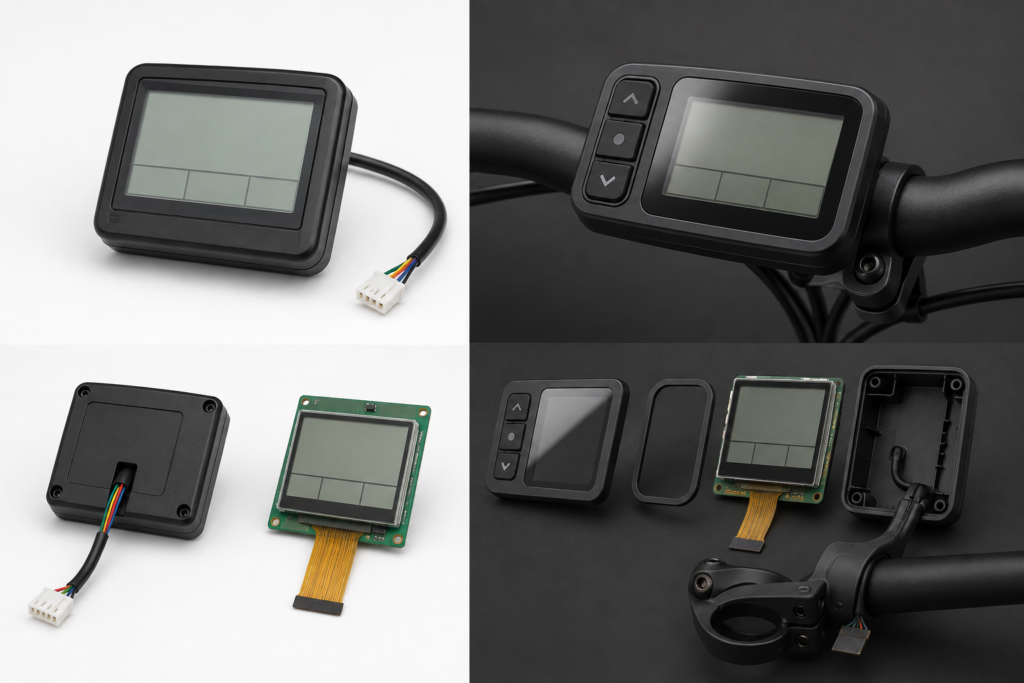
A standard module may have an acceptable panel size but an unsuitable bezel, connector direction, FPC length, or mounting arrangement. Customization can help adapt the display assembly to the actual cockpit design, including cover glass, housing coordination, FPC routing, touch layer, and mounting-related considerations.
In an e-bike, the display is continuously visible to the rider. Cover-glass shape, black border, visible area, button arrangement, and housing integration can make the cockpit feel intentionally designed rather than assembled from unrelated parts. This is a product-integration benefit, not a claim that a custom display alone improves ride performance.
For many OEM programs, adapting an established TFT LCD platform is a lower-risk approach than developing an entirely new panel size. Engineering effort can focus on the aspects that most directly affect final-product fit: cover glass, backlight, touchscreen, interface, FPC, controller board, firmware, and mechanical coordination.
A customized display project creates a defined set of inputs for technical review. Instead of asking whether a generic screen is “suitable for an e-bike,” the project team can assess the selected display assembly, cockpit geometry, interface requirements, environmental expectations, user controls, sample needs, and production plan.
RJY Display supports project-specific customization based mainly on existing display modules. The available scope depends on the selected module and the technical information provided for evaluation.
RJY Display does not position this service as development of any entirely new LCD panel size from scratch. The practical starting point is an existing display module that can be adapted around the requirements of the e-bike platform.
A complete brief helps reduce unnecessary iteration. For a custom LCD display for e-bike project, please provide:
RJY Display can help evaluate a custom TFT LCD assembly for an e-bike platform based on an existing display module. Share the display reference, cockpit drawing, interface information, user-control concept, and project requirements so the display, cover glass, backlight, touch, FPC, controller board, firmware, and mechanical scope can be reviewed before a configuration is proposed.
Provide the target e-bike application, display size and resolution, mechanical drawing or reference product, interface information, touch or button requirements, cable-routing constraints, environmental expectations, and expected annual quantity. A panel datasheet or pin definition is especially useful for compatibility review.
Possibly. A standard module can be a practical starting point if its size, interface, optical characteristics, and mechanical dimensions fit the project. Many e-bike programs still require customization around the module, such as cover glass, FPC routing, backlight, housing coordination, touch, or firmware support.
RJY Display focuses on customization based on existing display modules. Support may include cover glass, backlight, touchscreen, interface, FPC, controller board, firmware, and mechanical coordination. A completely new LCD panel size should not be assumed.
Compatibility can be reviewed after receiving the actual LCD panel model, resolution, interface, pin definition or datasheet, backlight data, touch requirements, input requirements, firmware needs, and application environment. It should not be assumed before this technical review.
Customization projects typically start from an MOQ of around 500 units, depending on the product type and project requirements. The final MOQ should be confirmed after the display configuration and customization scope are defined.
Share your display size, resolution, interface, brightness, touch requirement, controller board requirement, and application environment.
Continue reading related display technology guides and application references.
Talk to RJY’s engineering team for display matching, controller board review, and customization discussion.