¿Enfrenta un cuello de botella en su proyecto de pantalla integrada?
No permita que la integración compleja o los problemas de la cadena de suministro retrasen su tiempo de comercialización. Reserve una consulta gratuita con el equipo experto de RJY para obtener soporte personalizado en diseño y fabricación.
En el mundo de la tecnología de visualización, la comparación "TFT vs OLED vs LCD" es común y suele generar confusión. Ya sea que esté seleccionando una pantalla para un teléfono inteligente, televisor, panel industrial o señalización digital, es fundamental comprender las diferencias clave entre estas tecnologías. Este artículo analiza cómo se comparan las pantallas TFT LCD, OLED y LCD con retroiluminación LED en términos de rendimiento, costo, ángulo de visión y más.
Publicado:
12 minutos de lectura
Actualizado:
TFT LCD, OLED y LED son tres términos comunes que los compradores encuentran al comparar tecnologías de visualización. A menudo se utilizan como si pertenecieran a la misma categoría, pero técnicamente no significan el mismo tipo de cosa. TFT LCD se refiere a una tecnología LCD de matriz activa. OLED se refiere a una tecnología de visualización autoemisiva. LED, en la mayoría de las discusiones sobre monitores y televisores, generalmente significa una LCD retroiluminada por LED, no una pantalla donde cada píxel es un LED.
Esta distinción es importante para el desarrollo de productos. Una pantalla utilizada en un panel de control industrial, terminal de hogar inteligente, interfaz de dispositivo médico, pantalla relacionada con vehículos o producto de consumo no debe seleccionarse solo por las afirmaciones sobre la calidad de imagen. Los ingenieros y compradores también deben evaluar el brillo, el ángulo de visión, la vida útil, el consumo de energía, la compatibilidad de interfaces, el costo, la estabilidad del suministro, la integración táctil, el soporte de la placa controladora y el entorno operativo.
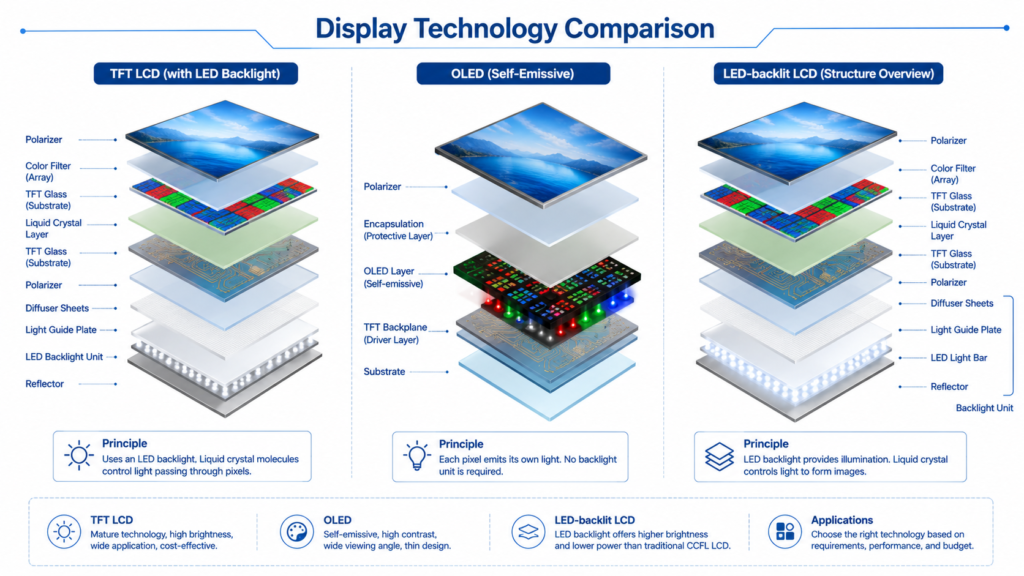
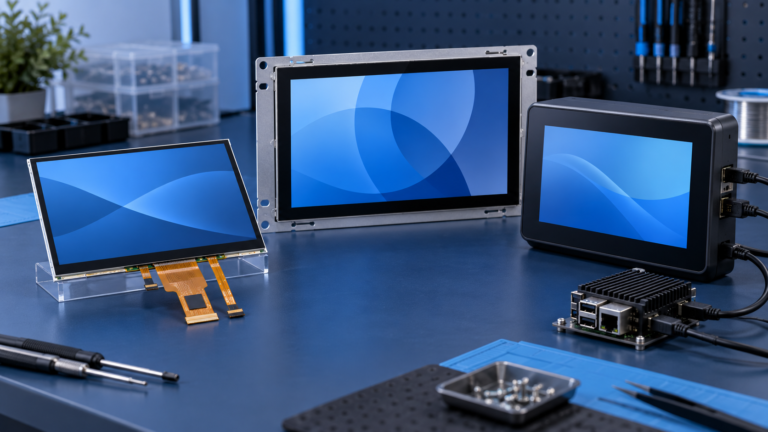
Comparación de la estructura de pantallas TFT LCD, OLED y LCD retroiluminada por LED
Esta guía explica las diferencias prácticas entre las pantallas TFT LCD, OLED y LCD retroiluminada por LED, con un enfoque en dispositivos integrados y la selección de pantallas B2B.
¿Qué es TFT LCD?
TFT LCD significa pantalla de cristal líquido con transistor de película delgada. Es un tipo de LCD que utiliza transistores de película delgada para controlar píxeles individuales en una matriz activa. En comparación con las LCD de matriz pasiva más antiguas, las TFT LCD proporcionan un mejor control de imagen, una respuesta más rápida, un contraste mejorado y una mayor idoneidad para pantallas de alta resolución.
Una TFT LCD no emite luz por sí misma. Necesita una retroiluminación, generalmente una retroiluminación LED, para hacer visible la imagen. La capa de cristal líquido controla cuánta luz pasa a través de cada píxel, mientras que los filtros de color crean subpíxeles rojos, verdes y azules.
En aplicaciones industriales e integradas, la TFT LCD sigue siendo una de las tecnologías de visualización más utilizadas porque ofrece un equilibrio práctico entre rendimiento, costo, disponibilidad, rango de tamaños, opciones de interfaz y flexibilidad de personalización.
Beneficios clave de TFT LCD
Ampliamente disponible en muchos tamaños y resoluciones
Rentable para proyectos B2B y de producción en masa
Adecuada para aplicaciones industriales, integradas y de electrónica de consumo
Admite muchas opciones de interfaz, incluyendo RGB, LVDS, MIPI, SPI, MCU, HDMI y eDP, dependiendo del módulo y la placa controladora
Puede admitir paneles táctiles, vidrio de cubierta, alto brillo, personalización de retroiluminación e integración de placa controladora
Generalmente adecuada para aplicaciones de interfaz de usuario estática donde el desgaste de OLED puede ser una preocupación
Limitaciones de TFT LCD
Requiere una retroiluminación, por lo que no puede lograr el mismo negro a nivel de píxel que OLED
El contraste depende del tipo de panel, la estructura de retroiluminación y el diseño óptico
El ángulo de visión varía según la tecnología del panel, especialmente TN, VA e IPS
El grosor del módulo suele ser mayor que el de OLED debido a la estructura de retroiluminación
La potencia de la retroiluminación y el diseño térmico deben considerarse en aplicaciones de alto brillo
Aplicaciones comunes de TFT LCD
Pantallas HMI industriales
Interfaces de dispositivos médicos
Paneles de control para hogar inteligente
Tableros de instrumentos y pantallas de equipos para vehículos
Equipos de seguridad
Electrónica de consumo
Sistemas integrados y soluciones de visualización basadas en placa controladora
¿Qué es OLED?
OLED significa diodo orgánico emisor de luz. A diferencia de TFT LCD, OLED no requiere una retroiluminación separada. Cada píxel emite su propia luz. Cuando un píxel necesita mostrar negro, se puede apagar o conducir a un nivel muy bajo, lo que le da a OLED su conocido negro profundo y alto rendimiento de contraste.
OLED se utiliza a menudo en teléfonos inteligentes premium, televisores de alta gama, dispositivos portátiles, dispositivos de realidad virtual y aplicaciones donde la estructura delgada, el amplio ángulo de visión, el alto contraste y el fuerte impacto visual son importantes.
Sin embargo, OLED no es automáticamente la mejor opción para cada proyecto de pantalla. Su costo, comportamiento de vida útil, requisitos de brillo, riesgo de imagen estática y condiciones de suministro deben considerarse cuidadosamente, especialmente en dispositivos integrados que muestran elementos de interfaz de usuario fijos durante largos períodos.
Beneficios clave de OLED
Píxeles autoemisivos sin retroiluminación separada
Excelente nivel de negro y alto contraste
Ángulos de visión amplios
Posible estructura de pantalla muy delgada
Respuesta rápida de píxeles
Fuerte rendimiento visual para productos de consumo premium
Limitaciones de OLED
Costo generalmente más alto que las opciones estándar de TFT LCD
Riesgo potencial de desgaste o retención de imagen con contenido estático con el tiempo
La vida útil puede variar según el color, el nivel de brillo, el patrón de uso y el sistema de materiales
El brillo de pantalla completa alta puede ser más difícil que con algunos diseños de LCD retroiluminados por LED
No siempre es la opción más práctica para productos industriales con pantallas de interfaz de usuario fijas
Aplicaciones comunes de OLED
Teléfonos inteligentes premium
Televisores de alta gama
Dispositivos portátiles
Dispositivos de realidad virtual y realidad aumentada
Electrónica portátil
Productos donde la estructura delgada y el alto contraste son puntos de venta clave
¿Qué es LED en la tecnología de visualización?
La palabra LED puede ser confusa en las discusiones sobre pantallas. En muchos mercados de consumo, “pantalla LED” a menudo significa una LCD retroiluminada por LED. Esto sigue siendo un panel LCD. La parte LED se refiere a la fuente de retroiluminación detrás o alrededor del panel LCD.
Una LCD retroiluminada por LED utiliza LED para iluminar el panel de cristal líquido. La capa LCD controla la luz, y la retroiluminación LED proporciona brillo. Esto reemplazó la retroiluminación CCFL más antigua en muchos productos de visualización porque las retroiluminaciones LED pueden ser más delgadas, más eficientes energéticamente, más fáciles de controlar y adecuadas para diseños de mayor brillo.
También existen pantallas LED de visión directa y tecnologías Micro LED, donde los propios LED forman los píxeles de la imagen. Estos son diferentes de las LCD retroiluminadas por LED comunes. En este artículo, “LED” se refiere principalmente a LCD retroiluminada por LED, porque ese es el significado más común cuando las personas comparan TFT LCD, OLED y LED para monitores, pantallas integradas y pantallas comerciales.
Beneficios clave de la LCD retroiluminada por LED
Mayor potencial de brillo que las LCD retroiluminadas por CCFL más antiguas
Rentable y ampliamente disponible
Adecuada para monitores, televisores, señalización digital, computadoras portátiles y pantallas integradas
Puede diseñarse para aplicaciones de alto brillo
Admite muchos tipos de paneles LCD, incluyendo TN, IPS y VA
A menudo práctica para aplicaciones de uso prolongado y de interfaz de usuario estática
Limitaciones de la LCD retroiluminada por LED
Todavía depende de una capa LCD, por lo que el nivel de negro está limitado por la fuga de luz y el control de la retroiluminación
El grosor suele ser mayor que el de OLED porque se requiere una unidad de retroiluminación
El contraste depende en gran medida del tipo de panel, el diseño de la retroiluminación y la atenuación local si está disponible
Un diseño de retroiluminación de baja calidad puede crear problemas de uniformidad de brillo
El método de conducción de la retroiluminación puede afectar el consumo de energía, el calor y el comportamiento de parpadeo.
Aplicaciones comunes de las pantallas LCD con retroiluminación LED
TFT LCD vs OLED vs LCD con retroiluminación LED: Diferencias principales
Característica
LCD TFT
OLED
LCD con retroiluminación LED
Tecnología básica
Pantalla de cristal líquido de matriz activa
Pantalla de diodos orgánicos autoemisivos
Panel LCD que utiliza retroiluminación LED
Fuente de luz
Requiere retroiluminación
Cada píxel emite luz
Requiere luz de fondo LED
Nivel de negro
Limitado por el bloqueo de luz del LCD y la fuga de retroiluminación
Excelente, porque los píxeles pueden apagarse
Depende del panel LCD y del control de la retroiluminación
Contraste
De moderado a bueno, según el tipo de panel
Muy alto
De moderado a alto, según el panel y el diseño de la retroiluminación
Ángulo de visión
Depende del tipo de panel TN, IPS o VA
Generalmente amplio
Depende del tipo de panel LCD
Brillo
Depende del diseño de la retroiluminación
Fuerte en muchos productos premium, pero el brillo de pantalla completa puede variar
Puede diseñarse para alto brillo
Grosor
Requiere retroiluminación, generalmente más grueso que OLED
Puede ser muy delgado
Requiere retroiluminación, el grosor depende del diseño
Idoneidad para imágenes estáticas
Generalmente adecuado
Requiere revisión del riesgo de quemado
Generalmente adecuado
Costo
Generalmente rentable
Generalmente más alto
Rentable en muchos tamaños
Mejor ajuste
Pantallas integradas, industriales, HMI, basadas en placas controladoras
Productos visuales premium y dispositivos de consumo delgados
Monitores, señalización, aplicaciones LCD de alto brillo
TFT LCD no es lo opuesto a LED
Un error común es tratar TFT LCD y LED como categorías de pantalla completamente separadas. En muchos productos, en realidad están conectados. Un módulo TFT LCD a menudo utiliza una retroiluminación LED. Eso significa que una pantalla puede ser tanto TFT LCD como una pantalla con retroiluminación LED.
Por ejemplo, muchos módulos TFT LCD industriales utilizan retroiluminación LED. La capa TFT controla los píxeles, mientras que la retroiluminación LED proporciona iluminación. Llamar a este tipo de producto “TFT LCD” enfatiza la tecnología LCD de matriz activa. Llamarlo “LCD con retroiluminación LED” enfatiza la fuente de luz.
Es por esto que la frase “TFT vs LED” puede ser engañosa a menos que LED esté claramente definido. Si LED significa LCD con retroiluminación LED, entonces no es un competidor directo de TFT LCD. Si LED significa LED de visión directa o Micro LED, entonces se refiere a una arquitectura de pantalla muy diferente.
TFT LCD vs OLED: ¿Cuál es mejor?
OLED generalmente proporciona un mejor nivel de negro, mayor contraste, ángulos de visión más amplios y una estructura más delgada. Para productos visuales premium, OLED puede ofrecer una imagen más impresionante que un TFT LCD estándar.
Sin embargo, TFT LCD suele ser mejor para aplicaciones que necesitan control de costos, suministro estable, visualización de interfaz de usuario estática a largo plazo, amplia disponibilidad de tamaños, personalización de retroiluminación de alto brillo e integración de placas controladoras. Esto es especialmente relevante para equipos industriales, paneles de control inteligentes, pantallas relacionadas con vehículos, dispositivos de seguridad y productos integrados.
En otras palabras, OLED puede ser mejor para una calidad de imagen premium, mientras que TFT LCD puede ser mejor para muchos proyectos de ingeniería B2B donde la disponibilidad, el costo, la personalización y la integración práctica son más importantes.
TFT LCD vs LCD con retroiluminación LED: ¿Cuál es la diferencia?
La comparación entre TFT LCD y LCD con retroiluminación LED a menudo no es una verdadera comparación uno a uno. TFT describe cómo se controlan activamente los píxeles del LCD. Retroiluminación LED describe cómo se ilumina el LCD.
Un TFT LCD moderno generalmente utiliza una retroiluminación LED. Por lo tanto, muchas pantallas TFT LCD también son LCD con retroiluminación LED. La comparación más útil no es TFT LCD vs LED, sino más bien:
TN TFT LCD vs IPS TFT LCD
Brillo estándar vs TFT LCD de alto brillo
Interfaz RGB vs interfaz MIPI vs interfaz LVDS
Solo módulo LCD vs LCD con placa controladora
Vidrio de cubierta estándar vs vidrio de cubierta personalizado
Pantalla interior vs pantalla exterior o semi-exterior
Estas comparaciones son más útiles para los ingenieros porque afectan directamente la adecuación del producto.
OLED vs LCD con retroiluminación LED
OLED y LCD con retroiluminación LED difieren principalmente en cómo se produce la luz. Los píxeles OLED emiten luz individualmente. Los paneles LCD con retroiluminación LED utilizan LED detrás o alrededor del panel LCD para proporcionar luz a toda el área de visualización o a zonas de la pantalla.
OLED funciona bien en escenas oscuras porque los píxeles negros pueden apagarse. Los LCD con retroiluminación LED pueden funcionar bien en entornos brillantes cuando se diseñan con una retroiluminación potente. Los productos LCD avanzados pueden utilizar atenuación local, retroiluminación Mini LED o películas ópticas para mejorar el contraste y el brillo, pero aún así funcionan de manera diferente a OLED.
Para interfaces industriales estáticas, los LCD con retroiluminación LED suelen ser una opción práctica. Para imágenes de consumo premium, a menudo se prefiere OLED. Para aplicaciones exteriores o de alto brillo, un TFT LCD de alto brillo diseñado adecuadamente puede ser más adecuado que un módulo OLED estándar.
¿Qué tecnología de pantalla es mejor para productos industriales e integrados?
Para muchos productos industriales e integrados, TFT LCD sigue siendo la opción más práctica. Las razones no se limitan al costo. Los módulos TFT LCD están disponibles en muchos tamaños, admiten muchas interfaces, pueden combinarse con paneles táctiles y vidrio de cubierta, y pueden combinarse con placas controladoras para diferentes entradas del sistema.
OLED puede usarse en productos integrados, pero debe seleccionarse con cuidado si la aplicación muestra íconos estáticos, tableros, menús, áreas de advertencia o elementos de interfaz de usuario fijos durante largos períodos. Deben revisarse el riesgo de quemado, las expectativas de vida útil, los requisitos de brillo y la disponibilidad de suministro.
El LCD con retroiluminación LED suele ser la forma estándar del TFT LCD moderno. Si se necesita alto brillo, el diseño de la retroiluminación se vuelve especialmente importante. Por ejemplo, un HMI industrial o una pantalla relacionada con vehículos puede necesitar un brillo más fuerte y una mejor legibilidad que un producto de consumo para interiores.
Cómo elegir entre TFT LCD, OLED y LCD con retroiluminación LED
La tecnología de pantalla adecuada depende de los requisitos del proyecto. En lugar de preguntar qué tecnología es mejor en general, pregunte cuál se adapta al entorno del producto, la interfaz de usuario, el objetivo de costo y el plan de producción.
Requisito del proyecto
Dirección recomendada
Razón
Producto integrado sensible al costo
TFT LCD o TFT LCD con retroiluminación LED
Buena disponibilidad y costo de integración práctico
Experiencia visual premium
OLED
Excelente contraste, nivel de negro y estructura delgada
Interfaz de usuario estática durante largos períodos
Pantalla LCD TFT o LCD con retroiluminación LED
Menor preocupación por el desgaste (burn-in) en comparación con OLED
Entorno exterior o con mucha luz ambiental
Pantalla LCD TFT de alta luminosidad
La retroiluminación puede diseñarse para una mayor visibilidad
Producto delgado y portátil (wearable)
OLED o LCD TFT compacto, según los requisitos
OLED puede admitir diseños muy delgados, pero deben evaluarse el costo y la vida útil
Pantalla HMI Industrial
LCD TFT con interfaz y placa controladora adecuadas
Admite personalización práctica e integración de sistemas
Cubierta de vidrio personalizada o diseño táctil
LCD TFT con personalización táctil y de cubierta de vidrio
Ruta común para el desarrollo de productos de visualización integrados
Factores importantes de selección para compradores B2B
Para los compradores B2B, la tecnología de visualización es solo una parte de la decisión. La pantalla final debe coincidir con el diseño completo del producto. Antes de elegir entre LCD TFT, OLED y LCD con retroiluminación LED, los compradores deben revisar los siguientes factores:
Tamaño de la pantalla y área activa
Resolución
Requisito de brillo
Requisito de ángulo de visión
Uso en interiores, exteriores o semi-exteriores
Requisito del panel táctil
Diseño de la cubierta de vidrio
Tipo de interfaz, como RGB, LVDS, MIPI, SPI, HDMI o eDP
Requisito de la placa controladora
Necesidades de adaptación de firmware o software
Temperatura de funcionamiento
Contenido de interfaz de usuario estático o dinámico
Costo objetivo y volumen de producción esperado
Requisitos de suministro a largo plazo
Una pantalla con excelente calidad de imagen puede seguir siendo la elección incorrecta si no coincide con la interfaz, la estructura mecánica, el diseño de alimentación, el requisito táctil o las condiciones de producción.
Soporte de RJY Display para LCD TFT e integración de pantallas
RJY Display ofrece productos LCD TFT, placas controladoras y pantalla personalizada soporte para proyectos impulsados por ingeniería. Para muchas aplicaciones B2B, la clave no es solo seleccionar una tecnología de visualización, sino hacer coincidir el módulo de pantalla con la interfaz, el panel táctil, la cubierta de vidrio, la retroiluminación, la placa controladora y los requisitos de firmware adecuados.
Si su proyecto requiere un módulo LCD TFT, una pantalla de alta luminosidad, una pantalla táctil, una placa controladora, una cubierta de vidrio personalizada, una retroiluminación personalizada o una adaptación de interfaz, RJY Display puede ayudar a evaluar la viabilidad práctica según los requisitos de su aplicación.
Conclusión: ¿Qué tecnología de visualización debería elegir?
A menudo se comparan LCD TFT, OLED y LED, pero no describen el mismo tipo de categoría de pantalla. LCD TFT es una tecnología LCD de matriz activa. OLED es una tecnología de visualización autoemisiva. LED, en la mayoría de las discusiones sobre productos LCD, generalmente significa un LCD con retroiluminación LED.
Elija LCD TFT cuando necesite un equilibrio práctico entre costo, disponibilidad, personalización, opciones de interfaz, idoneidad para interfaces de usuario estáticas e integración con placa controladora.
Elija OLED cuando el contraste premium, el negro profundo, el diseño delgado y el fuerte impacto visual sean más importantes que el costo y las preocupaciones por imágenes estáticas.
Elija LCD con retroiluminación LED cuando necesite las ventajas de la tecnología LCD con el rendimiento de la retroiluminación LED, especialmente en cuanto a luminosidad, control de costos y amplia disponibilidad del producto.
Para el desarrollo de productos industriales, integrados y B2B, la mejor opción es la que se adapta al sistema completo: tamaño de pantalla, resolución, luminosidad, interfaz, táctil, placa controladora, firmware, estructura mecánica, entorno operativo y plan de producción.
Preguntas frecuentes
¿Es lo mismo LCD TFT que LCD?
LCD TFT es un tipo de LCD. Utiliza transistores de película delgada para controlar los píxeles en una matriz activa. La mayoría de los módulos LCD en color modernos utilizados en productos integrados e industriales son LCD TFT.
¿Es LED mejor que LCD TFT?
Esta comparación puede ser engañosa. Muchos LCD TFT ya utilizan retroiluminación LED. Si LED significa LCD con retroiluminación LED, entonces no es lo opuesto a LCD TFT. Si LED significa LED de visión directa o Micro LED, se refiere a una arquitectura de visualización diferente.
¿Es mejor el OLED que el TFT LCD?
OLED generalmente ofrece mejor nivel de negro, contraste, ángulo de visión y delgadez. Sin embargo, LCD TFT suele ser más práctico para productos industriales e integrados debido al costo, la disponibilidad, la idoneidad para interfaces de usuario estáticas, las opciones de personalización y la compatibilidad con placas controladoras.
Sí. Los LCD TFT no emiten luz por sí mismos. Necesitan una retroiluminación, generalmente LED, para hacer visible la imagen.
¿Tiene OLED riesgo de desgaste (burn-in)?
OLED puede presentar riesgo de desgaste o retención de imagen cuando se muestra contenido estático durante períodos prolongados. El riesgo real depende de la luminosidad, el patrón de uso, el contenido, la tecnología del panel y las funciones de mitigación.
¿Qué pantalla es mejor para uso en exteriores?
Un LCD TFT de alta luminosidad o un LCD con retroiluminación LED suele ser una opción práctica para uso en exteriores o semi-exteriores. Sin embargo, la selección final también debe considerar la cubierta de vidrio, el reflejo, el ángulo de visión, la temperatura de funcionamiento y el diseño del gabinete.
¿Qué pantalla es mejor para HMI industrial?
LCD TFT se usa comúnmente para HMI industrial porque ofrece amplia disponibilidad, flexibilidad de interfaz, soporte táctil, opciones de placa controladora y potencial de personalización. La pantalla exacta debe seleccionarse según el tamaño, la resolución, la luminosidad, la interfaz y el entorno operativo.
¿Aún no sabe qué pantalla se adapta a su proyecto?
Hable con el equipo de ingeniería de RJY para obtener asesoramiento sobre compatibilidad de pantallas, revisión de placas controladoras y discusión sobre personalización.