Facing a bottleneck in your Embedded Display Project?
Don’t let complex integration or supply chain issues slow your time-to-market. Book a free consultation with the RJY expert team for tailored design and manufacturing support.

In the world of embedded systems and microcontroller projects, two platforms often stand out for their versatility and widespread use: STM32 and Arduino. Both have their strengths and weaknesses when it comes to LCD development, depending on the complexity of the project and the requirements of the display. In this article, we'll explore the differences between STM32 and Arduino for LCD development, helping you choose the right platform for your next project.
STM32 vs Arduino is a common comparison when engineers, product developers, and hardware teams choose a microcontroller platform for sensors, control systems, LCD projects, and embedded devices. Arduino is known for fast prototyping and ease of use. STM32 is known for stronger microcontroller performance, more peripheral options, and deeper control over embedded hardware.
For simple LCD projects, Arduino can be a practical starting point. It is easy to use, has many display libraries, and works well with basic character LCDs or small SPI TFT modules. For more demanding TFT LCD projects, STM32 is often a better fit because it can provide more processing capability, richer peripheral support, DMA options, and more professional development control.
The right choice depends on the project. A hobby prototype, classroom demo, or simple sensor display may not need STM32. A product-level HMI, industrial control display, touchscreen interface, or higher-resolution TFT LCD project may require a more capable microcontroller, controller board, or embedded platform.
STM32 is a family of 32-bit microcontrollers from STMicroelectronics. These MCUs are based on Arm Cortex-M processor cores and cover a wide range of performance levels, memory sizes, peripherals, packages, and power profiles. STM32 is widely used in embedded systems that require real-time control, communication interfaces, motor control, display interfaces, sensing, and industrial product development.
Arduino is an open-source electronics platform that includes development boards, software tools, and a large community ecosystem. Many Arduino boards are based on AVR, Arm, or other microcontrollers depending on the board model. The main strength of Arduino is not only the chip itself, but the simplified development environment, broad library support, and beginner-friendly workflow.
In simple terms:

| Factor | STM32 | Arduino |
|---|---|---|
| Main identity | Microcontroller family from STMicroelectronics | Open-source hardware and software development platform |
| Typical strength | Performance, peripherals, real-time control, hardware flexibility | Ease of use, libraries, community, fast prototyping |
| Learning curve | Higher, especially with registers, HAL, DMA, clocks, and debugging | Lower, suitable for beginners and rapid experiments |
| Development tools | STM32CubeIDE, STM32CubeMX, Keil, IAR, PlatformIO, others | Arduino IDE, Arduino Cloud, PlatformIO, many libraries |
| LCD project fit | Better for advanced TFT LCD, touch UI, real-time graphics, product-level control | Good for basic LCDs, small TFT modules, learning, and simple prototypes |
| Peripheral control | Stronger and more detailed | Simplified and library-driven |
| Debugging | Professional debugging workflows available | Simpler workflow, often serial-print based for beginners |
| Commercial product fit | Often suitable for embedded product development | Useful for prototypes; final product use depends on board, design, and requirements |
STM32 is a broad family of 32-bit microcontrollers. Different STM32 series are designed for different needs, such as low power, high performance, connectivity, motor control, graphics, security, and industrial control.
For display-related projects, STM32 can be useful because many STM32 MCUs provide rich peripheral support. Depending on the specific MCU, the project may use SPI, I2C, parallel interfaces, DMA, timers, external memory interfaces, or dedicated display-related features. Some STM32 families also support graphics-oriented development tools and middleware.
STM32 is not one board or one chip. It is a large product family. This means the exact LCD capability depends on the selected STM32 model, memory, clock speed, available pins, interface support, and software architecture.
Arduino is a development platform designed to make electronics and programming easier. It includes boards, an IDE, libraries, examples, and a large user community. Many display modules have Arduino-compatible libraries, which makes Arduino attractive for quick LCD testing and early prototypes.
Arduino boards vary widely. A classic Arduino Uno is limited compared with many modern boards, while newer Arduino boards can use more capable microcontrollers. Therefore, “Arduino” should not be judged as one fixed hardware level.
For LCD projects, Arduino is often useful when the goal is quick testing, simple UI, character display, small graphic display, sensor readout, or early proof of concept.
LCD projects vary from very simple to highly demanding. A 16 × 2 character LCD showing sensor values is very different from a color TFT LCD with touch interaction, animations, icons, menus, and real-time data updates.
Arduino is often enough for simple LCD projects. STM32 becomes more attractive when the project requires higher refresh performance, more precise timing, more memory, DMA, multiple peripherals, or integration into a commercial embedded product.
| LCD Project Type | Arduino Fit | STM32 Fit |
|---|---|---|
| 16 × 2 or 20 × 4 character LCD | Very suitable | Suitable but often unnecessary |
| Small SPI TFT display | Suitable for simple graphics | Suitable for better performance and control |
| Medium-resolution TFT LCD | Possible only with suitable boards and careful limits | Often more practical |
| Touchscreen UI | Good for simple touch demos | Better for product-level touch integration |
| Real-time industrial HMI | Usually limited | More suitable depending on MCU and system design |
| High-resolution graphical UI | Usually not ideal on basic Arduino boards | May be suitable with the right STM32 and memory design |
STM32 often provides higher performance and more embedded-control features than many basic Arduino boards. This matters when a display project must update graphics quickly, process sensor data, handle communication, manage touch input, and control other system functions at the same time.
Basic Arduino boards are not designed for heavy graphics workloads. They are more useful for simple display output, sensor dashboards, menu screens, and quick demonstrations.
However, performance depends on the exact board. A modern Arduino-compatible board may be stronger than an older STM32 board. A high-end STM32 may outperform many Arduino boards. Buyers should compare the actual MCU, clock speed, memory, interface, and graphics requirements rather than relying only on the platform name.
LCD module compatibility depends heavily on interface. Common display interfaces include SPI, I2C, MCU parallel, RGB, LVDS, MIPI DSI, HDMI, and eDP depending on the display and system level.
Arduino is commonly used with I2C character LCDs, SPI TFT displays, and display shields. This is convenient for learning and prototyping, but it may not fit larger or higher-resolution TFT LCD modules.
STM32 can support a wider range of embedded interfaces depending on the model. Some STM32 projects use SPI TFT displays, parallel interfaces, external memory, DMA, or display-oriented middleware. However, not every STM32 can drive every LCD. The specific MCU and display interface must be matched carefully.
Graphics require memory. A full-color TFT display may need frame buffers, image assets, fonts, icons, and UI data. Higher resolution increases memory demand quickly.
Basic Arduino boards often have limited RAM and flash memory. This makes them unsuitable for complex graphics unless the display library uses partial updates, small buffers, or the display controller handles much of the work.
STM32 devices are available with different memory sizes and may support external memory depending on the series. This makes STM32 more flexible for graphical LCD projects, but memory planning is still essential.
Before choosing the platform, engineers should estimate:
DMA, or direct memory access, allows data movement without making the CPU handle every byte manually. In display projects, DMA can help move pixel data more efficiently, especially when used with SPI, parallel interfaces, or memory operations depending on the MCU design.
Many STM32 projects use DMA to improve display refresh efficiency or reduce CPU load. This can be useful when the system also needs to read sensors, communicate with other devices, process touch input, or control motors.
Arduino libraries may hide some complexity, which is useful for beginners. But for advanced display performance, engineers often need lower-level control over timing, data transfer, buffering, and memory use. STM32 gives more room for that control.
Arduino is strong in software simplicity. The Arduino IDE, example sketches, and community libraries make it easy to connect a display and show results quickly. Libraries such as LiquidCrystal, Adafruit_GFX, and TFT_eSPI are widely used in display prototyping.
STM32 development is more structured and more complex. Common tools include STM32CubeMX, STM32CubeIDE, HAL libraries, LL drivers, Keil, IAR, PlatformIO, and graphics-related tools depending on the project. This workflow gives developers more control, but it requires stronger embedded knowledge.
For early experiments, Arduino can save time. For product-level development, STM32 can provide stronger control over hardware, timing, memory, power, and debugging.
Arduino is easier for beginners. Many users can connect a basic LCD and run an example within a short time. This makes Arduino useful for education, proof-of-concept prototypes, and fast display testing.
STM32 has a steeper learning curve. Developers may need to understand clock configuration, GPIO modes, peripheral setup, interrupts, DMA, memory layout, compiler settings, debugging, and hardware design details.
The trade-off is clear: Arduino reduces setup difficulty, while STM32 gives more engineering control.
Arduino can be cost-effective for learning and prototyping, especially when using common development boards and display shields. But an Arduino development board is not always the most cost-effective choice for mass production.
STM32 may require more engineering effort at the beginning, but it can be more suitable for optimized product hardware. The final cost depends on MCU selection, PCB design, display interface, memory, firmware development, testing, and production volume.
For B2B product development, buyers should not compare only board prices. They should compare total development cost, including engineering time, firmware complexity, debugging, display compatibility, certification planning, long-term supply, and production scalability.
STM32 is usually the better choice when the LCD project needs stronger embedded performance, more precise hardware control, or product-level development.
Choose STM32 when the project involves:
STM32 is not automatically required for every display project, but it is often a stronger platform when the final product must be stable, responsive, and technically controlled.
Arduino is usually the better choice when simplicity and speed matter more than advanced performance. It is useful for learning, demonstrations, simple prototypes, and early testing.
Choose Arduino when the project involves:
Arduino can help validate an idea quickly. If the product later needs better performance, lower-level control, or commercial integration, the design can move to STM32 or another embedded platform.

For many LCD projects, the real decision is not only STM32 vs Arduino. Some products should use a dedicated display controller board or an embedded control board instead of driving the LCD directly from a microcontroller.
A microcontroller may be suitable for simple displays or compact embedded interfaces. But higher-resolution TFT LCDs, HDMI input displays, Android-based panels, complex touch UIs, or multimedia interfaces may require a controller board or a more powerful embedded processor.
For example, if the project needs an HDMI input, Android interface, LVDS display output, MIPI display output, touch support, or firmware adaptation, a matched controller board may be more practical than developing everything from a small MCU.
This is why display selection should consider the complete system: LCD module, interface, controller board, firmware, touch panel, power, enclosure, and application software.
One common mistake is choosing the board before choosing the LCD. The display resolution, interface, driver IC, voltage, backlight, touch interface, and timing should be reviewed before the platform is finalized.
Another mistake is assuming that a display library guarantees product-level compatibility. A library may work for a demo, but final products also need stable timing, reliable wiring, EMI control, power design, touch accuracy, and long-term maintainability.
A third mistake is underestimating memory requirements. A display that seems small may still require more RAM or flash than expected when fonts, icons, images, and buffers are included.
A fourth mistake is using Arduino for a project that actually needs a controller board or embedded system platform. If the display interface is LVDS, MIPI, HDMI, or eDP, a basic Arduino approach may not be appropriate.
Before choosing STM32, Arduino, or a controller board, review the display requirement first. The display determines many of the platform requirements.
Key questions include:
These questions help avoid choosing a platform that is too weak, too complex, or unsuitable for the final product.

RJY Display supports TFT LCD modules, controller boards, and custom display solution discussions for engineering-driven projects. For LCD projects, platform choice should be based on the display interface, resolution, touch requirement, controller board needs, firmware needs, and final application environment.
RJY Display can help review whether a project should use a simple LCD module, a TFT LCD with touch panel, a matched controller board, or a more complete display solution. Controller boards can be discussed together with compatible TFT LCD modules based on panel interface, resolution, firmware, touch, and project requirements.
If your project involves a TFT LCD module, touch display, controller board, Android control board, firmware support, or display integration, prepare the LCD model, size, resolution, interface, touch requirement, host platform, and application details before inquiry.
Send Your LCD Project Requirements
STM32 vs Arduino is not a question of which platform is universally better. Arduino is easier to use and works well for simple LCD projects, prototypes, learning, and fast experiments. STM32 offers stronger performance, more peripheral control, DMA options, professional debugging, and better suitability for advanced embedded display projects.
For basic character LCDs and small SPI display prototypes, Arduino is often enough. For TFT LCD modules, touch interfaces, real-time graphics, industrial equipment, and product-level embedded development, STM32 is often the better direction.
For higher-resolution displays, HDMI input, Android interfaces, LVDS, MIPI, eDP, or complex graphical UI, the better solution may be a matched LCD controller board or embedded control board rather than a small microcontroller alone.
The right platform depends on the complete display system: LCD size, resolution, interface, graphics workload, touch requirement, memory, power, firmware, controller board, product stage, and production plan.
STM32 is a family of 32-bit microcontrollers from STMicroelectronics, while Arduino is an open-source development platform focused on ease of use. STM32 usually offers deeper hardware control, while Arduino is easier for beginners and rapid prototyping.
STM32 is often better for advanced TFT LCD projects, touch interfaces, real-time graphics, and product-level development. Arduino is often enough for basic character LCDs, small SPI displays, and simple prototypes.
Yes, Arduino can drive many small SPI TFT displays and simple LCD modules using available libraries. However, basic Arduino boards may be limited for larger displays, high resolution, fast refresh, or complex graphical UI.
Some STM32 devices can support more advanced TFT LCD projects, depending on the specific MCU, interface, memory, DMA, display timing, and software design. Not every STM32 can drive every high-resolution display.
Arduino is easier to learn because it has a simple IDE, many examples, and broad library support. STM32 has a steeper learning curve but provides more control over embedded hardware.
Use Arduino for simple prototypes, STM32 for advanced embedded display control, and a controller board when the display requires HDMI, LVDS, MIPI, eDP, Android, complex touch support, or higher-level UI integration.
Arduino can be useful for prototyping and some simple products, but commercial development usually requires careful review of hardware design, supply, reliability, firmware maintainability, cost, and certification needs.
Prepare the LCD size, resolution, interface, driver IC, touch requirement, backlight requirement, refresh needs, memory requirements, host system, application environment, and expected production volume.
Share your display size, resolution, interface, brightness, touch requirement, controller board requirement, and application environment.
Continue reading related display technology guides and application references.
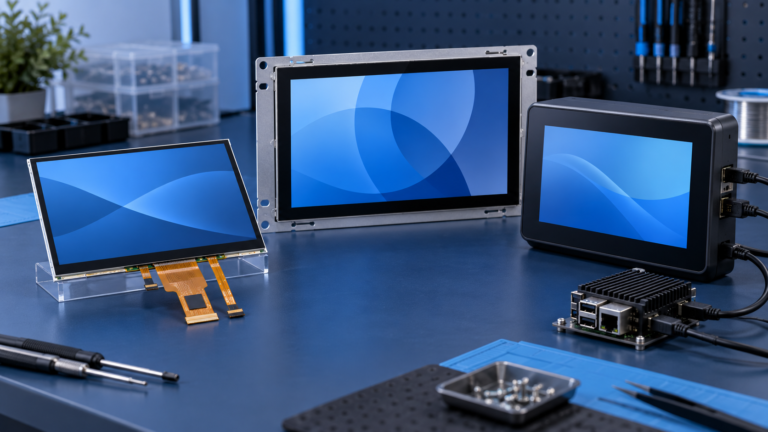
Explore product pages related to this article topic.
Talk to RJY’s engineering team for display matching, controller board review, and customization discussion.