Facing a bottleneck in your Embedded Display Project?
Don’t let complex integration or supply chain issues slow your time-to-market. Book a free consultation with the RJY expert team for tailored design and manufacturing support.

The phrase “TFT vs LCD” is a common search query—but it’s also a misleading one. That’s because TFT (Thin-Film Transistor) is not a competitor to LCD—it’s a type of LCD technology. To choose the right display for your project, it’s important to understand the relationship between TFT and LCD, how they differ from other technologies, and where each type excels.
The difference between LCD and TFT display is often misunderstood. LCD is a broad display technology that uses liquid crystals to control light. TFT is a type of active-matrix technology used inside many modern LCD panels to control pixels more precisely.
In simple terms: TFT is not separate from LCD. TFT is a type of LCD. More specifically, a TFT LCD is an active-matrix liquid crystal display that uses thin-film transistors to control individual pixels.
This distinction matters when selecting a display for an embedded device, industrial control panel, medical device interface, smart home product, vehicle-related display, or custom HMI system. If a buyer asks for “LCD vs TFT,” the real question is usually whether the project needs a basic LCD, a passive-matrix LCD, or a modern TFT LCD module with the right resolution, interface, brightness, touch panel, and controller board support.
LCD stands for liquid crystal display. It is a broad category of display technology that uses liquid crystal materials to control how light passes through the display structure. Since liquid crystal materials do not emit light by themselves, most modern LCD modules need a backlight to make the image visible.
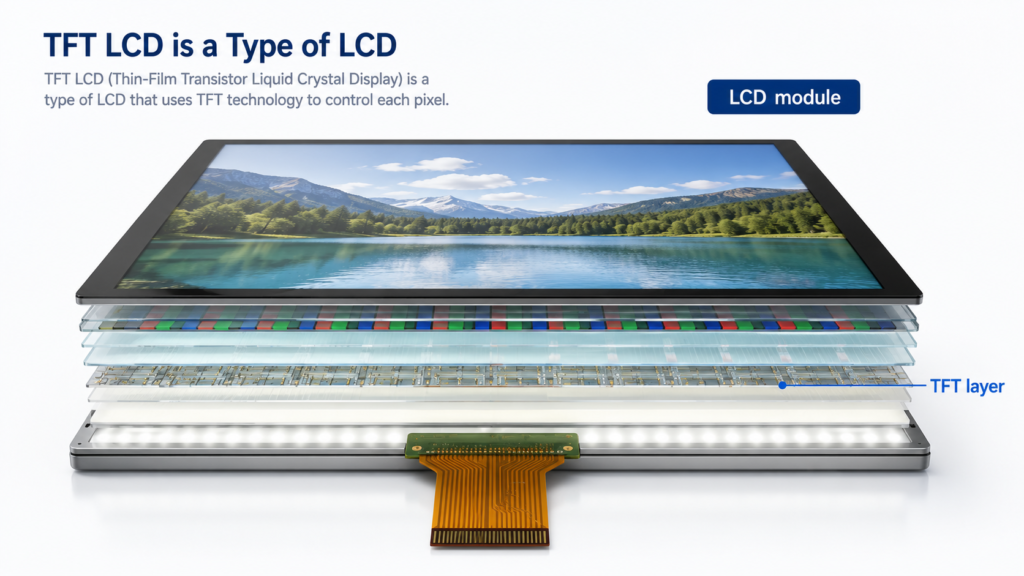
TFT stands for thin-film transistor. In display technology, TFT refers to a transistor structure used to control pixels in an active-matrix LCD. A TFT LCD uses a thin-film transistor at each pixel or subpixel area so that the display can control image information more accurately than older passive-matrix LCDs.
The relationship can be summarized clearly:
Therefore, “LCD vs TFT” is not a fully accurate comparison. The better comparison is usually TFT LCD vs passive-matrix LCD, or TN TFT LCD vs IPS TFT LCD vs VA TFT LCD.
The phrase “LCD vs TFT” sounds as if LCD and TFT are two competing screen technologies. They are not. TFT is one of the technologies used to build better LCD panels.
The confusion comes from product naming. Some older or simpler products may be labeled only as “LCD,” while more advanced color modules are labeled “TFT.” This makes buyers think that LCD and TFT are separate categories. Technically, a TFT display is still an LCD if it uses liquid crystal technology.
A more precise way to ask the question is:
These questions are more useful for engineering selection than a simple “LCD vs TFT” comparison.
An LCD uses liquid crystal material between layers of glass, polarizers, electrodes, and color filters. The liquid crystal layer changes how light passes through the display when an electrical signal is applied.
Most transmissive LCDs use a backlight. The backlight sends light through the LCD structure. The liquid crystal layer controls how much light passes through each pixel area, and color filters help create red, green, and blue subpixels.
Because LCDs do not emit light by themselves, the backlight design affects brightness, power consumption, contrast, thickness, heat, and readability. This is why LED backlight design is an important part of modern TFT LCD module selection.
A TFT LCD works like an LCD, but with a thin-film transistor matrix added to improve pixel control. Each pixel or subpixel is actively controlled by transistor circuitry. This active-matrix structure allows the display to hold pixel information more accurately between refresh cycles.
Compared with older passive-matrix LCDs, TFT LCDs generally support better response time, higher resolution, better color control, improved contrast, and more practical use in video, graphics, and modern user interfaces.
This is why TFT LCD technology is widely used in industrial displays, embedded touch panels, smart home interfaces, vehicle-related displays, security devices, consumer electronics, and HMI systems.
| Comparison Point | LCD | TFT LCD |
|---|---|---|
| Technical meaning | Broad display category using liquid crystals | A type of active-matrix LCD using thin-film transistors |
| Pixel control | Can be passive or active depending on design | Active-matrix pixel control |
| Image quality | Depends on LCD type | Usually better than passive-matrix LCD |
| Response time | Can be slow in passive-matrix designs | Generally faster and more suitable for dynamic content |
| Resolution support | Varies widely | Commonly used for higher-resolution color displays |
| Color performance | Depends on panel type and driving method | Generally better color control than passive-matrix LCD |
| Typical use | Simple displays, calculators, instruments, older modules, reflective displays | Industrial HMI, embedded devices, smart panels, monitors, touch displays |
| Correct comparison? | LCD is the broad category | TFT is one type within that category |
The more useful technical comparison is passive-matrix LCD vs active-matrix TFT LCD.
A passive-matrix LCD controls pixels using a grid of rows and columns. This structure is simpler and can be suitable for low-cost, low-information displays. However, passive-matrix LCDs usually have slower response, lower contrast, and weaker performance for detailed images or fast-changing content.
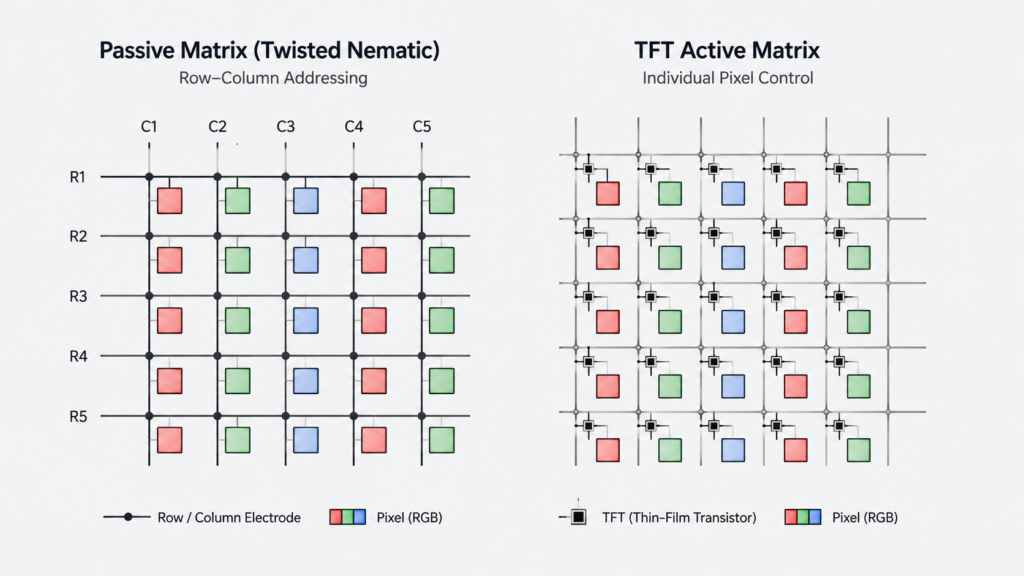
An active-matrix TFT LCD uses a transistor at each pixel area. This gives the display better control over each pixel and supports higher resolution, better color performance, faster response, and more stable image quality.
| Feature | Passive-Matrix LCD | Active-Matrix TFT LCD |
|---|---|---|
| Pixel control | Row and column addressing | Thin-film transistor control at pixel level |
| Response time | Slower | Faster |
| Image detail | Limited | Better for detailed graphics and UI |
| Color performance | Limited in many designs | Better suited for full-color displays |
| Power and cost | Can be low for simple applications | Higher complexity but better performance |
| Typical application | Simple instruments, calculators, basic indicators | Touch panels, HMI, embedded displays, smart devices |
IPS is not the same as TFT, and it is not the opposite of TFT. IPS stands for in-plane switching. It describes how the liquid crystal molecules move inside the LCD cell. TFT describes the active-matrix pixel control method.
This means an IPS display can also be a TFT LCD. In fact, most IPS LCD panels used in modern embedded and industrial products are IPS TFT LCDs.
IPS is commonly chosen when the application needs wider viewing angles and more stable color performance from different viewing positions. This is useful for control panels, equipment displays, medical-related interfaces, smart home terminals, and products viewed from multiple angles. IPS TFT LCD technology is generally used to improve viewing angle and color stability compared with traditional TN structures.
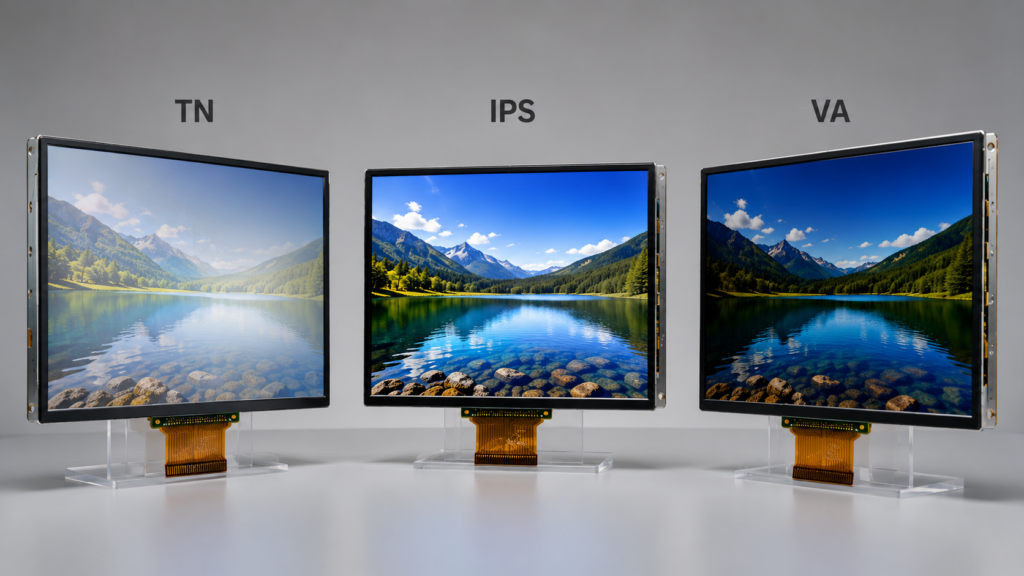
When buyers compare TFT LCD options, they often need to compare TN, IPS, and VA panel technologies rather than LCD vs TFT.
| Panel Type | Main Strength | Main Limitation | Typical Use |
|---|---|---|---|
| TN TFT LCD | Fast response and cost-effective structure | Narrower viewing angle and color shift compared with IPS | Cost-sensitive products, simple interfaces, some fast-response applications |
| IPS TFT LCD | Wide viewing angle and stable color performance | Can cost more than basic TN options | HMI, smart panels, medical-related interfaces, equipment displays |
| VA TFT LCD | Higher contrast than many TN panels | Response and viewing behavior depend on design | Displays where contrast is important |
The best panel type depends on viewing angle, contrast, color needs, cost target, operating environment, and interface requirements.
TFT LCD has become the dominant LCD technology for many modern color display applications because it offers a practical balance of image quality, cost, availability, size range, and interface support.
The active-matrix structure allows each pixel to be controlled more precisely than in passive-matrix LCDs. This improves image stability and makes TFT LCD suitable for modern user interfaces.
TFT LCD panels are widely available in many resolutions, from small embedded displays to larger industrial and HMI panels. Higher resolution supports sharper text, more detailed icons, and denser UI layouts.
Compared with passive-matrix LCDs, TFT LCDs generally handle moving images and dynamic UI changes better.
TFT LCD technology supports full-color displays suitable for graphical interfaces, dashboards, images, and video-based content.
TFT LCD modules can support different interfaces depending on the panel and controller design, including RGB, LVDS, MIPI, SPI, MCU, HDMI, eDP, and related controller board solutions.
TFT LCD is widely used, but it is not perfect for every project. Buyers should review the full application requirements before selecting a display.
A TFT LCD needs a backlight. The backlight affects brightness, power consumption, heat, thickness, lifetime, and readability.
Not every TFT LCD has the same viewing angle. TN, IPS, and VA panels behave differently. If the product will be viewed from wide angles, IPS TFT LCD may be more suitable.
Higher brightness, larger size, and higher resolution can increase power requirements. Battery-powered products need careful display and backlight planning.
A TFT LCD panel must match the host system or controller board. Resolution, timing, voltage, interface, pin definition, backlight requirements, touch interface, and firmware settings must be confirmed.
A TFT LCD is usually suitable when the product needs a color display, graphical UI, touch interface, industrial control panel, embedded display, dashboard, or controller-board-based display solution.
TFT LCD is especially practical for B2B projects that need:
For very simple numeric displays, indicators, or ultra-low-power devices, a passive or segment LCD may still be enough. For most modern color UI applications, TFT LCD is usually the more practical direction.
Before selecting a TFT LCD module, do not stop at the phrase “TFT.” The project needs a full display specification review.
Important information includes:
If the display requires a controller board, the LCD panel model, resolution, interface, pin definition, backlight requirement, touch requirement, and operating system should be reviewed together.
RJY Display supports TFT LCD products, controller boards, and custom display solution discussions for engineering-driven B2B projects. The display can be reviewed based on size, resolution, brightness, interface, touch panel, cover glass, backlight, controller board, firmware, and mechanical requirements.
For custom projects, the practical path is usually to start from an existing display module and adjust the related parts around it, such as cover glass, backlight, touchscreen, FPC, interface, controller board, firmware, or housing coordination.
If your project requires a TFT LCD module, IPS TFT display, touch display, controller board, high-brightness screen, or custom display solution, prepare your display size, resolution, interface, application environment, touch requirement, and target volume before inquiry.
Send Your TFT LCD Requirements
The difference between LCD and TFT display is not a difference between two completely separate technologies. LCD is the broad display category. TFT is a thin-film transistor pixel-control technology used in active-matrix LCDs.
A TFT LCD is therefore a type of LCD. The real comparison is usually between passive-matrix LCD and active-matrix TFT LCD, or between different TFT LCD panel types such as TN, IPS, and VA.
For modern embedded products, industrial HMIs, smart control panels, vehicle-related displays, security devices, and equipment interfaces, TFT LCD is often the practical choice because it supports color graphics, higher resolution, touch integration, interface flexibility, and controller board matching.
The correct display choice should be based on complete project requirements: size, resolution, brightness, viewing angle, touch, interface, controller board, firmware, operating environment, mechanical structure, and production plan.
LCD is a broad display technology that uses liquid crystals to control light. TFT is a type of active-matrix technology used inside many LCDs to control pixels more precisely. A TFT display is therefore a type of LCD.
This question is not technically precise because TFT is a type of LCD. Compared with older passive-matrix LCDs, TFT LCDs usually provide better response time, resolution, color performance, and image quality.
In normal display terminology, a TFT display used for LCD modules is a TFT LCD. It uses thin-film transistors to control pixels in a liquid crystal display.
No. IPS describes the liquid crystal alignment method, while TFT describes the active-matrix pixel control method. Most IPS LCDs are also TFT LCDs.
IPS TFT LCD usually provides wider viewing angles and more stable color performance. TN TFT LCD may be more cost-effective and can be suitable for simpler applications. The better choice depends on the product requirements.
Yes. TFT LCDs do not emit light by themselves. They normally need an LED backlight or another light source to make the image visible.
TFT LCD displays are commonly used in industrial HMIs, medical-related interfaces, smart home panels, vehicle-related displays, security equipment, consumer electronics, and embedded devices.
Choose based on display size, resolution, brightness, viewing angle, panel type, touch requirement, interface, controller board support, backlight requirement, operating environment, and mechanical fit.
Share your display size, resolution, interface, brightness, touch requirement, controller board requirement, and application environment.
Continue reading related display technology guides and application references.
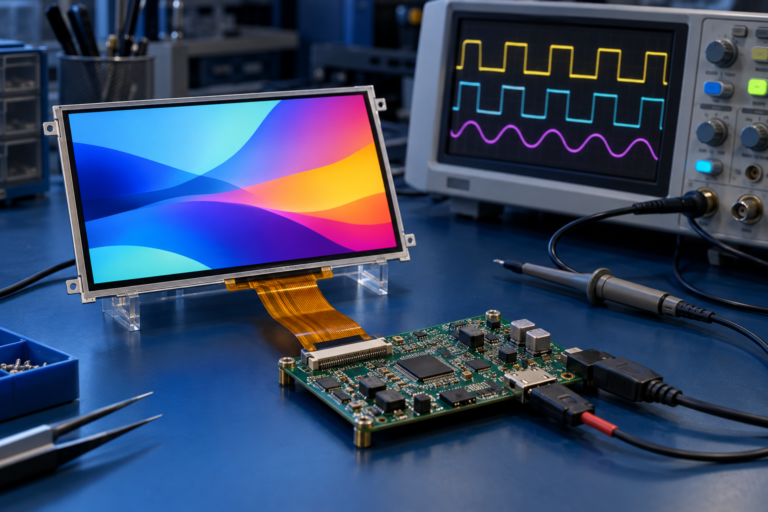
Explore product pages related to this article topic.
Talk to RJY’s engineering team for display matching, controller board review, and customization discussion.